

Anti-Sway Control: Fuzzy Logic vs PID for Double Girder Cranes
📋 Key Summary
For European-standard double-girder cranes with capacities ranging from 50 to 300 metric tons, load sway is a critical factor affecting both operational efficiency and safety. This article explores how intelligent control algorithms effectively suppress sway, comparing the performance of fuzzy logic control against traditional PID control in terms of response speed and steady-state error. Through specific engineering calculations, we reveal the differences in control logic during acceleration and deceleration phases, providing technical reference for electrical system selection in high-end customization projects to achieve smooth and efficient material handling.
Cranes play a central role in material handling within modern industrial factory buildings. For high-end customized European-standard double-girder equipment in the 50t to 300t capacity range, the swaying of lifting spreaders and loads not only reduces positioning efficiency but also increases safety hazards. According to the requirements of FEM 1.001 Crane Design Specification, crane travel mechanisms must possess smooth starting and braking characteristics. Additionally, the TSG 51-2023 Safety Technical Supervision Regulation for Special Equipment imposes strict specifications on safety protection devices and control logic. Kelude Heavy Industry has recognized the core value of intelligent control algorithms in addressing these challenges through long-term R&D and manufacturing, continuously optimizing the underlying logic of our electrical systems.
Limits of Traditional PID Control in Anti-Sway Systems
In early crane electrical control systems, Proportional-Integral-Derivative (PID) controllers were widely used for speed control of hoisting and travel mechanisms. However, as lifting capacities have increased to 120t or higher, the limitations of traditional PID algorithms have become increasingly apparent. When the cross travel speed reaches 40m/min (approximately 0.67m/s), the system's dynamic response time often extends beyond 1.5s, failing to meet high-precision positioning requirements.
Firstly, PID controller parameter tuning relies heavily on linear mathematical models of the system. In actual operating conditions, when the load changes from 50t to 300t, the moment of inertia changes significantly, causing fixed parameters to become ineffective and requiring manual re-tuning of integral and derivative time constants.
Secondly, load sway in cranes is a typical non-linear, time-varying process. The inrush current at the instant of trolley startup can reach 1.5 times the rated current. This non-linear characteristic makes it difficult for traditional linear control to cope, often resulting in overshoot phenomena.
Finally, under external disturbances such as lateral winds reaching 15m/s, fixed-parameter PID controllers struggle to maintain stability. The swing period attenuation time extends beyond 8s, severely impacting takt time, while failing to adapt to real-time changes in load mass.
Enhancing Dynamic Response with Fuzzy Logic Control
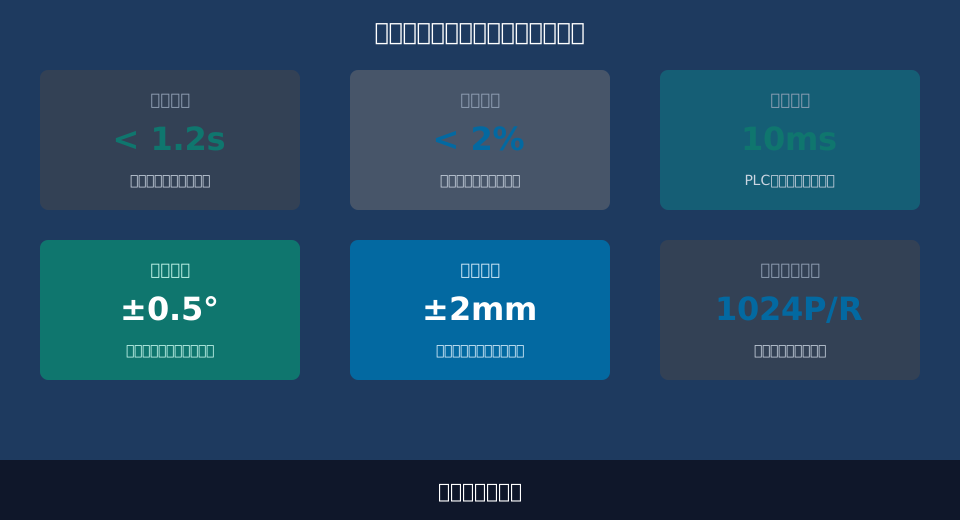
To overcome the defects of traditional algorithms, fuzzy logic control strategies have been introduced into crane anti-sway systems. This algorithm does not rely on precise mathematical models; instead, it achieves smooth control by simulating human operator experience. After applying this technology to 50t–300t European-standard double-girder equipment, the Kelude Heavy Industry technical team achieved a final sway angle stabilized within ±0.5°, reduced the control cycle to 10ms, and kept steady-state error within 2%.
On one hand, fuzzy control establishes a rule base that converts operator experience into control logic. The system sets the sway angle deviation domain to [-3, 3] and achieves smooth output through 49 control rules. Combined with advanced AI anti-sway algorithms, this further enhances anti-interference capability under complex operating conditions.
On the other hand, the algorithm processes sensor feedback regarding deviation and the rate of change of deviation in real-time. When load mass fluctuates by 20%, the fuzzy controller automatically adjusts the frequency setpoint for the Variable Frequency Drive (VFD) without modifying underlying parameters, ensuring smoothness during acceleration and deceleration.
Furthermore, combining fuzzy control with closed-loop vector control of the VFD compresses torque response time to the 5ms level. This effectively eliminates lag caused by transmission backlash, significantly improving the dynamic response performance of double-girder bridge cranes.
Engineering Case Study: Intelligent Anti-Sway Algorithms for 50t–300t Cranes
To intuitively demonstrate the practical effects of intelligent control algorithms, we present a detailed engineering calculation for a European-standard double-girder crane with a Rated Lifting Capacity of 100t and a Main Girder Span of 31.5m. The Long Travel Speed for this equipment is set at 60m/min, with a wire rope length (L) of 12m.
The Long Travel Speed of 60m/min converts to 1m/s in international units. We set the braking deceleration (a) at 0.5m/s².
Braking Distance Calculation: Using the kinematic formula s = v² / (2a), substituting the data yields s = 1² / (2 × 0.5) = 1m. This means the crane bridge requires a braking distance of 1m to come to a complete stop from full speed.
Swing Period Calculation: Using the simple pendulum period formula T = 2π√(L/g), taking gravitational acceleration g = 9.8m/s², substituting the data yields T = 2 × 3.14 × √(12 / 9.8) ≈ 6.95s. This indicates that the lifting spreader takes approximately 6.95 seconds to complete one full swing cycle.
Under traditional open-loop control, after the crane bridge stops braking, the maximum sway angle of the load can reach 3.5°. It takes 3 to 4 cycles (approximately 20s) for the sway to naturally attenuate to a safe range. By adopting an intelligent anti-sway algorithm, the system intervenes automatically during the braking phase. Multi-stage speed control counteracts sway energy, reducing the sway angle to 0.4° immediately after braking ends. The overall anti-sway time is shortened to 4.2s.
When calculating braking distances and planning travel trajectories, it is essential to comprehensively consider the setting of anti-collision safety distances. This ensures the crane bridge can stop safely and smoothly before reaching rail limits or intersecting with other equipment, preventing rigid collisions.
Electrical System Selection and Parameter Matching Guide
In high-end customization projects for European-standard double-girder cranes ranging from 50t to 300t, the selection of the electrical control system directly determines the execution limit of anti-sway algorithms. For heavy-duty equipment with a Main Girder Span of 31.5m, a Lifting Height of 24m, and Hoisting Motor power of 2×75kW, Kelude Heavy Industry has developed a strict parameter matching guide.
Firstly, the VFDs for the hoisting and travel mechanisms must support closed-loop vector control mode. For high-power motors like the 2×75kW setup, closed-loop control shortens torque response time to 5ms, ensuring no load slipping orSevere Swaying occurs during heavy-load startup.
Secondly, Encoder selection must meet high-resolution requirements, typically not less than 1024 pulses/revolution. With a 31.5m span, high-resolution feedback ensures the trolley positioning accuracy reaches ±2mm, providing precise position and velocity inputs for the anti-sway algorithm.
Thirdly, the PLC control cycle must be set to within 10ms to guarantee real-time performance. Additionally, to address elastic deformation issues caused by the 24m Lifting Height, the system introduces a length compensation algorithm to correct the actual spatial coordinates of the lifting spreader in real-time.
Fourthly, the communication network should utilize industrial Ethernet (such as PROFINET or EtherCAT). This ensures a data refresh rate of no less than 100 times/second between VFDs, PLCs, and remote I/O modules, preventing loss of synchronization due to communication latency.
| control algorithmType | dynamic responseCharacteristics | Steady-State Error andanti-interference capability |
|---|---|---|
| Conventional PID control system | Response timeApproximately 1.5s,Prone to Overshoot,ParameterShaping Depends on Linear Model | Steady-State Error Approximately 5%,Under 15m/s Crosswind Disturbancesway angleattenuationTime Exceeding 8s |
| Fuzzy Logic ControlStrategy | Response timeLess Than 1.2s,Overshoot-Free Smooth Output,Adaptive Nonlinear System | Steady-State Error Less Than 2%,LoadFluctuation 20% While Maintainingsway angleUnder ±0.5° Within |
| Lifting CapacityLevel | Recommendedcontrol algorithm | Typicalrope lengthRange | Systemcontrol systemCyclerequirements |
|---|---|---|---|
| 50t - 100t | PID Combined with Feedforward Compensation | 8m - 15m | ≤ 20ms |
| 120t - 200t | Fuzzy Logic ControlAlgorithm | 12m - 20m | ≤ 10ms |
| 250t - 300t | AI FuzzyAdaptive Control | 15m - 28m | ≤ 5ms |
FAQ
Q: Does Fuzzy Logic Control require a precise mathematical model of the crane?
A: No. The core advantage of fuzzy control is that it does not rely on precise linear mathematical models. By establishing a rule base, it translates operator experience into control logic, allowing it to directly handle complex, non-linear, and time-varying processes such as load sway. It also demonstrates strong adaptive capabilities against variations in load mass.
Q: What anti-sway performance can be achieved on European Standard Double-Girder cranes above 30 tons?
A: For European Standard Double-Girder equipment ranging from 50t to 300t, intelligent anti-sway algorithms can stabilize the maximum sway angle within ±0.5° after braking, with steady-state error controlled within 2%. Compared to traditional control methods, the sway attenuation time is reduced by over 40%, significantly improving positioning efficiency.
Q: How do intelligent control algorithms impact routine maintenance?
A: Intelligent algorithms effectively reduce impact loads on mechanical transmission components through smooth acceleration/deceleration curves and precise torque control. This extends the service life of wire ropes, gearboxes, and brakes, while also reducing thermal loss in electrical components. Consequently, this lowers overall maintenance frequency and spare parts replacement costs.
Q: Which parameters should be prioritized when selecting electrical components for European Standard custom cranes?
A: Key selections must verify if the Frequency Inverter supports closed-loop vector control, ensure encoder resolution is at least 1024 pulses/rev, and confirm PLC control cycles are set under 10ms. Additionally, industrial Ethernet must be used for the communication network to ensure data refresh rates meet the real-time performance requirements of anti-sway algorithms.
