

Port Portal Crane Selection for Breakbulk & Container
📋 Key Summary
When selecting a port gantry crane, the first question isn't which brand to choose — it's what you'll be handling. General cargo terminals need a general-purpose gantry crane with a hook or grab, while container yards need a rail-mounted or rubber-tyred container gantry crane with a specialized spreader. These two crane types differ significantly in lifting capacity, lifting height, work duty, and wheel load. Getting the parameters wrong means either wasted capacity or a safety risk. This article starts from the handling target and breaks down the parameter-matching logic for general cargo and container scenarios, providing a comparison checklist and cost framework to help port owners lock in the right crane type at the project planning stage.
During capacity expansion projects at inland river ports, it's common to see someone reuse old drawings for a general cargo grab gantry crane and purchase the same specification to stack containers. Only after the equipment arrives do they realize that a 40-foot container plus its spreader already approaches the upper limit of the rated lifting capacity, and the lifting height isn't enough to stack to the third tier. The yard can only operate at low density, and the return on investment is dragged out.
The root cause of this kind of problem is the most common mistake in port gantry crane selection — matching a model based on past experience instead of working backward from the handling target. The first step in crane selection is actually to figure out what you'll be handling.
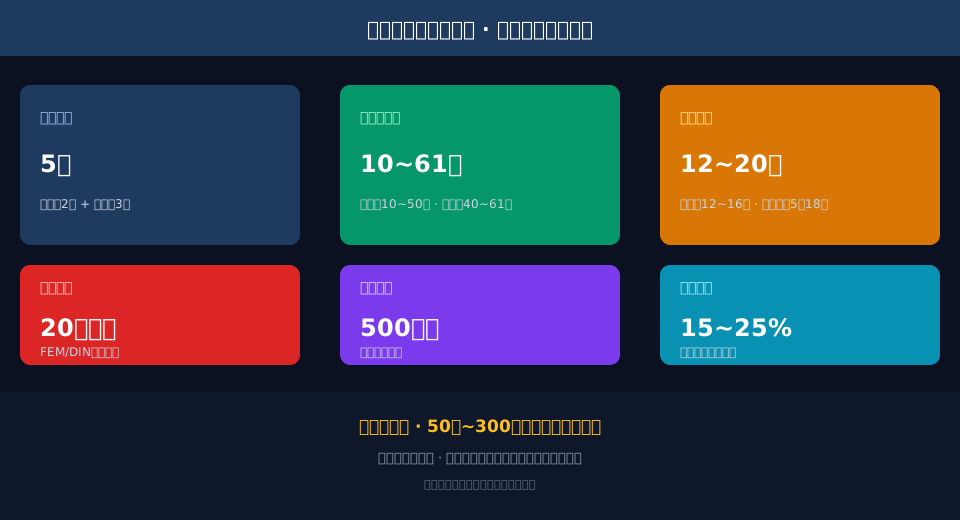
Two Handling Scenarios: General Cargo Hook/Grab vs. Container Spreader Cranes
Port gantry cranes fall into two clear categories by handling target: general-purpose gantry cranes for general cargo, which work with a hook or grab, and rail-mounted or rubber-tyred container gantry cranes, which work with a specialized spreader.
General cargo gantry cranes handle steel, timber, bagged goods, and bulk materials — items of varying unit weight and irregular shape. The load-handling device switches between hook and grab, and the core challenge is balancing the maximum single-piece weight against operating efficiency.
Container gantry cranes handle standardized containers with a dedicated Container Spreader. The takt time is highly fixed, and the core challenge is matching the total container weight to the number of stacking tiers. The two crane types differ from structure to parameters, and mixing them up rarely works well on either front.
Setting Lifting Capacity for General Cargo Gantry Cranes
For a general cargo gantry crane, the Rated Lifting Capacity starts with the heaviest single piece of cargo handled at the terminal on a regular basis, then factors in the dead weight of the load-handling device. Together, these two determine the lower bound of the rated lifting capacity.
When working with a grab, the grab dead weight can easily run several tons, and the actual payload must deduct that portion. If the heaviest single piece at the terminal is a 25-tonne steel coil and a 6-tonne grab is attached, the rated lifting capacity can't be sized at just 25 tonnes — otherwise the nominal capacity looks sufficient, but the crane can't actually lift the load.
From an efficiency standpoint, an oversized lifting capacity drives up wheel load and foundation costs, while an undersized one means a single lift can't handle the load and multiple lifts are needed, reducing per-shift efficiency. In general cargo gantry crane solutions, Kelude Heavy Industry typically works backward from the maximum single-piece weight to determine the rated lifting capacity, then checks the grab dead weight and cycle count to avoid conflicting parameters. For the design basis at this stage, refer to the load combination and work duty classification methods in FEM 1.001 Crane Design Standard.
| ParameterDimension | General CargoHookPortal Crane | General CargoGrab (grab bucket)Portal Crane | rail-mountedContainerPortal Crane | rubber-tyredContainerPortal Crane | Remarks |
|---|---|---|---|---|---|
| Rated Lifting Capacity | 10~50t | 16~40t | 40~61t | 40~50t | 40Total Weight of FT Container30.48t |
| Lifting Height | 12~16m | 12~16m | 15~18m | 15~18m | Stack5Approx. Tiers18m |
| Span | 18~35m | 18~35m | 30~60m | 23~26m | rubber-tyredcoverage6+1Container Rows |
| Work Duty / Classification | A6~A7 | A7 | A7~A8 | A7~A8 | PortHigh Trafficoperating condition |
| Wheel load | Relatively Low | Medium | High | Relatively High | ContainerLoad utilization ratioHigh |
| travel speed | 40~80m/Point | 40~80m/Point | 60~120m/Point | 60~100m/Point | Variable Frequency Speed Control |
Parameter Matching for Container Gantry Cranes: How 40-Foot Container Gross Weight and Stack Height Determine Lifting Height
Parameter matching for container gantry cranes is more standardized than for general cargo cranes, because the container type is fixed — lifting capacity and lifting height can both be derived directly from container data.
Take lifting capacity: a 40-foot container has a rated gross weight of 30.48 metric tons. Add the dead weight of a specialized spreader at 8 to 10 metric tons, and the actual load approaches 40 metric tons. That is why container gantry cranes are typically rated at 40 metric tons or above. For simultaneous lifting of two 20-foot containers, the lifting capacity must be sized at 61 metric tons.
Lifting height is calculated directly from the number of container tiers. In a yard stacking 5 tiers, the top container reaches roughly 13 to 14 meters above ground. Add clearance for the spreader and safety margin, and the lifting height typically needs to reach about 18 meters. The technical manager at Kelude Heavy Industry pointed out: "The lifting height of a container gantry crane isn't guesswork — it's built up tier by tier."
For the relationship between lifting capacity and lifting height, refer to the requirements for rated lifting capacity and spreader configuration in GB/T 19912-2005 Technical Conditions for Rubber-Tired Gantry Cranes.
Work Duty and Wheel Load Differences Between Two Gantry Crane Types: Why Container Cranes Have Higher Wheel Loads
Work duty measures how intensively a crane operates over its entire service life. Port portal cranes generally fall within the A6 to A8 range, but the actual load characteristics of the two crane types differ significantly.
Container gantry cranes operate at a far higher load utilization ratio than general cargo cranes. General cargo varies widely in piece weight, and most lifts are not at full load. Containers, by contrast, are almost always lifted at or near rated gross weight, with a fixed takt time and round-the-clock continuous operation — the number of working cycles is an order of magnitude higher.
High load utilization combined with high cycle counts means that container gantry cranes require greater wheel load and structural fatigue design margins than general cargo cranes of the same span. Wheel load differences translate directly to the rail foundation: at the same span, the crane rail and foundation cross-section for a container gantry crane typically need to be upsized by one grade. This is also why many ports that share a yard between the two equipment types verify the foundation against the worst-case wheel load of the container gantry crane. For safety supervision requirements, refer to the relevant provisions in TSG 51-2023 Crane Safety Technical Supervision Regulation.
Port Portal Crane Selection Cost Framework: Purchase Price, Rail Foundation, and a 20-Year Lifecycle Accounting
The cost of a port portal crane cannot be judged by purchase price alone. Rail foundation, energy consumption, and maintenance must all be factored into a 20-year service period — looking only at unit price leads to a distorted total.
General cargo cranes have a relatively lower unit purchase price, but the load-handling device must be switched according to cargo type, and attachments such as grabs and hook beams require more frequent replacement. Container gantry cranes have a higher purchase price, but standardized operations mean the unit container-stacking cost is significantly diluted as utilization rises.
When Kelude Heavy Industry develops a solution for a port, it incorporates drive unit selection and energy consumption into the cost model together, because the electricity costs of continuous-operation equipment like gantry cranes accumulate substantially over 20 years. For specific model pricing, Kelude Heavy Industry calculates across three dimensions — capacity, span, and work duty — subject to the actual contract, and does not provide broad figures at the proposal stage.
| costItem | General Cargo Portal Crane | ContainerPortal Crane | Notes |
|---|---|---|---|
| Procurementcost | Relatively Low | Relatively High | ContainerPortal Crane Includingspecialized spreaderandcontrol system |
| rail foundation | Standardcross-section | Need to Increase by One Size | Wheel loadHigher,Foundation to be Widened |
| energy consumption | Medium | Relatively High | Continuous operationandLoad utilization ratioHigh |
| maintenance | AttachmentreplacementFrequent | Standardizationmaintenance | Lifting spreadermaintenance cycleFixing |
| 20-Year Total Account | subject to the actual contract | subject to the actual contract | According tocapacity、Span、Work Duty / ClassificationThree-Dimensional Calculation |
Port Portal Crane Selection: 8 Checks Before You Specify
Run your parameters through a single checklist before the project gets approved, and you avoid most of those "the crane arrived and it doesn't fit" surprises.
📋
Define the cargo first
General cargo or containers?
📋
Weigh the heaviest lift
Size lifting capacity from the largest single piece
📋
Allow for spreader weight
Grab or spreader dead weight must be deducted
📋
Check the stacking height
Add up lifting height tier by tier
📋
Confirm the work duty
A6 to A8 for busy operations
📋
Verify maximum wheel load
What transfers into the rail foundation
📋
Match the span requirement
Coverage across berth and yard width
📋
Leave room for maintenance
Long travel clearance and inspection space
📖 Related reading: Why European Standard Cranes Cost More: The Technical Case Behind FEM and DIN | The Main Girder Is a Crane's Backbone: Structural Design in Imported vs. Domestic European-Standard Double-Girder Cranes
FAQ
Q: Can one crane handle both general cargo and containers?
A: Not recommended. A general cargo port portal crane works with a hook or grab, with lifting capacities typically between 10 and 50 metric tons. A container crane needs a specialized spreader, and since a 40 ft container has a rated gross weight of 30.48 metric tons plus the spreader's own weight, lifting capacity generally exceeds 40 metric tons. The two differ in work duty, wheel load, and trolley structure, so sharing one machine leads to either wasted capacity or an insufficient safety margin.
Q: What does a port gantry crane typically cost?
A: Port gantry crane pricing varies enormously. General cargo and container cranes differ significantly because of lifting capacity, span, and electrical configuration. Kelude Heavy Industry quotes port portal cranes on a per-contract basis, calculated across three dimensions: capacity, span, and work duty. We recommend owners define the cargo type and operating parameters first, then request quotations for comparison.
Q: How do I decide between a rail-mounted and a rubber-tyred container crane?
A: Look at yard utilization and the need to relocate. A rail-mounted container crane runs on a fixed rail, can stack 5 tiers or more, and offers a large span — ideal for high-utilization dedicated terminals. A rubber-tyred container crane can move between container blocks, which is flexible but comes with higher wheel loads and slightly lower stacking height. Choose rail-mounted for stable annual throughput; choose rubber-tyred when container blocks are scattered.
Q: Why is the lifting capacity of container gantry cranes typically rated at 40 tons or more?
A: A 40-foot container has a maximum gross weight of 30.48 tons, and the lifting spreader itself adds roughly 8 to 10 tons of dead weight, bringing the actual load to nearly 40 tons. When two 20-foot containers are lifted simultaneously, the required lifting capacity rises to 61 tons. GB/T 19912-2005 specifies the corresponding requirements for rated lifting capacity and lifting spreader configuration on container gantry cranes.
