

Accommodation Ladder Winch vs Electric Hoist: 5 Safety Designs
Accommodation ladder winches are personnel safety equipment mandated by the SOLAS Convention. They differ fundamentally from standard electric hoists across five design elements: drum capacity, wire rope safety factor (≥6), dual-circuit hydraulic redundancy, two-stage braking protection, and electrical interlocking. These winches must pass type-approval testing by a classification society before they can be installed onboard.
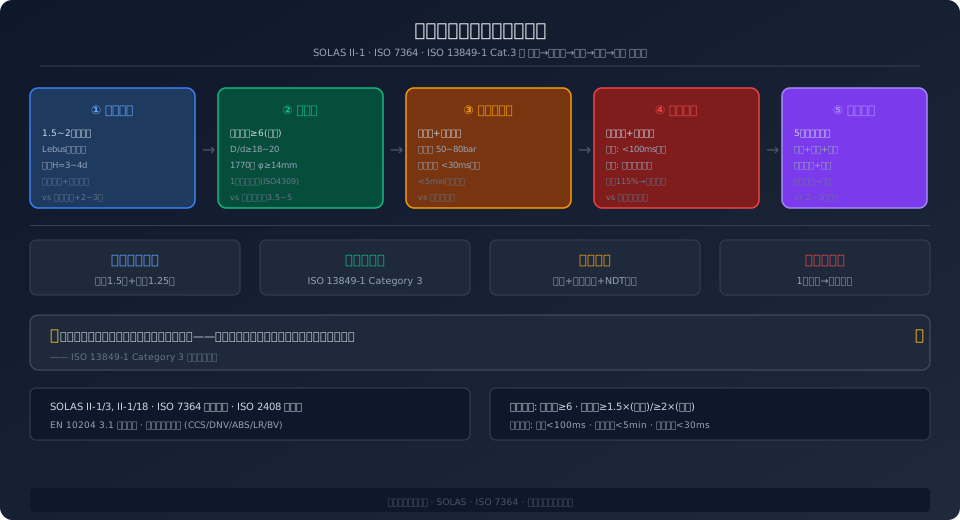
Among shipboard equipment, the accommodation ladder winch is perhaps the easiest to underestimate. With a rated load of just 500–1,500 kg and a lifting height of only 10–30 m, it neither commands attention like a marine deck crane nor demands the precision maintenance of a main engine. Yet this seemingly modest winch carries a far more precious load than cargo—human life. SOLAS Chapter II, Regulations 3 and 18 impose explicit mandatory requirements on the design, installation, testing, and maintenance of accommodation ladder winches, and in some respects, their safety criteria are even more stringent than those for large deck cranes. This article presents a systematic comparison between accommodation ladder winches and visually similar electric hoists, revealing the fundamental design differences.
The five-element design requirements for accommodation ladder winches are governed primarily by SOLAS Chapter II-1 and ISO 7364 Shipbuilding — Accommodation ladder winches. Wire rope and structural component safety factors are determined in accordance with the additional requirements for personnel-carrying equipment set out in ISO 4301 (referenced here as ISO 4301 Crane Design Standard).
Drum Capacity: Rope Reserve Goes Beyond "Good Enough"
The drum capacity of a standard electric hoist is designed simply to accommodate the required lifting height—wraps on the drum equal lifting height ÷ (π × drum diameter) × pulley ratio, plus 2–3 spare wraps for safety. The drum capacity calculation for an accommodation ladder winch is fundamentally different. Beyond the travel required to deploy and retrieve the ladder itself, the winch must account for the additional rope demand caused by vessel heave in waves. When a pilot is boarding and a large swell suddenly lifts the ladder's lower end, the winch must pay out sufficient slack rope quickly without overstressing the wire rope. For this reason, the drum capacity of an accommodation ladder winch is typically 1.5 to 2 times the rope length required for the ladder's full travel—a reserve margin explicitly required by SOLAS and ISO 7364.
The groove pitch design on the drum also differs from that of a conventional drum. To minimize crushing and wear during multi-layer spooling—accommodation ladder winches frequently alternate between low-tension slack rope and high-tension taut conditions, which can disrupt rope layering—a Lebus-type stepped groove is recommended over a standard helical groove. The parallel segment of the Lebus groove accounts for approximately 80% of the circumference, with the angled transition segment making up the remaining 20%, allowing the upper rope layer to settle naturally into the "valleys" formed by the layer below. This achieves neat spooling without a level-wind device. Combined with a flange height of 3–4 times the wire rope diameter (preventing the top layer from jumping the flange), this design effectively avoids rope crushing and accelerated wear caused by disordered spooling.
Wire Rope Safety Factor: ≥6, Not ≥3.5
This is the most immediately apparent technical difference between an accommodation ladder winch and a conventional crane. ISO 4301 requires a wire rope safety factor of ≥3.5 to 5 for crane ropes (depending on duty classification), whereas ISO 2408 Steel wire ropes for general purposes — Requirements specifies a minimum safety factor of ≥6 for personnel-carrying equipment (some classification societies, such as DNV, require ≥8). In practical terms, for a winch with a 1 t rated load, the wire rope breaking force must be at least 6 t (requiring a 1770-grade rope of ≥14 mm diameter), while a standard electric hoist of the same capacity needs only ≥3.5 t (achievable with a ≥10 mm rope). This may appear to add just 40% to the rope cost, but for an accommodation ladder winch with extremely limited space—overall width is typically only 600–800 mm—a 4 mm increase in rope diameter forces a proportional increase in drum diameter (D/d ≥ 18–20, so D grows from 200 mm to 280 mm), which in turn increases drum weight by 60–80%. The effect is a cascading chain of dimensional growth.
Wire rope discard criteria are also more stringent than for ordinary cranes. ISO 4309 Wire Rope Inspection Standard stipulates that a crane rope must be discarded when two visible wire breaks appear within a length of 6d (where d is the nominal diameter). For an accommodation ladder winch rope, however, even a single visible wire break warrants immediate replacement. Additionally, the time between rope manufacture and installation onboard must not exceed 12 months (to prevent corrosion and grease aging during storage), and each rope must be supplied with an EN 10204 3.1 material certificate, traceable to the heat number and batch.
Hydraulic Dual-Circuit Redundancy: Recovery Even Without Power
The hydraulic system of an accommodation ladder winch must incorporate a dual-circuit redundant design. The primary circuit controls winch motor rotation in both directions via a manually operated directional valve (spring-centered to the neutral position, which automatically stops the ladder). The emergency circuit uses an accumulator (bladder type, pre-charged with nitrogen typically at 50–80 bar) or a manual emergency pump (swept volume 3–5 cc/rev) to forcibly retrieve the ladder if the main pump fails or the vessel loses power. SOLAS requires that the time from primary circuit failure to full ladder retrieval not exceed 5 minutes per operation, and that the emergency circuit be capable of independently completing at least two full deployment-and-retrieval cycles of the ladder.
Another critical safety feature of the hydraulic system is the hose burst valve, installed at the lowering-side port of the hoist motor. If a high-pressure hose ruptures suddenly, this valve closes immediately to prevent an uncontrolled load drop. Unlike a counterbalance valve on a conventional crane, which merely prevents accelerated lowering, the hose burst valve on an accommodation ladder winch is designed to lock the motor in place the instant a hose bursts—the valve spool closes fully within 30 ms, holding the winch motor at its current angle. The operator then uses the manual emergency pump to release pressure gradually and lower the ladder. This "lock first, then intervene manually" philosophy is a design principle unique to personnel-carrying equipment.
Two-Stage Braking: Service Brake Plus Safety Brake
A standard electric hoist typically relies on a single-stage braking system, such as a conical rotor motor brake or an electromagnetic disc brake. An accommodation ladder winch, by contrast, must be equipped with a two-stage braking system. The first stage is the service brake, mounted on the high-speed shaft of the winch motor. It engages immediately when the control grip returns to neutral (response time <100 ms) and delivers a braking torque of at least 1.5 times the rated load torque. The second stage is the safety (emergency) brake, which acts directly on the drum flange or drum shaft—unaffected by any reducer gear failure—and is triggered by a centrifugal overspeed governor when drum speed exceeds 115–120% of rated speed, engaging a mechanical lock. The safety brake delivers a braking torque of at least 2 times the rated load torque and, even with a complete loss of hydraulic power, applies automatically via mechanically stored spring energy.
This "two-stage redundancy with mechanical energy storage" design logic derives from Category 3 architecture per ISO 13849-1 Safety of machinery — Safety-related parts of control systems: no single fault (such as a reducer gear fracture or hydraulic pipeline rupture) may result in loss of braking function. One mandatory test in classification society type-approval procedures simulates a reducer shaft fracture to verify that the safety brake triggers automatically after the drum free-accelerates and brings the load to a safe stop.
Electrical Interlocking: Five Safety Interlock Chains
The electrical control system of an accommodation ladder winch incorporates at least five independent safety interlock chains. If any one of these chains is broken, the winch stops immediately—the safety PLC acquires status through dual-channel redundant inputs, and a fault on any single channel triggers a safety shutdown:
①Ladder position limit switches—An upper limit (ladder fully stowed; once triggered, the winch can only lower, not hoist), a lower limit (maximum ladder deployment angle ≤55°; once triggered, the winch can only hoist, not lower), and an overtravel limit (a final mechanical stop that activates only if the upper and lower limits fail, cutting the main power supply).
②Emergency stop buttons—Red mushroom-head emergency stop buttons (per ISO 13850) are located at three positions: the ladder control station, the winch body, and the ladder platform. Pressing any one mechanically latches, cuts the main circuit, and applies the brakes immediately.
③Overload protection—A pressure sensor in the hydraulic circuit (monitoring cylinder/motor working pressure, converted to load) or a wire rope tension sensor triggers an alarm at 110% of rated load and automatically stops hoisting at ≥125% of rated load (manual lowering remains available to set the load down safely).
④Hatch door interlock—The shipside door can be opened only when the ladder is in its stowed position and the locking pin is engaged (confirming the ladder cannot be released accidentally). Conversely, the winch cannot be operated unless the door is fully closed. This interlock prevents accidental ladder deployment while the vessel is underway.
⑤Hydraulic system status interlock—If any of the following conditions occurs—hydraulic oil temperature too high (>75°C), oil level below the Low mark on the level gauge, or filter element clogged (differential pressure >5 bar)—the winch control circuit automatically switches to "lowering only" mode. This allows the ladder to be slowly retrieved but not deployed, preventing a situation where the ladder is left half-extended and cannot be recovered due to a hydraulic fault.
| Comparison Parameter | accommodation ladder winch | standard electric hoist | source of discrepancy |
|---|---|---|---|
| Wire Rope Safety factor | ≥6 (personnel lifting) | ≥3.5~5 | SOLAS (Australian Standard)/ISO 2408 Steel wire ropes for general purposes — Requirementspersonnel lifting requirements |
| braking system | Duty Classificationdynamic+safety Braking two-stage | single-stage conical Braking | ISO 13849-1 Cat.3 |
| Hydrauliccircuit | dual-circuitredundancy(main+emergency) | single-circuit | must be recoverable upon loss of power |
| Drumcapacity | 1.5~2×full stroke | Lifting Height+2~3turns | wave margin+emergency release requirement |
| classification society requirement | type approval+per vessel Inspection | non-classed requirement | SOLAS (Australian Standard) II-1/3, II-1/18 |
| safety interlock | 5independent interlock chains | typically2~3chains | safety integrity of personnel lifting appliances |
| classification society | accommodation ladder winch Specification Standard | Type Testrequirement | annual Inspectionrequirement |
|---|---|---|---|
| CCS | 《Rules for Classification of Steel Sea-going Vessels Specification》Part3Chapter | static load1.5×+dynamic load1.25× | visual inspection+functional test |
| DNV | DNV-ST-0378 Standard for Lifting | static load1.5×+dynamic load1.25× | NDTspot check+functional test |
| ABS (British Standard) | ABS (British Standard) Guide for Certification | static load1.5×+dynamic load1.25× | visual inspection+functional test |
| LR | LR Code for Lifting Appliances | static load1.5×+dynamic load1.25× | NDTspot check+Load test |
| BV | BV NR 526 Lifting Appliances | static load1.5×+dynamic load1.25× | visual inspection+functional test |
Frequently Asked Questions
Q: Can a standard electric hoist replace an accommodation ladder winch if the lifting capacity is sufficient?
A: Absolutely not. This is not a question of whether the hoist can physically handle the load — it is a regulatory requirement. SOLAS explicitly mandates that accommodation ladder winches must hold a Type Approval Certificate issued by a classification society. Standard electric hoists (even from well-known brands such as Demag, Kito, or Stahl) do not carry this type approval, and installing one would fail the vessel's safety inspection. Technically, a standard electric hoist also lacks the dual-stage braking, dual-circuit redundancy, and five safety interlock chains required for personnel-lifting equipment. If a Port State Control (PSC) inspection finds a standard electric hoist used in place of an accommodation ladder winch, the vessel will be detained until the non-compliance is rectified.
Q: Why can't a standard crane wire rope be used for an accommodation ladder winch?
A: Beyond the difference in safety factor (≥6 vs. ≥3.5), accommodation ladder winch wire rope must meet additional requirements: ① It must be rotation-resistant (e.g., 35×7 or 19×7 construction), because the ladder can rotate freely in waves — a standard 6-strand rope would untwist and unravel at the free end. ② The fiber core (FC) must be synthetic (polypropylene or polyethylene), not natural hemp, to prevent core rot and collapse from seawater exposure. ③ The surface must be hot-dip galvanized (Grade A, zinc coating ≥50 μm) or 316L stainless steel; bright finish rope is not permitted even on inland vessels. ④ Each rope must be supplied with an EN 10204 3.1 material certificate stating the heat number, batch number, tensile strength, and torsion/bending test results.
Q: What is the periodic inspection interval for accommodation ladder winches, and how much does it cost?
A: Under SOLAS and classification society rules, accommodation ladder winches require an Annual Survey (every 12 months) and a Special Survey (every 5 years). The Annual Survey covers: operational functional test (3 complete ladder deployment/retrieval cycles), safety device function testing (limit, emergency stop, overload, and hatch interlock — one test each), visual inspection of the wire rope, and brake clearance and wear checks. The Special Survey adds: static load test (1.5× rated load held for 10 minutes), electromagnetic wire rope testing (MRT), hydraulic oil sampling and analysis, and brake strip-down inspection. As for cost, the Annual Survey is approximately $740–$2,200 (including surveyor travel), and the Special Survey is approximately $4,400–$11,800 (including load test counterweights and possible component replacement). Final pricing depends on the actual survey contract.
Q: How often should the hydraulic oil in an accommodation ladder winch be changed? Can standard hydraulic oil be used?
A: The initial hydraulic oil change interval is approximately 2,000 operating hours or 2 years (whichever comes first). After that, the interval is determined by oil sample analysis results. Marine-grade hydraulic oil is mandatory — the key differences from standard industrial hydraulic oil are: ① Better demulsibility (ASTM D1401 separation time ≤15 min vs. ≤30 min for standard oil), preventing emulsification failure if seawater accidentally enters the system; ② Superior rust protection (passes the ASTM D665B synthetic seawater rust test); ③ Faster air release (≤5 min), preventing cavitation in the hydraulic system during vessel motion. Recommended brands: Shell Tellus S2 VX46, Mobil DTE 25 Ultra, Castrol Hyspin AWS 46. Standard construction equipment hydraulic oil must never be used — its poor demulsibility leads to oil emulsification in the humid marine environment, causing pump and valve corrosion and seizure.
Kelude provides full technical services for accommodation ladder winches on all vessel types — from design selection and classification society approval to installation & commissioning and periodic inspection. Contact our engineering team for a tailored solution.
