

Smart Crane ROI: 3 High-Payback Scenarios for Factories
📋 Key Summary
Not every plant is a good fit for a Smart Crane. The fastest payback comes from three scenarios: continuous three-shift operations where a machine downtime stalls the entire production line, high-temperature/high-risk environments like metallurgy and foundries, and automated workshops that need to interface with AGVs. This article uses the mandatory scope of the Safety Monitoring and Management System as a baseline, breaks down the decision criteria and payback calculation methods for these three high-ROI scenarios, and clears up three common misconceptions about crane intelligence.
Before deciding whether to invest in a Smart Crane, start by classifying your own operation: are you running continuous three-shift production where one equipment stoppage halts the entire line, or are you on a single-shift schedule with occasional use? The payback period for these two operating conditions can differ by several times.
The deciding factor isn't how trendy the word "smart" sounds — it's whether your operating conditions have enough pain points for intelligence to solve. The more concentrated and costly those pain points are, the faster your return.
Mandatory Scope Under the Standard: Which Tonnage and Duty Classes Require Safety Monitoring
Let's start with the regulatory requirements — this part is non-negotiable. Under GB/T 28264-2017 Safety Monitoring and Management System for Lifting Appliances, large-tonnage machines — including overhead cranes rated above 200 t and gantry cranes above 100 t — must be equipped with a Safety Monitoring and Management System that acquires and records parameters such as Lifting Capacity, Lifting Height, travel stroke, and mechanism working conditions in real time.
This mandatory scope defines the baseline for intelligence: for large-tonnage cranes, there's no debate about value — installation is required. The real decision lies with mid- and small-tonnage machines that fall outside the mandatory range.
For those smaller machines, the decision logic goes back to the operating conditions themselves. The three scenarios below have proven, across numerous projects, to deliver the fastest returns.
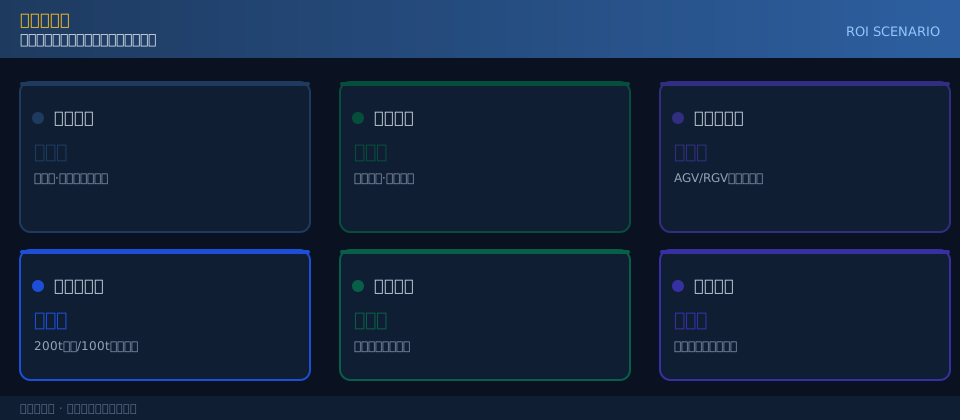
Three High-ROI Scenarios: Continuous Production, High-Risk Environments, and Automated Interfaces
Scenario 1: Continuous production. Three-shift operations with high equipment utilization, where any stoppage drags down the entire line, offer the fastest payback for Smart Cranes. The logic is straightforward: every minute wasted waiting for the load to stop swaying or repeatedly aligning the hook, multiplied by the heavy load of three shifts, adds up to a significant loss. Anti-sway and Precise Positioning recover that time directly.
Scenario 2: High-temperature and high-risk environments. In metallurgy, casting, and chemical workshops, equipment operates under harsh conditions — motors face elevated temperature rise, mechanisms are prone to wear, and personnel should not spend extended time in hazardous zones. Intelligent Condition Monitoring with temperature-rise early warning, plus unmanned operation capability, delivers far greater value here than in a standard workshop. In metallurgical projects, Kelude typically includes safety monitoring and anti-sway as default configurations.
Scenario 3: Automated interfaces. Production lines that already use — or plan to use — AGVs, RGV carts, or robotic loading and unloading require Precise Positioning and open interfaces as non-negotiables. Without repeat positioning accuracy of ±2 to 5 mm, automatic docking is impossible; without open OPC UA and API interfaces, the overhead crane cannot be integrated into the line's unified scheduling. Investment in this scenario is essentially laying the foundation for the entire automation system.
How to Calculate Payback: Two Tracks — Handling Efficiency and Downtime Loss
Whether intelligence is worth it ultimately comes down to the payback period. There are two calculation tracks: the efficiency track and the loss track.
The efficiency track calculates the time saved by anti-sway and Precise Positioning. Multiply the waiting time saved per handling cycle by the number of cycles per day and working days per year, then convert that into labor and Production Capacity value — that gives you an annualized benefit. This track is easiest to quantify in continuous production, where cycle counts are concrete and verifiable.
The loss track calculates the downtime losses avoided through monitoring and early warning. A sudden breakdown that halts the production line often costs far more than the repair itself. Condition Monitoring converts unexpected failures into planned maintenance — the downtime avoided is the benefit on this track.
Add the two tracks together, and you have the annualized return on intelligence. Divide the procurement increment by that annualized return, and you get the payback period. When Kelude prepares proposals for clients, we document both tracks clearly so the payback period is evidence-based — not a guess.
Three Common Misconceptions: Smarter Isn't Always Better, and Installation Isn't the Finish Line
Misconception 1: More expensive intelligence is better. The choice of smart features should follow the operating conditions, not a checklist of add-ons. Loading a single-shift, small-tonnage overhead crane with Digital Twin and a full AI vision suite spends a lot of money for limited return — you're paying for features you'll never use.
Misconception 2: Once installed, the job is done. The value of a smart system lies in Commissioning and ongoing maintenance. If VFD parameters aren't tuned properly, energy savings stay on paper; if monitoring alarms go unanswered, early warning becomes decoration. Data review after installation, threshold Calibration, and closing the loop on alarms are where the value is actually realized.
Misconception 3: Intelligence can replace safety devices. No matter how advanced the smart system, the Brakes, limit protection, and other safety devices required by FEM 1.001 Crane Design Standard are still mandatory. Intelligence is additive, not a substitute — this is the most common pitfall in crane procurement. Kelude lists safety device configuration and smart feature configuration separately in contracts to prevent any misunderstanding that adding intelligence allows for reduced safety equipment.
Parameter Requirements by Scenario
| Application Scenario | Key Requirements | core configuration |
|---|---|---|
| Continuous Operation | Handling Efficiency Improvement、Downtime Reduction | Anti-sway+Precise Positioning+Condition Monitoring |
| High-Temperature / Hazardous Environment | temperature riseearly warning、Minimized Staffing / Reduced Manning | safety monitoring+Anti-sway+remote control |
| automationInterface / Docking | Precise Positioning、Open Interface | Precise Positioning+OPC UA/API |
| large tonnageMandatory / Enforced | Passed Inspection / Compliance Verified、Data Traceability / Audit Trail | Safety Monitoring and Management System |
| Frequent Handling Cycles | Cycle Time Reduction | Variable Frequency Speed Control+Anti-sway |
| High-Value Material | Collision Mitigation、anti-dropping | Precise Positioning+AIanti-collision |
Inspection Clause Comparison for Intelligent Configurations
| InspectionItem / Criterion | standard basis | Acceptance Criteria / Key Assessment Point | Common / TypicalDefect |
|---|---|---|---|
| Safety Monitoring System | GB/T 28264 Safety Monitoring and Management System | parameter acquisitionComplete with Audit Trail | Display-Only (No Logging) |
| Overload Limiter | FEM 1.001 Crane Design Standard | AlarminterlockEffective / Functional | Alarm-Only (Without...)interlock |
| Various / All Typeslimit protection | TSG (Special Equipment Safety Technical Regulation) 51 Safety Technical Specification for Special Equipment-2023 Crane Safety Technical Supervision Regulation | limit switchReliable Operation / Dependable Actuation | limit switchFailureNot Detected / No Anomalies Found |
| anti-sway controlAngle / Corner | Contract Measured Value | sway angleMeasured Performance Meets Specification | Rated-Only (Not Verified by Measurement) |
| Positioning Accuracy | Contract Measured Value | Repetitive / RepeatedPositioningMeasured Performance Meets Specification | AccuracyReduced / Degraded (vs. Spec) |
| Data Interface | ISO 24619 | Interface Open and Operational | Proprietary Protocol / Closed Protocol |
| early warningClosed-Loop | GB/T 28264 Safety Monitoring and Management System | Alarm with Attended Response | Alarm Ignored / Unattended Alarm |
Smart Crane Application Scenarios: FAQs
Q: Which industries see the fastest ROI from smart cranes?
A: Three types of operations deliver the quickest returns: continuous production lines, high-temperature or high-risk environments, and automated material-handling systems. In metallurgical casting and similar high-risk settings running around the clock, safety monitoring and anti-sway features reduce both risk and cycle times. For automotive parts and appliance production lines that require automated loading and unloading, precise positioning is a must-have. Standard workshops running single shifts with light loads and loose positioning tolerances typically see longer payback periods—start with the mandatory safety configuration there.
Q: Which crane capacities are legally required to have safety monitoring systems?
A: Under GB/T 28264-2017 Safety Monitoring and Management System, overhead cranes above 200t and gantry cranes above 100t fall within the mandatory scope. Additionally, TSG 51-2023 Crane Safety Technical Supervision Regulation sets clear inspection requirements for safety limit switches and overload protection. While smaller-capacity cranes are not legally required to comply, retrofitting monitoring on units used in continuous or high-risk operations provides valuable operational traceability and early warning of potential hazards.
Q: With a limited budget, which production line should get smart cranes first?
A: Prioritize the line with the highest load, the greatest downtime loss, and the most frequent loading cycles. Start by adding anti-sway and precise positioning to your main continuous production line—that combination delivers the fastest payback. In high-risk environments, prioritize safety monitoring and temperature-rise early warning. If you have a clear automation roadmap, build precise positioning and open communication interfaces in from day one to avoid costly retrofits later.
Q: How do I know if my plant is a good fit for smart cranes?
A: Watch for three signals: how much of each loading cycle is spent waiting for the load to stop swaying, how much downtime costs your production line, and whether you have any automation integration plans. If even one of these is a clear pain point, the ROI case for smart features usually adds up. If none apply, stick with the mandatory safety configuration and routine maintenance. The deciding factor is pain-point density, not the "smart" label itself.
For a step-by-step retrofit roadmap, see The Complete Smart Crane Retrofit Guide: Kelude Heavy Industry's Digitalization Upgrade for Traditional Workshops for practical implementation details.
Whether a smart crane is worth the investment isn't determined by the equipment itself—it's about whether your operating conditions have enough pain points waiting to be solved. The first thing Kelude Heavy Industry does for every client is a thorough operating-condition assessment and ROI calculation.
