

Multi-Agent Crane Collaboration: From Centralized to Distributed
📋 Key Summary
Crane group scheduling is shifting from a centralized command-and-control model to one where each crane makes autonomous decisions and negotiates with its peers. Multi-agent coordination turns every crane into a self-governing agent that resolves conflicts through negotiation, delivering scalability and robustness. This article explains the essential difference between centralized scheduling and distributed decision-making, how the negotiation mechanism works, and where multi-agent coordination is headed next.
📌 Two Scheduling Paradigms at a Glance
Centralized scheduling: A central brain collects global information and assigns tasks to achieve system-wide optimization — but the center becomes a single point of failure.
Distributed decision-making: Each crane decides independently and negotiates with others — scalable and resilient to single points of failure, but global coordination is harder to achieve.
Crane group scheduling is undergoing a fundamental shift from a "central brain" to "collective intelligence." A decade ago, multiple overhead cranes followed commands from one central controller. Today, a growing number of applications let each crane make its own decisions and negotiate with its peers.
This shift is not merely a technical upgrade — it represents a move from centralized to distributed scheduling paradigms. Below, we explain where this transition is headed.
Centralized vs. Distributed Scheduling: The Essential Difference
Centralized scheduling operates on a "central coordination" model. A central brain collects global information, assigns tasks, and plans routes to pursue system-wide optimization. Its strengths are consistent decision-making and simple coordination; its weaknesses are that the center becomes a single point of failure — when equipment volume grows, the center becomes a computational bottleneck, and if the center goes down, the entire system halts.
Distributed decision-making, by contrast, operates on an "individual autonomy" model. Each crane acts as an intelligent agent, making decisions based on local information and resolving conflicts through peer negotiation. Its strengths are scalability and resilience to single points of failure; its weakness is that global coordination becomes more difficult, and local optima may emerge.
At its core, this difference comes down to where decision-making authority resides — centralized at the top or distributed to individual units. Kelude believes that in scenarios with large equipment fleets and highly dynamic conditions, the robustness advantages of distributed decision-making will become increasingly evident. ISO 24617, the intelligent control system standard for cranes, provides a framework for agent-based control.
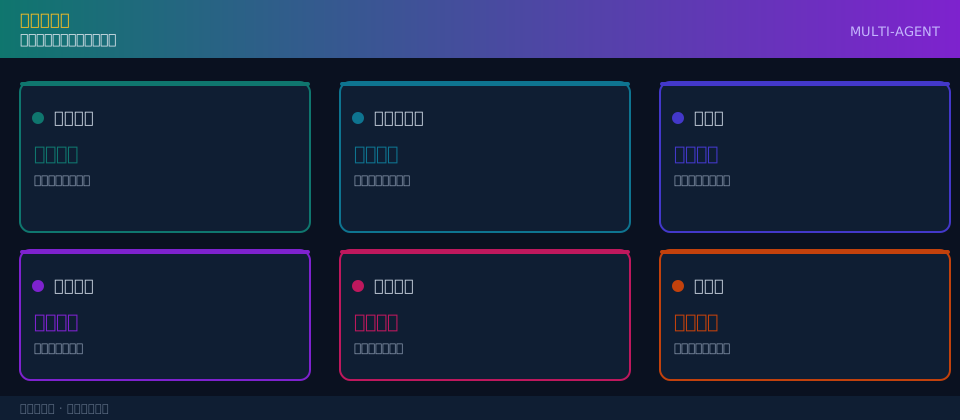
Core Mechanisms of Multi-Agent Systems: Autonomous Decisions and Conflict Resolution
Multi-agent coordination relies on two core mechanisms to function effectively.
Autonomous decision-making enables each agent to act on local information — for example, deciding which task to pick up or which route to take. Agents no longer need to check with a central controller for every action, which speeds up response times.
Negotiation-based conflict resolution comes into play when decisions collide — for instance, when two cranes need the same section of Crane Rail simultaneously. Agents resolve such conflicts through negotiation, whether by priority-based yielding or cost-based reallocation. This negotiation mechanism is both the cornerstone and the biggest challenge of multi-agent coordination.
Together, these two mechanisms strike a balance between "every agent for itself" and "central coordination": individual agents retain autonomy while the overall system stays aligned. In its group scheduling solutions, Kelude treats the negotiation mechanism as the foundation for deploying distributed decision-making. ISO 24619, the IoT interface specification for cranes, sets requirements for multi-machine communication access systems.
How to Deploy Multi-Agent Coordination: A Gradual Path from Centralized to Distributed
Multi-agent coordination cannot be implemented overnight — it requires a gradual transition from centralized scheduling.
Step one: Keep centralized scheduling as the base. The existing system continues to run on central coordination to ensure stability, serving as a safety net during the transition period.
Step two: Add local decision-making to individual units. Each crane makes autonomous decisions within its local scope (e.g., its own workstation), while the center handles only cross-area coordination. Decision authority is gradually delegated downward.
Step three: Delegate full authority once the negotiation mechanism matures. After the negotiation-based conflict resolution process has been proven reliable, expand the scope of individual autonomy until distributed decision-making is fully realized. Kelude follows this three-step approach — centralized base, local delegation, and mature negotiation — to ensure a smooth paradigm shift.
Common Mistakes in Deploying Multi-Agent Coordination
Mistake one: Going fully distributed in one leap. Deploying full autonomy across all agents without first validating the negotiation mechanism leads to unresolvable conflicts and a more chaotic system. Distribution must be gradual.
Mistake two: Delegating authority without negotiation. Giving agents autonomous decision-making power without a negotiation mechanism to resolve conflicts results in equipment working at cross-purposes and colliding with one another.
Mistake three: Ignoring local optima. Distributed decision-making is prone to situations where every individual agent is optimized but the overall system is not. Negotiation and global constraints are needed to correct this. In its distributed decision-making approach, Kelude pairs the negotiation mechanism with global constraints as supporting measures.
Centralized vs. Distributed Scheduling: A Comparison
| Dimension | Centralized Scheduling | Distributed Decision-Making | Differentiation Point | Application Scenarios |
|---|---|---|---|---|
| Decision Authority | Centralized Control | Decentralized Individual Control | Delegated Decision Authority | Distributed Preferred for Large Scale |
| Global Optimum | Strong | Weak Local Optimum | Varying Coordination Complexity | Centralized Preferred for Global Optimum |
| Scalability | Centralized Bottleneck | Ease of Equipment Addition | Differing Expansion Capability | Distributed Preferred for Expansion |
| robustness | Central Failure Halts Entire System | Single Point Failure Does Not Disrupt Entire System | Differing Fault Tolerance | Distributed Preferred for High Availability |
Quick Reference of Standard Clauses for Multi-Agent Collaboration
| Standard | Key Clause Points | Relationship with Multi-Agent Systems |
|---|---|---|
| ISO 24617 | intelligent control system for cranes | Agent Control Framework |
| ISO 24619 | craneIoT interface specification | Inter-Machine Communicationaccess system |
| GB/T 28264 Safety Monitoring and Management System | safety monitoringTraceability Loggingrequirements | Collaborative Decision Traceability |
Multi-Agent Coordination: Frequently Asked Questions
Q: What is the fundamental difference between multi-agent coordination and centralized scheduling?
A: The core difference comes down to where the decision-making authority resides. Centralized scheduling relies on a central controller that gathers global data and assigns tasks — all decisions flow from that single point. Distributed decision-making, by contrast, lets each crane make its own decisions and negotiate with others, pushing authority down to the individual units. Centralized systems chase global optimization but create a single point of failure; distributed systems scale better and tolerate faults, but coordination becomes more complex. In short, it's a shift in the decision-making paradigm — from centralized to distributed.
Q: How can we get started with multi-agent coordination on a limited budget?
A: Don't try to go fully distributed in one step. Keep the centralized scheduling system as your base, then give individual cranes limited local decision-making power — let them make autonomous decisions within their own workstation, while the central system handles cross-zone coordination. Once the negotiation mechanism proves reliable, gradually expand the scope of individual autonomy. The sequence is: centralized foundation, localized authority, then mature negotiation. This lets the paradigm shift happen smoothly rather than forcing a complete overhaul.
Q: Won't distributed decision-making lead to chaos?
A: Chaos only happens when you grant autonomy without a negotiation mechanism. When each crane makes its own decisions, two units will inevitably try to occupy the same section of crane rail at the same time — and without a way to negotiate, they'll just conflict with each other. Distributed decision-making must be paired with a collision-avoidance and conflict-resolution mechanism: priority-based yielding, cost-based task reallocation, and so on. Once the negotiation mechanism is mature, distributed control stays orderly. That's the make-or-break factor for multi-agent coordination in practice.
Multi-agent systems represent the natural evolution of fleet scheduling. For the fundamentals, see Overhead Crane Fleet Scheduling Algorithms: Engineering Implementation of Multi-Crane Collision Avoidance and Task Allocation.
Moving from centralized scheduling to distributed decision-making is about delegating authority — not tearing down the system. Kelude Heavy Industry follows a three-step path: centralized foundation, localized autonomy, then mature negotiation — so multi-agent coordination evolves with stability, not disruption.
