

Crane AI Fault Diagnosis: Root Cause vs. Symptom
📋 Key Summary
Today's crane AI can tell you "what" the fault is, but not "why" it happened. That's because AI learns correlation, not causation—it knows two phenomena often occur together, but not which one causes the other. Causal inference is exactly what fills this gap. This article explains the difference between correlation and causation, how to build a causal graph, and where causal inference hits its limits in industrial applications.
An overhead crane's AI system flags "abnormal temperature rise in the hoisting motor." The maintenance technician asks: why is this happening? The AI goes silent. It can only confirm the anomaly exists—it can't explain the chain of causes behind it.
This is the fundamental limitation of today's AI: it knows "what" but not "why." What it has learned is correlation, not causation.
Causal inference is what fills in that "why." Here's how it works.
Correlation vs. Causation: Co-occurrence vs. Cause-and-Effect
Correlation and causation are two entirely different things.
Correlation means two phenomena frequently appear together. For example, "high motor temperature" and "heavy load" often coincide. The AI can learn this correlation, but it can't tell whether the load causes the temperature rise, or whether both are driven by a third factor.
Causation, on the other hand, is about "what causes what." A heavy load causes the motor temperature to rise—that's a causal direction. Once you know that direction, you can apply a targeted solution: reduce the load or improve cooling, rather than adjusting the temperature sensor.
What AI learns from data is correlation, because data only records "co-occurrence"—it doesn't capture "which came first, or which acts on which." Causal direction must be established through intervention and domain knowledge. Kelude Heavy Industry believes this is the critical step that moves AI diagnostics from "alarm" to "explanation," and ISO 24621, AI Fault Diagnosis for Cranes, requires traceability of diagnostic evidence.
Causal Inference Methods: Graphs, Interventions, Counterfactuals
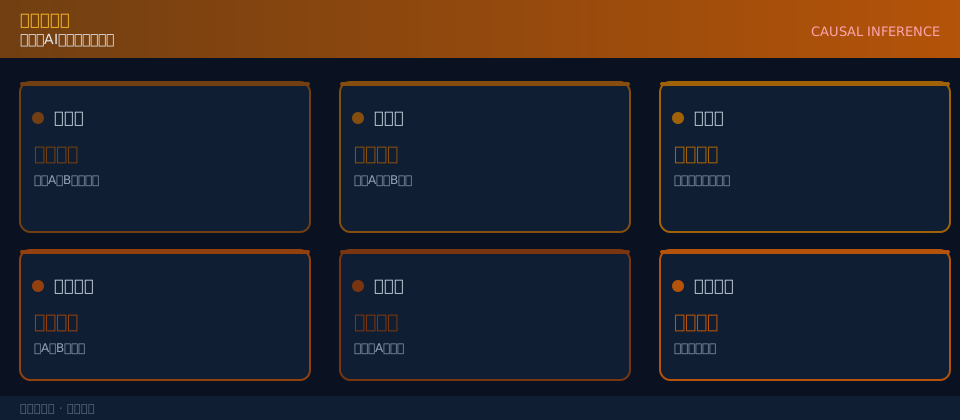
Causal inference has a well-defined methodology, and the core idea is to make causal relationships explicit.
A causal graph uses nodes and arrows to map out cause-and-effect relationships between variables—for example, "load → temperature → fault." The graph is built from domain knowledge: the experience of veteran engineers and engineering principles that tell the AI "what influences what."
Intervention analysis actively changes one variable and observes how another responds, thereby validating the causal direction. For instance, reduce the load and see if the temperature drops—if it does, that confirms the load is one of the causes of the temperature rise.
Counterfactual reasoning asks "what would have happened if we hadn't done X," which is used to evaluate the actual effect of an action. Used together, these three methods move AI from "correlation" to "causation." However, building a causal graph relies heavily on domain knowledge, and that's the main barrier to industrial adoption.
Why Causal Inference Matters: Targeted Fixes and Predictive Intervention
The value of causal inference shows up in real maintenance decisions.
Knowing causation enables targeted fixes. Correlation only signals "there's an anomaly"; causation tells you "where the root cause lies." You address the root cause rather than the symptom, avoiding the trap of treating the headache when the problem is in the feet.
Knowing causation also lets you predict the effect of an intervention. For example, you can estimate how much "improving cooling" will actually reduce temperature, so you can pick the most effective option among several—instead of trial and error.
These two capabilities are exactly what current AI diagnostics lack. Kelude Heavy Industry introduces causal graphs into its diagnostics to push AI alarms from "what" toward "why," but with restraint—causal inference in industry is still at the stage of assisting engineers' judgment, not making autonomous decisions. GB/T 28264-2017, Safety Monitoring and Management System for Lifting Appliances, requires traceability of causal data.
Common Pitfalls in Deploying Causal Inference
The first mistake is treating correlation as causation. When correlations learned from data are used as causal truths in decision-making, you end up with "the rooster's crow causes the sun to rise" logic. Causal direction must be established through domain knowledge and intervention validation.
The second mistake is relying entirely on data to learn the causal graph. Data can only provide correlations; causal direction requires domain knowledge to be injected. Purely data-driven causal graphs offer no reliability guarantee.
The third mistake is overestimating the maturity of causal inference. Industrial causal inference is still in its early stages—it can do only so much. Overselling it as a mature technology is a recipe for failure in the field. Kelude Heavy Industry positions causal inference as "assisting engineers' judgment," not as autonomous decision-making.
Correlation Learning vs. Causal Inference: A Side-by-Side Comparison
| Dimension | Related Learning | Causalityinference | Differentiator | Maturity Level |
|---|---|---|---|---|
| Question Addressed | What It Is | Why It Matters | DiagnosisDepth Variance | Correlation Maturity |
| Data Source | Data Relevance | Domain Knowledge with Intervention | Knowledge Dependency Variance | Correlation Maturity |
| Capability | Alarm Notification | Targeted Remediation | Decision Value Variance | Early Causality |
| Implementation Risk | false alarms and missed alarms | Misattributed Causality | Risk Type Variance | Early Causality |
Quick Reference of Standard Clauses for Causal Inference
| Standard | Clause Essentials | Relationship to CausalityinferenceCorrelation |
|---|---|---|
| ISO 24621 | craneAI fault diagnosisFramework | DiagnosisEvidence Traceability |
| GB/T 28264 Safety Monitoring and Management System | safety monitoringEvidence Traceabilityrequirements | Causal Datatraceable |
| TSG (Special Equipment Safety Technical Regulation) 51 Safety Technical Specification for Special Equipment-2023 Crane Safety Technical Supervision Regulation | safety interlockSupervisionrequirements | Causality Non-Substitutionsafety decision |
FAQ: Causal Inference in Industrial Diagnostics
Q: What is the fundamental difference between correlation and causation?
A: Correlation means two things occur together; causation means one thing drives the other. When two phenomena frequently co-occur, that's correlation—but it could be coincidence, the result of a shared cause, or mutual influence. Causation establishes the direction of influence from one phenomenon to another. AI can only learn correlations from data; determining causal direction requires domain knowledge and intervention experiments. That's the essential distinction.
Q: Is it worth investing in causal inference now?
A: It depends on how you approach it. Industrial causal inference is still in its early stages—not mature enough for large-scale deployment, but worth starting with causal graph construction. Use domain knowledge to map relationships between faults, root causes, and corrective actions into a causal graph. This layer offers controlled investment and clear value, moving diagnostics from simple alerts to explanations. Start with graph building to support engineer judgment, and revisit automated decision-making once the technology matures. That's a pragmatic path.
Q: How do I know if my use case needs causal inference?
A: Ask whether your diagnostics require the "why." If you only need to know "there's a fault and where it is," correlation-based learning suffices. If you need to understand the root cause, determine the right corrective action, or identify the most effective solution, you need causal inference. The judgment criteria: does your scenario lack detection capability or explanatory capability? Root-cause localization and targeted treatment justify the investment in causal inference.
Q: Why does AI learn correlation rather than causation?
A: Because training data only records that phenomena co-occur—it doesn't capture which came first or which influences which. From a set of co-occurring phenomena, AI can only extract statistical patterns of joint occurrence, which is correlation. Causal direction doesn't emerge automatically from data; it requires domain knowledge to indicate influence pathways and intervention experiments to validate direction. This is the fundamental reason AI diagnostics can't explain "why."
Causal inference is the next step in moving diagnostics from alerts to explanations. For related diagnostic approaches, see Equipment Health Management (PHM): Big Data and ML-Driven Predictive Maintenance for Overhead Cranes — Engineering Practice.
AI's ability to know "what" is mature; knowing "why" is still a work in progress. Kelude builds causal graphs from domain knowledge to move diagnostics from alerts to explanations, while maintaining a clear boundary: supporting engineer judgment, not automating decisions.
