

Preventing AI Hallucinations in Crane Operations
📋 Key Summary
When large language models are introduced into crane operations and maintenance, the toughest challenge isn't accuracy—it's hallucination. Models can confidently fabricate nonexistent clauses, maintenance procedures, and diagnostic data. This article doesn't dwell on the models themselves; it focuses on five practical trust barriers at the deployment layer: retrieval-augmented generation ensures answers are verified before being generated, knowledge base constraints lock outputs within validated boundaries, boundary limits prevent AI from authorizing high-risk actions like shutdowns, manual review backs up key conclusions, and audit trails make every recommendation traceable. These five barriers form a defense-in-depth strategy, not parallel options—relying on any single one leaves gaps, but together they keep hallucinations out of decision-making. For implementation, start with audit trails and boundary limits—they cost the least and deliver the fastest results.
When teams first consider bringing large language models into crane operations and maintenance, the immediate reaction is often fear rather than excitement: what if the model invents a maintenance step that doesn't exist and a technician follows it? That concern is rational, but the right conclusion isn't to "turn off the AI"—it's to "build in trust barriers."
The bad news: hallucination is inherent to generative models and can't be eliminated at the root. A model is fundamentally predicting the next token, not verifying facts. When a query falls outside its training coverage and lacks external constraints, the model fills the gap with whatever sounds most plausible—producing output that reads smoothly but is entirely wrong.
The good news: whether hallucinations cause harm is largely in the hands of system designers. A model prone to hallucination, when properly constrained by the right barriers, can still work safely in operations and maintenance scenarios. That's what this article covers—not training a "model that never lies," but designing a "system that withstands lying." Kelude has made these trust barriers standard practice across multiple operations and maintenance projects.
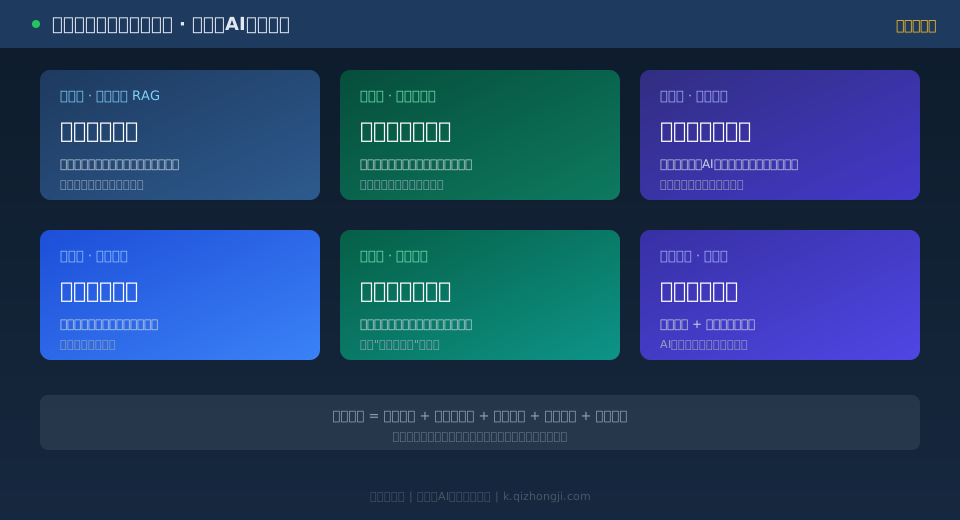
Why Retrieval-Augmented Generation Is the First Line of Defense Against Hallucination
Among the five barriers, retrieval-augmented generation (RAG) gets the most attention because it fundamentally changes how the model answers: instead of relying on memory to "recite" answers, the model first retrieves relevant clauses from a trusted knowledge base and then generates its response based on the retrieved source text.
This step may seem simple, but it blocks the most dangerous type of hallucination—fabricated clauses. Without retrieval constraints, a large model will fill in "what clause X of standard Y says" based on linguistic habit, and those clauses often don't exist at all. When Kelude integrated RAG into its crane maintenance knowledge base, it structured and indexed the operational requirements from ISO 24620:2022 "Crane Intelligent Operation and Maintenance Specification" and the traceability requirements for diagnostic conclusions from ISO 24621:2022 "AI Fault Diagnosis for Cranes", so the model can only cite text that actually exists in the knowledge base—compressing the space for fabrication at the source.
The real challenge is that RAG's effectiveness depends heavily on knowledge base quality. If erroneous content gets mixed into the knowledge base, the "facts" retrieved are already poisoned, and the model will confidently repeat the errors. So RAG isn't just about plugging in a vector database—it requires ongoing knowledge base governance.
Comparing the Five Trust Barriers: Hallucination Types Blocked, Cost, and Maturity
The five barriers aren't five ways of saying the same thing—they block different types of hallucinations, vary in implementation cost, and sit at different maturity levels. Understanding the differences is essential before deciding which to deploy first and how to combine them. The table below lays out the five core barriers alongside two supplementary measures for side-by-side comparison during selection.
| Defense Line | Hallucination Interception Type | Technical Principle | Implementation Cost | Deployment Maturity | Applicable Stage |
|---|---|---|---|---|---|
| retrieval-augmented generation(RAG) | Fabricated Clauses、Fabricated Data | Retrieve Firstknowledge base,Generate Based on Source Text | Medium | Relatively Mature | Q&A、DiagnosisAssistive |
| knowledge baseConstraint | Out-of-Bound Output、Incorrect Citation | Restrict Generation Scope to Verified Content | Medium | Relatively Mature | Full Textcoverage |
| Boundary Restriction | Unauthorized Decision-Making、Unauthorized Operation | Permission-Layer Removal of High-Risk Actions | Low | Relatively Mature | Shutdown、Release、ParameterModification |
| manual review | Final Fallback for All Types | key conclusionsManual Sign-off Confirmation | Medium | Relatively Mature | High-Risk Conclusions |
| Audit Trail | Untraceable Errors | Context Logging、Basis、timestamp | Low | Relatively Mature | full process |
| Out-of-Bound Outputverification(Supplement) | Rule-Determinable Errors | Rule-Engine Filtering of Anomalous Output | Medium | Relatively Mature | Numerical Value、Format、Range |
| Modelfine-tuningAlignment(Supplement) | SystematicDeviation | Incorrect Citationannotated datafine-tuningPreference | High | Early Stage | baseModel Optimization |
The surface impression can be misleading: many assume "manual review" is the most basic safeguard, but in practice it is the most mature line of defense and the one that provides the strongest safety net for high-risk scenarios. When selecting which safeguard to deploy first, don't be swayed by the perception that "retrieval-augmented generation is more high-tech." The decision should be driven by the interception objective and cost—not by how modern the name sounds.
Deployment Order: Audit Trails First, Access Control Second, RAG Last
When budget and manpower are limited, what order should these safeguards be deployed in? Based on Kelude's field experience, the sequence is: start with audit trails and access restrictions, then move to retrieval-augmented generation and knowledge base governance, and finally fine-tune output verification.
The reasoning is straightforward. Audit trails add virtually no cost on the model side—simply storing the context, cited sources, and timestamps of each Q&A session makes it possible to answer "where did this recommendation come from," which is the foundation for post-incident accountability and continuous improvement. Access restrictions work the same way: by removing high-risk actions such as equipment shutdown, release, and parameter modification from the AI's authority at the permission layer and placing them in the hands of qualified personnel, you get a quick win with minimal changes.
Deployment must also align with mandatory safety requirements, letting the AI adapt to the existing framework of monitoring and supervision. GB/T 28264 Safety Monitoring and Management System for Lifting Appliances requires that critical actions be traceable, while TSG 51-2023 Safety Technical Supervision Regulation for Lifting Appliances places primary safety responsibility on the user unit—together, these two mandates make it clear that the AI can only serve as an advisor, never as a decision-maker.
Compliance Conflicts Between AI Output and Mandatory Safety Requirements
| Conflict Scenarios | AILateral Bias | Safety-Side Rigidityrequirements | Engineering Recommended Practice |
|---|---|---|---|
| AIOut-of-Bound Output"recommendationImmediate Shutdown" | Model Tends to Give Decisive Conclusions | Shutdown Decision Requires Confirmation by Certified Personnel | Boundary Restriction:AIProvide Onlyrecommendation,Manual Execution of Actions with Audit Trail |
| AIIncorrect Citation"CertainStandardArticleXClause" | Model May Fabricate Non-Existent Clauses | Based on ActualStandardText Shall Prevail | retrieval-augmented generation:Clauses Must Be Retrieved Fromknowledge baseRetrieved Source Text |
| AIProvide"May Continue Operation" | Model May Miss Hidden Hazards | Implement Safety Subject Responsibility | manual review:Release Conclusions Must Be Manually Confirmed and Signed |
| AIAlarm Records | Output May Be Untraceable | MonitoringData Musttraceable | Audit Trail:Each EntryrecommendationStore Context andtimestamp |
Standards describe ideal operating conditions, but the workshop floor is never ideal. Large language models tend to produce confident answers without citing their sources, while safety monitoring and regulatory inspection both demand traceability—a direct conflict. The engineering solution is to adapt AI output formats to fit existing documentation and accountability frameworks, not to rewrite the rules to accommodate the model.
Four Common Compliance Pitfalls: Confusing AI Recommendations with AI Decisions Is the Most Dangerous
The most dangerous mistake is treating "AI gave a recommendation" as "AI can make the decision." No matter how confident a large language model sounds, it remains fundamentally unconstrained by factual reality. Decisions such as shutting down equipment or releasing a load must stay with certified personnel. AI only provides references and supporting evidence—judgment and execution always remain human responsibilities.
The second common misconception is assuming that integrating a large language model automatically delivers intelligent operation and maintenance. In reality, the opposite is true—a model without knowledge base constraints, audit trails, and boundary limits amplifies risk, because it can present errors more persuasively than a human ever could.
A more subtle trap: treating publicly available internet content as an authoritative knowledge base. Public pages contain large amounts of outdated, incorrect, or contradictory information. If retrieval-augmented generation is built on such a base, it opens a backdoor for hallucinations—the "facts" retrieved are already poisoned.
The final pitfall appears in the testing phase—validating only normal samples. If output verification rules are tested solely against normal data, they will miss hallucinations, which are rare but potentially catastrophic errors. Adversarial testing with deliberately constructed hallucination samples is essential to prove the defense actually works.
Trustworthy AI Defense: A Practical Pre-Launch Checklist
Retrieval-Augmented Generation Enabled
Implementation: Every response retrieves source text from the knowledge base first
Common gap: Model generates directly without a retrieval step
Verifiable Knowledge Base Sources
Implementation: Only current, valid authoritative entries are included
Common gap: Treating public web pages as an authoritative source
Boundary Limits Enforced
Implementation: High-risk actions are not delegated to AI
Common gap: AI can directly trigger shutdown or release
Documented Manual Review
Implementation: Key conclusions are signed off by certified personnel
Common gap: Review is a formality with no signature or record
Traceable Audit Trail
Implementation: Each recommendation stores context and timestamps
Common gap: Storing conclusions without supporting evidence
Comprehensive Output Verification
Implementation: Tested with adversarial hallucination samples
Common gap: Rules only cover normal samples
These six checklist items don't need to be implemented all at once, but each one corresponds to a real failure scenario that has occurred in practice. Checking them off one by one is far cheaper than discovering a missing link during post-incident accountability. Kelude Heavy Industry has made this checklist a mandatory pre-launch gate in its deployments.
📖 Related Reading: What Can Large Language Models Actually Do for Crane Operations? Practical Scenarios and Capability Boundaries | AI Vision Inspection for Cranes: A Technical Roadmap from Detection to Positioning
FAQ
Q: What exactly is the difference between retrieval-augmented generation and knowledge base constraints?
A: They complement each other rather than being the same thing. Retrieval-augmented generation addresses "where to find the answer"—it searches the knowledge base for relevant clauses before responding, governing the input source. Knowledge base constraints address "what content can be stated"—they lock the generation scope within verified content, governing the output boundary. The two are typically used together; deploying either one alone leaves a significant gap.
Q: What do relevant standards for AI fault diagnosis on cranes require regarding the trustworthiness of AI output?
A: Taking ISO 24620 and ISO 24621 as examples, both address intelligent operation and maintenance and AI fault diagnosis respectively, requiring AI output to have traceable sources of evidence, and imposing constraints on the grading of diagnostic conclusions and responsibility boundaries. Domestic safety monitoring and management systems for lifting appliances similarly emphasize traceability of key data. In practice, these clauses should serve as the alignment baseline for knowledge base governance and audit trails—any standard number cited must be locatable to its original text in the knowledge base.
Q: How can you tell whether an AI recommendation is a hallucination, and what criteria should you use?
A: First, check whether the output cites its sources—hallucinations typically present conclusions without references. Second, verify the citations themselves: cross-check any clause numbers the AI mentions against the actual standard text, since fabricated clauses usually don't exist. Finally, assess whether the values are physically plausible—if diagnostic parameters like current, temperature, or wear amount fall outside reasonable physical ranges, the output is almost certainly hallucinated. Applying these three criteria together filters out the vast majority of fabricated content.
Q: Why do large language models confidently invent maintenance procedures that don't exist?
A: Because LLMs generate text by predicting the next token, not by verifying facts. During training, they learn which word sequences sound most coherent—not which conclusions are actually true. When a query falls outside the training coverage and no external knowledge base constrains the output, the model fills the gap with whatever sounds most plausible. The resulting steps may look perfectly formatted and professionally worded, yet be entirely wrong. That's why relying on the model's own judgment alone can never eliminate hallucinations.
Keeping hallucinations out of the loop isn't about making the model more honest—it's about designing a system that can withstand a model that may lie. This is exactly the principle Kelude Heavy Industry follows in its crane intelligent operation and maintenance projects: the model can be wrong, but its errors must never translate directly into shutdown, release, or repair commands. Log first, restrict permissions, then retrieve—when these five defensive layers work together, they form the trustworthy foundation that makes crane AI truly deployable in the field.
