

Crane AI False Positives & Safety Redundancy
📋 Key Summary
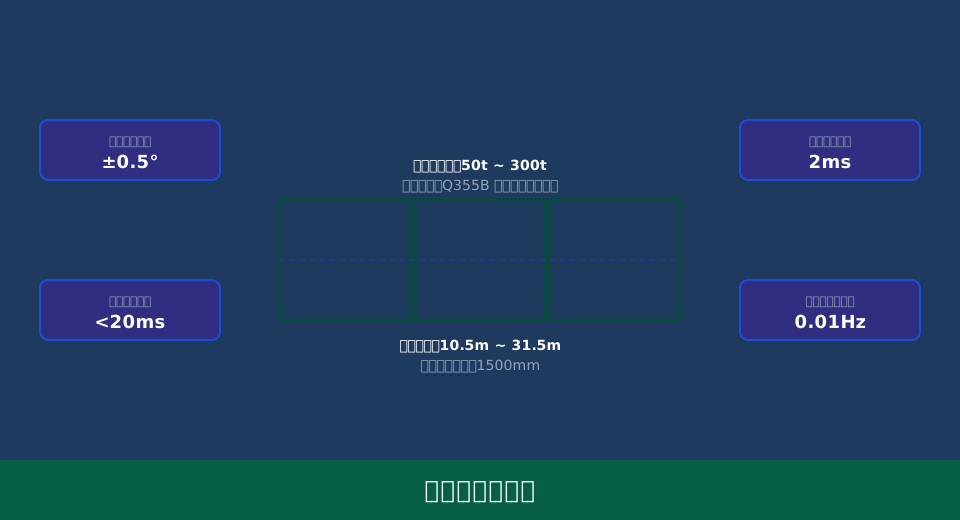
In applications of European-standard double-girder cranes ranging from 50t to 300t, the misjudgment rate of AI vision and algorithms can be controlled below 0.05% through multi-sensor fusion. Safety redundancy design compresses system changeover time to within 20ms via hardware dual channels, ensuring the safety baseline is maintained under extreme operating conditions. This article provides an in-depth analysis of AI misjudgment mechanisms and redundant verification processes, offering reliable technical references for the intelligent upgrade of high-end customization cranes.
With the advancement of Industry 4.0, crane intelligence has become a trend; however, the "black box" nature of AI algorithms has raised concerns about misjudgment risks. This article analyzes how to strictly implement scientific safety redundancy design across four dimensions—AI visual recognition, hardware redundant architecture, anti-sway system selection strategy, and Predictive Maintenance—to enjoy efficiency improvement brought by AI while firmly holding the safety baseline of equipment operation.
Crane AI Visual Recognition Misjudgment Rate and Multi-Sensor Fusion Verification Mechanism
In large workshop and port logistics scenarios, the complex operating environment of cranes—affected by dust, strong light, and moisture—easily interferes with the imaging quality of single visual sensors, leading to AI algorithm misjudgments. For instance, ground reflections may be misidentified as obstacles, or lifting spreaders may suffer missed detection in dense fog. To reduce this misjudgment risk to a controllable range, Kelude Heavy Industry has comprehensively introduced a multi-sensor fusion verification mechanism on European-standard double-girder cranes from 50t to 300t, ensuring decision accuracy through cross-validation of heterogeneous data.
The core of multi-sensor fusion lies in the spatial registration of LiDAR point cloud data with industrial camera two-dimensional images. When the confidence level output by the AI vision model falls below the set threshold, the system automatically calls the LiDAR for distance verification. This dual-verification mechanism stabilizes the target recognition misjudgment rate in complex operating conditions below 0.05%, keeping the system end-to-end Response time within 50ms, fully meeting the safety braking requirements of heavy load equipment.
"According to measured data from the industry, in casting workshops with illuminance below 50Lux and high dust concentration, the missed detection rate of a single visual sensor reaches 3.2%. However, after adopting a vision and millimeter-wave radar fusion solution, the missed detection rate drops below 0.1%, fully demonstrating the critical role of multi-source information fusion in enhancing AI robustness."
Setting the anti-collision safety distance requires rigorous calculation combining AI response delay and mechanical braking performance. Taking the Crane Travel Mechanism as an example, assuming the rated operating speed of the bridge travel is 60m/min (i.e., 1m/s) and the emergency braking deceleration is set at 0.5m/s². According to kinematic formulas, the pure mechanical braking distance s = v²/(2a) = 1²/(2×0.5) = 1m. Considering that the AI system processing and relay action have a delay of approximately 0.15s, during which the crane bridge continues to slide 0.15m. Therefore, the theoretical triggering distance should be 1.15m. To leave ample safety margin, engineering practice typically sets the AI anti-collision triggering distance at 2.5m. For more detailed ranging logic, please refer to the technical specification of Anti-Collision Safety Distance.
⚠️ Note
Multi-sensor fusion systems highly depend on the cleanliness of front-end detectors. In operating conditions with significant dust, it is recommended to air-blow clean the LiDAR window and camera lens every shift to avoid point cloud distortion or image blur caused by surface attachments, which could lead to AI misjudgment.
European Standard Double-Girder Crane Safety Redundancy Hardware Architecture and Electrical Interlock Design
No matter how advanced the AI algorithm is, software-level error correction ultimately relies on physical hardware as a fallback. The safety redundancy hardware architecture is the last line of defense against equipment loss of control due to a single electrical fault. In high-end customization models, Kelude Heavy Industry strictly follows a dualization design concept, configuring independent redundant control circuits and spare execution components from the Hoisting mechanism to the travel mechanism.
In the safety braking system of the Hoisting mechanism, in addition to the service brake, a Safety Brake is added. When the main control circuit fails or grid voltage drops abnormally, the Safety Brake can act independently to ensure the suspended load hangs steadily. According to relevant requirements in "FEM 1.001 Crane Design Standard", the safety braking torque of the hoisting mechanism must be greater than 1.75 times the rated hoisting torque. This hard indicator is strictly implemented in the design of European-standard double-girder cranes.
"Redundancy in the Electrical Control System is reflected not only in execution components but also in the architecture of the control core. Adopting a master-slave dual PLC architecture, the master PLC handles conventional logical operations and AI command distribution, while the slave PLC monitors the operating status of the master PLC and key safety circuits in real-time. Once the master PLC experiences watchdog timeout or communication interruption, the slave PLC seamlessly takes over control within 20ms, triggering a safe shutdown sequence."
Regarding electrical interlock design, all limit switches and Emergency Stop Buttons involving safety are connected in series into the Safety Relay module via dual channels. This design effectively prevents maloperations caused by contact sticking or line short circuits. Meanwhile, the system has strict requirements for insulation performance: the Insulation Resistance of the main circuit to ground must be greater than 1MΩ, and the control circuit insulation resistance must be greater than 0.5MΩ. Combined with Weld Seam Crack Detection technology at the structural level, the dual redundancy of electrical and mechanical systems jointly builds the safety cornerstone of the crane.
💡 Tip
When commissioning safety redundancy circuits, be sure to use a dedicated micro-ohmmeter to measure the contact resistance of dual-channel contacts, ensuring the deviation between the resistance values of the two channels is less than 5%, to guarantee that both channels can synchronously and reliably cut off the power supply when a fault occurs.
ROI and Selection Strategy for AI Anti-Sway Systems in High-End Custom Cranes
For cranes with large span and high Lifting Height, swinging of the lifting spreader not only affects Positioning Accuracy but also poses significant safety hazards. Traditional open-loop operations rely on driver experience, whereas introducing AI anti-sway algorithm allows the system to automatically compensate for the motion trajectories of the crane bridge and trolley using closed-loop control models by acquiring tilt angle and acceleration data of the lifting spreader in real-time, thereby effectively suppressing sway during start-up and braking stages.
From a return on investment (ROI) perspective, although the AI Anti-Sway System increases initial procurement costs, its hidden benefits are substantial. Field tests show that in operating conditions with a span of 30m and a lifting capacity of 100t, the system can keep the residual sway angle of the lifting spreader within 0.5°, reduce single-cycle time by approximately 12%, and improve overall operational efficiency by 15%. For high-frequency operations in metallurgical or papermaking workshops, the payback period is typically around 18 months.
"In a retrofit project for an automotive parts stamping workshop, introducing the AI anti-sway system reduced collision rates between the lifting spreader and the die by 90%, saving approximately $22,335 annually in maintenance costs. Additionally, improved positioning accuracy reduced manual labor hours for assisting with spreader movement by 40%, significantly lowering operator labor intensity and safety risks."
For equipment selection strategy, configuration should follow the guidelines in the TSG 51-2023 Crane Safety Technical Supervision Regulation and be tailored to specific operating conditions. For models with a lifting capacity of 50t~100t and a span under 20m, a semi-closed-loop anti-sway solution based on encoder feedback can be adopted. However, for large-span European Standard Double-Girder cranes with capacities ranging from 150t to 300t, a full closed-loop system equipped with laser distance measurement and inclination sensors is mandatory to ensure control accuracy and safety during heavy-load, long-distance operations.
⚠️ Note
The model parameters of the AI anti-sway algorithm are closely related to wire rope length and lifting spreader weight. After replacing the lifting spreader or when the wire rope undergoes significant elongation, the system must be re-tuned; otherwise, excessive or insufficient algorithm compensation may occur, which could exacerbate spreader sway.
To more intuitively demonstrate the differences in core performance indicators between traditional control and AI redundancy control, as well as the safety redundancy configuration standards for cranes across different tonnage ranges, we have compiled the following two sets of comparison data for reference during conceptual design and equipment selection.
📊 Comparison of Core Performance Indicators: Traditional vs. AI Redundancy Control
| Comparison Parameter | ConventionalPLC ControlSolution | AIMulti-Sensorredundancycontrol systemSolution |
|---|---|---|
| Objectiverecognition accuracy | Approx. 92% (Highly Sensitive to Lighting Conditions) | ≥ 99.9% (Multi-sourcedata fusion) |
| Systemfault switchingTime | > 200ms (Dependent onMachineryRelay) | < 20ms (DualPLCSeamless Hot Standby) |
| Anti-Sway ControlAccuracy | residual sway angle ±2.5° | residual sway angle < 0.5° |
| maintenanceMode | PeriodicPreventive Maintenance | AIPredictive Conditionmaintenance |
Once the performance differences in control systems are established, hardware safety redundancy configurations for European Standard Double-Girder cranes vary by capacity range (50t to 300t). The table below details the key redundancy standards for each capacity segment.
📊 Safety Redundancy Hardware Standards for 50t–300t Cranes
| capacitySegment | Hoisting mechanismredundancyconfiguration | travel mechanismredundancyconfiguration | safety circuitArchitecture |
|---|---|---|---|
| 50t - 100t | DualBrake wheel + DualLimit switch | Dual-driveMotor + Encoderclosed loop | SinglePLC + Safety RelayModule |
| 125t - 200t | Duty ClassificationDynamic + Independent SafetyBraking | Four-wheel DriveMotor + LoadAdaptive | Master-Slave DualPLC + Hardwareinterlock |
| 250t - 300t | double drumIndependentBraking + overspeed protection | Eight-wheel DriveSynchronization + Soft Startcontrol system | Triple Modular Redundancycontrol system + Independent Safetybus |
AI-Driven Predictive Maintenance: Life Management and Fault Diagnosis for Crane Core Components
Traditional periodic maintenance often leads to either over-maintenance or under-maintenance, wasting labor costs and potentially introducing new failure risks due to frequent disassembly. Kelude Heavy Industry leverages Internet of Things (IoT) and Edge Computing technologies to build an AI-based Predictive Maintenance system for high-end crane equipment. By deeply mining operational data from core components, this system facilitates a shift from reactive repairs to proactive prevention.
For vibration and temperature monitoring, the system installs high-frequency Vibration Sensor and PT100 temperature probes at critical locations such as hoisting Gearbox and crane bridge wheel bearings. AI algorithms use Fast Fourier Transform (FFT) to extract vibration spectrum features and establish health baseline models using historical data. When gearbox vibration severity exceeds 4.5mm/s or bearing temperature anomalously rises above 75℃, the system automatically triggers an early warning and generates a diagnostic report containing fault characteristics frequency.
"According to ISO 10816-3 mechanical vibration standards, large rotating machinery with vibration severity between 1.8mm/s and 4.5mm/s is allowed for long-term operation. However, exceeding 4.5mm/s indicates significant wear or damage to internal gears or bearings, requiring shutdown inspection. The AI predictive model can detect subtle sideband changes in the vibration spectrum up to 14 days in advance, providing ample time for spare parts procurement and scheduling."
Additionally, for hydraulic system and lubrication system management, AI models assess filter element blockage and oil aging status by monitoring oil pressure fluctuations and oil temperature changes. If the gearbox oil temperature remains consistently above 65℃ while cooling water flow is normal, the algorithm identifies abnormal internal friction and prompts an inspection of meshing clearance. This multi-dimensional data fusion approach significantly enhances the precision of device management.
💡 Tip
The installation position of vibration sensors is crucial for data accuracy. Ensure the sensor probe is tightly coupled to the Bearing Housing surface with a roughness below Ra1.6. Use dedicated magnetic bases or tightening mechanisms to prevent mechanical loosening, which causes high-frequency noise interference that disrupts AI feature extraction.
FAQ
During the implementation of crane intelligent upgrades and safety redundancy design, customers often have questions regarding technical details and selection strategy. Below are four representative issues addressed based on engineering practice.
"Safety redundancy and AI intelligence are not opposing forces but complementary. AI improves efficiency and accuracy, while redundant design ensures fail-safe security. Only by integrating both can we create high-end Material Handling equipment that truly meets modern industrial needs."
⚠️ Note
When evaluating AI system reliability, do not focus solely on theoretical accuracy. Prioritize assessing its Fail-Safe mechanism under extreme operating conditions, such as power loss, Sensor failure, or network interruption.
Q: How does the Safety Brake actuate after an AI system power outage?
A: Crane Safety Brakes utilize a fail-dead design. When the electrical control system or main Power Supply experiences a power outage, the Brake coil instantly loses excitation. Driven by internal Springs, the Brake shoe immediately clamps onto the Brake wheel, achieving mechanical locking. This process operates independently of the electrical control system, ensuring the suspended load never drops during any power failure.
Q: What is the budget increase for retrofitting an Anti-sway System?
The budget increase depends on the crane capacity, Span, and the complexity of the closed-loop solution selected. For standard 100t-class models, a full closed-loop solution incorporating Laser Distance Measurement and Inclination Sensor adds approximately 8% to 12% to the total equipment cost for hardware and software licensing. Specific Quotation requires evaluation based on actual operating condition parameters; final amounts are subject to the actual contract.
Q: Does multi-sensor fusion increase system latency?
Theoretically, data fusion algorithms consume computational resources. However, by employing high-performance Edge Computing gateways and FPGA hardware acceleration, the registration and fusion processing time for multi-source data can be controlled within 5ms. Although fusion solutions introduce slight computational delay compared to single sensors, they significantly reduce misjudgment rates. Consequently, the overall system Response time remains far superior to standard requirements.
Q: How does predictive maintenance data integrate with existing factory MES systems?
Kelude Heavy Industry's IoT platform supports standard OPC UA, MQTT, and RESTful API protocols. Industrial gateways can push characteristic data (vibration, temperature) and AI diagnostic results in real-time to the factory's MES or EAM systems. Integration only requires configuring the corresponding interface and parsing rules on the MES end, enabling collaborative management of equipment status and production planning.
In summary, the risk of misjudgment in crane AI is controllable. Through multi-sensor fusion verification, hardware dual-circuit redundancy, scientific selection strategy, and Predictive Maintenance systems, a robust safety defense line can be established. Kelude Heavy Industry is committed to the deep integration of cutting-edge AI technology with European Standard (EN) high-end manufacturing processes, providing safe, efficient, and intelligent customized Material Handling solutions for users of 50t to 300t Double Girder Cranes, ensuring peace of mind for every Lifting operation.
