

Predictive Maintenance: AI's First Crane Application
📋 Key Summary
By fusing high-frequency vibration and temperature data, Predictive Maintenance reduces unplanned downtime for 50-ton to 300-ton Double Girder Cranes by approximately 30%. Compared to traditional Preventive Maintenance based on periodic inspection, AI algorithms control the error margin of core component life prediction within 5% by extracting early fault characteristics, establishing this technology as a primary scenario for the large-scale industrial deployment of crane AI in heavy equipment.
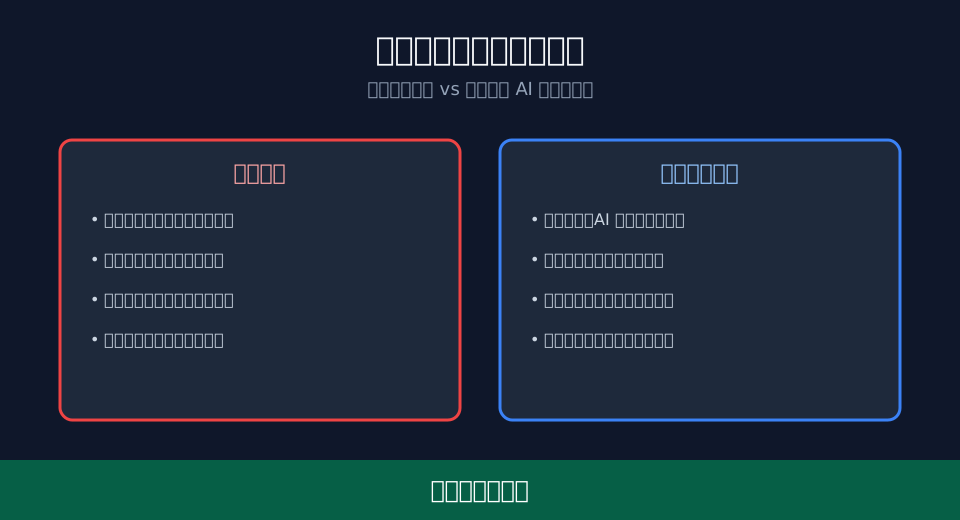
This article explores the practical implementation of AI-driven predictive maintenance in heavy-duty cranes. From multi-dimensional sensor data extraction and core component fault analysis to return on investment (ROI) calculations and engineering practices on European Standard customization platforms, we provide a comprehensive analysis of how this technology reshapes operation and maintenance for high-end lifting appliances.
Core Value of AI Predictive Maintenance in Heavy Double Girder Cranes
In metallurgical plants, ports, and heavy machinery workshops, European standard double-girder cranes with capacities ranging from 50t to 300t handle critical material flow tasks. These complex machines integrate multiple travel mechanisms, including hoisting, trolley, and crane bridge systems. Traditional time-based preventive maintenance often results in either over-maintenance or insufficient upkeep. The introduction of predictive maintenance fundamentally addresses these inefficiencies. By deploying sensors at key nodes, the system acquires vibration data at a sampling rate of 10kHz in real-time. Coupled with deep learning algorithms, it accurately identifies early-stage faults such as gearbox pitting and motor bearing wear.
「According to the technical framework outlined in ISO 24621:2022 "Crane AI Fault Diagnosis", condition monitoring-based predictive maintenance can reduce sudden mechanical failure rates in heavy cranes by over 28%, significantly extending the service life of core transmission components.」
Predictive maintenance is prioritized for AI implementation due to the directness of data acquisition and the distinctiveness of fault signatures. During heavy-load starts and stops, the vibration spectrum variations of motors and gearboxes exhibit high regularity, providing a high-quality sample library for model training. When developing high-end customized cranes, Kelude Heavy Industry incorporates edge gateways as standard configuration. This ensures preliminary data cleaning and feature extraction occur locally, drastically reducing latency associated with cloud transmission.
⚠️ Note
When installing Vibration Sensors at height, strictly implement lockout-tagout procedures. Sensor probes must be connected using High Temperature Resistant silicone wires, and junction boxes must achieve an IP67 Protection Rating to prevent signal distortion caused by workshop dust and condensation ingress.
Fault Feature Extraction for Crane Core Components via Multi-Dimensional Sensing
Achieving high-precision fault prediction requires more than single-dimension data. Modern European standard cranes typically fuse multi-dimensional sensing data, including vibration, temperature, current, and stress. Taking the Hoisting mechanism as an example, data points such as motor stator temperature, gearbox oil temperature, and wire rope tension form a multi-dimensional feature space alongside vibration signals. When microscopic spalling occurs on the Input Shaft bearings of a gearbox, abnormal peaks appear in high-frequency vibration signals first, followed by an oil temperature rise of approximately 5°C to 8°C. This multi-parameter coupling significantly lowers the false alarm rate of AI models.
In engineering practice, monitoring the braking system of the Crane Travel Mechanism is a focal point of predictive maintenance. Adhering to safety requirements in FEM 1.001 (formerly FEM 1.001 Crane Design Specification), AI algorithms are used to assess Brake Lining wear amounts in real-time. Consider this engineering case study: For a 300t crane with a Long Travel Speed of 60m/min (1m/s) and a set deceleration of 0.5m/s², the theoretical braking distance is calculated as s=v²/(2a)=1²/(2×0.5)=1m. The AI system monitors brake engagement time and motor current curves; if the actual braking distance approaches the warning threshold of 1.2m, it triggers an early warning for lining replacement. For complex dynamic safety distance calculations, refer to the technical analysis of anti-collision safety distance.
「Field tests indicate that when motor bearing temperature consistently exceeds 85°C and root mean square Vibration acceleration surpasses 4.5m/s², the probability of fatigue failure rises exponentially within 72 hours, providing reliable basis for setting thresholds in AI models.」
💡 Tip
When performing data fusion, ensure synchronization of sampling frequencies across sensors. It is recommended to set the temperature data sampling period to 100ms while maintaining vibration data at 10kHz. Align these using hardware timestamps to avoid phase differences that could lead to errors in feature extraction.
Calculating ROI for Predictive Maintenance Systems on Custom European Standard Cranes
For B2B enterprises, implementing an AI predictive maintenance system requires careful consideration of return on investment. While initial investments are needed for sensors, edge gateways, and software platforms, the hidden costs saved are substantial. In traditional maintenance modes, production line stoppages caused by unplanned downtime often far exceed repair costs themselves. Through AI forecasting, companies can shift spare parts procurement from "blind stocking" to "precise triggering," significantly reducing inventory capital tie-up. In compliance with the equipment integrity requirements of TSG 51-2023 Crane Safety Technical Supervision Regulation, integrating AI operations and maintenance can lower comprehensive maintenance costs by 25% and reduce overall downtime by 40%.
Regarding system architecture, Kelude Heavy Industry advocates a "Device-Edge-Cloud" collaborative model. The device layer handles high-frequency data acquisition, the edge layer runs lightweight inference models for millisecond-level early warnings, and the cloud layer manages model iteration and plant-wide equipment health management. This architecture enhances response speed while effectively controlling network bandwidth costs. Additionally, leveraging data feedback from AI anti-sway algorithms, the system further optimizes crane travel trajectories, reducing mechanical fatigue. The following table quantitatively compares the core economic indicators and operational efficiency between the two maintenance modes.
The table below illustrates the quantitative differences in core economic indicators and operational efficiency between traditional periodic inspection and AI predictive maintenance, providing intuitive reference for enterprise decision-making:
📊 Comparison of Core Indicators: Traditional Maintenance vs. Predictive Maintenance
| Evaluation Criteria | Conventionalperiodic maintenance | AI Predictive Maintenance |
|---|---|---|
| Single-liftmaintenance cost | Higher(With Blind Spotsparts replacementCost) | Reduce by approx. 25% |
| unplanned downtimeTime | Annual avg. approx. 120 Hours | Decrease 40% and above |
| spare parts inventoryTurnover Rate | Low(High Capital Tie-up) | Increase by approx. 3 Times |
| Systeminvestmentpayback period | No Additional Systeminvestment | Approx. 18 Months |
Industry data indicates that in heavy steel workshops with Continuous operation, deploying a predictive maintenance system can reduce the average annual comprehensive operation and maintenance expenditure for a single crane over 100t from approximately $66,600 to around $49,200, delivering significant economic benefits.
⚠️ Note
When calculating return on investment, do not overlook the annual subscription fees for the software platform and sensor calibration costs. It is recommended to explicitly include first-year free maintenance and data model iteration services in the Commercial Contract; specific amounts are subject to the actual contract.
Engineering Implementation of Kelude’s AI Operation & Maintenance Platform for High-End Cranes
As a manufacturer specializing in high-end customization of European Standard Double-Girder cranes ranging from 50t to 300t, Kelude Heavy Industry has accumulated extensive practical experience in the engineering implementation of AI operation and maintenance platforms. We provide differentiated Sensor configuration solutions tailored to cranes of varying capacities and operating conditions. For heavy load cranes exceeding 200t, monitoring critical stress points on the Main Girder and Weld Seam areas is paramount. By installing optical fiber light curtain strain sensors, the system captures minute deformations of the main girder in real-time with a 5ms cycle, effectively identifying the initiation of fatigue cracks through AI algorithms. For deeper technical insights into weld crack detection, please refer to the special topic on Main Girder Weld Crack Detection.
At the platform layer, Kelude’s independently developed Digital Twin system achieves a 1:1 virtual reconstruction of the physical crane’s operating status. Operators can view real-time data on a 3D interface and analyze operating condition changes before and after faults using the playback function. This visualized operation and maintenance approach significantly reduces reliance on the experience of on-site engineers. The following table illustrates the differences in standard configuration for AI operation and maintenance across various capacities of European Standard cranes.
The table below details the differentiated design schemes for hardware configuration and data acquisition strategies employed by Kelude Heavy Industry for typical capacity segments of 50t, 100t, and 300t:
📊 Comparison of AI O&M Configuration Solutions for European Standard Cranes by Capacity
| cranecapacity | CoreMonitoringComponent | data acquisitionCycle | Edge Computingcomputing power |
|---|---|---|---|
| 50t European Standard Double-Girder | Hoisting / LiftingGearbox / Reducer、Crane Bridgedrive system | 10 ms | 4 TOPS |
| 100t European Standard Double-Girder | Main GirderWeld Seam、Hoisting Motor | 5 ms | 8 TOPS |
| 300t European Standard Double-Girder | Fullmechanismvibration、structureResponse | 2 ms | 16 TOPS |
In a recent retrofit project for a 300t Gantry Crane at a major shipyard, Kelude’s AI-driven intelligent operation and maintenance platform successfully detected an inner ring defect in the trolley travel wheel Bearing 14 days before failure after just 2,000 hours of continuous operation, preventing a potential catastrophic rail derailment.
💡 Tip
For ultra-heavy cranes with a capacity of 300 tons, we recommend performing online fine-tuning of the deep learning algorithm quarterly. Under heavy load operating conditions, structural stiffness changes slightly; regularly updating model parameters ensures that fault prediction accuracy remains high.
FAQ
When implementing Predictive Maintenance, clients typically prioritize technical feasibility, investment cost, and data security. Below are answers to four frequently asked questions.
Q: What is the typical sampling rate for Vibration Sensors in an AI predictive maintenance system?
A: For high-speed rotating components such as the Hoisting mechanism and Gearbox, the sampling rate is typically set between 10kHz and 16kHz. This frequency range fully captures gear meshing characteristic frequencies and bearing defect signatures, ensuring the AI model extracts effective early-fault signals.
Q: What is the estimated budget for equipping a 100t European Standard Double-Girder crane with an AI operation and maintenance system?
A: The Quotation depends on the number of monitoring points and software modules. It typically includes hardware Sensors, an edge gateway, and first-year platform service fees. By reducing unplanned downtime costs and Spare parts expenses, the payback period is generally 12–18 months. Final pricing is subject to the actual contract.
Q: How does the system ensure enterprise information security when uploading operational data to the cloud for AI analysis?
A: The system uses an edge-cloud collaborative architecture where core control and real-time early warning occur locally at the edge gateway. Data uploaded to the cloud is desensitized and encrypted, and private deployment solutions are supported. Enterprises retain full data ownership, meeting strict industrial safety compliance requirements.
Q: Does Kelude’s AI operation and maintenance platform support intelligent upgrading for legacy cranes?
A: Yes. Our Sensors and edge gateways feature modular design, allowing external installation without major modifications to the existing Electrical Control System. The platform supports equipment capacities from 50t to 300t, helping legacy assets quickly gain Predictive Maintenance capabilities.
⚠️ Note
During retrofit projects, assess the Main Girder's structural stiffness beforehand. If severe Deflection exists, reinforce the structure first before installing high-precision strain sensors to prevent deformation from interfering with the AI model’s judgment.
In summary, AI-driven Predictive Maintenance leverages data fusion and deep learning algorithms to shift heavy crane management from reactive repairs to proactive prevention. Kelude Heavy Industry integrates cutting-edge AI technology with European Standard high-end customization principles, providing B2B clients with lifecycle intelligent operation and maintenance solutions to facilitate digitalization and refined asset management.
