
YOLO vs Faster R-CNN: Choosing a Defect Detection Model for Cranes
📋 Key Summary
When selecting a defect detection model for cranes, the choice inevitably comes down to YOLO versus Faster R-CNN. YOLO is a one-stage detector—fast and well-suited for real-time monitoring. Faster R-CNN is a two-stage detector—more accurate, ideal for small targets and re-inspection. This article breaks down the differences across four dimensions—real-time performance, accuracy, target size, and computing power budget—and provides a practical selection framework for crane applications.
📌 One-Sentence Comparison
YOLO: Computes bounding boxes and class labels in a single pass—fast, built for online deployment.
Faster R-CNN: Generates region proposals first, then classifies and refines each one—slower but more precise, suited for small targets and re-inspection.
Before rolling out defect detection, many teams get stuck at the very first step: which model to choose. YOLO and Faster R-CNN represent the two mainstream approaches—one prioritizes speed, the other accuracy. Choosing wrong can mean wasted budget at best, or missed defects leading to accidents at worst.
Neither model outright outperforms the other; each has its strengths. Below, we clarify the key differences and the logic behind the selection.
YOLO vs. Faster R-CNN: One-Stage vs. Two-Stage Detection
The most fundamental difference lies in the detection pipeline.
YOLO is a one-stage detector. It takes the entire image as input and directly regresses all object bounding boxes and class labels in a single pass. Because the pipeline is short, inference speed is high, making it ideal for real-time scenarios.
Faster R-CNN is a two-stage detector. It first uses a region proposal network to identify candidate boxes that may contain objects, then performs fine-grained classification and bounding-box refinement on each candidate. The extra refinement step delivers higher accuracy—especially for small targets—but at the cost of speed.
This "single-pass" versus "two-stage refinement" distinction dictates where each model excels. At Kelude, our rule of thumb is straightforward: use one-stage models for real-time monitoring and two-stage models for high-accuracy re-inspection. It's the simplest and most effective division of labor.
Four Selection Criteria: Speed, Accuracy, Target Size, Compute
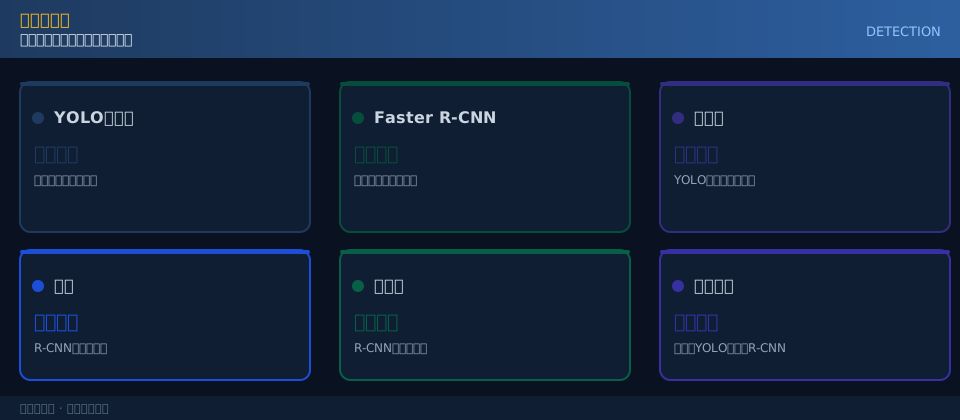
Model selection comes down to four criteria—let's walk through each.
Real-time requirements. If you need online, sub-second responses—such as real-time safety monitoring during hoisting operations—go with YOLO. Its one-stage pipeline sustains high frame rates.
Accuracy requirements. When precision is critical and missed detections carry heavy consequences—such as re-inspecting weld cracks or subtle defects—Faster R-CNN is the better choice. Its two-stage refinement is more reliable.
Target size. When defects are small and densely packed—like fine wire breaks or porosity—Faster R-CNN's two-stage architecture handles small targets more robustly, while YOLO is more prone to missing them.
Computing power budget. Edge devices have limited compute—on an edge box, for instance, a lightweight YOLO model is the practical pick. If you have cloud resources or a high-performance server, Faster R-CNN becomes viable. Stack these four criteria together, and the selection largely makes itself.
Crane Applications: Separate Real-Time Monitoring from Re-Inspection
For crane operations, the most pragmatic approach is to split the two use cases.
Real-time safety monitoring—such as detecting personnel intrusion along the hoisting path, load skew, or major wire rope anomalies—demands online, low-latency processing. Use YOLO as the first line of defense.
High-accuracy defect re-inspection—such as precisely identifying weld cracks, fine wire breaks, or surface defects—can be performed offline and at a slower pace. Use Faster R-CNN as the second-stage verification.
These aren't mutually exclusive choices; they work best in a tiered setup: YOLO for online screening, Faster R-CNN for offline precision checks—trading speed for coverage and accuracy for depth. At Kelude, our defect detection approach follows exactly this "online fast screening plus offline precision re-inspection" architecture.
Common Model Selection Mistakes
Mistake one: chasing the newest, largest model. The assumption that bigger and newer is always better often backfires—edge computing power can't keep up, and inference becomes too slow to be usable. Start with the scenario requirements, then evaluate models.
Mistake two: forcing YOLO into small-target precision work. YOLO tends to miss small, densely clustered defects. Using it for re-inspection carries a high risk of missed detections.
Mistake three: ignoring the computing power budget. You pick the model, but the deployment environment can't run it—leaving you to either swap the model or add hardware. At Kelude, we treat computing power as a hard constraint upfront: first determine what can run, then decide which model to run.
YOLO vs. Faster R-CNN: Side-by-Side Comparison
| Dimension | YOLO | Faster R-CNN | Differentiator | Applicability |
|---|---|---|---|---|
| Process | Single-Stage Direct Selection | Two-Stage Candidate & Refined Screening | DetectionProcess Variation | — |
| speed | Fast / Real-Time | Slow | Real-Time Performance Difference | Online SelectionYOLO |
| Accuracy | Medium | High | AccuracyProcess Variation | Refined ScreeningR-CNN |
| Small Target | Prone to Miss | More Stable | Small Target Capability Difference | Small Target SelectionR-CNN |
| computing power | Low — Suitable for Edge Deployment | High Requirementserver | computing powerRequirement Variance | Edge-Side SelectionYOLO |
Quick Reference of Standard Clauses for Detection Models
| Standard | Key Clause Points | andselectionRelationship with |
|---|---|---|
| ISO 24621 | crane AI fault diagnosisFramework | DetectionModelselection basis |
| GB/T 28264 Safety Monitoring and Management System | safety monitoringTraceabilityrequirements | DetectionResult Traceability |
| ISO 24445 | cranesmart sensortechnical specification | AcquisitionSensorAdaptation |
FAQ: How to Choose the Right Detection Model
Q: What is the fundamental difference between YOLO and Faster R-CNN?
A: The core difference lies in the detection pipeline. YOLO is a single-stage detector that predicts bounding boxes and class labels in one pass—fast, but it can miss small objects. Faster R-CNN is a two-stage detector: it first proposes candidate regions, then classifies and refines each one. It's slower but more accurate, especially for small or dense objects. In short, one prioritizes speed with a one-shot approach; the other prioritizes accuracy with a two-step refinement process.
Q: Which model should I choose if I have a limited budget?
A: It depends on your use case. For real-time safety monitoring that runs online with limited edge computing power, go with a lightweight YOLO model—it's cost-effective and practical to deploy. For high-accuracy re-inspection where defects are tiny and the cost of a miss is high, you'll need Faster R-CNN and more computing power. When budget is tight, prioritize YOLO for real-time monitoring; handle re-inspection offline with more powerful equipment. The key is to secure online detection first, then refine accuracy.
Q: How do I decide between YOLO and Faster R-CNN for my application?
A: Consider four factors. Need real-time, online detection? Choose YOLO. Need precise re-inspection? Choose Faster R-CNN. Defects are small and dense? Faster R-CNN handles them better. Defects are large and obvious? YOLO is sufficient. Limited edge computing power? YOLO is the practical pick. If you have a server available, Faster R-CNN becomes viable. The most pragmatic approach is a tiered strategy: use YOLO for fast online screening and Faster R-CNN for offline precision checks—leverage the strengths of each.
For practical deployment guidance on YOLO, refer to the hands-on approach in "Core Vision AI Technology: Suspended Load Identification with YOLOv8 and Jetson Edge Deployment".
Choosing a model isn't about picking the most powerful one—it's about picking the right fit. Kelude Heavy Industry applies a tiered strategy of "online fast screening plus offline precision re-inspection," with YOLO handling real-time monitoring and Faster R-CNN ensuring accuracy, so detection is both fast and reliable.
