

Edge vs. Cloud Inference for Crane AI: How to Split Tasks
📋 Key Summary
AI inference isn't a binary choice between edge and cloud. Real-time safety monitoring demands low latency and offline capability—that belongs on the edge. Model training and complex analytics need serious computing power—that belongs in the cloud. Cloud-edge collaboration simply means layering tasks across four dimensions: real-time requirements, computing power, data volume, and privacy. This article breaks down what each side should handle and how the division works in crane applications.
📌 Division of Responsibilities at a Glance
Edge: fast, local, and offline-capable—handles real-time monitoring and the first line of safety defense.
Cloud: massive computing power and storage—handles model training and complex offline analysis.
An overhead crane packed with sensors generates a continuous stream of data. Push everything to the cloud and you're fighting latency and blind spots when the network drops. Run everything on the edge and you simply don't have the computing power for sophisticated models.
That's the problem cloud-edge collaboration solves: break inference tasks down by their characteristics and let each side do what it does best. Here's how the division works in practice.
Edge vs. Cloud Inference: The Essential Difference
Edge inference and cloud inference each come with their own trade-offs.
Edge inference deploys models on the device side, close to the data source. Its strengths: low latency, fast response, and full functionality even offline—ideal for real-time tasks. Its limitation: constrained computing power that can't handle overly complex models.
Cloud inference, by contrast, sends data to cloud servers for processing. Its strengths: virtually unlimited computing power, support for large models, and ample storage. Its drawbacks: higher latency, network dependency, and data transmission costs plus privacy exposure.
This fundamental difference dictates the division of labor: the edge owns "speed and proximity," the cloud owns "power and depth." Kelude applies edge inference to real-time safety monitoring and reserves the cloud for model training and offline analysis—each side playing to its strengths.
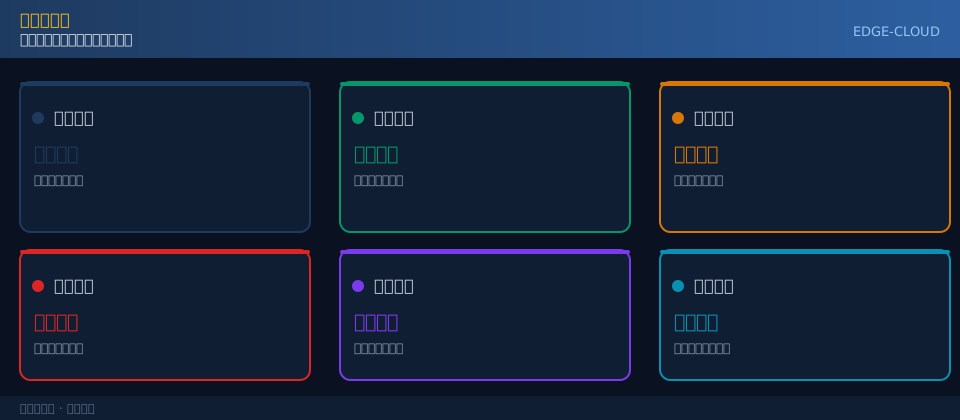
Four Dimensions That Decide: Real-Time, Compute, Data, Privacy
Whether a task belongs on the edge or in the cloud comes down to four factors.
Real-time requirements. Tasks demanding second-level or even millisecond-level response—such as personnel intrusion alerts during hoisting or anti-sway control feedback—belong on the edge. Cloud network latency simply can't keep up.
Computing power. Tasks that require large models or complex algorithms—fine-grained defect analysis, large-scale data modeling—belong in the cloud. The edge doesn't have enough compute.
Data volume. Storage and processing of massive raw datasets belong in the cloud, where storage is plentiful. But real-time streaming data must be filtered at the edge first, with only key data uploaded to the cloud.
Privacy. Data involving production processes that shouldn't leave the factory stays on the edge for local processing—only results are transmitted, never raw data. Stack these four dimensions together, and the edge-versus-cloud decision becomes clear.
Cloud-Edge Collaboration for Cranes: Fast Screening at the Edge, Deep Analysis in the Cloud
In crane applications, cloud-edge collaboration takes shape as a clear architecture.
On the edge side, lightweight models run real-time fast screening. Personnel intrusion detection, load skew alerts, and preliminary wire rope anomaly checks—these real-time tasks run continuously on the edge box with lightweight models, delivering low latency and offline availability.
On the cloud side, heavyweight models handle offline deep analysis. Model training, large-scale data modeling, and fine-grained defect re-inspection are compute-intensive jobs that go to cloud servers, where strong processing power handles them offline.
The two sides coordinate through a data channel: the edge uploads filtered key data to the cloud, and the cloud pushes trained lightweight models back down to the edge for deployment. ISO 24619, the IoT interface specification for cranes, sets requirements for this cloud-edge data channel. This closed loop—fast screening at the edge, deep analysis in the cloud, and models flowing both ways—is what cloud-edge collaboration looks like in practice. Kelude builds its intelligent monitoring system on this architecture, and GB/T 28264-2017, the Safety Monitoring and Management System standard for lifting appliances, requires traceability of collaborative data.
Common Cloud-Edge Pitfalls to Avoid
Mistake one: putting everything in the cloud. Route all data to the cloud and you're stuck with high network latency, total failure when connectivity drops, and no real-time monitoring capability. Real-time tasks must stay on the edge.
Mistake two: putting everything on the edge. Run all inference locally and the computing power falls short for complex models, dragging down accuracy. Complex tasks must go to the cloud.
Mistake three: treating edge and cloud as isolated silos. When the edge and cloud operate independently—models not shared, data not flowing back—collaboration becomes a hollow exercise. Kelude treats "model distribution and data feedback" as a hard requirement for collaboration, ensuring the edge and cloud are truly connected.
Edge Inference vs. Cloud Inference: A Side-by-Side Comparison
| Dimension | edge inference | cloud inference | Differentiator | Applicable Task |
|---|---|---|---|---|
| latency | Low-Millisecond Level | High Network Sensitivity | latencyDistinct | Real-Time Edge Selection |
| computing power | Limited for Lightweight Tasks | Powerful for Large Models | computing powerDistinct | Heavy Computation Cloud Selection |
| Offline Availability | Yes | Network Independence | Availability Variance | Offline Edge Selection |
| Data Privacy | data stays on-site | Data Upload Required | Privacy Variance | Sensitive Data Edge Selection |
Quick Reference of Standard Clauses for Cloud-Edge Collaboration
| Standard | Key Terms | Cloud-Edge Collaboration Relationship |
|---|---|---|
| ISO 24619 | craneIoT interface specification | Cloud-Edge Dataaccess system |
| GB/T 28264 Safety Monitoring and Management System | safety monitoringTrace Retentionrequirements | Collaborative Data Traceability |
| ISO 24445 | cranesmart sensortechnical specification | EdgeSensorAdaptation |
Cloud-Edge Collaboration: Frequently Asked Questions
Q: What standards govern cloud-edge collaboration implementation?
A: For IoT interfaces, refer to ISO 24619; for safety monitoring and traceability, GB/T 28264-2017 applies; and for edge sensor adaptation, ISO 24445 is the relevant specification. These standards define the technical requirements for cloud-edge data access systems, collaborative data traceability, and edge sensor selection. While no single mandatory standard covers cloud-edge collaboration as a whole, implementation relies on engineering specifications built around "edge-level fast screening, cloud-level deep computation, and bidirectional model synchronization."
Q: How do you decide whether a task belongs on the edge or in the cloud?
A: Evaluate four key factors. Tasks requiring real-time response or offline operation belong on the edge; tasks demanding high computing power or large-model inference belong in the cloud; large data volumes requiring massive storage belong in the cloud; and sensitive data that must stay within the factory belongs on the edge. When factors overlap: real-time and sensitive tasks take priority on the edge, while compute-heavy tasks requiring storage go to the cloud. The principle is simple—the edge handles speed and proximity, the cloud handles power and depth.
Q: Why not put everything on the cloud or everything on the edge?
A: Because each approach has critical limitations on its own. A cloud-only setup suffers from high latency for real-time tasks and becomes completely inoperable when the network drops—making real-time monitoring impossible. An edge-only setup is constrained by limited computing power, cannot run complex models, and accuracy suffers as a result. Cloud-edge collaboration is about leveraging the strengths of both: the edge compensates for the cloud's latency shortcomings, and the cloud compensates for the edge's computing limitations. Together, they deliver both speed and capability.
Cloud-edge collaboration builds on the same principles as edge computing. For a deeper look at edge deployment strategies, see "Why Crane AI Inference Must Run on the Edge: The Cloud's Computing Shortcomings".
Cloud-edge collaboration is not an either-or proposition—it's about playing to each side's strengths. Kelude follows an architecture built on "edge-level fast screening, cloud-level deep computation, and bidirectional model synchronization," ensuring low-latency real-time monitoring and sufficient computing power for complex analysis—fast and capable, all at once.
