

LLM Agents for Crane Maintenance: From Q&A to Hands-On Action
📋 Key Summary
Large language models (LLMs) are more than just chatbots — an Agent enables them to take action: calling tools, breaking down tasks, and executing steps. In crane maintenance, an Agent can autonomously perform inspections, pull data, and provide troubleshooting recommendations. However, the technology is still in its early stages, with reliability and safety boundaries as key constraints. This article clarifies the difference between an Agent and standard Q&A, its core capabilities, and the boundaries that must be respected for industrial deployment.
📌 One-Line Positioning
LLM Q&A: You ask, it answers — it talks but doesn't act.
LLM Agent: Calls tools, breaks down tasks, and executes actions — moving from "talking" to "doing."
When LLMs enter the maintenance domain, the first stop is Q&A — looking up standards, answering questions, and drafting reports. But Q&A has a ceiling: it can only talk, not act. When equipment malfunctions, it tells you "what might be wrong," but it won't pull data or trigger an inspection.
An Agent fills that "doing" gap. It gives the LLM the ability to call tools, decompose tasks, and execute steps — moving from "talking" to "acting." That's the next step for LLMs in maintenance operations.
Below, we break down the difference between an Agent and Q&A, and where its capability boundaries lie.
LLM Agent vs. Q&A: The Core Difference Between Talking and Doing
Standard LLM Q&A is a one-shot exchange: you say something, it replies. It understands the question and generates an answer, but the response stops at language — it doesn't query real-time data from systems or trigger any actions.
An LLM Agent, on the other hand, adds the ability to act on top of Q&A. It can call tools — retrieving sensor data, pulling maintenance records, or triggering inspection workflows. It can decompose tasks — breaking "inspect equipment" into multiple steps like "fetch data, compare thresholds, draw conclusions." And it can execute steps sequentially, adjusting based on results.
The essential difference is the leap from a "language model" to an "action agent." The Agent uses the LLM as its brain and tool calls as its hands and feet. At Kelude, we see Agents first landing in support actions like "query, review, and report" — not control actions like "command, adjust, or modify." ISO 24617, the standard for intelligent control systems for cranes, defines the boundaries of intelligent control.
What Makes an Agent Work: Tool Calling, Multi-Step Planning, and Environment Awareness
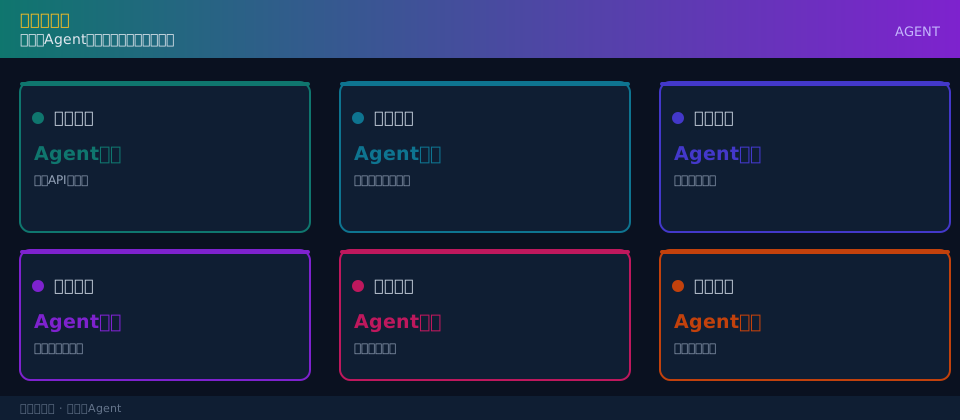
An Agent can take action thanks to three core capabilities.
Tool calling lets the Agent invoke external APIs and systems. Retrieving equipment data, pulling historical work orders, or accessing maintenance manuals — all done through tool calls, not by relying on the LLM's "memory."
Multi-step planning enables the Agent to break a complex task into sequential steps. For example, "troubleshoot abnormal temperature rise in the hoisting motor" becomes "check current temperature, review historical trends, pull load data, compare against thresholds, and draw a conclusion."
Environment awareness allows the Agent to read the current state and adjust its next steps based on execution results. Data from the first step influences what the second step does. With these three capabilities working together, the Agent moves from "answering questions" to "getting things done."
How Agents Are Deployed in Crane Maintenance: Query, Review, and Report First — Control, Adjust, and Modify Later
Deploying Agents in crane maintenance requires a clear line between what's allowed and what's off-limits.
What's allowed: support actions like "query, review, and report." Autonomous inspection — checking equipment status unit by unit against a schedule, comparing thresholds, and generating inspection reports. Troubleshooting — pulling relevant data and providing recommendations with supporting evidence. Report generation — aggregating operational data into weekly or monthly summaries. These don't touch equipment control, so risk stays manageable.
What's deferred: control actions like "command, adjust, or modify." Directly controlling hoisting, adjusting parameters, or changing configurations — these involve safety and are off-limits for Agents right now. They require human sign-off and execution via the PLC.
Kelude draws a clear boundary: pilot programs can explore decision support, but control actions are never opened up. Safety is a line that cannot be crossed. GB/T 28264-2017, the Safety Monitoring and Management System standard for lifting appliances, requires that all Agent actions be logged and traceable.
Common Mistakes When Deploying Agents
The first mistake: letting the Agent touch control directly. Wiring the Agent into the hoisting or traveling control chain means a hallucination or misjudgment becomes a safety incident. Agents are support tools for now — not control systems.
The second mistake: ignoring hallucination risk. An Agent can confidently fabricate equipment data or maintenance records that don't exist. Decision support must be grounded in facts with full data traceability.
The third mistake: expecting full automation overnight. Expecting an Agent to run fully automatic maintenance from day one is unrealistic. Kelude starts with "query, review, and report" support scenarios, validates reliability, and then expands gradually — no shortcuts.
LLM Q&A vs. Agent: A Side-by-Side Comparison
| Dimension | LLM Q&A | Large Language Model (LLM)Agent | Differentiator | maturity |
|---|---|---|---|---|
| Capabilities | Response Generation | Tool Invocation & Execution | Verbal vs. Actional Gap | Q&A Maturity |
| Tool Calling | None | Data & Ticket Lookup | capability boundaryDistinction | AgentEarly Stage |
| Task Decomposition | None | Multi-Step Planning & Execution | Planning Capability Variance | AgentEarly Stage |
| implementation scenarios | QueryStandardReport Generation | InspectionTroubleshooting Reports | Scenario Coverage Variance | AgentEarly Stage |
Quick Reference of Standard Clauses for Large Model Agents
| Standard | Clause Key Points | andAgentRelationship with |
|---|---|---|
| ISO 24617 | intelligent control system for cranes | intelligent controlBoundary |
| GB/T 28264 Safety Monitoring and Management System | safety monitoringAudit Trailrequirements | AgentAction Logging |
| TSG (Special Equipment Safety Technical Regulation) 51 Safety Technical Specification for Special Equipment-2023 Crane Safety Technical Supervision Regulation | safety interlockSupervisionrequirements | AgentNon-Interferencesafety decision |
FAQ: Large Model Agents in Crane Operations
Q: What is the fundamental difference between a large model Agent and a standard large model Q&A system?
A: The core difference lies in "talking" versus "doing." A Q&A system responds to your queries with language only—it doesn't pull data or trigger actions. An Agent builds on that foundation by adding tool invocation, task decomposition, and step-by-step execution. It can query sensor data, check work orders, and initiate inspection workflows. The leap from a language model to an action-taking entity is what sets an Agent apart from a simple Q&A system.
Q: What standards can guide Agent deployment?
A: For intelligent control boundaries, refer to ISO 24617. For safety monitoring and traceability, GB/T 28264 Safety Monitoring and Management System applies. For safety interlock oversight, TSG 51-2023 Crane Safety Technical Supervision Regulation is the governing document. These standards define what an Agent can and cannot touch: assisted decision-making and action logging are permitted, but control actions and safety decisions must remain with human operators and be executed by the PLC. This is the non-negotiable safety boundary for Agent deployment.
Q: Is it worth investing in Agents now?
A: It depends on how you approach it. Starting with assistive use cases—"query, view, report"—is worthwhile. Autonomous inspection, troubleshooting recommendations, and report generation carry minimal risk since they don't touch control systems. These deliver quick wins with manageable investment. But don't expect full automation overnight. Control actions and safety decisions are not ready to be handed to an Agent. A pragmatic approach is to pilot in assistive roles, validate reliability, then expand gradually.
Q: Why can an Agent actually get things done?
A: Because it has three core capabilities. Tool invocation: it can call external APIs to retrieve data and check work orders. Multi-step planning: it can break complex tasks into sequential steps and execute them in order. Environmental awareness: it can read execution results and adjust its next move. The large model serves as the brain, tool invocation provides the hands, and together they transform the Agent from "answering questions" to "getting things done."
Agents represent the next step in large model–based operations and maintenance. For a deeper look at capability boundaries, see "Large Models in Crane Maintenance: Practical Scenarios and Capability Boundaries".
Moving from answering to acting is where large models are headed in operations. Kelude Heavy Industry is taking a measured approach—letting Agents handle "query, view, report" tasks first while holding the line on "no control, no safety decisions." It's the steady path forward.
