

Custom Cranes for Extreme Environments: Material Selection and Protection Solutions for High-Temperature, High-Dust Outdoor and Underwater Applications
📌 Key Considerations for Material Selection in Custom Cranes for Extreme Environments: High temperatures (Q390D/Q420D, Class H insulation 180), dust (IP65 fully enclosed + removable filter), Outdoor Marine Environments (C3–C5-M-grade corrosion protection / hot-dip galvanizing 280 μm), and Underwater Environments (304 stainless steel drum + 316 steel wire rope + IP68 motor).Krude Heavy Industries has accumulated extensive experience in selecting non-standard materials and designing protective solutions for extreme operating conditions in metallurgical casting, mining and cement production, ports, and wastewater treatment.
The operating environments of custom-built cranes often fall outside the scope of standard crane design specifications: high-temperature thermal radiation (60–200) in metallurgical workshops; dusty environments in mines and cement plants; high-salt-fog corrosion at ports and at sea; and even underwater operations at wastewater treatment plants and offshore platforms. Each of these extreme environments places special demands on the crane’s steel, motors, cables, lubrication, and seals; incorrect material selection can cause the equipment to fail within a matter of weeks. Krude Heavy Industry has developed material selection guidelines and protection solutions for non-standard cranes categorized by environment. This article focuses on four typical extreme environments: high temperatures, high dust levels, outdoor corrosion protection, and underwater operations.
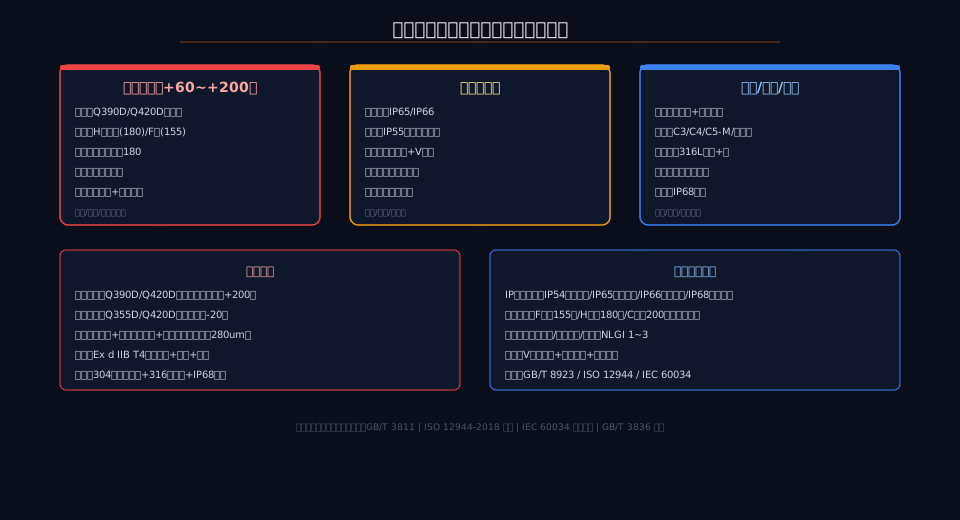
Summary of Material Selection and Protection Solutions for Extreme Environments
| Environment | Structural Materials | Motor/Insulation | Protection Rating | Lubrication |
|---|---|---|---|---|
| High Temperature: +60 to +200 | Q390D/Q420D | Grade H (180)/Grade C (200+) | IP54+ Thermal Insulation + Air-Cooled | Synthetic High-Temperature Grease |
| High dust levels: 50–200 mg/m³ | Q355B+ Dust-Proof Cover Plate | IP55 Fully Enclosed | IP65/IP66 | NLGI 2+ Centralized Lubrication |
| Outdoor/Marine C3–C5-M | Q355B + Hot-Dip Galvanized | F-Grade and H-Grade options available | IP65+ Condensation-Proof | Anti-rust Grease + Marine Grease |
| Underwater/Diving | 304/316 Stainless Steel | IP68 Submersible Motor | IP68 | Waterproof Grease |
| Explosion-proof Ex d IIB T4 | Q235B+ Spark-Free Treatment | Ex Explosion-Proof Motor | Ex d flameproof type | Anti-static grease |
High Temperatures Q390D/Q420D + H-class insulation + synthetic high-temperature grease. Control cabinet thermal insulation + forced air cooling. A water-cooling system is required when the temperature exceeds 200. |
Dust IP65/IP66+ removable filter screen+ labyrinth seal+ centralized lubrication. Dust protection via track wiper and positive pressure control cabinet. |
Corrosion Protection Hot-dip galvanized 80 µm + three coats of paint with a total thickness of 280 µm. 304 stainless steel bolts + 316L shaft. C3–C5-M classification according to ISO 12944. |
Underwater 304 stainless steel drum + 316 steel wire rope + IP68 motor + waterproof grease. Dual-seal redundancy; annual submersion inspection. |
Explosion-proof Ex d IIB T4 explosion-proof certification + copper alloy non-sparking tools + antistatic grounding. Motor cable connectors must be explosion-proof sealed. |
Inspection The product must pass the following environmental simulation tests prior to shipment: 8 hours of high-temperature operation, dust seal test, and 96 hours of salt spray test. A test report must be provided. |
Material Selection for Cranes in High-Temperature Environments
Cranes in metallurgical and hot-working workshops are continuously exposed to thermal radiation ranging from 60 to 200. The strength of standard Q235B steel decreases significantly when temperatures exceed 300. According to GB/T 3811, structural temperature stress verification is required when the ambient temperature exceeds 100.Structural MaterialsQ390D or Q420D low-alloy steel is selected, with a yield strength that remains essentially constant at or below 200. E5015-NP low-hydrogen welding rods are used, and the impact toughness of the weld must be ≥47 J (20). The motor should be equipped with Class H insulation (maximum allowable operating temperature of 180) or Class C insulation (for temperatures above 200, requiring independent water cooling).
Lubrication and cable selection are equally critical in high-temperature environments: Standard lithium-based grease suffers severe loss at temperatures above 100, so it must be replaced with synthetic high-temperature grease (operating temperature range: -40 to 200). For cables, select silicone rubber insulation (temperature resistance: 180) or fluoroplastic insulation (temperature resistance: 250). Electrical control cabinets should be equipped with thermal insulation and forced air cooling, and positioned away from heat sources. In a steel mill foundry crane project, Krude Heavy Industry implemented a solution using double-layer insulation panels combined with water-cooled air-conditioned control cabinets, maintaining the internal cabinet temperature below 40.For more information on custom designs for extreme operating conditions, please refer to the Comprehensive Guide to Custom Design Technology.。
Protective Design for High-Dust Environments
Dust concentrations in mines, cement plants, and coal chemical processing facilities can reach 50–200 mg/m³, far exceeding the tolerance of standard cranes with an IP54 protection rating. Dust that enters motor bearings and gearboxes accelerates wear and tear, while dust entering electrical control cabinets can cause poor contacts and short circuits.Protection RatingRated to IP65 (fully enclosed, dust-tight) or IP66 (protected against powerful water jets); the motor is a fully enclosed, self-ventilated type rated to IP55. All cable entry points are sealed with waterproof cable glands, and the control cabinet is equipped with a positive-pressure dust-proof system.
The tracks and travel mechanisms in high-dust environments require special treatment: polyurethane scrapers are installed on the track surfaces to remove accumulated dust, and V-ring seals and labyrinth seals are added to the wheel bearing housings. The lubrication interval is reduced to half the standard interval. The air filters feature a removable, washable, multi-layer fine-mesh structure. Krud Heavy Industries also equips cranes operating in high-dust environments with centralized lubrication systems, reducing the frequency of manual oiling and minimizing maintenance personnel’s exposure time in dusty environments.
Outdoor and Marine Corrosion Protection Solutions
Cranes at ports and coastal plants are constantly exposed to environments with high salt fog and high humidity, resulting in corrosion rates 5 to 10 times higher than those in inland environments. According to the ISO 12944-2018 standard, corrosion protection levels are classified as C3 (moderate), C4 (high), and C5-M (very high, marine grade).Hot-dip galvanizingThis is the most cost-effective anti-corrosion solution—with a galvanized coating thickness of no less than 80 µm (corresponding to a service life of more than 25 years in coastal environments). The topcoat system consists of a three-layer system: an epoxy zinc-rich primer (60 µm) + a micaceous iron oxide intermediate coat (80 µm) + a polyurethane topcoat (60 µm), with a total dry film thickness of no less than 280 µm.
The key focus of electrical protection for outdoor cranes is waterproofing and condensation prevention. Control cabinets are rated IP65 and equipped with anti-condensation heaters (which activate automatically when the humidity inside the cabinet exceeds 85%). Bolted connections use 304 stainless steel, while shaft components use 316L stainless steel or are chrome-plated. Wheels and rails are made of weather-resistant steel or undergo surface hardening treatment. All port crane projects by Krud Heavy Industry are designed to meet C5-M corrosion protection standards, with bolt torque and galvanized coating thickness serving as mandatory factory inspection items.
Frequently Asked Questions (FAQ)
Q: Is it mandatory to use Q390D/Q420D steel for cranes operating in high-temperature environments?
Answer: Use is recommended when the ambient temperature exceeds 100. For Q235B, the yield strength drops to 200 MPa (approximately 401 TP3T) at temperatures above 150; in this case, if designed according to the standard safety factor, the cross-sectional area would need to be increased by more than 251 TP3T, so using Q390D would actually be more economical. If the crane is not operating continuously in high-temperature conditions (cumulative daily exposure to high temperatures is less than 2 hours), a solution using Q355B steel with heat-insulating plates is also acceptable.
Q: Is there a significant difference in maintenance intervals between IP65 and IP66 ratings in dusty environments?
A: There is a significant difference. For IP65, the filter screen should be cleaned every 3 months and the grease in the bearings replaced every 6 months when the dust concentration is below 100 mg/m³. For IP66, under the same conditions, the filter screen can be cleaned every 6 months. We recommend selecting IP66 directly for high-dust environments. Although the initial investment is 15%–20% higher, maintenance costs are reduced by 40% or more. Krude Heavy Industry’s high-dust cranes come standard with IP66.
Q: How often does the anti-corrosion coating on marine cranes need to be maintained?
Answer: According to the ISO 12944-2018 standard: the corrosion protection service life is 10–15 years in a C3 environment, 5–10 years in a C4 environment, and 3–5 years in a C5-M environment. For marine-grade corrosion protection (C5-M), it is recommended to inspect the coating every 3 years and touch up any localized damage promptly. The service life of hot-dip galvanized components can reach over 25 years (in atmospheric environments) or 15 years (in marine atmospheres). Krude Heavy Industry’s port cranes utilize a hot-dip galvanizing plus three-coat paint system, requiring no coating maintenance for the first 5 years.
Q: By how much do the design cycle and costs increase for non-standard cranes used in extreme environments?
Answer: The design cycle increases by 30%–50% (requiring environmental assessment, material selection, and protection scheme design), and manufacturing costs increase by 20%–50% (depending on the severity of the environment). High-temperature environments add 20%–30%; dusty environments add 15%–25%; marine corrosion protection adds 25%–40%; and underwater environments add 50%–80%. Lead times are 2–4 weeks longer than for standard and non-standard products. For projects in extreme environments, we recommend confirming environmental parameters (temperature, humidity, dust concentration, and salt spray rating) in advance.
