
Overhead Crane Hoist Load Spectrum Monitoring & Fatigue Life

The overhead crane hoisting mechanism load spectrum online acquisition system records the load-time history of every lift using strain sensors and a lifting capacity encoder, then evaluates the remaining fatigue life of the main girder and drum based on the Palmgren-Miner Linear Cumulative Damage Rule (D = Σ n_i/N_i ≤ 1.0 for Design Life Verification) and S-N curves.

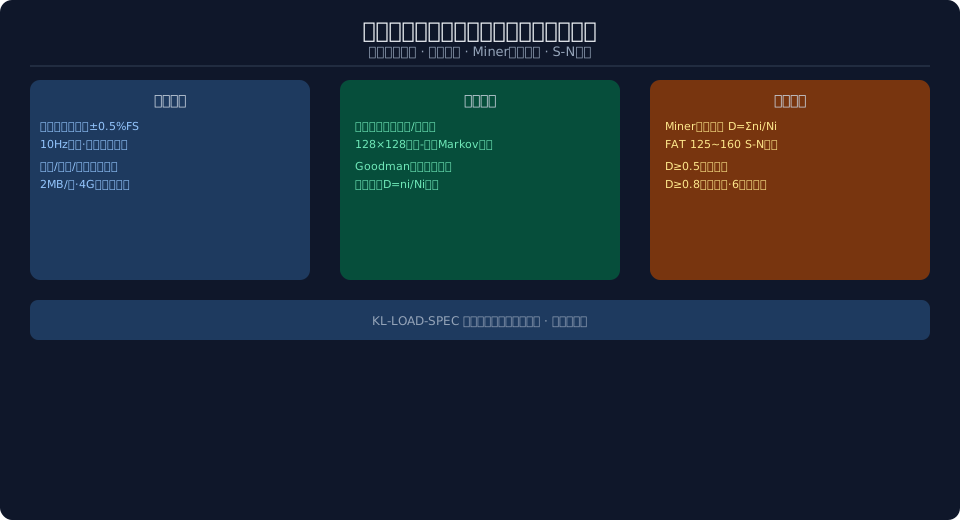
The load spectrum of the hoisting mechanism is the core input data for assessing the fatigue life of an overhead crane's steel structure. Current maintenance strategies typically set fixed inspection intervals based on Work Duty Classification (e.g., A5/A6/A7), yet actual load distributions vary significantly in service—cranes of the same classification can experience fatigue damage differing by a factor of 3 to 5 depending on operating conditions. The KL-LOAD-SPEC system installs a pin-type force sensor (accuracy ±0.5%FS) at the fixed end of the hoisting wire rope, paired with a PLC lifting capacity encoder signal, to continuously record load-time history data for every lift at a 10 Hz sampling rate. The system automatically performs rainflow counting and builds a Markov matrix, then applies the Palmgren-Miner rule to assess fatigue life consumption of the main girder, end carriage, and drum.


Схема системы сбора спектра нагрузок крана


Load Data Acquisition and Rainflow Counting

The pin-type force sensor replaces the original pin at the fixed end of the hoisting pulley block. Manufactured from 40CrNiMoA alloy steel with a safety factor ≥5.0 (per ISO 4301), the sensor features a dual-bridge strain gauge full-bridge configuration (sensitivity 2.0 mV/V, bridge excitation 10 V). The dual-bridge outputs are cross-validated to ensure data reliability. The signal is digitized via a 24-bit Σ-Δ ADC and transmitted wirelessly (LoRa, 470 MHz band) to an edge gateway.

At Kelude, load data for each lift is automatically segmented by "lift cycle": a hoisting cycle begins when the load rises from zero to >5% of rated load and persists for >3 seconds; the cycle ends when the load returns to zero for >5 seconds. Each cycle records peak load, valley load (including potential impact negatives during unloading), duration, and operating speed level. The sensor stores approximately 2 MB of data locally every 24 hours and uploads it to the cloud platform via 4G. Rainflow counting uses the three-point method to extract full and half cycles, and a 128×128 amplitude-mean Markov matrix is updated daily for each crane.

Force Sensor Accuracy
±0.5%FS
Sampling Rate
10Hz
Storage Volume
2MB/day
Rainflow Matrix
128×128
Damage Assessment
Miner+S-N
Fatigue Class
FAT125~160

S-N Curves and Fatigue Damage Calculation

The core of fatigue life assessment is converting the load-time history into fatigue damage. The system applies the Palmgren-Miner Linear Cumulative Damage Rule: D=Σnᵢ/Nᵢ, where nᵢ is the actual number of cycles at stress amplitude σᵢ for level i, and Nᵢ is the allowable number of cycles at that stress amplitude (read from the S-N curve). The S-N curves for Q235B (≈S235JR) and Q355B (≈S355JR) steels commonly used in crane steel structures follow ISO 4301, with fatigue class FAT 125~160 (corresponding to stress amplitudes of 125~160 MPa at 2×10⁶ cycles). The S-N curve descends with slope m=3 for N<10⁷ cycles, then flattens for N≥10⁷ cycles (fatigue limit approximately 0.55×FAT). For welded joints, the FAT class is reduced by one level per IIW recommendations (e.g., FAT125 to FAT100).

Cumulative damage for each crane is updated monthly and displayed on a dashboard showing remaining fatigue life percentages for three critical locations: the main girder mid-span, end carriage connections, and the drum. A yellow warning is triggered when cumulative damage D≥0.5 (corresponding to 50% life consumption); an orange warning at D≥0.8, recommending a full flaw detection inspection and structural assessment within 6 months. The system also records the frequency and magnitude of every overload event (>110% of rated load)—a single overload above 60% is equivalent in damage to 10,000 normal full-load cycles and is a major contributor to fatigue life consumption. In one case, a 32t crane at a steel mill showed actual fatigue damage consumption of 82% of design life after 18 months of system operation (compared to an expected ~30% based on A7 classification), due to frequent overloads (averaging 12 per day). The process route was subsequently adjusted to reduce the crane load.


Application Scenarios and Work Duty Reclassification

The KL-LOAD-SPEC load spectrum system is designed for fatigue life assessment of hoisting mechanisms across all types of overhead cranes, covering Work Duty classifications from A5 through A8. While cranes are initially classified based on predetermined utilization class and load spectrum, actual operating conditions often deviate significantly from design assumptions. Variations in operator habits across different workshops and shifts can cause the actual load spectrum factor Kp to drift one or even two classes from the design value. For instance, a A5-class foundry crane at a steel mill was found to have an actual Kp of 0.5 (equivalent to A7 class) after commissioning, meaning the inspection intervals established per A5 standards lagged considerably behind the actual damage rate. The system calculates the actual Kp value monthly (Kp=Σ(Pᵢ/Pₘₐₓ)³×tᵢ/T), compares it against the design Kp, and automatically triggers a reclassification recommendation when the actual Kp exceeds the upper limit of the current duty class.

Beyond duty class reassessment, the system supports synchronized monitoring across multiple lifting points. For twin-trolley or dual-hoist winch configurations, each system independently captures load data while sharing a unified evaluation model. Fatigue life at the main girder mid-span is calculated based on the combined stress history of both load paths, while end carriage connections are verified under the most adverse eccentric loading condition. After upgrading to KL-LOAD-SPEC, a 40t portal crane at a port facility revealed that drum fatigue consumption was 2.3 times faster than that of the main girder (main girder D=0.28, drum D=0.64), attributed to higher stress concentration on the drum. This finding enabled targeted monthly flaw detection on the drum rather than a full overhaul of the entire hoisting mechanism, saving approximately 40% in maintenance costs. Kelude's load spectrum system is now deployed on over 80 overhead cranes, with cumulative monitoring data exceeding 2 million lifting cycles.


Work Duty Classification and Assessment Standards

Work Duty / ClassificationDesignload spectrum factor KpTypical Total Duty Cycle CountInspection Interval(Main Girder)System Re-evaluation Threshold
A5Kp≤0.1252.5×10⁵12MonthsActual Kp>0.125
A60.125< Kp≤0.255.0×10⁵6MonthsActual Kp>0.25
A70.25< Kp≤0.51.0×10⁶3MonthsActual Kp>0.5
A80.5< Kp≤1.02.0×10⁶1MonthsActual Kp>1.0(Beyond Design)

Sensor Installation, Calibration & Maintenance

The pin-type force sensor is installed by directly replacing the original pin at the fixed end of the hoisting pulley block—no structural retrofit is required. Key installation requirements include: a pin-to-lug-hole clearance of ≤0.05mm (H7/g6 tolerance), routing the sensor cable through the pin's center bore (8mm diameter) to the junction box, and mounting the wireless transmitter module inside the protective cover at the pin end (IP67-rated). After installation, both zero calibration (recording output under no-load conditions) and full-scale calibration (loading to 100% rated load using standard test weights or a hydraulic jack, then recording the full-scale output) must be performed. The sensor features built-in temperature compensation (drift ≤0.02% FS/°C across −20~+85°C), ensuring stable accuracy in routine overhead crane operating environments.

For calibration and maintenance, the system automatically performs a zero-drift check every 24 hours: a zero-calibration prompt is triggered when the no-load output deviates from the initial zero point by more than ±2% FS. A third-party full-scale verification is recommended every 6 months. The LoRa wireless module (470MHz band, transmit power ≤17dBm) offers a communication range of ≥500m in open areas, and approximately 100–200m in factory steel-structure environments. For overhead cranes with a span of ≥30m, an optional repeater or 4G direct transmission mode is available. Kelude provides Remote Operation & Maintenance services, generating daily load trend charts automatically and monthly fatigue life consumption reports from our maintenance team, giving users precise insight into the structural safety of their overhead crane.


Maintenance Mode Comparison

Comparison ParameterPer Work Duty / Classification Fixing Inspection IntervalLoad spectrum Online Assessment
Maintenance BasisDesign Work Duty / Classification(e.g.A7)Actual Load spectrum Data
Inspection & Repair ImprovementFixing Inspection IntervalDynamic Based on Actual Damage Rate Air Compressor
Overload DetectionNoneAutomatic Recording & Alert for Each Overload Event
fatigue life ConsumptionUnknown(Black Box)Monthly Updated Consumption Percentage
Data SupportNo DataRainflow Matrix+Markov Matrixtraceable
Design CorrectionUnableActual Kp Feedback to Design Iteration

Frequently Asked Questions

Q: How is load spectrum data used to determine the actual work duty?

A: Per ISO 4301/1, the work duty is determined by the load spectrum factor Kp and the total number of duty cycles. The KL-LOAD-SPEC system calculates the actual Kp value monthly and compares it against the design Kp — if the actual Kp exceeds the design level by one class (e.g., from A5 to A6), the system recommends reassessing the maintenance schedule.

Q: Does installing sensors at the wire rope fixing point compromise safety?

A: No. The pin-type force sensor replaces the original fixing pin, with dimensions and material strength manufactured to a safety factor of ≥5.0 per ISO 4301 Crane Design Standard. The sensor features a redundant design: dual internal bridge circuits cross-validate each other, so a failure in either bridge does not result in loss of measurement capability.

Q: Will the 2MB daily upload consume excessive 4G data?

A: The 2MB daily upload per overhead crane costs approximately $0.01 in data charges (at $0.005/MB). The system supports edge-gateway compression before upload (5:1 compression ratio), reducing the payload to 0.4MB/day. Uploading only rainflow-count results and overload events (about 50KB/day) can further reduce data usage.

Q: Can the Kelude solution integrate with existing PLC systems?

A: Yes. Sensor signals interface with the existing PLC via 4–20mA or Modbus RTU without altering the original control logic. For legacy PLCs with no spare DI/AI channels, a standalone data acquisition gateway (Modbus TCP/MQTT output) can be added as an option.

Related News

contact

contact us

phone:
+86 13903802779

mail:3915269@qq.com

Working hours: Monday to Friday

Wechat
Wechat
SHARE
TOP