

Magnetic Crane Safety Standards & Compliance Guide
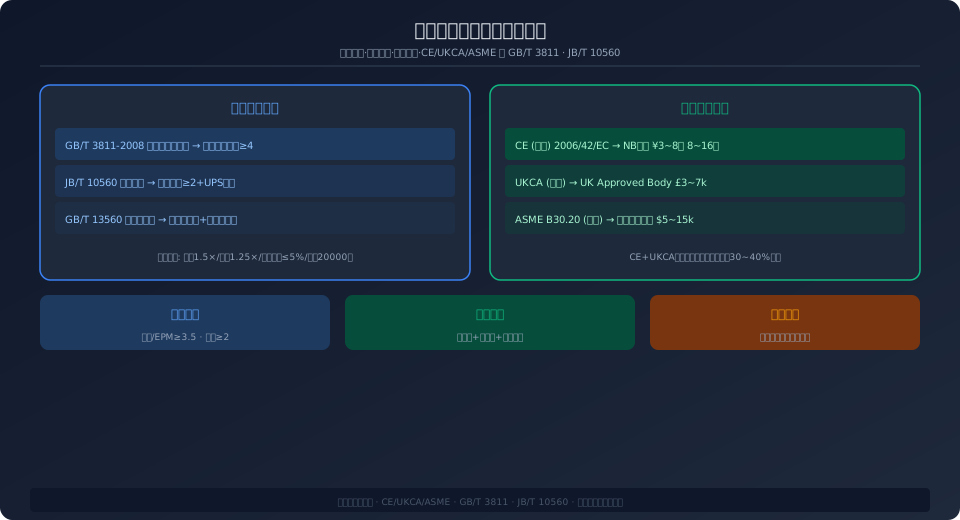
A magnetic crane lifter may look simple—pick up, lift, release—but the safety standards behind it span four distinct layers: design safety factors, type testing, material certification, and factory acceptance testing. The applicable standards and compliance paths differ significantly depending on the magnet source type: permanent magnet, electromagnetic, or electro-permanent (EPM). GB/T 3811-2008 Crane Design Standard—Core Provisions sets a general safety factor of ≥4 for lifting spreaders, while JB/T 10560 Lifting Magnets for Cranes specifies a lower factor of ≥2 for electromagnetic lifters (justified by UPS redundancy that compensates for the reduced margin). Permanent magnet lifters and EPM units typically operate with a safety factor of ≥3.5. This article systematically maps the compliance framework for all three types of magnetic lifters, giving manufacturers and end users a solid reference for procurement and acceptance decisions.
For export-oriented manufacturers, CE certification (EU) and UKCA (UK) are mandatory market-entry requirements for magnetic lifters in Europe. CE certification is governed by the EU Machinery Directive 2006/42/EC and the EMC Directive 2014/30/EU. Core requirements include: technical documentation (design calculations + risk assessment + FMEA analysis), type testing (witnessed by an EU notified body), and an EC Declaration of Conformity. Taking a 1000 kg permanent magnet lifter as an example, CE certification costs approximately ¥30,000–80,000 (about $4,400–11,800) with a lead time of 8–16 weeks. For the North American market, ASME B30.20 Below-the-Hook Lifting Devices certification places greater emphasis on load testing (static load at 1.5× rated load + dynamic load at 1.25× rated load) and operation manual review.
GB/T 3811-2008, as the top-level design standard for lifting appliances, sets a general safety factor of ≥4 for spreaders (based on wire rope breaking force). However, a magnetic lifter is a "non-contact lifting device"—it holds the workpiece through magnetic force rather than mechanical constraint—so its failure mode is fundamentally different from that of wire ropes or spreader beams. Magnetic decay is gradual rather than sudden fracture, which is why JB/T 10560 establishes an independent safety factor of ≥2 for lifting magnets, provided a power-loss magnetism retention system is fitted. GB/T 13560-2017 (Sintered NdFeB Permanent Magnet Materials) governs the magnetic performance grades and temperature stability requirements for permanent magnets.
This article is part of the magnetic lifter series. For a full three-way comparison and selection guidance, see the pillar page Magnetic Lifter Selection Guide: All Types Compared.
Type Testing: Far More Than "Test One Unit and Call It Done"
Type testing is the critical step in obtaining certification for a magnetic lifter. Each standard defines specific test items and acceptance criteria:
Static Load Test: Hold the workpiece at 1.5× rated load and maintain for 10 minutes—no visible slippage or release is permitted. After unloading, inspect the magnet pole faces for residual deformation (allowable: <0.05 mm). The purpose is to verify that the magnetic circuit structure does not undergo plastic deformation or magnetic performance degradation under extreme load.
Dynamic Load Test: Complete at least 3 full hoisting–traversing–lowering cycles at 1.25× rated load. After the test, verify that the magnetic circuit switching mechanism (permanent magnet handle / electromagnetic coil / EPM controller) operates correctly and that holding force decay remains within 5%.
Magnetic Flux Decay Test (for permanent magnet and EPM types): Hold the lifter at its maximum rated operating temperature (e.g., 150°C) for 2 hours, then cool to room temperature. Measure the pole-face magnetic flux density and compare with the initial value—decay ≤5% passes; 5–10% requires derating; >10% indicates irreversible demagnetization (product failure).
Fatigue Test (for large lifters >5 t): Complete at least 20,000 pick-up–lift–release cycles at 1.0× rated load. After testing, holding force decay must be ≤10%. This test simulates the cumulative effect of repeated magnetizing/demagnetizing cycles over the lifter's full life cycle (typically 10–15 years).
Power-Loss Magnetic Holding Test (for lifting magnets): Disconnect the mains supply at rated load and record the UPS holding time. The system must maintain magnetic holding for ≥20 minutes (covering generator startup plus safe handling time), with a switchover time of <10 ms (seamless UPS takeover).
Factory Acceptance Test: Three Checks on Every Unit
Unlike type testing (performed once), the factory acceptance test is mandatory for every magnetic lifter before it leaves the production facility:
① Holding Force Calibration: Using a standard test steel plate (Q235B, ≈S235JR, thickness ≥20 mm, surface prepared to Sa 2.5 grit-blasted finish, Ra≤3.2 μm), measure the actual holding force at the rated air gap (workpiece in full contact with the pole face). The measured value must be ≥ rated lifting capacity × safety factor. For example, a permanent magnet lifter rated at 1000 kg with a safety factor of 3.5 must achieve a measured holding force of ≥3500 kg. Use a force sensor or hydraulic loading device with an accuracy of ±2%.
② Pole-Face Flatness Inspection: Check pole-face flatness using a straightedge and feeler gauge; the requirement is ≤0.05 mm/100 mm. Any protrusion or depression on the pole face increases the effective air gap and reduces holding force—an air gap increase of just 0.1 mm can cause a 40–60% loss in holding force.
③ Safety Device Functional Checks:
• Permanent magnet lifter: handle operating force ≤150 N, safety lock pin inserts and releases smoothly, magnetic circuit status indicator (red/green) clearly visible.
• Lifting magnet: coil insulation resistance ≥1 MΩ (measured with a 500 VDC megohmmeter/insulation tester), temperature rise test (coil temperature ≤ insulation class limit after 2 hours at full load), UPS switchover time ≤10 ms.
• Electro-permanent EPM: pulse magnetization function (10 consecutive pick-up/release cycles, each achieving rated holding force), capacitance check (deviation ≤10% of nominal value), communication interface test (Modbus/Profinet read/write verified).
Export Certification: Key Differences Between CE, UKCA, and ASME
CE Certification (EU): Governed by the Machinery Directive 2006/42/EC, applicable to the EU 27 member states plus the EEA. Two certification routes are available: self-declaration (for small lifters <1 t) or notified body type examination (for >1 t or personnel-lifting applications). Core documentation: Technical File (TCF) + risk assessment per ISO 12100 + operation manual (translated into the official language of the destination country). Lead time: 8–16 weeks. Cost: ¥30,000–80,000 (about $4,400–11,800) via a notified body.
UKCA (UK, replacing CE post-Brexit): From 2025, magnetic lifters entering the UK market must bear the UKCA mark. Technical documentation requirements are essentially identical to CE, but assessment must be carried out by a UK Approved Body. Lead time and cost are comparable to CE.
ASME B30.20 (US): Published by the American Society of Mechanical Engineers, this standard applies to below-the-hook lifting devices entering the US/Canadian market. Key difference: no EU-style notified body assessment is required. Instead, the manufacturer's self-declaration is supported by a load test report from a third-party laboratory (e.g., UL or TÜV's US division). Load testing must be performed at an ASME-recognized laboratory, with the test load ≥125% of rated load. Lead time: 4–8 weeks. Cost: $5,000–15,000.
Other Markets: GSO (Gulf Cooperation Council states, referencing ISO standards plus additional GSO Mark requirements), EAC (Eurasian Customs Union—Russia, Belarus, Kazakhstan, referencing GOST standards), and CCC (China domestic; certain magnetic lifters are already included in the compulsory certification catalog).
Magnetic Lifter Certification Standards Comparison
Kelude Heavy Industry: Overhead Crane & Gantry Crane Manufacturer
Kelude Heavy Industry is a professional manufacturer of industrial cranes, offering a comprehensive range of overhead cranes, gantry cranes, and electric hoists. With over 20 years of engineering experience, we deliver reliable material handling solutions tailored to workshops, warehouses, shipyards, and heavy fabrication facilities across the United States and Europe.
Frequently Asked Questions (FAQ)
Q: What is the lead time for a standard overhead crane?
A: For standard single-girder cranes up to 10 tons, lead time is typically 30-45 days. Double-girder and custom-engineered cranes may require 60-90 days depending on complexity and current production schedule.
Q: Do you provide installation services?
A: Yes, we offer complete installation services including foundation check, crane assembly, electrical connection, and load testing. Our technicians can also provide training for your operators and maintenance staff.
Q: Can your cranes be adapted for outdoor use?
A: Absolutely. We offer weatherproofing packages that include IP55 or higher electrical protection, marine-grade paint, and stainless steel components for coastal or high-humidity environments.
Q: What safety certifications do your cranes have?
A: All our cranes comply with ISO 4301, ISO 12480, and IEC 60204-32 standards. We can also provide CE certification and other regional compliance documentation as required.
Q: Do you offer spare parts and after-sales support?
A: Yes, we maintain a comprehensive inventory of spare parts for all models. Our after-sales team is available 24/7 for technical support, and we can dispatch service engineers to your site within 72 hours for most regions.
FAQ: Permanent Magnet Lifter Safety, Certification & Maintenance
Q: Is a magnetic crane classified as special equipment in China? Does it require an annual inspection?
A: Magnetic lifters fall under the category of lifting spreaders for cranes. In some provinces and municipalities, they have been included in the special equipment registry, managed as auxiliary lifting devices under cranes. Even where mandatory inspection under the special equipment regime does not apply, a third-party inspection once a year is strongly recommended as a safety best practice. This should include a holding force re-test, magnetic flux decay detection, and functional testing of all safety devices. Always verify current requirements with your local Administration for Market Regulation.
Q: Can CE and UKCA certification be obtained simultaneously? How much can we save?
A: Yes, both certifications can be pursued in parallel. The technical requirements for CE and UKCA overlap significantly, as both reference ISO and EN standards. By sharing a single Type Test Report and a common risk assessment file, you can reduce certification costs and lead times by roughly 30–40%. For example, if CE alone costs ¥50,000 and UKCA alone costs ¥40,000 (totaling ¥90,000), applying for both together typically brings the combined cost to approximately ¥60,000–70,000, thanks to the shared documentation. Note, however, that UKCA certificates must be issued by a UK Approved Body. A CE Notified Body cannot issue UKCA certificates unless it is also recognized in the UK’s approved list.
Q: Is a safety factor of ≥3.5 a mandatory requirement?
A: The GB/T standard is recommendatory rather than mandatory. In practice, however, a safety factor of ≥3.5 has become the industry norm. For permanent magnet lifters and EPM units, the actual condition of the lifted workpiece — oil contamination, corrosion, or surface irregularities — can reduce the effective holding force by 20–40% compared to laboratory calibration values. A 3.5× safety factor is the minimum engineering margin that covers this uncertainty. For applications involving personnel below the load or when lifting high-value workpieces, a safety factor of ≥5 is strongly advised.
—
Referenced standards: GB/T 3811-2008 (ISO 4301), JB/T 10560, GB/T 13560-2017, ASME B30.20
