

Magnetic Crane Lifter Selection: Permanent, Electromagnetic & More
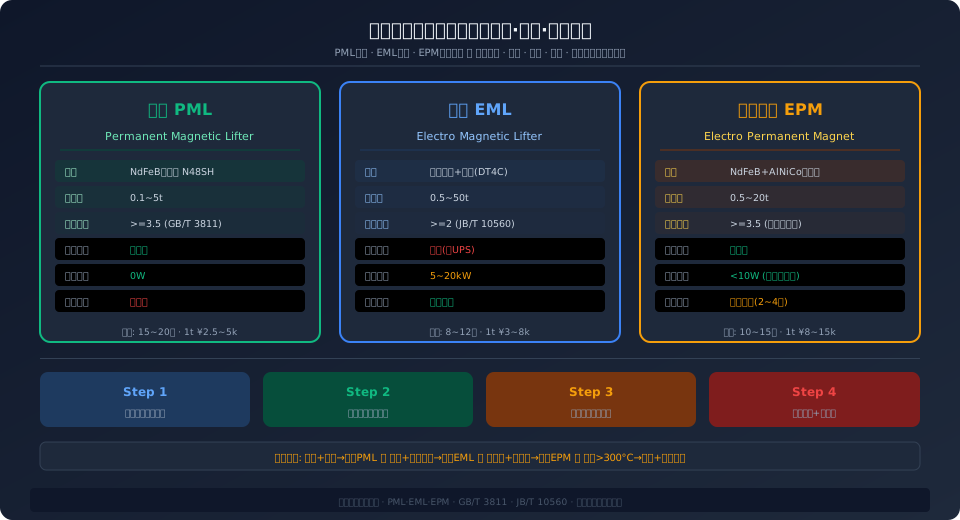
Key point: Magnetic lifters fall into three categories based on magnetic source: permanent magnet (PML, lifting capacity 0.1–5 t), electromagnetic (EML, lifting capacity 0.5–50 t), and electro-permanent (EPM, lifting capacity 0.5–20 t). These three types differ fundamentally in power-outage safety, lifting-force adjustability, energy consumption, and cost-effectiveness. Selection must account for workpiece material (ferromagnetic?), surface air gap (oil, corrosion, or coatings can reduce lifting force by 40–60%), and operating temperature (permanent magnets demagnetize above 150°C; electromagnets require Class H insulation above 300°C). This quick-reference page is a pillar article — see the sub-articles below for in-depth breakdowns of each type.
A magnetic lifter is one of the most common lifting spreaders used with overhead cranes. It picks up ferromagnetic loads such as steel plates, structural sections, and billets via magnetic force, enabling rigging-free lifting. Compared with traditional wire-rope lashing or spreader-beam clamping, the key advantages of a magnetic lifter are faster lift cycles (30–60 seconds per lift), no need for manual hook-up or release, and remote operation for improved safety. However, the three magnetic-source technologies differ significantly in safety logic, suitability, and cost — choosing the wrong type can lead to poor efficiency at best and a serious safety incident at worst.
Industry statistics show that more than 500,000 magnetic lifters are in service across China's steel fabrication and shipbuilding sectors. Lifting magnets account for roughly 65% of that installed base (driven by low cost and adjustable lifting force), permanent magnet lifters make up about 25% (zero power consumption and no demagnetization during power outages), and electro-permanent (EPM) units — though only about 10% of the fleet — are replacing conventional electromagnets at an annual growth rate exceeding 20%. This article provides a full-dimensional comparison of the three lifter types, referencing the lifting spreader safety factor requirements in ISO 4301 Crane Design Standard — Core Clauses and the technical specifications for crane lifting magnets in JB/T 10560 Electromagnetic Lifter (EML)s for Cranes, so that selection engineers can determine the most suitable magnetic lifter type within five minutes.
How the Three Magnetic Lifter Types Work: Where Does the Magnetism Come From?
The fundamental difference between magnetic lifter types lies in how the magnetic field is generated — which in turn drives the three key differentiators: lifting-force characteristics, safety, and energy consumption.
Permanent Magnet Lifter (PML) uses neodymium-iron-boron (NdFeB) permanent magnets to produce a constant magnetic field. A mechanical handle rotates the internal magnetic circuit to engage or release the load. Magnet grades range from N42SH to N48SH, with remanence Br = 1.2–1.4 T. These lifters consume zero power during operation and do not lose magnetism during a power outage. The main limitation is that lifting force is fixed and non-adjustable, and NdFeB magnets demagnetize permanently above 150°C.
Lifting Magnet / Electromagnetic Lifter (EML) generates an electromagnetic field via a current-carrying coil. Lifting force is proportional to current (and therefore adjustable), with magnetic flux density at the pole face of 0.5–1.5 T and power consumption of 5–20 kW. The critical drawback is that the load drops instantly on power failure — a UPS battery backup system (maintaining the field for 15–30 minutes) is mandatory as safety redundancy. The advantage is steplessly adjustable lifting force, making it suitable for steel plates of varying thickness.
Electro-Permanent Magnet (EPM) is a hybrid of permanent-magnet and electromagnetic technologies. A brief current pulse (<1 second) reverses the magnetization direction of internal AlNiCo (aluminum-nickel-cobalt) reversible magnets to switch between lift and release, while NdFeB provides the primary holding force. EPM combines the best of both worlds: no demagnetization on power failure (zero power consumption during operation) and controllable lift/release like an electromagnet. The trade-offs are a more complex control circuit and higher manufacturing cost — roughly 2–3 times that of a PML and 1.5–2 times that of an EML. EPM is widely regarded as the technology of the future for magnetic lifters and is rapidly gaining adoption in automated production lines and unmanned overhead crane applications.
Quick Parameter Reference: Safety Factor, Lifting Force, and Energy Consumption
| Comparison Parameter | Permanent Magnet Lifter PML | Lifting magnet EML | Electro-Permanent Magnet (EPM) EPM |
|---|---|---|---|
| Magnetic Source | Nd Fe B Permanent Magnet | Current Coil + Iron Core | Nd Fe B + Al Ni Co Dual Magnet |
| Holding Force Range | 0.1~5t | 0.5~50t | 0.5~20t |
| Safety factor | ≥3.5(ISO 4301 Crane Design Standard) | ≥2(JB/T 10560) | ≥3.5(Including Permanent magnet Section) |
| Adjustable Lifting Force | Fixed Value | Current Adjustment | Zone Control(2~4Zone) |
| Power-Off Safety: No Demagnetization / Demagnetization (Requires UPS) / No Demagnetization | Magnetization Retention(Requires UPS) | Magnetization Retention | |
| Operating Power Consumption | 0W | 5~20kW | <10W(Only During Lift/Release) |
| Temperature Resistance Upper Limit | 150°C(N48SH) | >300°C(HClass Insulation) | 150°C(Same as Nd Fe B) |
| Applicable Materials | Ferromagnetic Materials | Ferromagnetic Materials | Ferromagnetic Materials |
| 1000kg Class Price | ¥2,500~5,000 | ¥3,000~8,000 | ¥8,000~15,000 |
| Maintenance Complexity | Low(Machinery Type) | Medium(Electrical+Coil) | Medium(Electric Control+Dual Magnet) |
| Typical Lifespan | 15~20Years | 8~12Years | 10~15Years |
Four-Step Selection Framework
Step 1: Confirm workpiece material. All three magnetic lifter types are suitable only for ferromagnetic materials (carbon steel, martensitic stainless steel 400 series, cast iron). Austenitic stainless steels (304/316), aluminum alloys, and copper alloys are non-magnetic and cannot be lifted by any magnetic lifter—in these cases, a vacuum lifter or mechanical clamp (gripper) should be used instead. For duplex stainless steels (e.g., 2205), magnetic attraction is only 30–50% of carbon steel, resulting in a significant drop in holding force; these materials are not recommended for magnetic lifting.
Step 2: Assess power-loss safety requirements. If workshop power supply is stable (dual-circuit feed + UPS + generator), a lifting magnet is the most economical choice—holding force is adjustable and unit cost is the lowest. If intermittent power outages are a concern or maximum safety is required (e.g., lifting valuable molds, working above personnel), a permanent magnet lifter or electro-permanent magnet (EPM) is the safer option.
Step 3: Determine whether adjustable holding force is needed. If workpiece thickness or material varies frequently on the production line (e.g., a steel processing center handling 10 mm plate in the morning and 50 mm plate in the afternoon), adjustable holding force is required—a lifting magnet or zone-controlled EPM is the preferred choice. If the line is dedicated to a single task (e.g., lifting only 20 mm thick Q235B (≈S235JR) steel plate), a fixed-force permanent magnet lifter offers the best cost-effectiveness.
Step 4: Evaluate temperature environment and automation level. High-temperature applications (>150°C hot-rolled plate off the line) can only use a lifting magnet (Class H insulation + high-temperature-resistant wiring) or a mechanical spreader beam. For automated production lines or unmanned overhead crane systems, an electro-permanent magnet (EPM) is the optimal choice—it can be controlled automatically via PLC for pick-and-release without manual intervention. For intermittent, manually operated applications, a permanent magnet lifter (zero power consumption + maintenance-free mechanical handle) is the most practical solution.
In-Depth Breakdown by Type (Sub-Article Navigation)
The following sub-articles provide a detailed technical breakdown of each magnetic lifter type. Click the titles to read the full articles:
• Sub-Article ① Permanent Magnet Lifter Deep Dive: NdFeB magnetic circuit design (Pc value / B-H operating point), Halbach array optimization, three-tier safety redundancy (safety factor ≥3.5 / mechanical self-locking / secondary retention), three-dimensional selection criteria (material / air gap / temperature), cost breakdown The Plug-Free Lifting Solution: A Complete Guide to Permanent Magnet Lifter Magnetic Circuit Design, Selection, and Safety Redundancy
• Sub-Article ② Lifting Magnet (Electromagnetic): Coil ampere-turn calculation, core materials (DT4C electrical pure iron vs. silicon steel laminations), power-loss magnetism retention system design (UPS sizing / battery capacity / switching time), temperature rise control and heat dissipation, multi-pole zone control Lifting Magnet Deep Dive: Four Core Technologies—Coil Thermal Design, Core Magnetic Circuit, Power-Loss Retention, and Multi-Pole Zone Control
• Sub-Article ③ Electro-Permanent Magnet (EPM): NdFeB + AlNiCo dual-magnet synergy, pulsed current timing control, magnetic circuit switching dynamics (<1 second pick/release), independent zone control strategy, PLC interlocking and safety redundancy, unmanned overhead crane integration Electro-Permanent Magnet (EPM) Deep Dive: Dual-Magnet Synergy, Pulse Control, Magnetic Circuit Switching, and PLC Unmanned Crane Integration
• Sub-Article ④ Magnetic Crane Safety Standards & Compliance: ISO 4301 Crane Design Standard vs. JB/T 10560 safety factor comparison, ASME B30.2 Overhead and Gantry Cranes Safety Standard and ASME B30.20 Below-the-Hook Lifting Devices Safety Requirements, CE/UKCA certification, type test requirements (static load 1.5× + dynamic load 1.25× + magnetic flux decay test) Magnetic Crane Safety Standards and Compliance: ISO 4301, JB/T 10560, CE, UKCA, and ASME Certification Pathways
• Sub-Article ⑤ Magnetic Lifter Routine Inspection & Maintenance: Monthly gauss meter magnetic field inspection, magnetic pole face wear detection (maximum allowable wear <0.3 mm), handle mechanism lubrication, electromagnetic coil insulation resistance test (≥1 MΩ), battery annual inspection and replacement Magnetic Lifter Maintenance Manual: Monthly Gauss Meter Checks, Battery Management, and Pole Face Repair—The Essential Three-Part Routine
• Sub-Article ⑥ Magnetic Lifter Selection for Special Applications: Underwater recovery (IP68 waterproof magnetic lifter), high-temperature hot-rolled plate (>300°C lifting magnet), thin plate handling (<3 mm anti-flux-leakage design), irregular workpieces (custom curved magnetic poles) Magnetic Lifter Selection Guide for Special Applications: Underwater Recovery, High-Temperature Rolling, Thin-Plate Flux Leakage Prevention, and Irregular Curved Surfaces
Frequently Asked Questions
Q: Can a magnetic lifter lift stainless steel?
A: Ferritic and martensitic stainless steels (e.g., 430, 410, 420 series) are magnetic and can be lifted. Austenitic stainless steels (304/316) are completely non-magnetic and cannot be held by any magnetic lifter—a vacuum lifter or mechanical clamp (gripper) is required instead. Duplex stainless steel (2205) has weak magnetic properties, with holding force only 30–50% of carbon steel, so it is not recommended as a standard application.
Q: Which of the three magnetic lifter types is the safest?
A: In a power-outage scenario: permanent magnet = EPM > electromagnetic (electromagnetic requires UPS to retain magnetism). Under normal power supply, all three offer comparable safety, with the main difference being the safety factor rating (permanent magnet ≥3.5, electromagnetic ≥2, EPM ≥3.5). When purchasing, prioritize models with a mechanical lock pin, anti-misoperation control grip, and working status indicator—these safety features do more to reduce accident risk than the magnetic source type itself.
Q: How long does a magnetic lifter last? What determines its service life?
A: Permanent magnet lifters have the longest service life (15–20 years), with degradation primarily caused by demagnetization of the permanent magnets under high temperatures or strong reverse magnetic fields (negligible decay at room temperature). Lifting magnets have a medium service life (8–12 years), with degradation mainly driven by coil insulation aging (accelerated by humidity/high temperature) and magnetic pole face wear. Electro-permanent magnets (EPM) have a medium service life (10–15 years), with degradation primarily due to cumulative fatigue from repeated magnetization cycles of the AlNiCo magnets and control circuit aging. All three types require an annual inspection every 12 months (magnetic flux test + structural flaw detection + handle/coil functional test).
Q: How much does a magnetic lifter cost? How can I control the budget during selection?
A: Market reference prices for 1,000 kg capacity: permanent magnet ¥2,500–5,000, electromagnetic ¥3,000–8,000 (including UPS + ¥3,000–8,000), EPM ¥8,000–15,000. Imported brands (Kanetec, Tecnomagnete, etc.) typically cost 2–5× more than domestic options. Three budget-control tips: ① Confirm whether adjustable holding force is truly needed (if not, a permanent magnet lifter saves 30–50%), ② Assess the automation level (unmanned overhead crane EPM has higher upfront investment but lower maintenance costs), ③ Volume purchases can typically negotiate 15–25% discounts. These are market reference prices; final pricing is subject to the actual contract.
—
Standards referenced: ISO 4301, JB/T 10560, GB/T 13560-2017
