

Magnetic Crane Selection Guide for Special Conditions
Standard magnetic crane selection covers conventional conditions—ambient temperature, dry environments, and flat or structural steel. However, in four demanding scenarios—underwater salvage, hot-rolled plate offloading, thin-plate handling (<3mm), and irregularly shaped workpieces—standard magnetic lifters suffer severe performance degradation or complete failure. This article provides customized selection parameters and technical solutions for each of these four special operating conditions.
This is a sub-article in the magnetic crane series. For a full three-way comparison and selection guidance, see the pillar page Magnetic Crane Type Selection Quick Reference
Underwater Salvage: Waterproof and Pressure-Resistant Design for Freshwater and Seawater Magnetic Lifters
Underwater salvage imposes the most demanding requirements on magnetic lifters. In freshwater environments (e.g., reservoirs, sunken-ship recovery), the relatively low electrical conductivity keeps the risk of insulation breakdown in lifting magnet coils manageable after submersion—provided the unit is IP68 waterproof-sealed at the factory using full epoxy encapsulation of the coil, a 316L stainless steel housing, and dual O-ring seals. Seawater, however, with conductivity roughly 1,000 times that of freshwater, is lethal to electromagnetic coils—even with IP68 encapsulation, chloride ions penetrate microscopic seal defects during energization and corrode the copper wire. Seawater salvage therefore typically employs fully mechanical permanent magnet lifters (no electrical components) with an all-316L stainless steel housing and an anti-biofouling coating. Maximum operating depth is governed by the pressure rating of the permanent magnets—standard NdFeB performs unaffected at 50m depth (approx. 0.5MPa), but the housing must withstand the corresponding external water pressure (wall thickness verified to ASME VIII-1 pressure vessel standard). The following solutions are based on the lifting spreader safety requirements of ISO 4301 Crane Design Standard—Core Clauses and JB/T 10560—Lifting Magnets for Cranes, adapted to each special condition.
Hot-Rolled Plate Offloading: Selecting Magnetic Lifters for >300°C
The maximum operating temperature of a standard magnetic lifter is limited by the permanent magnet's Curie temperature and the coil's insulation class:
• Permanent magnet lifter (N48SH NdFeB): 150°C max—irreversible demagnetization occurs beyond this; at 400°C, magnetic performance loss exceeds 50%
• Lifting magnet (Class H insulated coil): 180°C max—insulation aging accelerates beyond this; at 300°C, expected service life is only 200–500 hours
• Electro-permanent magnet (EPM): same limitation as permanent magnets
For extreme high-temperature scenarios such as hot-rolled plate offloading (plate temperature 500–800°C), three magnetic lifter approaches are available:
Option A: Remote lifting magnet with thermal barrier. Install a 50–80mm thick insulating pad (e.g., ceramic fiber board or aerogel insulation layer) on the magnet pole face. The thermal gradient across the insulation reduces the pole-face temperature from 500°C at the workpiece side to <150°C at the coil side. The trade-off: the insulation layer adds 50–80mm of effective air gap, causing a dramatic drop in holding force (at a 50mm gap, holding force is only 2–5% of that at direct contact). This requires proportionally larger magnet area and power to compensate—for example, a 300°C steel plate needs a lifting magnet 2–3 times the standard area to maintain equivalent effective holding force.
Option B: Forced water cooling system. Embed copper water-cooling coils inside the electromagnetic coil, circulating cooling water (inlet temperature ≤30°C, flow rate ≥10L/min) to maintain coil temperature stably below <100°C. The added cost of the water cooling system is approximately 50–80% of the lifting magnet's unit price, and it requires supporting cooling water piping and a circulation pump station.
Option C: Abandon magnetic solutions in favor of mechanical spreader beams. For extreme temperatures above >600°C, the economics and reliability of thermal-barrier or water-cooled lifting magnets are both unsatisfactory. In this case, switch to a fully mechanical high-temperature-resistant spreader beam (e.g., alloy steel cast clamps with high-temperature ceramic gripping pads and remote hydraulic actuation)—magnetic lifters are no longer applicable.
Thin-Plate Handling: Solving the Flux Leakage Challenge for <3mm Steel
When steel plate thickness drops below <3mm, magnetic lifter holding force declines sharply—a physical limitation caused by magnetic circuit saturation. NdFeB permanent magnets have a remanence of Br=1.2–1.4T, while ferritic steel plate has a saturation flux density of Bs≈2.0T—seemingly leaving ample flux-carrying capacity. The problem: the cross-sectional area through the plate thickness is extremely small (e.g., 3mm plate × 100mm width = 300mm²). The total magnetic flux generated by the NdFeB magnet (approx. 0.5–2mWb, depending on magnet area) easily drives the flux density in the thin plate to 1.5–2.0T (near saturation). Beyond saturation, excess flux leaks into the air ("flux leakage"), and effective holding force drops sharply. Solution: adopt a multi-pole, shallow-penetration design—replace the conventional 2 large poles with 6–8 smaller poles (each with reduced area and correspondingly lower total flux), keeping each pole's magnetic flux below the thin plate's saturation capacity. For example, for 2mm steel plate: use 8 small NdFeB poles of φ25mm (N52, individual pole flux ≈0.15mWb) instead of 2 large poles of 120×80mm (individual flux ≈1.5mWb, far exceeding the thin plate's saturation capacity). The trade-off of the multi-pole design is reduced overall holding force (due to smaller individual pole area), but this can be partially compensated by increasing the pole count—this is the core design tension in thin-plate magnetic lifters.
Irregular Workpieces: How to Lift Curved or Corrugated Steel Plates
Standard magnetic lifters have flat pole faces—meaning they can only achieve intimate contact with flat workpieces. For curved steel plates (e.g., drums, pressure vessel shells) or corrugated plates (e.g., ship hull plating, storage tank walls), a wedge-shaped air gap forms between the flat pole face and the curved workpiece, causing a sharp drop in holding force.
The solution is custom-contoured pole faces—CNC-machined to match the workpiece curvature (radius must precisely match the workpiece, within ±5mm tolerance). For workpieces with varying curvature (e.g., drums of different diameters), design replaceable contoured pole-face pads—pads with different radii are quickly swapped via bolts to accommodate multiple workpiece specifications.
For corrugated steel plates (with regular raised-and-recessed patterns), if the corrugation pitch is ≤ the pole width, an elastic pole-face adapter layer can be used—bond a 3–5mm thick soft magnetic rubber layer (iron-powder-filled silicone rubber, relative permeability μr≈3–5) to the pole face. Under pressure, this layer deforms slightly to fill the corrugation recesses, reducing the effective air gap. The soft magnetic rubber layer introduces an equivalent air gap of approximately 0.5–1mm (due to its permeability being far lower than pure iron), resulting in a 20–30% holding force reduction—this derating factor must be built into the design.
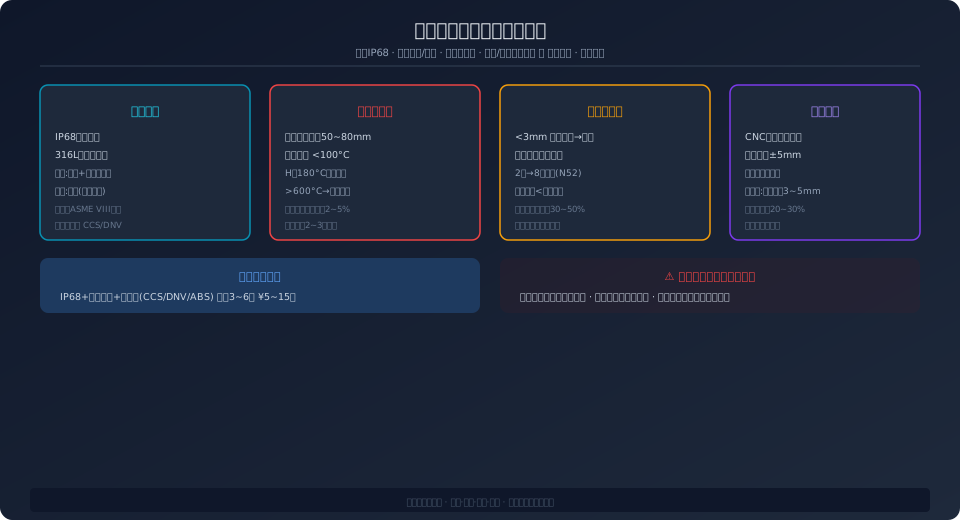
Four-Scenario Solution Comparison at a Glance
| Comparison Parameter | Underwater Salvage | High-Temperature Hot Rolling | Thin Plate Handling | Irregular-Shaped Workpiece |
|---|---|---|---|---|
| Recommended Solution | Permanent Magnet Lifter(Full Sealing) | Lifting magnet(Heat Insulation/Water Cooling) | Multi-Pole Permanent Magnet Lifter | Custom Arc-Shaped Pole |
| Prohibited Type | Lifting magnet(Seawater) | Permanent Magnet Lifter(>150°C) | Standard Large Pole Permanent magnet | Flat Pole Standard Model |
| Temperature Limit | ≤50°C(Nd Fe B) | After Insulation≤150°C(Coil Side) | Ambient Temperature | Ambient Temperature |
| Derating Coefficient | 0.9~0.95 | 0.02~0.05(Air Gap50mm) | 0.3~0.5(2mm Plate) | 0.7~0.8(Arc Surface Conformity) |
| Special Certification | IP68+Classification Society(CCS/DNV) | HClass Insulation+Temperature Rise Testing | Derating Curve Calibration | Curvature Matching Detection |
| Cost Increase | +50~100% | +50~80%(Water Cooling) | +20~40% | +15~30% |
Frequently Asked Questions
Q: What special certifications are required for a magnetic crane used in 50 m underwater salvage operations?
A: In addition to standard lifting spreader certifications (ISO 4301 + JB/T 10560), an underwater magnetic crane must also obtain: ① An IP68 waterproof rating test report (immersed at an equivalent pressure of 50 m water depth for 24 hours with no internal water ingress); ② A pressure vessel strength verification (hydrostatic test at 1.5 times the design pressure, held for 30 minutes with no leakage or deformation); ③ For offshore applications, a product inspection certificate from a classification society (CCS/DNV/ABS). The certification process typically takes 3–6 months and costs approximately $7,400–$22,200, depending on water depth and complexity.
Q: Can a magnetic lifter actually handle thin steel plates (under 2 mm)?
A: Yes, but you must use a specially designed thin-plate multi-pole magnetic lifter, and the rated lifting capacity must be significantly derated — typically to only 30–50% of the nameplate value. For example, a standard 1,000 kg lifter may only deliver 300–500 kg of usable lifting capacity on a 2 mm plate, depending on the number of magnetic poles and the steel grade. When purchasing, clearly specify your plate thickness range to the manufacturer so they can provide a tailored thin-plate solution and a derating curve. We do not recommend derating a standard lifter on your own, as the safety factor has not been re-verified for thin-plate applications.
Q: Will a magnetic lifter be damaged by high-temperature lifting applications?
A: Permanent magnet lifters undergo irreversible demagnetization above 150°C — even after cooling back to room temperature, magnetic performance cannot be restored, and the unit must be returned to the factory for re-magnetization. For lifting magnets, coil insulation accelerates aging above 180°C, typically leading to turn-to-turn short circuits, localized overheating, insulation carbonization, and further short-circuiting — a "thermal runaway" cycle that ultimately burns out the coil. Therefore, strict adherence to temperature limits is critical in high-temperature environments. A single over-temperature use can permanently ruin a magnetic crane.
Q: How much does a custom curved magnetic pole for irregular workpieces cost, and what is the lead time?
A: The surcharge for a custom curved magnetic pole typically ranges from 15–30% of the lifter's base price, covering CNC machining and pole-face grinding. Replaceable curved pole-piece liners cost approximately $74–$296 per set, depending on curvature complexity and material. Custom fabrication generally takes 2–4 weeks, including measurement, 3D modeling, CNC machining, pole-face finishing, and lifting-force calibration. We recommend ordering 2–3 sets of liners for your most common curvatures at the time of purchase to avoid costly downtime if you need additional sets later.
—
Reference standards: ISO 4301, JB/T 10560, IEC 60529 (IP Protection Rating)
