

Magnetic Crane Daily Inspection & Maintenance Guide
Routine inspection and maintenance of magnetic lifters are the foundation for preventing lifting-force degradation and avoiding safety incidents. Many users assume a magnetic lifter will perform indefinitely after purchase, but neodymium-iron-boron permanent magnets demagnetize under high heat, electromagnetic coils age from moisture exposure, and magnet pole faces wear, increasing the air gap—all progressive deterioration that daily inspection can catch early. The three lifter types each require different inspection focus and frequency: permanent magnet lifters center on magnetic-flux decay and mechanical handle operation, electromagnetic lifters on insulation integrity and UPS health, and EPM units on capacitor condition and magnetization verification. An annual inspection every 12 months and a semi-annual test every 6 months represent the industry minimum requirement.
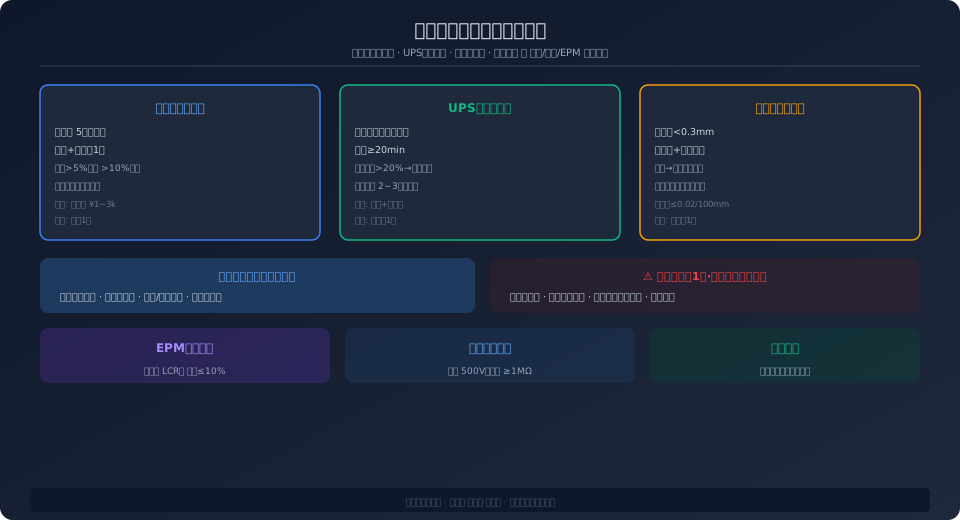
For permanent magnet lifters, daily inspection is the simplest yet most overlooked practice. Magnetic flux decay checks are the core priority—use a handheld gauss meter (e.g., Lake Shore Model 410, accuracy ±0.1 mT) to measure flux density at one point at the center of the pole face and one at the edge, then compare against factory calibration values. A deviation exceeding 10% means the unit requires service or derating. Handle mechanism lubrication is equally critical—apply 2–3 drops of machine oil (e.g., ISO VG 32 hydraulic oil) to the pivot shaft monthly to prevent corrosion-induced operating-force increase or seizing. Check the safety lock pin's spring elasticity quarterly—press the pin and it should spring back automatically; sluggish return indicates spring fatigue and replacement is required.
The inspection and maintenance indicators below are based on the ISO 4301 Crane Design Standard—Core Provisions and the manufacturer's Maintenance Manual.
This article is part of the Magnetic Crane series. For a full three-type comparison and selection guidance, see the pillar page Magnetic Crane Type Selection Quick Reference.
Inspection Checklist: Three Lifter Types Compared
| Detection Item | Permanent magnet PML | Electromagnetic EML | Electrical Control Permanent magnet EPM | Frequency |
|---|---|---|---|---|
| Magnetic Pole Face Flux Density | gauss meter Measure | Measure After Energization | Measure After Pickup | Monthly |
| Magnetic Pole Face Wear Measurement | <0.3mm | <0.3mm | <0.3mm | Quarterly |
| Handle Operating Force | ≤150N | N/A | N/A | Monthly |
| Coil Insulation Resistance | N/A | ≥1MΩ | N/A | Monthly |
| UPSMagnetic Holding Time | N/A | ≥20min | N/A | Semi-annually |
| Capacitance Capacity | N/A | N/A | Deviation≤10% | Quarterly |
| EPMMagnetization Verification | N/A | N/A | After Each Pickup | Each Time |
| Safety Latch/indicator | Function Normal | Indication Normal | Indication Normal | Before Each Use |
| Housing Anti-corrosion coating | No Detachment | No Detachment | No Detachment | Quarterly |
| Annual Inspection(Professional Organization) | Comprehensive Detection | Comprehensive Detection | Comprehensive Detection | Annually |
Gauss Meter Monthly Magnetic Field Checks: The Simplest Inspection That Catches the Biggest Problems
A handheld gauss meter (tesla meter) is the most fundamental—and most important—maintenance tool for a Magnetic Crane. An investment of $150–$450 can prevent safety incidents caused by insufficient lifting force. Here's how to perform the measurement: ① Attach the Magnetic Crane to a standard test Steel Plate (thickness ≥ 20 mm, surface clean and free of oil), ensuring the magnetic pole face makes full contact with the plate (no visible air gap).
② Hold the gauss meter probe perpendicular to the pole face and take readings at the center and four corners (5 points total), recording the magnetic flux density at each point (in mT or G; 1 T = 1,000 mT = 10,000 G).
③ Compare readings against the previous month's records (a monthly trend table per unit is recommended). A Deviation > 5% warrants attention; > 10% requires immediate investigation (pole face Wear? Permanent magnet demagnetization? Changes in workpiece surface condition?)—and the crane should be derated or sent for servicing.
For Electromagnetic lifting magnets, the monthly check should also include a full-load Current measurement while energized—use a clamp meter around the power supply line and record the steady-state current, comparing it to the rated current. If the current is noticeably low and the pole face temperature is normal, inter-turn short circuits in the coil may be the cause (fewer active turns reduce Resistance, which should increase current, but the opposing magnetic flux from shorted turns cancels part of the main magnetic flux, reducing total magnetic flux). If the current is high and the pole face runs hot, poor heat dissipation or coil Aging is likely. Either anomaly requires the unit to be taken out of service for repair.
Batteries and Capacitors: The Overlooked Time Bombs
The UPS battery in an Electromagnetic lifting magnet is the backbone of the power-loss magnetism retention system—but chemical degradation in batteries is irreversible. A lead-acid battery's capacity decay curve typically looks like this: ~95% after Year 1, ~85% after Year 2, ~70% after Year 3, and ~50% after Year 5. That's why industry practice calls for mandatory replacement of the entire battery bank every 2–3 years—even if the battery "looks fine," an aged unit can drop below the voltage required to hold the load at the worst possible moment (full load + high Ambient Temperature). A loaded discharge test every six months (manually cutting off mains power and timing how long it takes for lifting force to be lost, compared against the baseline) is the only reliable way to assess true battery health.
The pulse Capacitors in an EPM (Electromagnetic Permanent Magnet) system also degrade over time. The primary cause of Capacitance loss in electrolytic capacitors is gradual drying-out of the electrolyte—a typical decay rate of 2–5% per year, depending on usage Frequency and ambient temperature (heat accelerates the process). When Capacitance drops by more than 15%, the pulse energy is no longer sufficient to fully magnetize the AlNiCo, triggering a low-lifting-force alarm. Every quarter, use an LCR meter to measure the actual Capacitance of the capacitor bank and compare it against the nameplate value. Also, safely discharging residual capacitor Voltage is a critical safety point during maintenance—after powering down, wait at least 5 minutes (the built-in discharge resistors should bleed the Voltage down to <50 V) and confirm with a multimeter before touching anything.
Frequently Asked Questions
Q: How much pole face wear is too much before replacement or repair is needed?
A: The allowable wear on the pole face (DT4C pure iron) is typically <0.3 mm. Beyond 0.3 mm, even if the surface still looks flat, the added 0.3 mm effective air gap can reduce lifting force by more than 50%. The repair procedure: send the Magnetic Crane to the factory, where the pole face is re-ground on a surface grinder (the unit must be disassembled for separate machining, with final Flatness ≤ 0.02 mm/100 mm). After repair, the unit must be re-calibrated for lifting force and re-validated for Safety factor.
Q: What data should be recorded during routine inspections, and what tools are needed?
A: Minimum data set: date + magnetic flux density at 5 pole face points + pole face wear measurement + handle/coil/UPS status + inspector's signature. Tools: gauss meter ($150–$450), straightedge and feeler gauge ($15), clamp meter ($30–$75), Megohmmeter (Insulation Tester) ($45–$120). We recommend keeping an electronic file for each Magnetic Crane in Excel or a simple equipment management app—monthly trend charts make gradual degradation visible far earlier than any single absolute measurement.
Q: When should the battery be replaced, and what happens if it isn't?
A: Lead-acid batteries should be replaced on a mandatory 2–3 year schedule. The fatal risk of an aged battery isn't in "normal operation"—it's in the "critical moment." Under full load and high temperature, an old battery with capacity decayed below 50% can drop below the hold-voltage the instant mains power is lost, causing the load to be dropped. A loaded discharge test every six months is the only way to truly assess battery health. If discharge time has shortened by more than 30% from the baseline, replace the battery immediately—even if it looks perfectly fine.
Q: What does an Annual Inspection cover, and can we do it ourselves?
A: The Annual Inspection (every 12 months) must be carried out by a qualified professional organization. Core items include: ① Full-point magnetic flux testing (compared against factory Calibration; Deviation > 10% means derating or servicing); ② Magnetic Particle Inspection (MPI) of structural components (handle pivot, Lifting Eye, housing Weld Seams); ③ Safety factor verification (static load at 1.5× rated load + dynamic load at 1.25× rated load); ④ Electrical safety Testing (Insulation Resistance, Grounding continuity, UPS loaded discharge). Routine monthly checks (gauss meter + visual inspection + functional Testing) can be performed by the user, but the Annual Inspection report is a hard compliance requirement—missing inspection records will be treated as a serious management failure in any incident investigation.
—
Standards referenced: ISO 4301 (formerly ISO 4301), JB/T 10560 "Lifting Electromagnets for Cranes"
