

How to Prevent AI Hallucinations in Crane Maintenance
📋 Key Summary
The most dangerous thing about large language models in crane maintenance isn't a wrong answer—it's a wrong answer delivered with absolute confidence. A model may invent a standard clause that doesn't exist, fabricate a plausible-looking maintenance procedure, or generate monitoring data with no traceable source. That's what we call a "hallucination." This article breaks down the three typical forms of hallucination, the questioning and verification methods used to catch them, and the root cause: models are fundamentally probabilistic text generators with no hard constraint on factual accuracy. The engineering approach to preventing hallucinations has four layers: retrieval-augmented generation, knowledge base constraints, boundary limits, and manual review. The principle is simple—AI assists, but humans always make the final call on anything safety-related.
Experienced crane maintenance professionals trust AI models—and that trust is exactly what makes them dangerous. The more fluent and confident a model's answer, the more likely it is to be confidently fabricating a standard clause that doesn't exist. It never hesitates, never says "I'm not sure." It simply produces a well-formatted, assertive answer that falls apart the moment you try to verify it.
This phenomenon has a name: hallucination. It's not a matter of the model "occasionally making mistakes"—it's a structural weakness of generative models. What the model does from start to finish is predict the most probable next token, not verify whether a fact actually exists. When asked "How do I fix abnormal noise in a crane reducer?" it can assemble a plausible-looking maintenance process, but the model has no idea whether any individual step in that process is actually valid.
In crane maintenance, the damage from hallucination isn't about "losing face"—it's about "causing real harm." A non-existent standard clause written into an inspection sheet, a fabricated maintenance procedure followed by a novice, a set of invented monitoring data used to make a shutdown decision—any one of these can escalate into a safety incident. So the question isn't "should we use large language models?" but "how do we keep them within the boundaries of fact?" Kelude Heavy Industry has hit this wall across multiple maintenance projects and has made hallucination prevention the first step in every AI application.
What Hallucination Looks Like: Fabricated Standards, Invented Procedures, and Fake Data
The first typical form of hallucination is fabricating standard clauses that don't exist.
When asked "Which standard does this refer to?" a model may produce a reference number and clause that look perfectly formatted but don't exist in reality. It knows what a standard number looks like, so it generates something in the "GB/T number-year" format, complete with a plausible-sounding clause. Unless a maintenance technician goes back and checks the original text line by line, it's easy to be fooled.
The second typical form is inventing maintenance steps that seem reasonable.
The model can string together "disassembly, inspection, replacement, reassembly" into a logically coherent procedure—but the key parameters in the middle may be pure fabrication. For example, a bolt's tightening torque or a clearance adjustment value. These numbers don't come from any manual; they're statistical combinations of similar sentences in the training data.
The third typical form is fabricating monitoring data and conclusions.
When you ask "What do these vibration readings indicate?" the model may generate an analysis complete with chart values, claiming "amplitude exceeds limits, recommend shutdown." These numbers have no correspondence to the actual data, but they look credible because of their clean formatting. This type of hallucination is the most dangerous because it leads directly to wrong maintenance decisions.
How to Spot Hallucinations: Source Verification, Cross-Checking, and Plausibility Checks
Detecting hallucinations isn't a matter of intuition—it's a repeatable verification process. Kelude Heavy Industry has built a cross-checking checklist into its internal knowledge base, and frontline personnel follow it item by item. The core consists of three actions.
Step one: question the source.
For every standard number, parameter, and conclusion the model produces, ask one question: "Where does this come from?" Only answers that link back to a specific entry in the knowledge base move to the next round. Anything without a source—or with a vague one—gets flagged as suspicious.
Step two: cross-check.
Compare the model's answer line by line against maintenance manuals, equipment records, and historical work orders. Do the parameters match? Does the equipment model check out? Do the operating procedures align with actual conditions? Any mismatch means the model is filling in gaps with guesswork. This step catches the vast majority of mix-up-style hallucinations.
Step three: verify numerical plausibility.
When the model gives you a number, ask yourself: "Does this make sense?" A torque value that defies common sense, a load figure that exceeds the equipment's rated range—even if the formatting looks perfect, reject it immediately. Plausibility checks don't aim for precision; they're meant to filter out the most obviously wrong values first.
Hallucination Identification and Response Comparison Table
| hallucination manifestation | Identificationsignal | Detectionmeans | assessment conclusion | handling action |
|---|---|---|---|---|
| fabricationstandard clauses | Standardarticle not found | retrieve source database | unverifiable source deemed hallucination | annotationdisable and backfill feedback |
| fabricationMaintenanceprocedure | Parameterover-precision | cross-check with manual | Parametermismatch deemed hallucination | revert to manualStandardprocedure |
| fictitiousMonitoringdata | unsourced value | compare with raw data | untraceable deemed hallucination | raw data prevails |
| misattributed equipment | Modelmechanismconfusion | verify against equipment ledger | Modeldiscrepancy deemed hallucination | correct and re-query |
| overconfident conclusion | unqualified wording | requirementsprovide basis | no basis deemed hallucination | transfermanual reviewconfirmation |
| timeliness error | citing obsoleteStandard | verify current valid version | Standardobsolete deemed hallucination | update knowledge base entry |
Why Large Language Models Hallucinate: The Root Causes of Probabilistic Generation and Missing Factual Constraints
To prevent hallucinations, you first need to understand why they happen. A large language model's output is fundamentally probabilistic generation—each token it produces is sampled from a distribution of "the most likely next token" calculated from all preceding tokens. The model has no independent fact database to cross-check against, nor does it understand the semantics of "right" or "wrong." It only understands what flows most naturally next in a given context.
This explains why hallucinations often appear "grammatically flawless, logically coherent, yet factually wrong": fluency is what the model is trained to optimize, but factual accuracy is not. When a certain type of content appears frequently enough in the training corpus, the model learns its format; however, when asked to generate a specific, unique, verifiable answer, format correctness does not guarantee content correctness.
The second root cause is the absence of hard constraints on factual accuracy.
A genuine maintenance manual maps every step to real components and parameters. A model's memory, by contrast, is a statistical distillation of training data—it may blend information from different equipment and different operating conditions into a hybrid that does not exist in reality. This "misattribution" is essentially a retrieval failure, not deliberate deception by the model.
The third root cause is knowledge staleness.
Once model training is complete, its knowledge is frozen. Standards get revised, procedures get updated, but the model does not automatically learn about these changes. When asked about a new standard, it may fall back on memories of an older one—or even stitch together fragments into a "new standard" that never existed.
A Prevention System Against Hallucinations: Retrieval-Augmented Generation, Knowledge Base Constraints, and Boundary Limits
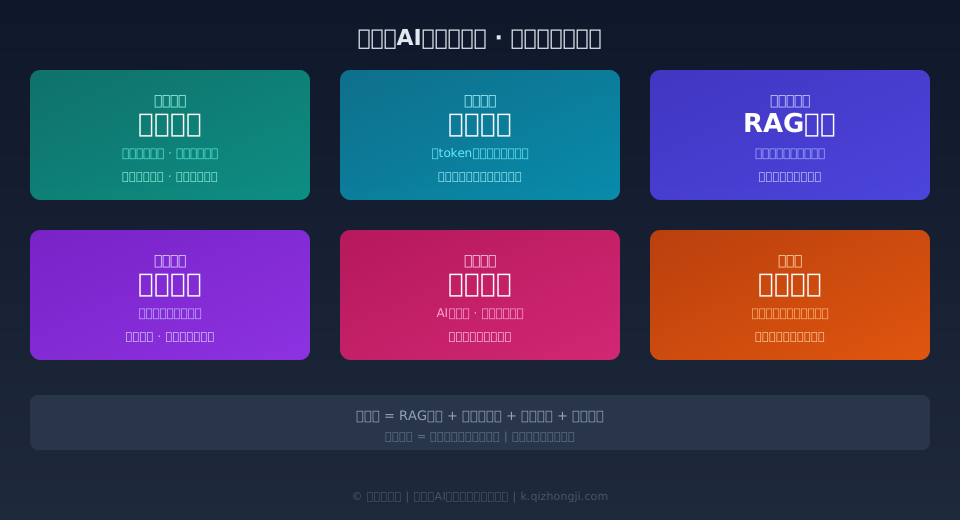
The first line of defense against hallucinations is retrieval-augmented generation, commonly known as RAG.
Rather than letting the model "recall" from thin air, the better approach is to have it look things up first. The RAG method works like this: before generating an answer, the system retrieves relevant entries from the enterprise knowledge base—standard clauses, maintenance manuals, historical work orders—and feeds these entries to the model along with the question, instructing it to "answer strictly based on the provided materials." This gives the answer factual anchor points and drastically narrows the model's room for fabrication.
Kelude's practical experience is that RAG effectiveness depends on knowledge base quality. The standard clauses and parameters in the knowledge base must be authoritative, current, and traceable. GB/T 28264 Safety Monitoring and Management System for Lifting Appliances sets out requirements for the collection and storage of monitoring data—this serves as a key foundation for the knowledge base's data layer. Meanwhile, regulations such as TSG 51-2023 Crane Safety Technical Supervision Regulation are authoritative sources for the maintenance knowledge base. Every standard number cited must be locatable in the knowledge base; otherwise, it is treated as a hallucination.
The second layer is knowledge base constraints.
The approach is straightforward: the model is only allowed to reference entries that actually exist in the knowledge base—no "on-the-spot improvisation." Every standard number and every parameter in the answer must be traceable back to a specific entry in the knowledge base. Writing this constraint into the prompt is not enough; it must also be enforced at the system level through hard validation—standard numbers in the model's output are automatically checked against the knowledge base, and any entry not found is blocked and flagged.
The third layer is boundary limits.
This is the most important one: large language models do not participate in safety decisions. They may summarize materials, generate report drafts, and explain clauses, but determinations such as whether to shut down equipment, replace components, or allow continued operation must be made by humans. Confining AI's role to "assistance" rather than "decision-making" is the most effective institutional safeguard against hallucination risk.
The fourth layer is manual review.
Any content generated by the model that will be used in practical operation must go through review by qualified personnel. The focus of review is not "does it read smoothly" but rather "can every standard number be verified, does every parameter match the manual, and does every conclusion have supporting raw data." Kelude's experience is that building review into a fixed workflow is far more reliable than relying on individual conscientiousness.
Quick Reference of Standard Clauses for a Hallucination-Proof Knowledge Base
| Standard/Procedure | clause key points | role in hallucination prevention |
|---|---|---|
| GB/T 28264 Safety Monitoring and Management System《lifting appliancesSafety Monitoring and Management System》 | Monitoringdata acquisitionand storagerequirements | knowledge base databaseprovide basis |
| TSG (Special Equipment Safety Technical Regulation) 51 Safety Technical Specification for Special Equipment-2023 Crane Safety Technical Supervision Regulation《lifting appliancessafety technical supervision regulation》 | Inspectionandsafety technical requirements | Maintenanceauthoritative knowledge base source |
| FEM 1.001 Crane Design Standard《crane design specification》 | design calculationbasic provisions | Parameterauthoritative benchmark for verification |
| ISO 24621:2022《craneAI fault diagnosis》 | AIDiagnosisshalltraceableverifiable | constraintAIconclusions must be traceable |
| ISO 4310《crane test specificationand procedures》 | Testitems andAcceptancedetermination | numerical plausibilityverificationprovide basis |
📖 Related Reading: What Can Large Models Actually Do for Crane Maintenance? Practical Scenarios and Capability Boundaries | Equipment Health Management (PHM): Big Data and ML-Driven Predictive Maintenance for Overhead Cranes
FAQ
Q: Which is better for preventing hallucinations—retrieval-augmented generation (RAG) or fine-tuning? What's the fundamental difference?
A: RAG queries a knowledge base before generating a response, feeding the model relevant entries as factual anchor points so answers remain traceable. Fine-tuning, by contrast, adjusts model parameters on domain data to make the model "more knowledgeable," but it doesn't eliminate the probabilistic nature of generation. The two aren't mutually exclusive: use RAG first to ensure cited claims are grounded, then fine-tune as needed to sharpen domain-specific phrasing. For safety-critical crane maintenance, RAG's hard constraints take priority, because every citation can be traced back to the source text. Kelude also deploys RAG as the first line of defense in its implementations.
Q: The model cited a standard number that can't be found. Is that a hallucination or an outdated knowledge base? How do we troubleshoot it?
A: Start by investigating two separate tracks. First, check whether the knowledge base actually contains the latest version of that standard—if it was never indexed, the issue is missing data, not fabrication. Second, ask the model to produce the original text snippet and source link for that standard number. If it can't, or the cited passages contradict each other, it's almost certainly a hallucination. In either case, flag the entry as untrusted, backfill the knowledge base, and feed the correction back to the model to prevent recurrence.
Q: How often do hallucinations actually occur in crane maintenance, and which scenarios deserve the most caution?
A: Hallucinations aren't rare events—they're an inherent weakness of generative models, and their frequency depends on how open-ended the query is and how tightly the knowledge base constrains the output. The three scenarios that demand the most vigilance are: requests to cite standard clauses, requests to generate maintenance procedures, and requests to interpret monitoring data and draw conclusions. Any time the output touches on shutdown decisions, component replacement, or safety limits, treat the model's answer as unverified by default—trace every claim to its source and require manual review.
