

Semi-Supervised Learning With Unlabeled Data: A Guide
📋 Key Summary
Semi-supervised learning targets the most expensive bottleneck in deploying AI for cranes: annotation. Defect detection models require massive labeled datasets, but manually drawing boxes around wire rope broken wires, weld seam porosity, and similar flaws is extremely labor-intensive. Semi-supervised learning uses only a small portion of annotated data, paired with a large volume of unlabeled data, allowing the model to extract structural patterns from unlabeled samples on its own—reducing reliance on manual annotation. This article reviews three mainstream approaches—self-training, consistency regularization, and FixMatch—and examines practical prerequisites such as pseudo-label noise and distribution assumptions. It also notes that this direction remains in early validation stages for the crane industry, with accuracy ceilings determined by real-world operating conditions.
A crane manufacturer launched a defect detection project, and its annotation team spent weeks drawing boxes on screen—managing only a few thousand images in that time. Yet a detection model stable enough for field deployment typically requires tens of thousands to hundreds of thousands of annotated samples. The defect annotation dataset previously published on this site has already reached 500,000 images—a figure that represents months of repetitive labor by annotators.
What makes this harder is that cranes generate a continuous stream of images, vibration data, and current readings every day—the vast majority of it raw, unlabeled data. Training on just those few thousand annotated images won't expose the model to enough operating condition variation. Waiting for manual annotation of all hundreds of thousands of images would blow past the delivery window entirely. Semi-supervised learning is about putting that "unaffordable-to-label" data to work.
Why Annotation Is the Costliest Step in Crane AI
In computer vision, a model's performance ceiling is set by two variables: data quantity and label quality. Supervised learning is straightforward—the more annotated samples you have, the more supervisory signals the model learns from. Stop annotating, and the model stops improving. That's a real problem for crane defect detection.
Take wire rope broken wire detection as an example. The model previously disclosed on this site achieved 97.3% recognition accuracy on a specific dataset—but only because it was trained on samples annotated down to individual steel wires and individual fracture points. The fact that the defect annotation dataset reached 500,000 images means the annotation effort far exceeded the model training itself.
Semi-supervised learning changes that premise. Its input has two parts: a small batch of labeled samples and a large batch of unlabeled ones. The model first builds basic judgment capability on the labeled set, then transfers that capability to unlabeled data, extracting additional supervisory signals from the distribution structure of the unlabeled samples. Strictly speaking, it's not "skipping annotation"—it's spreading the marginal cost of annotation thinner.
One engineering boundary needs to be stated clearly: unlabeled data is only valuable when it satisfies certain distribution assumptions. Otherwise, it contributes noise rather than signal. GB/T 28264 Safety Monitoring and Management System for Lifting Appliances sets normative requirements for the collection, transmission, and storage of monitoring data—which is precisely the foundation for a semi-supervised learning data pipeline. Kelude's experience in data governance is that you first ensure consistent collection standards, then worry about whether the model can benefit from unlabeled data.
Self-Training vs. Consistency Regularization vs. FixMatch
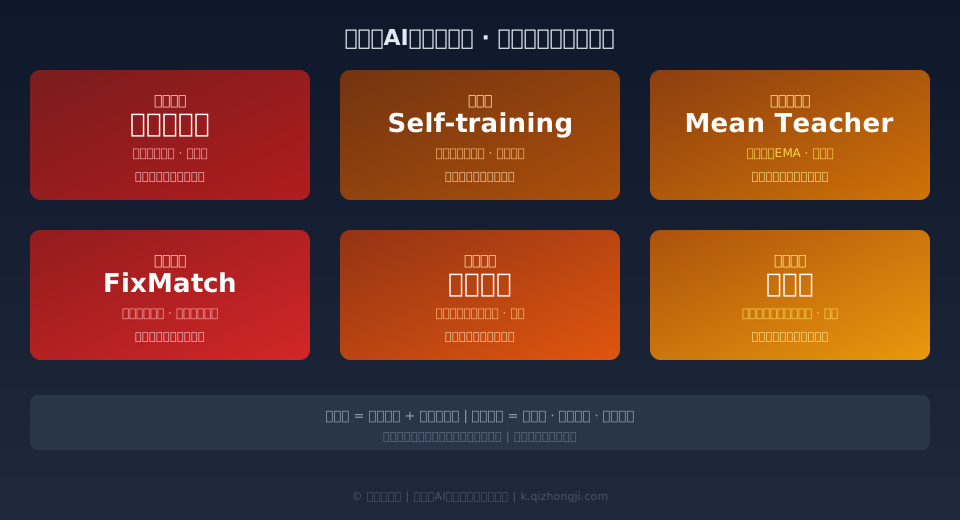
The semi-supervised learning family is large, but three approaches dominate engineering discussions: self-training, consistency regularization, and hybrid augmentation methods that combine both.
Self-training is the most straightforward. Train an initial model on labeled samples, use it to predict on unlabeled samples, treat high-confidence predictions as "pseudo-labels," retrain the model on the combined set, and repeat. Its strength is simplicity—it works with almost any model architecture. Its weakness is that early model errors get amplified through pseudo-labels, creating error accumulation.
Consistency regularization is best represented by Mean Teacher. The system maintains two models with identical architecture—a student and a teacher. The teacher's weights are an exponential moving average of the student's historical weights. During training, the same unlabeled sample is perturbed twice, and the two models are required to produce similar outputs. This perturbation-invariance constraint lets the model learn smooth decision boundaries even where no labels exist.
FixMatch combines pseudo-labeling with weak and strong augmentation: apply weak augmentation to an unlabeled sample, generate a pseudo-label from the model's prediction, then apply strong augmentation to the same sample and require the strongly augmented version to match that pseudo-label. Pseudo-labels are only used when confidence exceeds a threshold. This combination performs impressively on image classification benchmarks, but for defect detection—where targets are much smaller—augmentation strength must be chosen carefully.
AI fault diagnosis for cranes is an emerging field. The appearance of standards like ISO 24621:2022 AI Fault Diagnosis for Cranes shows the industry is beginning to bring AI capabilities into a regulatory framework. How semi-supervised methods align with the traceability and verifiability requirements of such standards is a question that must be addressed in real deployments.
Parameter Comparison Across the Three Methods
| Method | core mechanism | Noneannotated dataUsage | Pseudo-LabelnoiseSensitivity | TrainingStability | applicable working conditions |
|---|---|---|---|---|---|
| Self-Training Self-training | Iterative Pseudo-Label Refeeding | Model Predictions as Pseudo-Labels | High(Error Accumulation) | Medium(RequiredthresholdControl) | annotationMinimal and Class-Distinct |
| Consistency Regularization Mean Teacher | Teacher-StudentEMA | Perturbation-Invariant Outputs | Low(Perturbation Smoothing) | Relatively High(EMAStable) | Image-Sequential and On-SitenoiseLarge |
| Mixup Augmentation FixMatch | Weak Augmentation for Labels, Strong Augmentation for Features | Dual-Branch Weak-Strong Augmentation | Low(Confidence Threshold) | Relatively High | Image Tasks with Mature Augmentation Techniques |
| Graph-Based Semi-Supervised Graph-based | Sample Similarity Graph Propagation | Label Diffusion via Similarity Relations | Medium(Dependent on Graph Construction Quality) | Medium | structuringData with Explicit Relations |
| Generative Semi-Supervised | Generative Model for Sample Supplementation | Generated Pseudo-Sample Expansion | Medium | Medium | Extremely Scarce Samplesoperating condition |
Pseudo-Label Noise, Distribution Assumptions, and When to Use Each Semi-Supervised Approach
No single semi-supervised method wins across the board. The right choice comes down to two variables: whether your unlabeled data follows the same distribution as your annotated data, and how tolerant your task is to pseudo-label errors.
When unlabeled data comes from the same equipment fleet and similar operating conditions, distribution drift is minimal, and self-training with a strict confidence threshold performs well. If field data is noisy and operating conditions vary widely, consistency regularization's noise resistance becomes more valuable. For image-based tasks with mature augmentation pipelines, hybrid methods like FixMatch typically deliver the clearest gains.
The flip side: once distribution assumptions break down, semi-supervised learning can hurt more than it helps. A typical failure scenario is unlabeled data that mixes operating conditions from different tonnages, mechanisms, or even different manufacturers' equipment, while the annotated data covers only a narrow slice. The model then "learns" structural patterns from unlabeled data that are really cross-equipment interference.
Kelude's recommendation across multiple projects has been consistent: verify distribution consistency first, then choose your method. The checklist below covers eight points to work through before rolling out semi-supervised learning.
📋
Annotated Baseline
Run a fully supervised baseline first to confirm annotation quality
🔍
Distribution Check
Verify unlabeled and annotated data share the same distribution
📊
Pseudo-Label Threshold
Set a confidence gate to prevent error accumulation
🧪
Data Augmentation
Match strong/weak augmentation strategies to defect characteristics
🛡
Noise Monitoring
Continuously track pseudo-label contamination rates
🔄
Incremental Retraining
Feed new operating-condition samples back into training periodically
📏
Evaluation Loop
Benchmark against fully supervised on an independently annotated test set
👥
Human Fallback
Route low-confidence samples to manual review
Is Semi-Supervised Annotation Cost Savings Worth It? A Real-World Breakdown
The most direct way to judge whether semi-supervised learning pays off is to put three things side by side: the volume of annotated data, the annotation cost, and the accuracy ceiling. Fully supervised training offers the highest accuracy ceiling, but it demands complete annotation coverage. Semi-supervised learning trades a portion of annotation effort for near-comparable accuracy, at the cost of two added risks: distribution assumptions and pseudo-label noise.
It's worth emphasizing that semi-supervised learning mainly saves on "repetitive annotation" costs, not the entire annotation budget. The initial high-quality annotated dataset remains the foundation — it sets the ceiling for pseudo-label quality. This also explains why semi-supervised learning is still in early validation stages in the crane industry: where the data foundation isn't solid yet, even the most advanced methods won't take root. When Kelude plans AI roadmaps for customers, data governance always comes before semi-supervised method selection.
Kelude's after-sales data shows that what actually stalls projects is rarely a model being a few accuracy points off — it's the engineering loop of annotation, cleaning, and retraining that hasn't been closed. Getting that math right matters more than agonizing over which semi-supervised framework to use.
Annotation Cost Comparison Across Training Approaches
| Training Scheme | annotated dataDependent on Graph Construction Quality | Relativeannotation cost | AccuracyCeiling Reference |
|---|---|---|---|
| Fully Supervised(Full-Scaleannotation) | Tens of Thousands to Hundreds of Thousands of Images | 100%(Baseline) | Highest Upper Bound,Subject toannotationQuality Constraints |
| Graph-Based Semi-Supervised(Approximately 30%annotation) | Small AmountannotationPlus Large Amount of Unlabeledannotation | SignificantLowering | Approaching Fully Supervised,Based onoperating conditionAs Reference |
| Self-Supervised(Zeroannotation) | Unlabeled Onlyannotated data | Lowest | Effective in Representation Stage,Downstream Still Requires Small Amountannotation |
| active learningPlus Semi-Supervised | On-Demand Incrementalannotation | Moderate | More Stable Under Equal Budget,Requires Human-in-the-Loop |
📖 Related reading: How 500,000 annotated images were produced for crane defect detection | AI visual inspection for cranes: a complete overview
FAQ
Q: How much accuracy do you actually lose with semi-supervised learning compared to fully supervised learning?
A: There is no fixed number — it depends on the size of the annotated dataset, the quality of the unlabeled data, and how well the two distributions match. When annotations are plentiful and high-quality, fully supervised learning remains the most reliable baseline. When annotations are scarce, semi-supervised learning typically outperforms a fully supervised model trained on the same limited annotation budget. For crane defect detection, fully supervised approaches are still the engineering mainstream; semi-supervised methods are mostly at the validation stage, and the accuracy ceiling depends on real-world operating conditions. Kelude always runs head-to-head comparisons on an independent test set rather than quoting numbers straight from research papers.
Q: How do I decide whether to adopt semi-supervised learning for a crane defect detection project?
A: Start with two conditions: whether the unlabeled data comes from the same distribution as the annotated data, and whether annotation cost is the dominant expense. If you have accumulated a large volume of raw images, vibration, or current data from the same operating conditions, but your annotation team can only label a fraction of it, semi-supervised learning is worth trying. Conversely, if the dataset is small or distribution drift is significant, investing in solid data acquisition and cleaning will pay off more than forcing a semi-supervised approach.
Q: How do I detect and fix error accumulation from pseudo-labels in a semi-supervised model?
A: Typical warning signs are validation accuracy rising then falling, or consistent misclassification of certain sample types. First, tighten the confidence threshold for pseudo-labels so only high-confidence samples are fed back. Then check whether the strong and weak augmentations are destroying critical defect features. If needed, pull out the misclassified samples, run manual review, and add them back into the annotated set. Pseudo-label contamination needs continuous monitoring — not a one-time check after training.
