

Ship Crane Classification Society Certification: CCS vs DNV vs ABS
A Ship Crane must pass classification or certification inspection by a recognized Classification Society before it can be installed and put into service. The world's major classification societies—CCS (China), DNV (Norway), ABS (USA), LR (UK), and BV (France)—follow broadly similar certification procedures, but they differ significantly in design review depth, material traceability requirements, and NDT sampling rates, which directly impacts certification lead time and cost.
Classification certification is the first hurdle for any crane manufacturer aiming to enter the marine and offshore market. A crane without a class certificate is like a car without CCC certification—no matter how advanced the technology or competitive the price, shipowners and shipyards will not risk using it, because uncertified equipment prevents the entire vessel from passing classification surveys and obtaining safety certificates.
The comparative analysis of certification processes is based on each society's current classification rules and the IACS UR series unified requirements, with the crane design specification grounded in ISO 4301 as the underlying design standard.
For domestic crane manufacturers—especially those transitioning from land-based to offshore applications—the classification certification process is often the biggest knowledge gap: "Which society should we choose?" "Is CCS easier to pass than DNV?" "How much will certification cost and how long will it take?" Drawing on Kelude Heavy Industry's years of hands-on experience with Ship Crane certification projects, this article provides a systematic comparison of the certification requirements across the five major classification societies.
Market Share and Application Scenarios of the Five Major Classification Societies
Choosing a classification society is not a unilateral decision for the crane manufacturer—the final society is specified by the shipowner in the vessel construction contract (or proposed by the shipyard and approved by the shipowner). However, understanding each society's market footprint helps manufacturers plan their certification strategy in advance. DNV holds approximately 35% of the global offshore platform and FPSO market—particularly strong in the North Sea and West Africa—and is the preferred society for offshore platform cranes. ABS is equally dominant in the US Gulf of Mexico, Brazil, and Southeast Asia offshore markets. CCS is the statutory classification society for Chinese-flag vessels, with 100% coverage on China's coastal and inland waterway ships. LR retains strong traditional influence in the UK, India, and the Middle East. BV leads in the French West Africa and Mediterranean cruise ship markets.
| Classification Society | Global Market Share | Offshore Advantage Regions | crane Related Specification | Certification Complexity |
|---|---|---|---|---|
| DNV | ~18% | North Sea/West Africa/Brazil FPSO | DNV-ST-0378 | Most Stringent |
| ABS (USA) | ~15% | Gulf of Mexico/Southeast Asia/Brazil | ABS (British Standard) Lifting Guide | |
| CCS | ~10% | Chinese Flag/Domestic Trade/Coastal | 《Steel Sea-going Vessel Classification Specification》 | |
| LR | ~12% | United Kingdom/India/Middle East | LR Lifting Code | |
| BV | ~11% | France/West Africa/Cruise Ship | BV NR 526 |
Certification Process Overview: From Design Review to Certificate Issuance
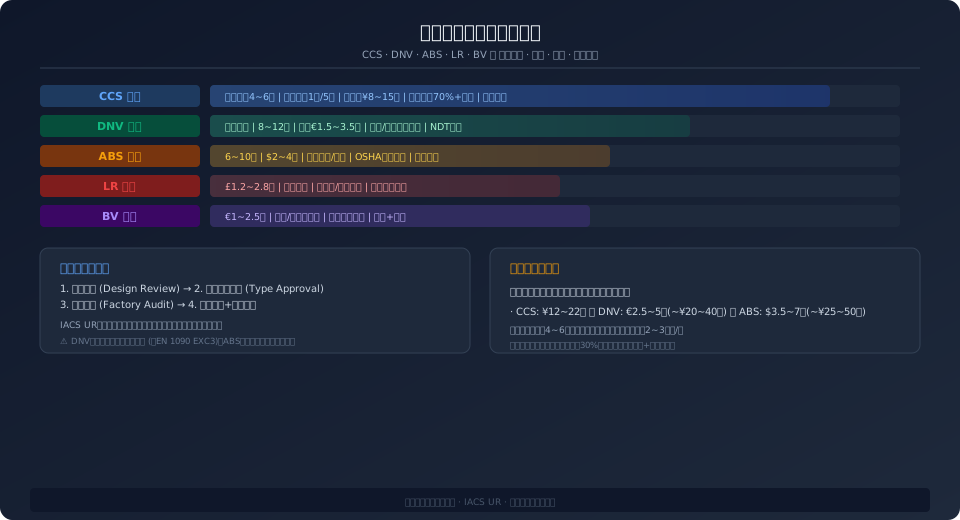
While specific requirements vary among classification societies, the certification process can be broadly grouped into five stages. Stage One: Design Review — The manufacturer submits the crane's complete design drawings and calculation documents to the classification society, including the General Arrangement Drawing, steel structure drawings, mechanism transmission drawings, Hydraulic schematic diagram, Electrical Schematic, safety device layout, major component lists, and the Technical Specification. The society's review engineers examine each item for compliance with applicable codes (e.g., DNV checks the mesh density and boundary conditions of the structural FEM analysis report, while CCS verifies material allowable stresses and Safety factor values), and issue a Comment Sheet. The manufacturer responds, revises the drawings, and resubmits until all comments are Closed.
Stage Two: Factory Approval/Material Certification — Surveyors visit the manufacturing facility to audit the Quality Management System (typically requiring ISO 9001 certification; some societies such as DNV additionally mandate ISO 3834 Quality requirements for fusion welding). They verify the heat-number traceability of raw materials (Steel Plate, forgings, castings) and EN 10204 3.1/3.2 certificates, and witness Welding procedure qualification record (WPQR) and Welder qualification tests. Stage Three: Fabrication Surveillance — Surveyors conduct periodic site visits (typically 1–2 times per week) to inspect critical processes: Cutting dimensions of main structural Steel Plate, weld bevel preparation, Preheating (≥100°C when plate thickness exceeds 30 mm), Welding parameter records, Post-Weld Heat Treatment (PWHT) where required, and non-destructive testing of welds (UT/MT/PT). The NDT sampling rate is where classification societies diverge most — CCS typically requires UT sampling of 20%–30% of critical Weld Seams, while DNV and ABS require 30%–50%.
Type Test and Factory Test: Key Differences Between Classification Societies
Stage Four: Type Test — This is the most critical milestone in the certification process and the area with the greatest variation in requirements among societies. All classification societies require a Static load test (1.25 × SWL, held for 10 minutes) and a Dynamic Load Test (1.1 × SWL, completing at least 3 full operating cycles of Hoisting / Lifting, Lowering, Slewing, and Luffing). However, key differences include:
| Test Project | CCSRequirement | DNVRequirement | ABS (British Standard)Requirement |
|---|---|---|---|
| Static load test | 1.25×SWL 10min | 1.25×SWL 10min | 1.25×SWL 10min |
| Dynamic Load Test | 1.1×SWL Full Operation Cycle | 1.1×SWL Full Operation Cycle | 1.1×SWL Full Operation Cycle |
| Overload Protection Test | 1.1×SWLTrigger | 1.1×SWLTrigger, Actual Value at Trigger to be Recorded Load | 1.1×SWLTrigger |
| Brake Test | Load Hovering5min No Drift | Load Hovering10min, Measure Drift≤50mm | Load Hovering5min No Drift |
| Safety Devicefunctional test | Each Safety Function2Times | Each Safety Function5Times+FMEAVerification | Each Safety Function2Times |
| Emergency Operation Test | Manual pump Single Operation | Manual pump3Times+Accumulator Release2Times | Manual pump Single Operation |
Stage 5: Certification and Annual Survey. Once initial certification is complete, the classification society issues a Full-Term Certificate valid for five years, subject to satisfactory completion of an Annual Survey each year to maintain its validity. The Annual Survey is typically completed in one day (for cranes installed onboard) and covers: operational functional tests, safety device testing, visual inspection of wire ropes, brake clearance measurement, and visual structural inspection. If defects are found during the Annual Survey (e.g., wire rope reaching discard criteria, safety device failure), the surveyor will issue a Condition of Class (CoC) rectification notice. The owner must complete the rectification within the specified timeframe (typically 30–90 days) and apply for re-survey; otherwise, the certificate may be suspended.
Certification Timeline and Cost Estimate
The certification cycle covers five stages—drawing approval, factory inspection, manufacturing process surveillance, type testing, and certificate issuance—and typically takes 4 to 8 months from signing the survey contract to issuance of the Full-Term Certificate. CCS offers the shortest cycle (4–5 months, as both plan approvers and surveyors are Chinese nationals, enabling efficient communication), while DNV and ABS generally require 6–8 months (involving foreign plan approvers, bilingual drawing submissions in Chinese and English, and time-zone differences that impact communication efficiency).
Certification costs comprise the following components (based on a 50t marine deck crane as reference): ① Drawing approval fee: ¥30,000–80,000 (charged according to the number and complexity of drawings); ② Initial Factory Approval review fee: ¥20,000–50,000 (including travel expenses); ③ Manufacturing process inspection fee: ¥50,000–150,000 (depending primarily on the factory location and inspection frequency, e.g., 2 visits per week × 3 months ≈ 20 visits × ¥2,000–5,000 per visit); ④ Type Test witnessing fee: ¥30,000–80,000 (including surveyor travel and test counterweight costs); ⑤ Certificate issuance fee: ¥10,000–30,000. The total estimated cost ranges from approximately ¥140,000 to ¥390,000. Note that these figures are estimates for domestic (China-based) factories; if the manufacturer is located overseas or requires foreign surveyors for cross-border inspection, costs may double—the actual amount is subject to the survey contract.
| Cost Item | CCS | DNV | Cost Description |
|---|---|---|---|
| Drawing Approval | ¥3~50,000 | ¥5~80,000 | Dependent on Drawing Quantity and Complexity |
| Factory Approval | ¥2~30,000 | ¥3~50,000 | Inclusive of Quality Management System Review |
| Manufacturing In-Process Inspection | ¥5~80,000 | ¥8~150,000 | Dependent on Factory Location and Inspection Frequency |
| Type Test Witnessing | ¥3~50,000 | ¥5~80,000 | Inclusive of Surveyor Travel and Counterweight Cost |
| Certificate Issuance | ¥1~20,000 | ¥2~30,000 | Full-term Certificate(5Valid for One Year) |
| Annual Inspection(Per Annum) | ¥0.5~10,000 | ¥1~20,000 | Per Occasion Inspection1Day |
Common Classification Society Review Comments and How to Address Them
Based on years of experience with ship crane certification, three types of review comments come up most frequently. Knowing them in advance can significantly shorten the plan approval cycle. First: Unrealistic boundary conditions in FEM analysis reports. Review engineers often point out that the model's constraint setup doesn't match real-world conditions — for instance, bolted connections of the slewing bearing are simplified as fixed supports when they should be modeled as elastic constraints. The fix is to add spring stiffness calculations or switch to contact nonlinear analysis. Our approach: the initial FEM submission already uses conservative yet reasonable constraint assumptions, with detailed justification of boundary conditions attached. Second: Safety factors for allowable material stress don't align with class rules. Different classification societies apply slightly different allowable stress values for the same material (DNV uses 0.67× yield strength, CCS uses 0.60×). Submitting calculations based on Chinese national standards directly to DNV will inevitably result in rejection. Our approach: the cover page of the calculation notes states that all calculations follow DNV-ST-0378, with values cross-checked line by line against the relevant rule tables. Third: Missing FMEA (Failure Mode and Effects Analysis) report. DNV and ABS require FMEA analysis for safety-related control systems (such as load moment limiters and brake control circuits) to identify all single-point failure modes and their consequences; CCS does not mandate this. This item is frequently overlooked by domestic manufacturers applying for DNV certification for the first time.
Frequently Asked Questions
Q: If a crane already holds a CCS certificate, can we still obtain DNV certification? Do we need to repeat all tests?
A: Yes, it's possible, but it's not simply a matter of "swapping certificates." DNV will accept some drawings already approved by CCS (you'll need to submit the closed review comments from CCS as reference), but they will independently review critical drawings — especially the structural FEM analysis report and hydraulic schematic diagram. DNV plan approvers typically demand stricter mesh quality and boundary conditions than CCS, so you may need to resubmit certain analysis reports. Regarding type tests: if no more than 12 months have passed since the last CCS test and the test report was signed and witnessed by a CCS surveyor, DNV may partially accept the results (e.g., accepting load test data but requiring functional tests of safety devices to be repeated). The final decision rests with the DNV project manager. The retrofit certification typically takes 3–5 months and costs 50%–70% of the initial certification fee. If the crane is already installed onboard, additional survey fees for the DNV surveyor's onboard inspection will apply.
Q: How should a ship crane manufacturer choose its first classification society?
A: Choose based on your target market. If your primary customers are domestic coastal and inland vessels, CCS is the best starting point — shortest timeline, lowest cost, and no language barrier. If you have clear offshore project ambitions overseas (such as ADNOC in the Middle East or Petronas in Southeast Asia), go directly with DNV or ABS certification. Many international oil companies (Shell, BP, TotalEnergies) explicitly require "DNV or ABS certification" in their equipment procurement specifications and will not accept CCS as a substitute. If budget allows, applying for CCS + DNV dual certification simultaneously is a smart move — the technical standards of both systems (both based on IACS unified requirements) have largely converged, and the incremental cost is about 30%–40% with an additional 2–3 months, which is more economical than doing CCS first and adding DNV later.
Q: What happens if the annual survey expires? Can the certificate be reinstated?
A: An annual survey is considered valid if completed within 3 months before or after the anniversary date. If you miss this window, the certificate doesn't lapse immediately — the classification society grants a grace period (typically 30–60 days) during which the overdue survey can still be completed. However, if the grace period also passes (i.e., more than 5 months past the anniversary date without survey), the certificate is automatically suspended. The crane must not be used during suspension; doing so could lead the classification society to revoke the vessel's class certificate entirely. To reinstate a suspended certificate, you'll need to complete the overdue annual survey plus an additional comprehensive inspection (similar to a simplified special survey), at roughly 2–3 times the cost of a routine annual survey. The suspension record remains permanently in the classification society's database and may affect technical due diligence in future vessel sale and purchase transactions.
Q: Does a ship crane need re-certification after modification or retrofitting?
A: It depends on the scope of the modification. If you're only replacing wear parts of the same model (e.g., wire rope, brake friction linings, seals), reporting the change to the surveyor during the annual inspection and keeping a record is sufficient—no re-certification is required. However, an "Alteration Survey" must be applied for if any of the following applies: ① replacement of the hoisting mechanism (changes to motor, gearbox, or drum model); ② modification of the steel structure (e.g., extending the crane lighter, adding counterweight, or changing the slewing bearing model); ③ upgrade of the electrical control system (e.g., switching from relay control to PLC control, or adding explosion-proof certification). The alteration survey process is essentially a simplified version of new equipment certification—submit the modification drawings and calculations for plan review, have the surveyor witness the load test on site, and update the certificate. The cost for an alteration survey ranges from ¥30,000 to ¥80,000 (approx. $4,400–$11,800), with a typical turnaround of 4–8 weeks. Unauthorized modifications carried out without class society approval are a serious violation; if discovered during a Port State Control (PSC) inspection or the owner's own audit, the certificate will be suspended immediately.
Kelude Heavy Industry provides certification consulting, plan approval, and inspection coordination services for ship crane projects across all major classification societies, including CCS, DNV, ABS, LR, and BV. Contact our engineering team for a tailored solution.
