

Low-Temperature Offshore Crane Steel Selection & Impact Toughness
When offshore cranes operate in extreme cold regions such as the Arctic, the North Sea, and the Russian Far East, ambient temperatures can drop to -40°C or even -50°C. At these temperatures, standard carbon steel undergoes a ductile-to-brittle transition, causing a sharp drop in Impact Toughness and the risk of unannounced brittle fracture. The core of low-temperature material selection lies in Charpy V-notch impact energy (CVN) and the Ductile-to-Brittle Transition Temperature (DBTT). Critical load-bearing components must use low-temperature ship plate steels such as EH36, FH36, or API 2W Gr.50.
In 1943, the American Liberty Ship S.S. Schenectady was moored quietly at the Portland shipyard in -2°C weather — with no wind or wave loading whatsoever, the hull suddenly cracked in two. The investigation revealed that the fracture originated in a steel plate with a transition temperature of approximately +10°C — at -2°C, that plate had already shifted from ductile to brittle behavior. Since then, low-temperature Impact Toughness has become the primary mandatory material selection indicator in ship and offshore structure design codes worldwide. Offshore platform cranes operate in the harshest industrial environments on Earth, enduring not just the cold itself, but the triple combination of low temperature, wave-induced dynamic loads, and welding residual stresses — placing their material requirements a full grade above conventional shipbuilding steel.
Low-temperature steel selection for crane structures follows the low-temperature toughness requirements of classification society rules (DNV-OS-C101, ABS Part 2 Chapter 1), with load case combinations per ISO 4301 Crane Design Standard.
Ductile-to-Brittle Transition: Why Steel Gets Brittle in the Cold
Steel exhibits a temperature-dependent fracture mechanism: above a certain temperature, the material absorbs energy through plastic deformation, producing a fibrous fracture surface (ductile fracture). Below that temperature, dislocation movement within the crystal lattice becomes "frozen," the material can no longer dissipate energy through plastic deformation, and once a crack initiates it propagates at near-sonic speed, leaving a granular fracture surface (brittle fracture). This transition temperature — the Ductile-to-Brittle Transition Temperature (DBTT) — is the single most important indicator of a steel's low-temperature performance.
In practice, DBTT is measured using the Charpy V-notch impact test (CVN Test): a standard 10×10×55mm specimen with a 2mm-deep V-notch is soaked at the target temperature for at least 5 minutes, then struck once by a pendulum, and the absorbed impact energy (in Joules) is recorded. Classification societies and offshore codes specify different CVN requirements for different components at the minimum design temperature: primary load-bearing members (such as crane lighter chords, slewing bearing races, and A-frames) require longitudinal CVN ≥ 34J (individual minimum ≥ 24J), while secondary members require ≥ 27J. The test temperature is typically set 10–20°C below the minimum design temperature (e.g., for a -40°C design temperature, testing is performed at -50°C or -60°C).
Low-Temperature Steel Grades: A Tiered Selection from EH36 to Stainless Steel
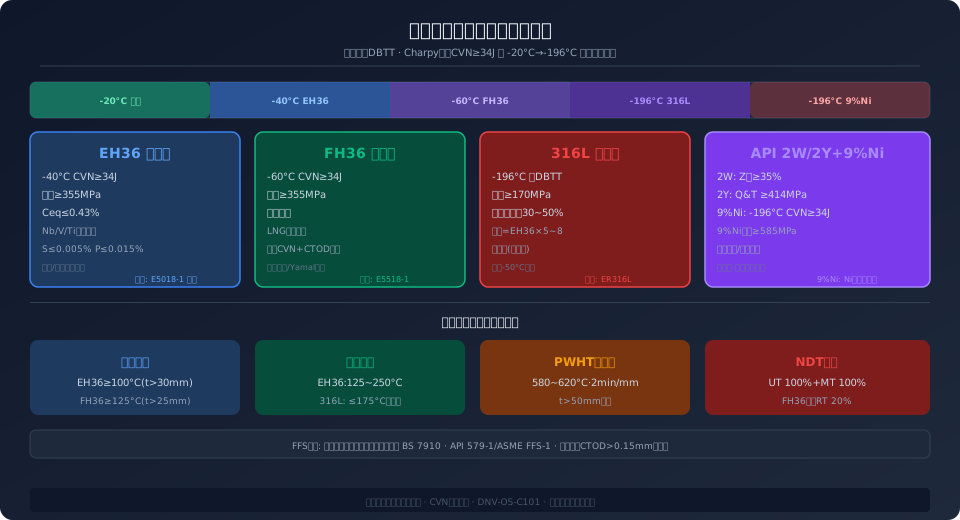
Steels used for low-temperature offshore crane applications fall into three tiers. The first tier is low-temperature ship plate steel — EH36 (tested at -40°C, CVN ≥ 34J) is the most widely used offshore structural steel, commonly found on offshore platform cranes and deck cranes in the North Sea and Arctic waters. Its chemical composition features a low carbon equivalent (Ceq ≤ 0.43%) for excellent weldability and reduced cold-crack risk, microalloying (0.02%–0.05% Nb/V/Ti for grain refinement and improved low-temperature toughness), and low sulfur and phosphorus content (S ≤ 0.005%, P ≤ 0.015%) to minimize inclusion-induced localized embrittlement. FH36 is the higher-grade low-temperature ship plate, suitable for minimum design temperatures down to -60°C (CVN ≥ 34J at -60°C).
The second tier is API-standard offshore steel — API 2W Gr.50 and API 2Y Gr.60, produced to American Petroleum Institute standards and widely used in Gulf of Mexico and Brazilian offshore projects. The key difference from EH36: API 2W imposes additional through-thickness (Z-direction) reduction-of-area requirements (≥ 35%, versus only ≥ 25% for EH36), making it better suited for gusset plates subjected to through-thickness tensile loads. API 2Y, through Quenching + Tempering (Q&T), achieves higher strength (Yield Strength ≥ 414MPa, versus ≥ 355MPa for EH36), offering a significant advantage in reducing Dead Weight.
The third tier is low-temperature stainless steel and nickel steel — for extreme environments below -50°C (such as Arctic ice zones and Russia's Yamal LNG project), austenitic Stainless Steel 316L (no DBTT; retains excellent toughness even at -196°C) is the material of choice. However, its Yield Strength is only ≥ 170MPa (far below EH36's 355MPa), requiring larger sections to compensate for the strength deficit — increasing structural weight by 30%–50% — and its unit material cost is 5–8 times that of EH36. 9% nickel steel (ASTM A553 Type I) is another option — Yield Strength ≥ 585MPa, CVN ≥ 34J at -196°C — and is the classic material for LNG storage tanks, though its use in crane structures is limited by complex welding requirements (dedicated Ni-based filler metals and strict Preheating plus Post-Weld Heat Treatment procedures).
| Steel Grade | Minimum Design Temperature | Yield Strength | CVNRequirement | Application Scenarios |
|---|---|---|---|---|
| EH36 | -40°C | ≥355MPa | -40°C≥34J | North Sea/Arctic Offshorecrane |
| FH36 | -60°C | ≥355MPa | -60°C≥34J | Extreme Cold Marine Environment/LNGProject |
| API 2W Gr.50 | -40°C | ≥345MPa | -40°C≥34J ZFor≥35% | Gulf of Mexico/Gusset Plate |
| API 2Y Gr.60 | -40°C | ≥414MPa | -40°C≥34J Q& THeat treatment | lightweight design High Strength Demand |
| 316L Stainless Steel | -196°C | ≥170MPa | None DBTT | Extreme-50°CBelow/Food Grade |
| 9%Ni Steel | -196°C | ≥585MPa | -196°C≥34J | LNGStorage Tank/Cryogenic Structure |
Welding: The Weakest Link in Low-Temperature Steel Structures
Even the finest low-temperature steel will develop brittle microstructures in the weld seam or heat-affected zone (HAZ) if welding procedures are not properly controlled. Three critical control points govern low-temperature steel welding:
①Preheating Temperature — Preheating prevents rapid cooling of the weld, which can otherwise form hardened martensitic microstructures. For EH36 steel, the preheating temperature is typically ≥100°C (when plate thickness exceeds 30mm). In practice, the target is calculated as Max(100°C, 0.4 × plate thickness in mm) — for example, a 50mm plate requires Max(100, 20) = 100°C, and a 100mm plate requires Max(100, 40) = 100°C. The preheating zone must extend at least 75mm on each side of the weld seam. Use electric heating blankets with temperature controllers for uniform heating — never use flame torches for localized "spot preheating," as the steep temperature gradient introduces thermal stress. Interpass temperature control must be maintained between the preheating temperature and 250°C; exceeding this upper limit causes grain coarsening, which also degrades toughness.
②Filler Metal Matching — For low-temperature steel welding, the filler metal must exhibit a lower ductile-to-brittle transition temperature than the base metal (the "undermatching" principle — it is preferable to have weld metal strength slightly below the base metal than to compromise weld toughness). Recommended consumables for EH36: E5018-1 electrodes (low-temperature basic electrodes, CVN ≥47J at -45°C), F7A8-EM12K submerged arc welding wire and flux, and E71T-1C-J flux-cored wire. DNV requires diffusible hydrogen testing (mercury method, H_DM ≤5mL/100g) on every batch of consumables before warehouse acceptance, ensuring hydrogen content in the weld will not trigger hydrogen-induced delayed cold cracking.
③Post-Weld Heat Treatment (PWHT) — For EH36 primary load-bearing welds on plates thicker than 50mm (such as crane lighter root joints), post-weld stress-relief heat treatment is typically required: heat at a rate not exceeding 50°C/h to 580–620°C, hold for 2 minutes per mm of plate thickness (minimum 30 minutes), then furnace-cool at ≤50°C/h to below 300°C before air cooling. The purpose of PWHT is not to improve low-temperature toughness (in fact, for TMCP-controlled rolled plates, toughness may remain unchanged or even decrease after PWHT) — it is to eliminate welding residual stress, which, when combined with low-temperature service conditions, reduces the structure's safety margin against brittle fracture.
| Welding Parameter | EH36 | FH36 | 316LStainless Steel |
|---|---|---|---|
| Preheating Temperature | ≥100°C (t>30mm) | ≥125°C (t>25mm) | ≤100°C (Carbide Precipitation Resistance) |
| Interpass temperature | 125~250°C | 150~250°C | ≤175°C |
| Welding Method | SMAW/FCAW/SAW | SMAW/FCAW/SAW | GTAW/GMAW (Ar+2%O₂) |
| Welding Consumable Matching | E5018-1 Basic (Low-Hydrogen) | E5518-1 Basic (Low-Hydrogen) | ER316L (Low Carbon Type) |
| Post-Weld Heat Treatment | t>50mm PWHT | t>40mm PWHT | Not Recommended(Desensitization (Anti-Sensitization)) |
| NDTRequirement | UT 100%+MT 100% | UT 100%+MT 100%+RT 20% | PT 100% |
Impact Test Sampling: Longitudinal vs. Transverse, Surface vs. Core
The orientation and location of CVN impact test specimens have a direct and significant effect on results. During steel rolling, non-metallic inclusions are elongated along the rolling direction into banded structures — impact energy from longitudinal (L-direction, parallel to rolling) specimens typically runs 30%–50% higher than transverse (T-direction, perpendicular to rolling) specimens, because the V-notch in transverse samples cuts directly across the inclusion bands, allowing cracks to propagate rapidly along the inclusion-matrix interface. For this reason, CVN sampling for critical load-bearing members in offshore cranes must be taken in the transverse orientation (T-L or T-S), ensuring toughness requirements are met in the most unfavorable direction.
Sampling location matters just as much — the plate surface cools faster during rolling, producing finer grains (better toughness), while the core cools slower, yielding coarser grains (poorer toughness). Per DNV-OS-B101, for members with plate thickness exceeding 40mm, CVN specimens must be taken at both the 1/4-thickness and 1/2-thickness positions (3 parallel specimens per set), with both sets meeting minimum requirements. For extra-heavy plates over 70mm thick, an additional specimen set must be taken between the 1/4 and 1/2 thickness positions — because core segregation and porosity are more severe in ultra-heavy plates, making this the highest-risk zone for low-temperature brittle fracture.
Fitness-for-Service Assessment for Low-Temperature Structures with Defects
After years of service in extreme cold, offshore cranes may develop small defects missed during fabrication (such as buried cracks or lack of fusion) or new in-service flaws (fatigue cracks, corrosion pits) in welds or base metal. Rejecting these components outright under construction codes would force crane shutdowns and incur enormous repair costs. In such cases, a Fitness-for-Service (FFS) assessment per BS 7910 or API 579-1/ASME FFS-1 can be performed — using fracture mechanics calculations (e.g., Failure Assessment Diagram, FAD) to determine whether the flawed structure can continue to operate safely under current loads and within the design life, accounting for reduced fracture toughness at low temperatures. Key input parameters for FFS include: precise defect size and location (obtained via 3D phased-array ultrasonic testing, PAUT), material fracture toughness (K_IC or CTOD) at the minimum design temperature, and maximum working stress. If the FFS assessment passes, the defect can be classified as an acceptable Engineering Critical Assessment (ECA) flaw, allowing continued crane service with inspection intervals shortened to every six months.
Frequently Asked Questions
Q: What is the difference between EH36 and DH36? Can DH36 be substituted for EH36?
A: The key difference lies in the CVN impact test temperature: DH36 must achieve CVN≥34J at -20°C, while EH36 must achieve the same at -40°C. DH36 is suitable for waters with a minimum design temperature ≥-10°C (e.g., South China Sea, Southeast Asia), whereas EH36 is intended for minimum design temperatures ≥-30°C (e.g., North Sea, Bohai Bay in winter). Substituting DH36 for EH36 in cold-water applications is absolutely not permitted — even if a particular DH36 batch happens to "coincidentally" exceed 34J at -40°C, its chemical composition and production process are not systematically optimized for toughness below -20°C (e.g., insufficient grain-refining Nb/V/Ti additions), resulting in much greater batch-to-batch toughness scatter than EH36.
Q: Is Post-Weld Heat Treatment (PWHT) mandatory for low-temperature crane structures? How does PWHT affect TMCP steel toughness?
A: Not all low-temperature structures require PWHT. DNV-OS-C101 mandates PWHT only when plate thickness exceeds these thresholds: EH36 >50mm, FH36 >40mm. For TMCP (thermo-mechanically controlled processed) steel plates, the fine-grain and precipitation strengthening effects are partially lost during PWHT's high-temperature soak — grain growth reduces both strength and toughness simultaneously. Therefore, if the design can avoid the PWHT threshold by reducing plate thickness (e.g., using API 2Y Gr.60 high-strength steel instead of EH36), that approach is strongly preferred. For structures that must use extra-heavy plate and require PWHT (such as slewing bearing mounting bases), the Welding Procedure Qualification Record (WPQR) must include CVN testing on specimens in the PWHT condition to confirm toughness still meets requirements.
Q: Do hydraulic cylinders and seals on cranes require special material selection for -40°C service?
A: Yes, it is. The toughness of both the cylinder barrel and the piston rod is equally critical at low temperatures—standard C45E (1045 steel) has a DBTT of approximately -10°C, making it extremely brittle at -40°C, where the piston rod may suffer brittle fracture under abrasion-resistant loading conditions. For low-temperature hydraulic cylinders, the barrel is recommended to be made of 27SiMn or 30CrMo quenched and tempered steel (CVN≥27J at -40°C), and the piston rod should be hard-chrome plated (20~50μm thickness), with a mandatory post-plating baking treatment at 200°C for 4 hours to remove hydrogen—hydrogen introduced during electroplating can easily trigger hydrogen-induced delayed fracture in low-temperature steels. As for seals, standard NBR (nitrile rubber) has a brittleness temperature of approximately -30°C to -35°C; below -40°C, it must be replaced with low-temperature-grade FKM (fluoroelastomer, Tg≈-20°C but serviceable down to -40°C) or FFKM (perfluoroelastomer, Tg≈-30°C, serviceable down to -50°C). The dust wiper should be made of low-temperature polyurethane (e.g., Simrit PU95/500) instead of standard NBR.
Q: Do low-temperature steel structures require post-weld dehydrogenation heat treatment (Post-Heating)? How is it different from PWHT?
A: The two serve different purposes and should not be confused. Dehydrogenation Heat Treatment (DHT) is performed immediately after welding—while the weld seam is still above the preheating temperature—by raising the temperature to 200~250°C and holding for 2~4 hours. Its purpose is to accelerate the escape of diffusible hydrogen from the weld seam, preventing hydrogen-induced delayed cold cracking (commonly known as "hydrogen embrittlement delayed fracture"). DHT is a mandatory step for all thick-plate weld seams in low-temperature steels, regardless of whether PWHT is required. PWHT, on the other hand, is a high-temperature soak at 580~620°C performed after DHT, aimed at relieving welding residual stress. The sequence must always be DHT first, then PWHT—if PWHT is carried out directly, residual diffusible hydrogen in the weld seam may accumulate during heating and form hydrogen-induced cracks. For thin-plate weldments where PWHT is not required, DHT remains mandatory (200°C×2h); the fact that "thin plates don't need PWHT" does not justify omitting DHT.
Kelude has accumulated extensive project experience in low-temperature material selection and welding procedures for offshore crane applications, offering full-process technical support—from material selection and welding qualification to manufacturing and inspection—for crane projects destined for extreme cold environments. For detailed solutions, please contact our engineering team.
