

Permanent Magnet Lifter Selection & Safety Redundancy
Permanent magnet lifters use high-performance neodymium-iron-boron (NdFeB) permanent magnets to generate holding force, allowing safe lifting and transport of steel plates, profiles, and dies without continuous power supply. Rated lifting capacities range from 0.1 to 5 tons. Compared to lifting magnets, they offer fundamental advantages in two dimensions: safety (no loss of magnetism during power outages) and energy consumption (zero operating electricity). However, the inherent non-adjustable holding force limits their application scenarios.
In 2013, at a steel structure fabrication workshop in Jiangsu, a 10-ton lifting magnet was hoisting a bundle of 20mm thick steel plates when a lightning strike tripped the plant's power distribution cabinet. The lifting magnet instantly lost its magnetic field, and five steel plates plummeted from a height of 3 meters, directly smashing a CNC cutter on the floor below. The accident investigation concluded bluntly: "As a single-point-failure lifting spreader, the lifting magnet lacks independent load-holding capability under power-loss conditions." This incident triggered a fundamental rethinking of lifting spreader safety philosophy across the industry — was there an alternative technology that required no electricity yet delivered equivalent holding force?
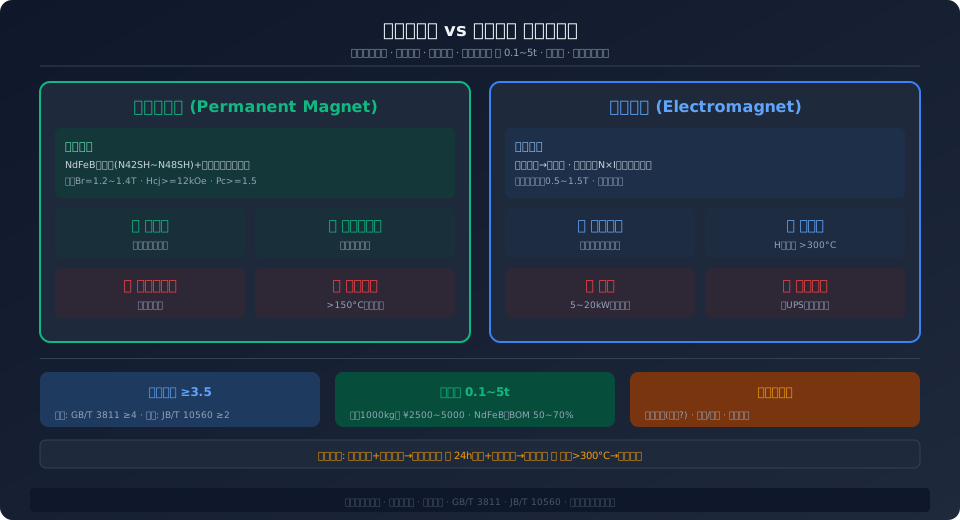
The answer is the permanent magnet lifter. Rather than relying on an external power supply, it generates a constant magnetic field through high-performance permanent magnet materials (primarily NdFeB), with a mechanical handle controlling the magnetic circuit's "on/off" state to pick up and release workpieces. Compared to lifting magnets, the intrinsic safety of permanent magnet lifters under power-loss conditions is the defining difference between the two — and the central thesis of this article.
Technical parameters in this article are based on the safety factor requirements of ISO 4301 Crane Design Standard, combined with actual performance data from JB/T 10560 Lifting Magnets for Cranes and permanent magnet materials (GB/T 13560-2017 Sintered NdFeB Permanent Magnet Materials).
This article is Part ① of the magnetic crane series. For a full three-way comparison and selection guidance, see the pillar page Magnetic Crane Selection Guide: Permanent Magnet, Electromagnetic, and Electro-Permanent Types — Principles, Parameters, Safety Factors
Electromagnetic vs. Permanent Magnet: One Word Apart, Fundamentally Different Safety Logic
While both lifting magnets and permanent magnet lifters can pick up steel plates, the underlying physics dictate fundamental differences in safety, applicability, and economics.
Lifting magnets generate a magnetic field via current-carrying coils — the magnetomotive force is determined by ampere-turns (N×I), and the air-gap flux density B_gap is a nonlinear function of core permeability, air-gap distance, and coil current. Their core advantage is adjustable holding force (by regulating current), accommodating steel plates of varying thicknesses and surface conditions. The critical disadvantage: power loss equals magnetism loss — a power outage means holding force drops to zero.
Permanent magnet lifters work entirely differently. They use the static magnetic field generated by NdFeB (Nd₂Fe₁₄B) permanent magnets in a closed magnetic circuit to hold workpieces. NdFeB's remanence Br reaches 1.2–1.4T (Tesla), with intrinsic coercivity Hcj ≥ 12kOe (kilo-oersteds) — meaning a palm-sized permanent magnet can generate hundreds of kilograms of holding force. The lifter's "switch" is not electrical but mechanical: rotating the internal magnetic circuit via a handle. In the "on" position, magnetic flux forms a closed loop through the bottom working face, generating suction; in the "off" position, flux is short-circuited internally, and the working face's magnetic field drops to near zero.
Taking a permanent magnet lifter with a rated lifting capacity of 1000kg as an example: it contains approximately 10–15kg of NdFeB permanent magnets (grade N42SH–N48SH, temperature-resistant to 150°C). The magnetic circuit is channeled through electrical pure iron (DT4C, permeability μr ≈ 4000–6000) to the bottom working face (two 120×80mm magnetic poles), with an air gap of 0.05–0.1mm (determined by workpiece surface roughness). Flux density at the pole faces is approximately 0.8–1.2T, with a safety factor ≥ 3.5. Handle switching force is typically ≤ 150N (about 15kgf), operable with one hand.
NdFeB Magnetic Circuit Design: Why Bigger Magnets Don't Always Mean More Holding Force
The heart of a permanent magnet lifter lies in its magnetic circuit design, which optimizes the match between the permanent magnet's B-H operating point (demagnetization curve) and the external circuit's air-gap reluctance.
The operating point is determined by the permeance coefficient (Pc). Pc = B/H, defined by both magnet geometry (area A_m / length L_m) and air-gap permeance (P_gap = μ₀ × A_gap / L_gap). For a typical N48SH NdFeB magnet (Br ≈ 1.38T, Hcj ≥ 12kOe), at Pc = 1.5, the operating point B ≈ 0.75T — meaning the effective flux output is only about 54% of remanence. If Pc drops too low (e.g., Pc < 0.5), the operating point approaches the knee point of the demagnetization curve, and the magnet undergoes irreversible demagnetization — particularly dangerous at elevated temperatures (N48SH's knee point at 100°C is approximately 0.3T higher than at 20°C).
The design goal is to achieve Pc ≥ 1.0 (preferably ≥ 1.5) while maximizing air-gap flux. These two objectives conflict — increasing Pc requires larger magnet cross-sections (cost and weight), while maximizing air-gap flux requires minimizing air-gap distance (limited by workpiece surface roughness). The optimal engineering solution involves iterative optimization of pole geometry (rectangular/trapezoidal/arc) and magnet arrangement via 3D finite element magnetic circuit simulation (e.g., ANSYS Maxwell or JMAG). Halbach arrays can boost working-face flux density by 15–25%, though manufacturing costs rise by approximately 30%.
Taking the Halbach array as an example: arranging permanent magnets with magnetization directions rotated sequentially by 90° concentrates the magnetic field on one working side while nearly canceling it on the other — forming a closed magnetic circuit without a yoke. In permanent magnet lifters, Halbach arrays are typically used in compact high-holding-force designs (1.5t–5t class), but require specialized magnetizing fixtures and assembly processes, making manufacturing costs significantly higher than conventional arrangements.
Safety Redundancy: Three Lines of Defense for a "Never Drop" Promise
Permanent magnet lifters enjoy a reputation for intrinsic safety — no electricity required, immune to power outages. But that doesn't mean they can dispense with safety redundancy. A compliant permanent magnet lifter needs at least three lines of defense:
① Holding force safety factor ≥ 3.5. The actual holding force generated by the magnetic circuit must be ≥ 3.5 × rated lifting capacity (WLL, Working Load Limit). For example, a lifter rated at 1000kg must deliver an actual maximum holding force of at least 3500kg. The rationale behind this safety factor: hidden surface defects in workpieces undetectable by NDT (such as internal laminations) can cause sudden local air-gap changes and sharp drops in holding force — the 3.5× margin covers this uncertainty. Additionally, oil, corrosion, and surface irregularities on workpieces significantly reduce holding force — test data shows that a 0.2mm oil film or rust layer can attenuate holding force by 20–40%.
② Mechanical self-locking mechanism. The force required to switch the handle from the "engaged" position to the "release" position is ≥ 150N (about 15kgf), and the handle is fitted with a safety lock pin — the pin can only be inserted after the handle is fully rotated to the engaged position, preventing the handle from springing back to release during lifting due to vibration or accidental contact. Some premium models feature a mechanical indicator on the handle — red/green markings that visually display the magnetic circuit state, allowing operators to verify at a glance whether the lifter is locked.
③ Secondary retention device (optional). For lifting valuable workpieces or working near personnel, it is recommended to add a mechanical safety chain or wire rope secondary protection to the permanent magnet lifter — this is not a failure safeguard for the permanent magnets themselves, but rather a response to extreme scenarios such as pole-face slippage (when lateral sliding force exceeds static friction due to uneven workpiece surfaces) or operator error.
The significant gap between ISO 4301's safety factor requirement for lifting spreaders (≥ 4) and JB/T 10560's requirement for lifting magnets (≥ 2) is prompting the industry to re-examine the logic behind safety factor values in spreader standards.
Selection in Three Dimensions: Material, Thickness, and Surface Condition
Selecting a permanent magnet lifter is not a simple "match the lifting capacity" exercise — it's a three-dimensional decision:
Dimension 1: Workpiece material — the "ID card" of magnetic materials. Permanent magnet lifters can only hold ferromagnetic materials (ferritic steel, martensitic stainless steel 400 series, cast iron, etc.) and cannot be used on austenitic stainless steel (304/316), aluminum alloys, copper alloys, or non-metallic materials. For ferritic steels, higher carbon content (medium-carbon > low-carbon steel) means higher permeability and greater holding force — the same lifter can deliver 15–25% more force on Q235B steel plates than on 45# steel. Workpiece thickness also matters: for thin plates (<5mm), flux saturates through the thickness direction, and effective holding force drops sharply (the so-called "flux leakage" phenomenon) — in such cases, multi-pole designs (increasing pole count to distribute flux density) or derated lifting capacity are required.
Dimension 2: Workpiece thickness and air gap. Air gap is the number-one enemy of permanent magnet lifter holding force. Paint, galvanizing layers, mill scale, and oil on workpiece surfaces all increase the effective air gap. Taking a 0.1mm air gap as an example: for a lifter with 200cm² pole area, the reluctance at a 0.1mm air gap (air) is approximately 3–5 times that at zero gap, reducing holding force by 40–60%. When purchasing, prioritize models with high-precision ground poles (Ra ≤ 0.8μm) and flat bottom working faces, and remove weld spatter, splatter, and heavy rust from workpiece surfaces using a scraper or wire brush before use.
Third Dimension: Temperature Environment — Heat Makes Permanent Magnets "Forget." The temperature resistance grade of NdFeB permanent magnets is indicated by the last two characters of their grade designation (e.g., "SH" in N48SH represents 150°C). When the rated operating temperature is exceeded, permanent magnets may undergo reversible demagnetization (magnetic properties recover as temperature drops) or irreversible demagnetization (magnetic strength permanently decreases after cooling). For high-temperature applications such as lifting hot-rolled steel plates off the production line with plate temperatures between 200–300°C, a high-temperature-resistant grade (e.g., N42UH at 180°C or N38EH at 200°C) must be selected, along with derating — typically calculated at 60–80% of the rated lifting capacity.
For more extreme heat conditions exceeding 300°C, permanent magnet lifters are no longer suitable. In such cases, opt for a high-temperature-resistant lifting magnet (featuring Class H insulation and heat-resistant wiring in the coil) or a mechanical spreader beam solution instead.
Permanent Magnet Lifter Selection Parameters at a Glance
| Parameter | Small | Medium | Large | Heavy Duty |
|---|---|---|---|---|
| Holding Force | 0.1~1t | 1~2t | 2~3t | 3~5t |
| Magnet Grade | N42SH~N45SH | N45SH~N48SH | N48SH | N48SH~N50SH |
| Safety factor | ≥3.5 | ≥3.5 | ≥3.5 | ≥3.5 |
| Handle Operating Force | ≤80N | ≤120N | ≤150N | ≤200N(Two-Person) |
| Pole Face Dimensions | 60×40mm×2Pole | 100×60mm×2Pole | 120×80mm×2Pole | 150×100mm×2~4Pole |
| Dead Weight | 3~15kg | 15~40kg | 40~80kg | 80~150kg |
| Applicable Plate Thickness | ≥6mm | ≥10mm | ≥15mm | ≥20mm |
| Reference Price | ¥800~2,000 | ¥2,000~4,000 | ¥4,000~6,000 | ¥6,000~12,000 |
Frequently Asked Questions
Q: Which is safer — a Permanent Magnet Lifter or a lifting magnet?
A: In a power outage, the Permanent Magnet Lifter is clearly the safer option — it holds the load with zero electrical input. However, a lifting magnet offers adjustable holding force during normal operation (ideal for varying steel plate thicknesses), and models equipped with a power-loss magnetism retention system (UPS + battery backup, typically sustaining 15–30 min) also deliver a high level of safety. The right choice depends on your duty cycle: for 24/7 continuous operation with stable power, go with a lifting magnet; for intermittent use or unstable power supply, a Permanent Magnet Lifter is the better fit. Final selection should always follow the contract specifications.
Q: Can a Permanent Magnet Lifter pick up stainless steel?
A: No — austenitic stainless steels (304/316, etc.) are non-magnetic and cannot be lifted. Martensitic grades (410, 420, 440 series) and ferritic grades (430 series) are magnetic and can be handled. Duplex stainless steels (e.g., 2205) are only weakly magnetic, with holding force reaching just 30–50% of that on carbon steel of equal thickness — not recommended for routine lifting applications.
Q: Do permanent magnets lose strength over time?
A: NdFeB permanent magnets exhibit virtually zero flux loss at room temperature — typically less than 1% per decade, provided they are not subjected to excessive heat, strong reverse magnetic fields, or severe mechanical shock. However, exposure above the rated operating temperature (e.g., N48SH beyond 150°C) can cause irreversible demagnetization, with losses ranging from 5% to 30%. We recommend checking pole-face field strength with a gauss meter every 12 months and logging the readings to track any trend.
Q: What does a 1000 kg Permanent Magnet Lifter cost?
A: For domestic (Chinese-made) lifters with N42SH NdFeB magnets and conventional magnetic circuit design, typical market pricing is: 100 kg class — ¥600–1,200; 500 kg class — ¥1,500–3,000; 1,000 kg class — ¥2,500–5,000; 3,000 kg class — ¥6,000–12,000; 5,000 kg class — ¥12,000–25,000. Imported brands (e.g., Kanetec from Japan, Tecnomagnete from Italy) typically run 2–5 times higher. The price is driven mainly by the magnet grade and quantity — NdFeB accounts for roughly 50–70% of BOM cost. These are reference prices only; the binding figure is the one in your contract.
—
Standards referenced: ISO 4301, JB/T 10560, GB/T 13560-2017
