

Overhead Crane IoT Remote Monitoring Platform
Overhead Crane IoT Remote Monitoring Platform: Over 70% of factory cranes operate without any remote monitoring, and it typically takes 4–6 hours from the onset of a fault to its detection. Built on a three-tier architecture (field layer, edge layer, cloud platform), the system collects data via OPC UA, displays real-time dashboards in the cloud, and sends alerts to mobile devices. This approach cuts fault-related downtime by 62%, with an annual investment of roughly $3,000–$4,500 per crane—recovering the cost within one year.
How long has that overhead crane been running in the workshop? How many tons has it lifted? Is the motor temperature within normal range? For most factories, the answer is "we don't know—someone has to climb up and check." This isn't an isolated issue. In our experience across numerous plants, over 70% of cranes have zero remote monitoring capability, relying entirely on operator intuition and scheduled inspections. The result: minor issues escalate into major failures, bearings overheat and burn out before anyone notices, and wire ropes are only replaced after they snap. This article walks through the full picture of building an overhead crane IoT remote monitoring platform—system architecture, data acquisition, cloud visualization, health management, and deployment costs—so plant managers can use it directly for solution evaluation.
Why Your Cranes Need Remote Monitoring
Let's talk about what we see on the ground. After years of crane retrofits and maintenance work, the pattern is consistent: when a crane fails, it takes an average of 4–6 hours from the first anomaly to actual detection. The operator hears abnormal noise and files a report; the maintenance technician arrives and diagnoses—half a day gone. Meanwhile, the production line sits idle, losing hundreds of dollars per minute.
With remote monitoring in place, data tells the story. A steel producer equipped 30 cranes with remote monitoring, and after six months the results were clear: fault-related downtime dropped 62%, unplanned maintenance fell 45%, and equipment availability rose from 81% to 93%. Just as importantly, two motor burnouts were prevented—temperature alerts triggered on mobile devices, maintenance crews intervened early, and each avoided incident saved $4,500–$7,500 in repair costs.
Remote monitoring isn't a gimmick. Its core value boils down to three words: visibility—equipment status you can see, fault trends you can see, and maintenance progress you can see.
Three-Tier Architecture: A Practical Breakdown
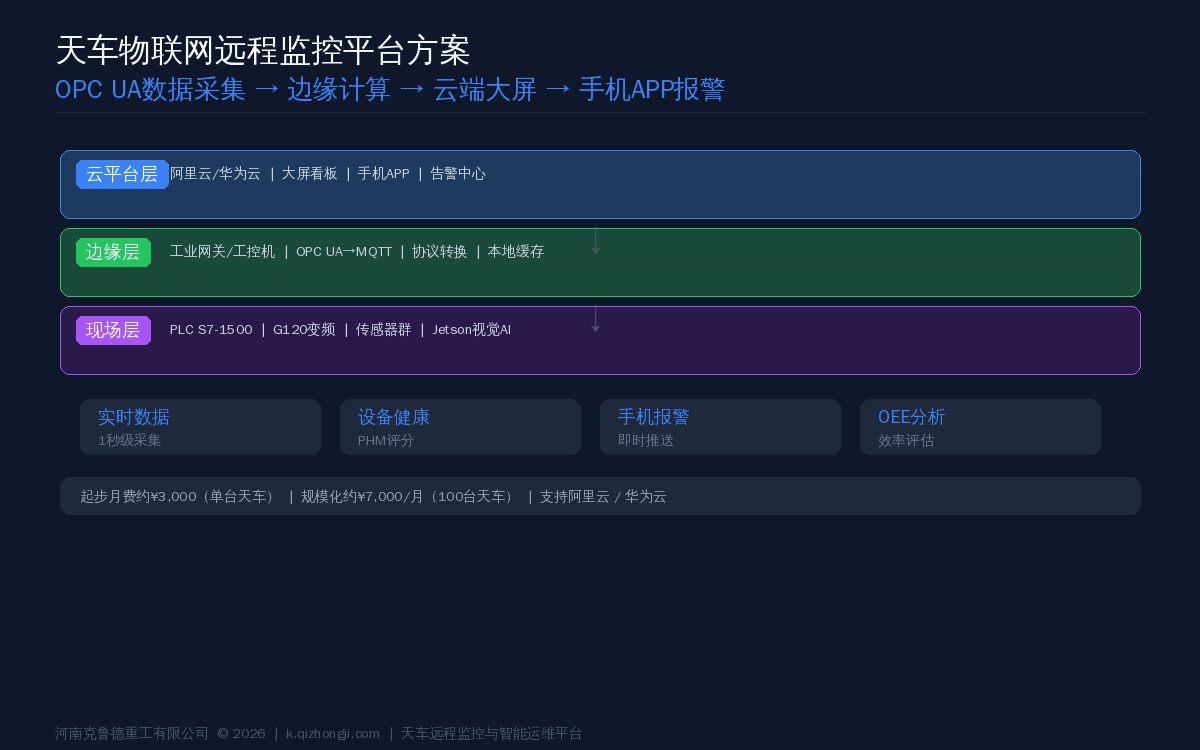
The overhead crane IoT remote monitoring platform is structured in three layers, from the ground up:
Layer 1: Field Layer—The crane's own control system. This includes the PLC (S7-1500), VFD (G120), an AI vision box (Jetson), and a suite of sensors (temperature, vibration, load, position). This layer handles operations and raw data collection.
Layer 2: Edge Layer—Industrial gateways or industrial PCs. These read data from the PLC via OPC UA, convert PROFINET protocols to MQTT/HTTP, and transmit to the cloud. Local caching ensures no data loss during network interruptions. A single edge gateway can connect 5–10 cranes.
Layer 3: Cloud Platform Layer—Hosted on Alibaba Cloud or Huawei Cloud. This layer provides device management, data analytics, an alert center, dashboard visualization, and a mobile app. It supports unified management across multiple workshops and plants.
The three layers communicate over industrial Ethernet plus 4G/5G. The data path—from sensor to PLC to edge gateway to cloud platform to mobile device—completes in under 3 seconds.
What Data to Collect and at What Frequency
Data is collected at three frequency grades—not everything needs to transmit every second, given bandwidth costs and storage overhead.
| Frequency | Cycle | Data Item | Application |
|---|---|---|---|
| High Speed | 1Second | Real-Time Position(X/Y/Z), Speed, Current Load, Motor Current, Frequency Inverter / VFD Status, Safety Status | Real-Time Monitoring, Operation Traceability |
| Medium Speed | 10Second | Motor Temperature, Reducer / Gearbox Temperature, Brake Status, Cumulative Operating Time, Daily Cycle Count | Trend Analysis, Health Assessment |
| Low Speed | 1Hour | Energy Consumption(k Wh), Maximum Load, Operating Mileage, Fault Record Summary | Daily Report/Monthly Report, OEECalculation |
Data collection frequency is not fixed. Under normal operating conditions, the system follows the schedule above. However, once an abnormal threshold is triggered—for example, motor temperature exceeding 70°C—the system automatically switches to a 1-second high-frequency collection mode until the temperature returns to normal. This dynamic sampling strategy cuts invalid data transmission by roughly 60%.
Cloud Dashboard & Mobile Alerts
Getting data to the cloud is only half the battle—the real challenge is making it actionable, not just generating charts nobody looks at.
PC Dashboard: The plant floor map displays the real-time location and status of every overhead crane (green = running, yellow = standby, red = fault, gray = offline). Click any crane to view its live data panel: load, speed, temperature, and current at a glance. The right-hand side shows today's alarm log and operational statistics.
Mobile App: Four main screens—Home (fleet overview), Monitoring (real-time data), Maintenance (schedule management), and Statistics (performance analysis). The most-used feature is push notifications: when a crane behaves abnormally, the phone alerts you instantly—no waiting for someone to notice. Custom alarm rules are supported; for instance, you can set "motor temperature >80°C sustained for 30 seconds" as the trigger to avoid nuisance alerts.
One of our clients received two "reducer temperature abnormal" alerts on their mobile app. On-site inspection revealed low lubricating oil—they topped it up and kept running, avoiding gearbox tooth damage. The client later said those two alerts saved them at least $11,800 in repair costs.
Predictive Health Management (PHM)
Real-time monitoring alone isn't enough—you need to anticipate failures. Predictive Health Management (PHM) is the next-level capability of remote monitoring, calculating a health score for each overhead crane based on vibration, temperature, load, and other collected data.
Health Scoring Model: Six weighted dimensions, each scored from 0 to 100:
- Operating hours (weight 20%): Depreciated against a 15-year/30,000-hour design life—the longer it runs, the lower the score
- Overload history (weight 20%): 5 points deducted per overload event
- Brake pad wear (weight 20%): Directly proportional to wear percentage
- Wire rope condition (weight 15%): Full score below 7% wear, then rapidly decreasing
- Reducer temperature (weight 10%): Normal below 70°C, 2 points deducted per degree above
- Motor vibration (weight 15%): Per ISO standard, normal below 2.8 mm/s, 20 points deducted per severity level above
A composite score of 85 or above indicates healthy, 60–84 indicates caution, 35–59 indicates warning, and below 35 indicates critical. Management can tell at a glance which units need attention—no need to dig through dozens of pages of reports.
The system also automatically calculates each crane's OEE (Overall Equipment Effectiveness): availability × performance × quality. World-class OEE is above 85%; typical overhead cranes run between 60–75%. One of our clients improved OEE from 63% to 78% within six months using remote monitoring plus PHM.
Deployment Options & Cost
The remote monitoring platform supports deployment on Alibaba Cloud or Huawei Cloud. Pricing depends on the number of connected devices and required features.
| Phase | Configuration | Monthly Fee | Description |
|---|---|---|---|
| Startup | 1Unit ECS 8C16G(Application+Database) + 1Unit ECS 4C8G(Frontend+Gateway) + 30Mbps Bandwidth | ≈3,000CNY | Applicable To1-5Unitoverhead crane Commissioning |
| Scalable | Application Cluster + Standalone RDS + Time-Series Database TSDB + 50Mbps + Io TGateway(1000Equipment) | ≈7,000CNY | Applicable To30-100Unitoverhead crane |
| Enterprise-Grade | Dual AZDisaster Recovery + Containerized + End-to-End Monitoring + 100Mbps + CDNAcceleration | ≈15,000-20,000CNY | Multi-Plant Applicability, High-Demand |
Hardware retrofit costs for a single overhead crane (edge gateway + sensors + installation & commissioning) typically run between $1,200 and $2,200. If the crane already has a PLC and VFD, the cost drops even further—you only need to add an edge gateway box that reads data via OPC UA. On an annual basis, total investment per crane (hardware + cloud services) comes to roughly $3,000–$4,400, which pays for itself within a year when compared to a single motor burnout repair bill ($4,400–$7,400) plus downtime losses.
Crane Remote Monitoring FAQ: Costs, Compatibility & Standards
Q: Do I need to replace my existing crane equipment for remote monitoring?
A: No. As long as your crane has a PLC Controller (S7-200/300/1200/1500 all work), you can simply add an edge gateway that reads data via OPC UA. Older relay-controlled cranes will need an electrical retrofit first—this can be combined with our legacy crane intelligent upgrade solution.
Q: Can the system be installed if our plant has no external network access?
A: Yes. The edge gateway supports 4G/5G cellular data, so no external network is required from your facility. Data is transmitted to the cloud over an encrypted channel without affecting your internal network. If your plant already has WiFi coverage, that works too—and at a lower cost.
Q: Does remote monitoring interfere with the crane's safety system?
A: No. Remote monitoring is strictly "read-only"—it pulls data from the PLC but never writes control commands. All safety interlocks, limit switches, and overload protection remain in the original PLC and are completely unaffected by the monitoring system. Cranes certified to SIL3 safety levels can be retrofitted with confidence.
Q: What can I view on my phone?
A: Live load, operating status, fault alarms, maintenance reminders, and operational statistics. Supports both Android and iOS. Plant managers see the big picture on their devices, while maintenance technicians get detailed diagnostics—access permissions are fully configurable.
Q: What standards does the crane remote monitoring system comply with?
A: The system design follows GB/T 36413-2018 (Industrial Internet of Things Overall Architecture) and GB/T 22239-2019 (Cybersecurity Classified Protection Baseline Requirements). Data acquisition interfaces comply with OPC UA (IEC 62541), and device connectivity follows MQTT 3.1.1 (OASIS standard). The crane's own safety monitoring must also meet GB/T 28264-2017 Safety Monitoring and Management System for Lifting Appliances.
Further reading: SHM and Remote Monitoring Integration—the IoT remote monitoring platform delivers real-time visualization of crane operating parameters, while the structural health monitoring system adds a steel structure safety dimension on top—moving from "watching operating data" to "watching structural safety."
Further reading: AI Large-Model Maintenance—the IoT remote monitoring platform brings crane operating data to the cloud with full visualization, and the AI large-model maintenance assistant adds intelligent Q&A capabilities, letting maintenance technicians query fault resolution procedures on-site using natural language.
