

AI Fault Diagnosis vs. Threshold Alarms for Cranes
📋 Key Summary
Threshold alarms trigger on a single parameter exceeding its limit—simple and direct, but they only catch known over-limit conditions. AI fault diagnosis, by contrast, uses multi-parameter pattern recognition to detect early anomalies, compound faults, and trend degradation that threshold alarms miss. This article compares the two across six dimensions—early warning timing, scope of coverage, false positives and missed detections, data requirements, explainability, and implementation cost—and provides a decision chain for selecting the right diagnostic approach by scenario.
If you're equipping a crane with fault diagnosis capability, you've likely grappled with these questions:
① If threshold alarms are already working, why add AI diagnosis?
② What exactly does AI diagnosis catch that threshold alarms don't?
③ Could AI diagnosis make false positives and missed detections harder to manage than threshold alarms?
④ Is AI diagnosis worth the investment for smaller-tonnage equipment?
This article lays out a head-to-head comparison of threshold alarms and AI fault diagnosis across six dimensions.
Threshold Alarms vs. AI Fault Diagnosis: Early Warning Timing and Scope of Coverage
Threshold alarms operate on a simple "parameter exceeds limit, alarm sounds" logic: temperature rise over the set point, current above rated capacity, vibration beyond the limit—each triggers an alarm. GB/T 28264 Safety Monitoring and Management System for Lifting Appliances sets requirements for parameter acquisition and data logging. This approach is simple, reliable, and easy to explain, but it has an inherent limitation—it only catches known, single-parameter over-limit conditions.
AI fault diagnosis works differently: it "learns normal patterns and identifies deviations." Models are trained on vibration, current, and temperature data from normal operation, and alarms fire when parameter combinations deviate from the learned normal pattern. ISO 24621 AI Fault Diagnosis for Cranes provides the technical framework. Its key advantage lies in detecting early signs—when parameter combinations start behaving abnormally but before any single threshold has been breached.
In engineering terms, this difference translates to how early warnings arrive and how wide the coverage extends. Threshold alarms typically fire only when a fault has already become pronounced; AI diagnosis can issue early warnings while the fault is still in its degradation stage. In Kelude's fault diagnosis solutions, threshold alarms serve as the baseline safety net, while AI diagnosis provides the lead time.
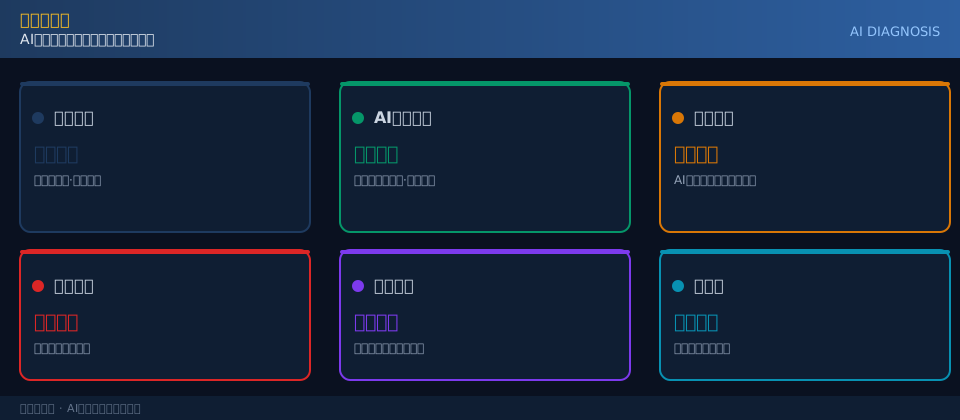
Six-Dimension Comparison: Timing, Accuracy, Data, Explainability, and Cost
| Comparison Parameter | Threshold Alarm | AI fault diagnosis | Difference Point | Datarequirements | Implementation Cost |
|---|---|---|---|---|---|
| early warningTiming | Alarm Only on Limit Exceedance | Early Deteriorationearly warning | Different Lead Times | SingleParameterSufficient | Low |
| scope of coverage | Known Single Limit Exceedance | Compound Fault and Anomaly Patterns | Different Range Widths | MultipleParameterhistorical data | Medium |
| False Alarms and Missed Alarms | Fixed Thresholds Prone to False Alarms | Learning Mode Can Reduce | CalibrationDifferent Approaches | Labeled Samples | Medium-High |
| explainability | ParameterLimit Exceedance Clearly Visible | Pattern Deviation Hard to Explain | Different Levels of Transparency | feature engineering | Medium |
This comparison table is a core reference document Kelude uses when developing diagnostic solutions. Each difference corresponds to specific early-warning capabilities and costs, helping customers determine which level of protection they need.
How to Choose by Scenario: The Diagnostic Capability Decision Chain
Threshold alarms and AI diagnostics are not mutually exclusive—they work in layers. The decision logic follows a chain: first assess equipment value, then operating-condition complexity, and finally the data foundation.
Step one: assess equipment value. Critical equipment with large tonnage, high loads, and costly downtime justifies AI diagnostics to catch early signs of trouble. For standard equipment with smaller tonnage and lighter loads, threshold alarms plus regular inspection are generally sufficient.
Step two: assess operating-condition complexity. Equipment with single parameters and well-defined failure modes is adequately served by threshold alarms. AI diagnostics deliver real value only when mechanisms are coupled, failure modes are complex, and degradation is gradual.
Step three: assess the data foundation. AI diagnostics require historical operational data. Equipment without accumulated data cannot support AI and must start with threshold alarms, building data while in service. Kelude follows this decision chain, treating threshold alarms as the baseline and AI diagnostics as the advanced tier, determining unit by unit which level applies.
Eight Must-Check Points Before Purchase
🎯
Equipment Value
Assess tonnage, load, and downtime cost
📊
Data Foundation
Is historical operational data sufficient?
🔍
Failure Modes
Single or compound complexity
🛡️
Baseline Alarms
Are threshold alarms fully deployed?
📈
Lead Time
Is early warning required?
🧠
Explainability
Can alarms be understood and acted on?
💰
Budget Limits
AI diagnostic investment vs. return
🔧
Maintenance Team
Is there in-house AI expertise?
Life Cycle Cost Comparison of the Two Diagnostic Approaches
| Cost Item | Threshold Alarm | AI fault diagnosis | Difference Direction |
|---|---|---|---|
| Initial Investment | Low | Medium-High | AIHigh |
| Data Cost | Nearly None | historical data+Labeling | AIHigh |
| maintenance cost | Low | Modelcontinuous iteration | AIHigh |
| downtime cost | Alarm Only on Limit Exceedance is Late | Early Stageearly warningReduce Losses | AISave |
FAQ: AI Fault Diagnosis
Q: What is the fundamental difference between AI fault diagnosis and threshold-based alarms?
A: The core difference lies in the logic. Threshold alarms trigger when a single parameter exceeds a preset limit—they only catch known over-limit conditions. AI diagnosis learns the normal operating pattern of the equipment and detects early anomalies where parameter combinations deviate from that baseline, even before any individual threshold is breached. One passively waits for a limit violation; the other actively seeks out deviations. The difference shows up in both early-warning timing and scope of coverage.
Q: With a limited budget, should we start with threshold alarms or AI diagnosis?
A: Start with threshold alarms. They are the safety baseline—low cost, easy to interpret, simple to maintain, and always necessary. AI diagnosis is the next step up, and it should be implemented only after threshold alarms are fully in place and sufficient historical data has been accumulated. The sequence is baseline first, AI second—AI diagnosis complements threshold alarms rather than replacing them. The two work together, not as substitutes.
Q: How do I know if my equipment needs AI diagnosis instead of threshold alarms?
A: Look at three factors: equipment value, fault complexity, and data availability. AI diagnosis is worth the investment for critical equipment with high value and heavy loads, complex multi-mechanism fault patterns, and enough historical data. For standard equipment with lower tonnage, simple fault modes, and no data history, threshold alarms plus regular inspection are sufficient. The key question is whether the equipment value justifies the cost of AI diagnosis.
Q: Why can AI diagnosis catch early faults that threshold alarms miss?
A: Because early-stage faults rarely show up as a single parameter exceeding its limit. Instead, multiple parameters drift slightly at the same time—each one stays within its threshold, but the combination is already abnormal. Threshold alarms only look at individual parameters, so they miss these combined deviations. AI diagnosis learns the normal multi-dimensional parameter pattern and can identify anomalies at the combination level. That is why it provides earlier warnings and reduces missed detections.
AI diagnosis is built on a foundation of equipment health management. For a complete approach to predictive maintenance, refer to the practices outlined in "Equipment Health Management (PHM): Big Data and ML-Driven Predictive Maintenance for Overhead Cranes".
Threshold alarms hold the safety line; AI diagnosis buys lead time. Together they form a complete diagnostic capability. Kelude follows a three-step decision framework—equipment value, operating-condition complexity, and data foundation—to help customers right-size their diagnostic capabilities without over- or under-investing.
