

How to Start Crane AI Defect Detection with Few Samples
📋 Key Summary
Annotating industrial defects is costly and slow because defects are rare, require specialized labelers, and drive up labor expenses—while generic models often fail on industrial defect data. Four few-shot approaches—data augmentation, transfer learning, synthetic data, and active learning—let AI-based detection get started with minimal labeling. This article breaks down the root causes of the few-shot challenge and lays out a practical path: start with transfer learning, then accumulate data as you go.
Here's a counterintuitive fact about AI-based crane inspection: the hardest part isn't the algorithm—it's the labeling. Open-source algorithms are plentiful; what actually stalls projects is the thousands or tens of thousands of defect samples that need manual annotation. Defects are inherently rare, and engineers who understand the equipment have to label each one by hand.
Building a labeled dataset for issues like wire breaks in wire rope, cracks in weld seams, or load skew takes months and can cost more than the algorithm development itself. This is the "few-shot dilemma" of industrial AI.
The good news: few-shot learning has matured into a set of proven techniques that let projects get off the ground with minimal annotation. Here's how it works.
The Few-Shot Dilemma: Why Industrial Defect Labeling Is Slow and Expensive
Three root causes make industrial defect labeling slow and costly. First, defects are rare. You'll have plenty of normal samples, but very few that actually show a defect—so waiting on a production line to collect enough defective samples takes time.
Second, labeling requires expertise. Industrial defects aren't like cat-or-dog photos that anyone can tag. Identifying a wire break in a steel wire rope or incomplete penetration in a weld seam takes an engineer who knows the equipment and the process. That drives up both the cost and the scarcity of qualified labelers.
Third, there's class imbalance. Defect types are numerous, but sample counts are highly uneven across categories. Rare defects may have only dozens—or even a handful—of samples. With conventional training methods, the model simply ignores these rare classes.
These three factors compound, making annotation the biggest hidden bottleneck in industrial AI inspection projects. At Kelude, annotation cost and timeline are evaluated as a standalone item when an AI inspection project is initiated.
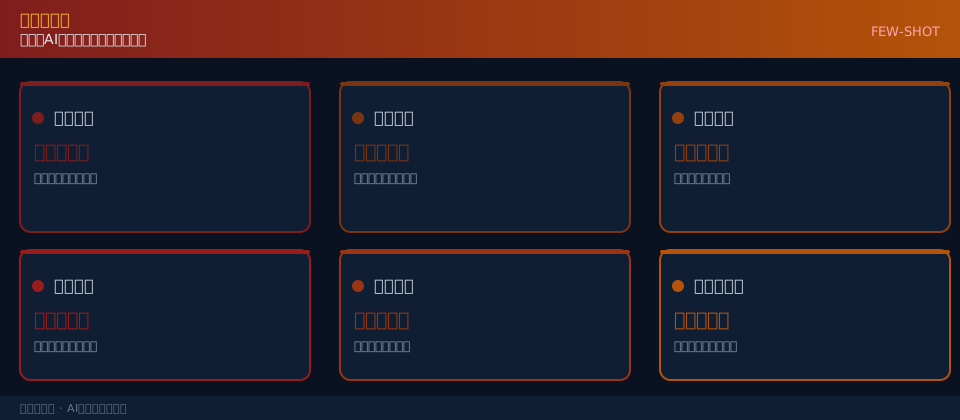
Four Few-Shot Techniques: Augmentation, Transfer, Synthetic Data, Active Learning
1. Data augmentation. Flip, rotate, scale, add noise, or adjust brightness on your existing samples to multiply them several-fold at low cost. It's the most basic and fastest win, and it solves the problem of "not enough samples."
2. Transfer learning. Start with a model pre-trained on large-scale datasets and fine-tune it for industrial defect detection with just a small amount of labeled data. ISO 24621, the standard for AI fault diagnosis in cranes, provides the implementation framework for diagnostic models. This is the most powerful technique for getting started with few samples, as it dramatically reduces your dependence on labeled data.
3. Synthetic data. Use simulation rendering or generative models to create defect samples artificially, filling gaps where real-world samples are hard to capture—especially for rare defects that are rarely seen on site.
4. Active learning. Instead of labeling every sample, let the model pick the ones it's "least certain about" and prioritize those for engineers to label. With the same labeling budget, active learning directs annotation effort to where it improves the model the most.
Root Cause Analysis: Why Generic Models Fail on Industrial Defects
Generic vision models perform well on natural images like cats, dogs, and pedestrians, but they often stumble on industrial defects. Two root causes explain this.
The first is distribution shift. The morphology, texture, and lighting of industrial defects differ vastly from natural images. The generic features learned by pre-trained models aren't sensitive enough to detect fine wire breaks or subtle cracks, so direct application yields poor results.
The second is annotation scarcity. Generic models are built on massive amounts of labeled data, while industrial defects are precisely where labeled data is scarce. The gap in data volume spans several orders of magnitude, so simply transplanting the training paradigm used for natural images doesn't work.
This is why industrial AI inspection has to take the few-shot route: it's not that more data isn't desirable—it's that data is inherently scarce, and the methodology has to adapt to that reality. At Kelude, AI inspection projects default to starting with transfer learning plus data augmentation rather than training from scratch.
A Practical Path to Few-Shot Adoption: Start with Transfer Learning, Accumulate as You Go
Getting started with few-shot learning follows a clear path—the key is not expecting perfection on day one.
Step 1: Build the skeleton with transfer learning. Pick a pre-trained model, fine-tune it with a small set of labeled samples to get a first working detection model, and get the system running. The goal here is "good enough to use," not "perfect."
Step 2: Deploy and accumulate data in production. Once the system is live, continuously feed misclassified samples and new defect types back into the labeling workflow, letting the dataset grow naturally with usage. ISO 24619, the standard for IoT interfaces in cranes, provides the access system for data acquisition and feedback loops. This step is the long-term engine of any few-shot project.
Step 3: Boost efficiency with active learning. When labeling budgets are tight, let the model prioritize the hardest samples for labeling, so every dollar of annotation spend goes where it matters most. Kelude's AI inspection projects follow exactly this path: start with transfer learning, accumulate data in production, and use active learning to maximize efficiency.
Few-Shot Methods and Application Scenarios at a Glance
| Method | Problem Addressed | Initial Cost | Performance Ceiling | Application Scenarios |
|---|---|---|---|---|
| data augmentation | Insufficient Sample Size | Extremely Low | Medium | Universal Across Scenarios |
| Transfer Learning | Insufficient Annotation Volume | Extremely Low | High | Preferred for Few-Shot Start |
| Synthetic Data | RareDefectUncapturable | Medium | Medium-High | RareDefectSupplement |
| Active Learning | Limited Annotation Budget | Medium | High | Annotation Budget Optimization |
Quick Reference of Standard Clauses for Few-Shot Detection
| Standard | Key Clause Points | Relation to Few-Shot Learning |
|---|---|---|
| ISO 24621 | craneAI fault diagnosisFramework | diagnostic modelDeployment Framework |
| ISO 24619 | craneIoT interfaceSpecification | data acquisitionand Feedback Loopaccess system |
| GB/T 28264 Safety Monitoring and Management System | safety monitoringTraceabilityrequirements | operational dataTraceability-Driven Accumulation |
FAQ: Few-Shot AI Detection for Industrial Defects
Q: How is few-shot learning different from traditional deep learning training?
A: Traditional deep learning relies on massive amounts of annotated data to train models from scratch — the more data, the better the accuracy. Few-shot learning acknowledges that data is scarce and instead leverages techniques like data augmentation, transfer learning, synthetic data, and active learning to achieve usable performance with only a small set of labeled samples. The core difference lies in how each approach handles data dependency: one scales by accumulating data, the other compensates through methodology. Few-shot learning is far better suited to the reality of industrial defect annotation, which is both costly and time-consuming.
Q: When annotated defect data is insufficient, where should we start?
A: Start with data augmentation — flip, rotate, and add noise to existing samples to multiply your dataset at zero extra cost. Next, apply transfer learning by fine-tuning a pretrained model to get going with minimal annotation. For rare defects, generate synthetic data. If your labeling budget is tight, use active learning to let the model prioritize the most challenging samples for human review. The sequence is: augmentation first, transfer learning for the backbone, synthetic data for rare cases, and active learning to maximize efficiency.
Q: With a limited budget, how do we get started with few-shot AI detection?
A: Begin with transfer learning combined with data augmentation — these two offer the lowest cost and fastest time-to-value, letting you get a first working model with minimal annotation. Get the system deployed, accumulate real-world data through use, then gradually introduce synthetic data and active learning. Don't chase full coverage or high accuracy from day one. First, get a basic detection capability running at minimal cost, then refine accuracy over time as more data comes in.
For a practical look at starting small with few-shot learning, see the data accumulation approach outlined in "Crane AI Vision Algorithm Training and Testing Platform Built, with Over 500,000 Annotated Industrial Defect Images Accumulated".
The bottleneck in industrial AI detection is annotation, not algorithms. Kelude starts with transfer learning, accumulates data through real-world use, and applies active learning to boost efficiency — so few-shot projects can move forward instead of stalling at the labeling stage.
