

How to Fuse Sensors for Crane Early Warning Accuracy
📋 Key Summary
Vision sensors capture surface conditions, vibration sensors monitor mechanical health, and current sensors track electrical performance—each has blind spots, and relying on any single type invites false alarms and missed alarms. By aligning all three data streams to a common timeline and applying feature-level and decision-level fusion, you can cross-validate findings and suppress false alarms. This article breaks down the data acquisition foundation, time synchronization, feature alignment, and decision voting behind three-source fusion, and outlines the deployment steps and the most common pitfalls to avoid.
An overhead crane equipped with vision, vibration, and current sensors can quickly become a source of confusion if each system operates in isolation. One sensor flags a surface anomaly, another reports a mechanical issue, and a third detects an electrical fault—three disconnected alerts that leave maintenance teams chasing noise instead of root causes. The real value lies in fusion: aligning and cross-validating all three data streams so alerts reinforce one another rather than compete for attention.
That is the problem multi-sensor fusion solves. Here is a closer look at how to fuse the three sources and what the payoff can be.
Prerequisites for Multi-Sensor Fusion: Data Acquisition Fundamentals
Fusion only works if each data stream is accurate and complete. Each sensor type covers a different domain, so the acquisition foundation must be solid for each one individually.
Vision monitoring covers surface conditions. Cameras track wire ropes, weld seams, suspended loads, and work zones to catch visible anomalies such as wire breaks, cracks, skew, and personnel intrusion.
Vibration monitoring covers mechanical health. Vibration sensors mounted on bearings, gears, and reducers detect early signs of mechanical faults like wear, looseness, and shaft misalignment.
Current monitoring covers electrical performance. Current sensors capture signals from motors and mechanisms to identify overloads, rotor lock, and electrical aging.
Sampling frequency, accuracy, and coverage for all three data streams must be calibrated to the actual operating conditions—this is the foundation fusion stands on. ISO 24445, Technical Specification for Smart Sensors on Cranes, provides a reference for sensor selection. When Kelude builds a fusion solution, the first step is always locking down the sensor selection and installation position for each individual sensor.
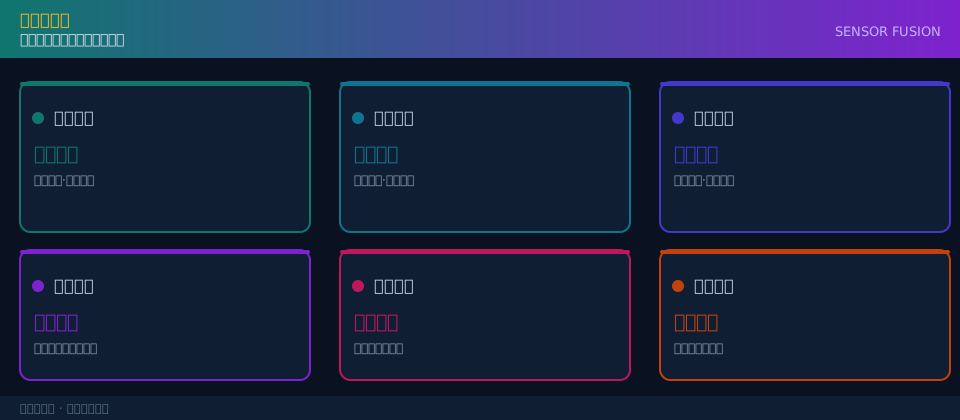
Fusion Parameters: Aligning Vision, Vibration, and Current on One Timeline
The hardest part of multi-source fusion is aligning three data streams to a single timeline. Vision arrives as video frames, vibration as high-frequency waveforms, and current as low-frequency signals—if their time bases don't match, fusion is impossible.
Time synchronization is the key. Applying a unified timestamp to all three streams and aligning sampling instants lets you correlate a visual anomaly, a vibration signature, and a current spike from the same moment, enabling true cross-validation.
Once aligned, fusion operates at two levels: feature fusion and decision fusion. Feature fusion combines extracted features from all three streams into a single model for integrated judgment—ISO 24621, AI Fault Diagnosis for Cranes, provides the diagnostic model framework. Decision fusion, by contrast, lets each stream make its own call and then aggregates the results through voting or weighting. Feature fusion captures more information but is more complex to implement; decision fusion is simpler but can lose some nuance.
Which level you choose depends on data quality and available compute. If alignment is solid and compute is sufficient, go with feature fusion. For early-stage deployments, decision fusion gets you to value faster.
Step-by-Step Deployment of Multi-Source Fusion
Multi-source fusion should not be switched on all at once. It needs a phased rollout.
Step one: get each channel working on its own. Commission vision, vibration, and current separately until each is stable and its acquisition and early warning functions are verified. If a single channel is unreliable, fusion will only amplify the chaos.
Step two: synchronize time. Apply unified timestamps across all three streams and verify that sampling instants align. This is the hard prerequisite for fusion.
Step three: start with decision fusion. Use it to cross-validate and vote on alerts from the three channels, delivering quick wins and reducing false alarms.
Step four: advance to feature fusion. Once enough data has accumulated and compute allows, upgrade to feature fusion to fully exploit the complementary value of multi-source information. Kelude follows this path—stability first, accuracy second.
Common Fusion Mistakes
Mistake one: fusing without time alignment. If the time bases of the three streams don't match, the "cross-validation" is misaligned and ends up generating false alarms. Time synchronization must be done first.
Mistake two: fusing before individual channels are stable. If any one of vision, vibration, or current has unstable acquisition or early warning, fusion will magnify the problem. Get each channel solid first, then fuse—the order cannot be reversed.
Mistake three: treating fusion as a replacement. Multi-sensor fusion is an enhancement, not a substitute for the accuracy of individual sensors. The precision and coverage required of each channel cannot be compromised just because fusion is in place. In its fusion solutions, Kelude insists that each channel meeting its own specification is a precondition for fusion.
Sensor Types vs. Fusion Configuration Comparison
| Sensor | MonitoringTarget Object | Sampling Characteristics | Blind Zone | Complementary Fusion Points |
|---|---|---|---|---|
| Vision | SurfaceDefectAppearance | Video Frame | InternalMachineryElectrical | SupplementvibrationCurrentBlind Zone |
| vibration | MachineryWearLoosening | High-Frequency Waveform | Electrical Surface | Vision SupplementCurrentBlind Zone |
| Current | Electrical Load Anomaly | Low-Frequency Signal | MachinerySurface | Vision SupplementvibrationBlind Zone |
Acceptance Standard Comparison for Multi-Source Integrated Deployment
| AcceptanceItem | standard basis | Judgment Criteria | CommonDefect |
|---|---|---|---|
| Single-Channel Compliance | Contractual Agreement | Per-Channel Acquisitionearly warningNormal | Fusion When Single Channel Unstable |
| TimeSynchronization | ISO 24445 | Three-Source Timestamp Alignment | Temporal Misalignment Fusion |
| Cross-Validation | Contractual Agreement | false alarm rateLowering | Fusion Without False Alarm Reduction |
| Decision Voting | Contractual Agreement | Multi-Source Voting Logic Valid | Single-Source Dominance |
FAQ: Multi-Sensor Fusion for Crane Monitoring
Q: What standards apply to multi-sensor fusion?
A: Smart sensors can reference ISO 24445, AI fault diagnosis can reference ISO 24621, IoT interfaces can reference ISO 24619, and safety monitoring and traceability follows GB/T 28264-2017. These standards provide the technical framework for sensors, diagnostics, interfaces, and monitoring. There is no single mandatory standard for fusion itself — in practice, engineering specifications for time synchronization and cross-validation govern the implementation.
Q: Which sensor should I deploy first with a limited budget?
A: It depends on where your greatest risk lies. If mechanical wear is the primary concern, start with vibration monitoring. If electrical faults are more likely, current sensing should come first. For surface defects and personnel safety risks, vision systems take priority. In general, we recommend starting with vibration — mechanical faults are the most common crane failure mode and deliver the most direct return on investment. Once a single channel is running reliably, add a second and third channel incrementally for fusion rather than deploying all three at once.
Q: How do I know if my equipment needs multi-sensor fusion?
A: Look at how frequently your current single-channel monitoring produces false alarms or misses real faults. If alerts from a single sensor are often spurious — or genuine faults go undetected — that sensor has blind spots, and a second or third channel is needed for cross-validation. Multi-sensor fusion delivers the most value on critical equipment, machinery with coupled mechanisms, and complex fault modes. If your equipment has a single failure mode that one sensor can already cover reliably, fusion adds little benefit.
Q: Why does multi-sensor fusion reduce false alarms and missed alarms?
A: Because every single sensor has blind spots. Vision cannot see inside the machinery, vibration cannot detect electrical issues, and current sensing cannot reveal surface conditions. A single-channel approach tends to mistake noise for a fault — or miss a genuine one entirely. Fusion enables cross-validation across all three channels: an anomaly must be corroborated by multiple sources before it escalates to an alarm. Noise cancels out, real faults are confirmed from multiple angles, and both false alarms and missed alarms drop simultaneously.
The foundation for deploying fusion in practice is equipment health management. For a complete approach to predictive maintenance, see the Equipment Health Management (PHM): Big Data and ML-Driven Predictive Maintenance for Overhead Cranes.
The value of multi-sensor fusion lies in cross-validation, not in simply adding more sensors. Kelude's approach — getting each channel to a reliable baseline first, then aligning time stamps, and finally fusing decisions — turns three independent data streams into a single, mutually corroborating system.
