

AI Crane Alarms Without Clear Cause? Solving Industrial Deployment
📋 Key Summary
When an AI system raises an alarm but can't explain why, maintenance crews lose confidence and hesitate to act—this is the biggest trust barrier in industrial AI deployment. Feature attribution, rule cross-checking, and human-in-the-loop collaboration turn AI alarms from black-box alerts into evidence-backed recommendations. Using a real case where an alarm was ignored, this article breaks down the traceability logic and implementation path for explainability.
An AI monitoring system on an overhead crane flagged an abnormal temperature-rise trend in the hoisting motor. But when the maintenance technician checked, the temperature rise was nowhere near the threshold and current readings were normal. His first instinct: "This AI is giving false alarms again." He dismissed the alert.
Three days later, the motor actually overheated and tripped. A post-incident data review showed the AI had detected a combined anomaly in current and vibration three days earlier—but since it couldn't explain why, nobody believed it.
This is the most awkward gap in industrial AI: a model can issue early warnings, but if it can't justify them, those warnings might as well not exist. Here's how to close that trust gap.
An Unexplained Alarm: The AI Warned, but No One Listened
What makes this case typical is that the algorithm wasn't wrong—it just couldn't explain itself. The AI did catch the early anomaly, but its reasoning was buried inside model parameters that maintenance crews couldn't see. All they got was an alert with no apparent cause.
Industrial settings are nothing like the consumer internet. When an AI recommendation misses on a shopping app, the user just scrolls past. But when an industrial AI alarm is wrong—or can't be explained—it gets ignored at best and misleads operators at worst. Explainability isn't a nice-to-have in industry; it's the threshold for whether AI can be trusted and deployed at all.
The root cause of the ignored alarm is that the AI output was a conclusion without supporting evidence. To earn trust, every alarm must answer the question: "Why are you telling me this?"
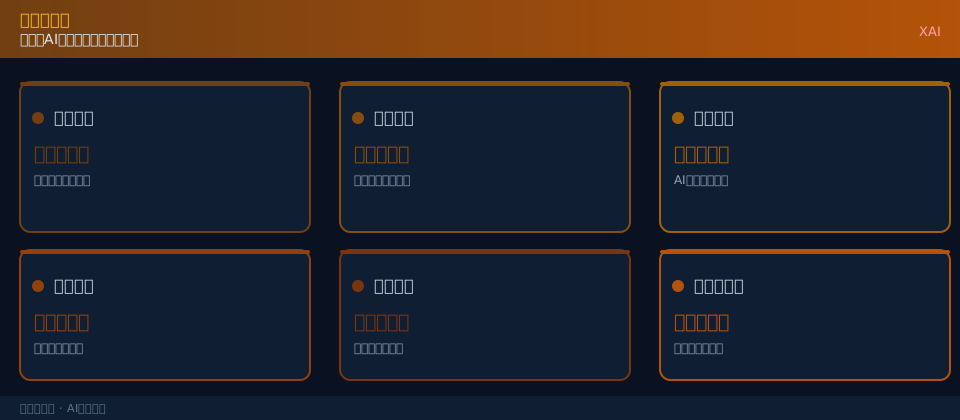
The Investigation Chain: Tracing the Evidence Behind an AI Alarm
When faced with an unexplainable AI alarm, the investigation starts with the data. Step one: pull the raw data from the moment of the alarm and identify which parameter or combination of parameters triggered the model.
Step two: use feature attribution to break down the alarm's causes by parameter. Methods like SHAP quantify how much each parameter contributed to the alert, showing that "the deviation came mainly from the combination of vibration and current, not temperature rise." ISO 24621, AI Fault Diagnosis for Cranes, requires that diagnostic reasoning be traceable.
Step three: cross-validate with rule-based checks. Compare the AI alarm against thresholds and established rules to see whether the detected anomaly maps to an explainable pattern—for example, "current fluctuation combined with rising vibration is commonly associated with early-stage bearing wear."
Following this chain, the alarm transforms from "unexplained" to "evidence-backed." Kelude builds feature attribution and rule cross-checking into its AI alarm system as standard output.
Explainability Methods: Feature Attribution, Rule Checks, Human Oversight
The first method is feature attribution. Tools like SHAP and LIME break down each alarm's contribution by specific parameter, so every alert comes with a clear statement of which variable was the primary driver. This is the most direct step from black box to gray box.
The second method is rule cross-checking. When the AI raises an alarm, it automatically compares the anomaly against thresholds and expert rules, then states which known rule the pattern matches. Rules are inherently explainable—when an AI alarm lands on a rule, people can understand it.
The third method is human-in-the-loop collaboration. Instead of positioning AI as an autonomous decision-maker, it acts as an advisor that provides evidence-backed recommendations, while final judgment and action remain with the operator. The AI supplies the alarm, the rationale, and a suggested response; the human makes the call. This preserves the AI's early-warning capability while maintaining explainability and accountability. Kelude tiers these three methods by alarm severity, with high-risk alarms mandating human-in-the-loop review.
From Single Alarms to an Explainability Framework
Making one alarm explainable isn't enough—the approach needs to scale into a system. Step one: make feature attribution and rule cross-checking the standard output for every alarm, so each alert automatically includes its supporting evidence.
Step two: log the alarm together with its rationale. Maintenance crews can trace any alarm back to its evidence, and post-incident reviews can verify exactly why the alarm fired. This gives alarms auditability, and GB/T 28264-2017, Safety Monitoring and Management System for Lifting Appliances, requires operational data to be retained for traceability.
Step three: use the logged data to feed continuous improvement. Accumulated alarms and their actual outcomes train the model to explain itself better over time, creating a positive feedback loop. Kelude treats "alarms with evidence, evidence that is traceable" as a basic requirement for its AI alarm systems.
Explainability Methods vs. Application Scenarios
| Solution | Problem Statement | Implementation Complexity | Application Scenarios |
|---|---|---|---|
| feature attribution | Alarm Contribution BreakdownParameter | Medium | AllAIStandard Alarm Configuration |
| Rule Mapping | Alarm Classification to Known Rules | Low | Complete Rule Base Scenario |
| Human-Machine Collaboration | AIrecommendationHuman Decision-Making | Low | Accountability-Bearing Decision Scenario |
Quick Reference of Standard Clauses for Explainability
| Standard | Clause Highlights | andexplainabilityRelationship with |
|---|---|---|
| ISO 24621 | craneAI fault diagnosisFramework | DiagnosisEvidence Traceability |
| GB/T 28264 Safety Monitoring and Management System | safety monitoringEvidence Traceabilityrequirements | Alarm Datatraceable |
| TSG (Special Equipment Safety Technical Regulation) 51 Safety Technical Specification for Special Equipment-2023 Crane Safety Technical Supervision Regulation | safety interlockSupervisionrequirements | Safety Actions Not Dependent onAIDecision-Making |
FAQ: AI Explainability in Equipment Health Management
Q: When an AI alarm doesn't clearly explain its cause, where should I start investigating?
A: Start by pulling the raw data from the moment the alarm triggered to see which parameter activated the model. Then use feature attribution to break down the alarm's contributing factors to specific parameters, identifying which one deviated most. Finally, cross-check against known rules to anchor the AI alarm to explainable, established patterns. Following these three steps turns an unexplained alarm into a data-backed event. Don't jump to conclusions about false alarms—trace the data first.
Q: How do I determine whether an AI alarm is genuine or false?
A: Evaluate whether the alarm has supporting evidence and whether that evidence is credible. Alarms backed by feature attribution, traceable to known rules, and corroborated by multiple parameters deserve high confidence. Alarms lacking clear justification or based on a single isolated parameter anomaly warrant skepticism. The final call rests with human judgment—AI alarms are simply recommendations with supporting rationale. The key is building a "why" into every alarm, so genuine warnings get identified and false ones get filtered out.
Q: Why must industrial AI be explainable?
A: Because industrial decisions carry accountability. When maintenance personnel see an alarm they can't understand, they hesitate to act on it or escalate it—so the alarm gets ignored, and the AI's early-warning capability is wasted. Only when alarms come with evidence and that evidence is traceable can people judge their validity and act on recommendations. Explainability isn't a technical nicety; it's the threshold for whether industrial AI earns trust and delivers real-world value.
The practical foundation for explainability lies in the AI diagnosis itself. For fault diagnosis methodology, refer to the approach outlined in "Equipment Health Management (PHM): Big Data and ML-Driven Predictive Maintenance for Overhead Cranes—An Engineering Practice".
AI alarms earn trust only when they can articulate their reasoning. Kelude builds feature attribution and rule cross-checking into every alarm as standard practice, ensuring each early warning comes with evidence and full traceability—turning the black box into actionable recommendations that maintenance teams can confidently adopt.
