

Comparison of Comprehensive Solutions for Coordinated Operation Between Overhead Cranes and AGVs/RGVs—An Overview of Path Arbitration, Interlocking Protocols, and Collision Avoidance Technologies
📌 The overhead crane and AGV/RGV collaborative system achieves fully automated material flow on smart factory production lines through a three-tier architecture comprising the scheduling management layer (OPC UA + MES), the equipment control layer (overhead crane PLC + AGV controller), and the execution and sensing layer (sensors + safety devices). Its three core technologies—path arbitration and task allocation, four-layer interlocking protocol and status sharing, and collision avoidance algorithms (DWA+VO+artificial potential field)—have been deployed in over 30 cases across automotive final assembly, steel cold rolling, and lithium-ion battery production lines.
In smart factories, the coordinated operation of overhead cranes (gantry/bridge types), AGVs (automated guided vehicles), and RGVs (rail-guided vehicles) is key to fully automated material flow on production lines. Overhead cranes handle cross-bay and cross-workstation lifting, AGVs handle flexible ground-level transport, and RGVs handle rapid transport along fixed tracks. The independent control systems of these three components must be integrated through a unified scheduling platform and interlocking protocols to achieve safe and efficient collaborative operations. This article provides a comprehensive analysis of the engineering implementation path for the collaborative operation of overhead cranes with AGVs and RGVs, covering system architecture, three core technical areas, and typical configuration solutions.
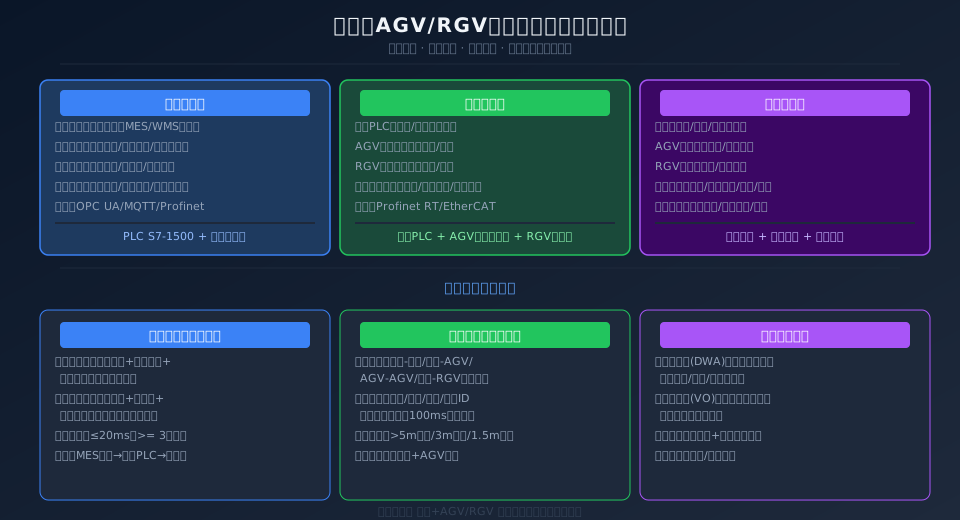
Three-Tier System Architecture and Data Flow Design
The overhead crane + AGV/RGV coordinated operation system is divided into three layers based on functional responsibilities.Scheduling Management TeamIt serves as the core of decision-making—after receiving material handling tasks issued by the MES or WMS, it breaks down the tasks into crane-based lifting segments and AGV/RGV ground-level handling segments, and assigns them to the most suitable equipment based on a path arbitration algorithm. The hardware platform for the scheduling management layer is a scheduling server (industrial PC + i7 processor + 16 GB RAM) or a high-performance PLC (Siemens S7-1500). The communication protocols used are OPC UA (for interfacing with MES/WMS) and MQTT (for data exchange with device controllers), with a scheduling cycle of ≤100 ms.
Device Control LayerThese are the independent controllers for each piece of equipment. The overhead crane uses a Siemens S7-1200/1500 PLC (Profinet control of the variable-frequency drive + encoder closed-loop control), while the AGV uses an industrial PC + STM32 low-level driver (laser SLAM navigation + differential drive control). RGVs use Mitsubishi FX5U or Siemens S7-1200 (inverters for track movement + hydraulic station for lifting control). Each controller executes its own operations after receiving task instructions from the dispatch management layer, while simultaneously reporting its current position, speed, status, and fault information to the dispatch management layer every 100 ms.Execution Perception LayerThese are the end points of physical actuation and sensor detection. The three mechanisms of the overhead crane (hoist, main girder, and trolley), the travel and steering of the AGV, and the track travel and platform lifting of the RGV are each equipped with encoders, limit switches, and safety sensors (laser collision prevention, safety edges, and audible and visual alarms).
Comparison of Three Core Technologies
The core technologies enabling the coordinated operation of overhead cranes and AGVs/RGVs can be summarized in three areas: path arbitration and task allocation (addressing the efficiency issue of ”who does what”), a four-layer interlocking protocol and state sharing (addressing the safety issue of ”how to coexist safely”), and collision avoidance algorithms (addressing the real-time avoidance issue of ”how to handle dynamic obstacles”) . The objectives, algorithms, and data cycles for these three technical areas differ; in actual projects, they are combined based on the number of devices and the complexity of the scenario. The following comparison examines each aspect across five dimensions: core objectives, primary algorithms, data cycles, resource consumption, and implementation complexity:
| Dimensions of Comparison | Path Arbitration and Task Assignment | Four-Layer Interlocking Protocol | Collision Avoidance Algorithm |
|---|---|---|---|
| Core Objectives | Optimal Allocation of Multiple Tasks, Maximizing Overall Efficiency | Safe Coexistence of Multiple Devices, Zero Collisions | Real-time Avoidance of Dynamic Obstacles, Optimal Path Planning |
| Key Algorithms | Priority Queue + Time Window + Shortest Path | Zone Interlock / Distance Interlock / Priority Interlock | DWA/VO/Artificial Potential Field |
| Data Cycle | Scheduling cycle ≤ 100 ms | Status broadcast ≤ 100 ms per instance | DWA computation cycle ≤ 200 ms |
| PLC Computing Resources | High (Priority Sorting + Path Search) | Part 2 (Distance Calculation + Interlock Logic) | High (High-Speed Sampling + Evaluation Function) |
| Number of compatible devices | ≥5 units (including overhead cranes, AGVs, and RGVs) | 3–12 units | 3–8 units |
| Implementation Complexity | High (Requires MES integration and development of scheduling algorithms) | Chinese (PLC Program + Communication Configuration) | High (requires an edge computing box) |
| Krude's Recommended Scenarios | Automotive Final Assembly / Lithium-Ion Batteries / Cold-Rolled Steel | All scenarios involving multiple devices on the same line | Yards/Workshops with Many Dynamic Obstacles |
Typical Configuration Schemes for Systems of Different Sizes
System configurations that integrate overhead cranes with AGVs/RGVs are categorized into three scale levels based on the number of devices and the complexity of the application scenario, with clearly defined distinctions in the scheduling schemes, hardware configurations, and communication architectures for each level.
Small-scale systems (3–5 units)—Suitable for coordination between a small number of overhead cranes and AGVs within a single workshop, such as small- to medium-sized machining shops. Scheduling solution: A single Siemens S7-1200 (CPU 1215C) handles all scheduling tasks, running a basic priority queue combined with a zone interlock algorithm. The crane PLC and scheduling PLC are combined into a single unit (scheduling functions are integrated into the main crane PLC). AGVs connect directly to the scheduling PLC via Modbus TCP (200 ms polling interval). There is no host computer; operators view the scheduling status through the crane HMI (Siemens KTP700). Features: Low hardware costs (the scheduling solution requires only approximately 3,000 yuan for PLC expansion) and rapid deployment (1–2 weeks); however, it does not support complex pathfinding or dynamic replanning. Krude Heavy Industry’s compact solution has already been deployed in multiple collaborative scenarios involving a single overhead crane and 2–3 AGVs.
Medium-sized systems (6–12 units)—Suitable for medium-sized production lines, such as lithium-ion electrode sheet workshops (2 overhead cranes + 4 AGVs + 2 RGVs). Scheduling Solution: Dedicated scheduling PLC (S7-1500 CPU 1516-3 PN/DP), performing full-path arbitration, time-window conflict detection, and dynamic re-planning. Each device controller connects to the scheduling PLC network via Profinet IRT (cycle time ≤ 100 ms). The scheduling PLC interfaces with the MES via OPC UA. An industrial switch (Siemens SCALANCE XB208) and an industrial control touchscreen (IPC227E + WinCC) are used for scheduling monitoring. Communication cycles: 50 ms for overhead cranes, 100 ms for AGVs, and 50 ms for RGVs. Features: Low scheduling latency (path arbitration + conflict detection ≤ 8 ms per cycle), support for emergency task prioritization and automatic reallocation after failures, and a deployment cycle of 4–6 weeks.
Large-scale systems (12–64 devices)—Suitable for large-scale factories, such as automotive final assembly shops (12 overhead cranes + 24 AGVs + 8 RGVs). Scheduling scheme: Multi-PLC zone-based scheduling combined with global optimization by the host computer. Each S7-1500 manages ≤12 devices (divided by zone), with boundary tasks exchanged between zones via PN/PN Coupler. The host computer (Industrial PC with i7 processor and 16 GB RAM + scheduling software) runs a global optimization algorithm (genetic algorithm/particle swarm algorithm to optimize task allocation, optimized every 30 seconds). The scheduling PLCs handle rapid response (100 ms cycle), while the host computer handles medium- to long-term optimization (30-second to 5-minute cycles). If the host computer fails, the scheduling PLCs in each zone revert to standalone operation mode (while basic interlocks remain active). Features: Supports ultra-large-scale operations; efficiency gains are 15–251 TP3T higher than those of medium-sized systems; deployment cycle is 8–12 weeks.
A Guide to Selecting Among Three Major Technology Pathways
Path arbitration, interlock protocols, and collision avoidance algorithms are not mutually exclusive; rather, they are selected based on the complexity of the scenario. The following provides clear recommendations for selection:
Scenarios Requiring Only Interlocking (Minimum Configuration)— Number of devices ≤ 4; no complex path planning required; only needs to ensure that the overhead crane and AGVs do not collide. Solution: Deploy only a four-layer interlock protocol (zone interlock + distance interlock + priority interlock + emergency stop interlock), and add interlock logic to the PLC of each device. No central PLC is required; the PLCs of each device exchange status information directly via Profinet. Cost: Adding a communication module and programming to each device costs approximately 3,000–5,000 yuan, with an implementation period of 1–2 weeks. Applicable to: Small and medium-sized workshops and retrofitting of existing equipment.
Interlock + Collision Avoidance (Standard Configuration)— 5 to 10 units; the workshop contains many obstacles and is subject to significant dynamic changes (e.g., people and forklifts moving through the yard). Solution: Use an interlocking protocol as the safety baseline, combined with a collision-avoidance algorithm for dynamic avoidance. Building on the interlock system, edge computing boxes (Jetson Orin NX, 100 TOPS) are installed on the overhead cranes to run DWA/VO algorithms. The collision-avoidance calculation results are written via Ethernet to the speed setpoint of the crane’s PLC (overriding the variable-frequency drive’s speed command, with the highest safety priority). Cost: Interlocking solution approximately 30,000–50,000 yuan + edge computing unit approximately 8,000 yuan per crane + AI algorithm license approximately 10,000 yuan per crane. Applicable to: yard areas, steel mills, and workshops with mixed pedestrian and vehicle traffic.
Complete Solution (Interlocking + Collision Avoidance + Path Arbitration)— With 10 or more units, tasks are automatically assigned via MES/WMS, and overall efficiency must be optimized. Solution: Deploy all three layers of technology. The scheduling PLC (S7-1500) handles path arbitration, conflict detection, and task allocation (every 100 ms cycle). Each crane is equipped with an edge computing box to handle local collision avoidance (DWA algorithm), with an interlock protocol serving as the final safety net. The scheduling PLC interfaces with the MES via OPC UA, while the host computer handles global efficiency optimization and KPI dashboards. Cost: Approximately 150,000–300,000 for medium-sized facilities and 500,000–2,000,000 for large-scale facilities (depending on the number of devices and factory area). Applications: Automotive final assembly, lithium-ion battery production lines, steel cold rolling, and smart new factories.
Krude Heavy Industries provides end-to-end services ranging from on-site surveys to system delivery. All three configuration options support future upgrades and expansion—the interlock system can be upgraded to the full solution without replacing any hardware. For more detailed consultation on product selection, please refer to the same series’Path Arbitration Scheduling Scheme和AGV Interlock SolutionFeature Article.
Frequently Asked Questions
Q: How can the coordinate systems of overhead cranes and AGVs be aligned? Can their positioning accuracies be matched?
Answer: The coordinate system for the overhead crane is a one-dimensional track coordinate system (with the X-axis aligned with the track), while the AGV uses a two-dimensional factory coordinate system (X/Y + orientation angle). The unified solution involves maintaining an ”Equipment Position Mapping Table” in the PLC at the dispatch management level—where the crane’s X-coordinate is mapped to the Y-direction of the factory coordinate system, and the AGV’s X/Y coordinates are used directly. The crane’s positioning accuracy is ±2–5 mm (laser + encoder fusion), while the AGV’s positioning accuracy is ±10–30 mm (laser SLAM + reflectors). At the docking station (where the overhead crane unloads onto the AGV), the AGV first moves to the docking point and stops precisely (error ±10 mm), after which the overhead crane lowers the load onto the AGV’s loading platform. Krude Heavy Industry has achieved a docking accuracy of ±5 mm for the overhead crane and AGV combination in the final assembly workshop of a certain automotive plant, with a docking success rate of 99.71 TP3T.
Q: How can we implement interlocking between the overhead cranes on the old production line and the newly added AGVs? Do we need to replace the PLC?
Answer: There is no need to replace the PLC, but an Ethernet communication module (Siemens CP1542-1, approximately 3,000 yuan) and an AGV interlock program (approximately 20 lines of FBD logic) must be added to the overhead crane’s PLC. The overhead crane PLC receives device status information (position/speed/direction/operating mode) broadcast by the AGV dispatch system via Profinet or Modbus TCP. An interlock check is added to the PLC program: when the projected distance between the overhead crane and the AGV in the X-direction falls below the safety threshold, the crane automatically slows down or stops. For older overhead cranes with pure relay control, an upgrade to a PLC (S7-1200, approximately 3,000 yuan + programming, approximately 5,000 yuan) is required first. Krude Heavy Industry provides retrofit solutions for installing AGV interlocks on older overhead cranes, with an on-site installation period of approximately 3–5 days per unit.
Q: When multiple overhead cranes and AGVs are operating simultaneously, where is the bottleneck in the dispatch system?
Answer: Addressing bottlenecks primarily involves three key areas: ① Path search computational load—for every additional device, the complexity of path conflict detection increases by O(n²). With 6 devices, 15 pairs of conflict combinations must be checked per cycle; with 12 devices, 66 pairs; and with 18 devices, 153 pairs. The solution is to divide the factory into sub-zones, performing conflict detection only among devices within the same zone, so that devices across different zones do not affect one another. ② Communication bandwidth—Each device broadcasts a status message (approximately 200 bytes) every 100 ms. With 12 devices, this generates 12 × 10 × 200 = 24 KB of data per second, which Profinet/OPC UA can easily handle. ③ PLC Scan Cycle — The scheduler performs path arbitration, collision detection, and task allocation in each PLC cycle. Code execution time is approximately 2–5 ms (for 6 devices) and increases to approximately 8–15 ms when scaled to 12 devices; the S7-1500’s 1-millisecond scan cycle remains sufficient.
Q: What preliminary survey data is required for a crane-AGV collaboration system?
Answer: The preliminary survey requires four types of data: ① Production line layout diagram—overhead crane track location/length/lifting height; AGV/RGV travel lane width/turning radius restrictions; precise coordinates of equipment docking stations; ② Equipment parameters—overhead crane lifting capacity/span/hoisting speed/travel speed; AGV payload/speed/navigation method (magnetic strip/laser/QR code); RGV track length/travel speed/vertical travel range; ③ Production cycle—number of material handling operations per hour, material demand schedules for each workstation, and number of concurrent equipment operations during peak periods; ④ Network Conditions — 4G/5G signal strength within the factory, Wi-Fi coverage, or Profinet wired network conditions. Krued Heavy Industry provides free on-site surveys and will issue a survey report and preliminary proposal within 2 days.
