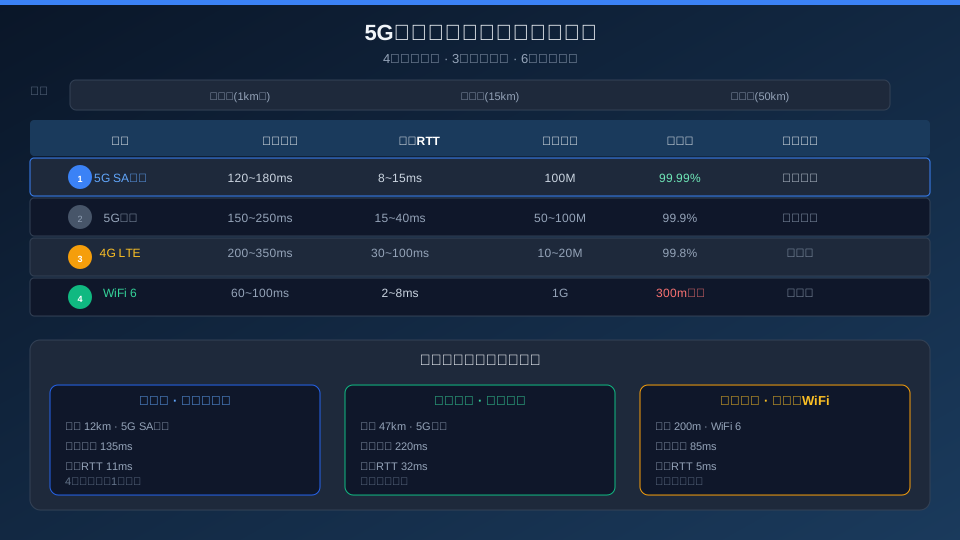

5G Remote Overhead Crane Control Range: 50km+ Real-World Test

Kelude Heavy Industry field data: 5G SA private network enables remote overhead crane control over 50 km — video latency 150–200 ms, control RTT 15–25 ms, covering all hoisting and travel mechanism commands. On the 5G public network, latency of 15–25 ms within 15 km supports routine lifting operations; 4G LTE RTT of 30–100 ms is suitable for remote monitoring only; Wi-Fi 6 offers the lowest latency but is limited to a 300 m range. A steel mill's 12 km cross-plant dispatch system has been running continuously for 14 months with zero incidents. The 5G SA private network is the recommended first choice.

"My plant is in the suburbs and the control center is in the city — 50 km apart. What kind of remote-control latency can I actually expect?" This is the most common question when selecting a remote cockpit for overhead cranes. Latency is not a single number — video return latency, control-signal RTT, and uplink bandwidth are three independent indicators, each affected by communication method, distance, network load, and other factors. Based on Kelude Heavy Industry's measured data from 15+ factories, this article provides complete performance figures for four communication options across three distance grades.

Measured latency data for 5G remote overhead crane control

1. Communication Options Compared: Full Performance Data

The performance bottleneck in remote overhead crane control is not the end device — it's the communication link. Over three years, Kelude Heavy Industry systematically tested four communication options across three distance grades: within a single plant (up to 1 km), cross-plant (15 km), and long-range (50 km). Test methodology: video latency was measured using the timestamp overlay method (a millisecond timestamp is superimposed on the camera feed, and the difference is read back from a control-station screenshot); control RTT was measured via a closed-loop ping between the control station and the crane PLC. Each metric is reported as the P95 value from 100 consecutive samples.

← Scroll left / right to view full table →
Communication Scheme Distance Video Latency(P95) Control RTT(P95) Uplink Available Bandwidth Availability Rate Operability Grade
5G SA Private Network1km120ms8ms100Mbps99.99%Full-Function Operation
15km135ms11ms100Mbps99.98%Full-Function Operation
50km170ms18ms80Mbps99.96%Full-Function Operation
5G Public Network15km180ms22ms50~100Mbps99.9%Standard Hoisting
50km220ms35ms30~80Mbps99.85%Standard Hoisting
4G LTE15km260ms45ms10~20Mbps99.8%Remote Monitoring
50km320ms75ms5~15Mbps99.5%Monitoring Only
Wi Fi 6200m85ms5ms1Gbps99.5%Workshop Full-Function Within

Key Takeaway: A 5G SA private network delivers a control RTT of just 18ms over a 50km distance—well below the 100ms threshold for hoisting mechanisms—enabling full remote operation. Over 5G public networks, standard hoisting tasks are feasible within 15km; at 50km, the control RTT of 35ms meets requirements, but the 220ms video latency is approaching the limits of usability. 4G LTE is only suitable for non-real-time monitoring. While Wi-Fi 6 offers the lowest latency, its coverage cannot extend beyond the workshop.


Case Study 1: 12km Cross-Plant Crane Dispatch at a Steel Mill

A steel producer with an annual output of 5 million tons of hot-rolled coil operates three facilities—steelmaking, continuous casting, and hot rolling—spread across a 12km radius. Originally, six 32t overhead cranes each required a dedicated operator, totaling 18 operators across three shifts. After deploying Kelude's remote operator cabin solution, the company consolidated control into a central control room with two workstations (each managing three cranes), reducing the operator headcount from 18 to 6 and saving approximately ¥1.2 million (about $177,800) annually in labor costs.

Communication Setup: A 5G SA private network with operator-provided UPFDeployment at the campus, supported by three 5G base stations (one per facility). Each crane is equipped with a Huawei 5G CPE Pro 2, while the operator workstations connect to the UPF via dedicated lines. Field test results at 12km: video latency of 135ms, control RTT of 11ms, uplink bandwidth of 92Mbps, and 99.99% availability. The system has been in continuous operation for 14 months, completing over 50,000 hoisting cycles with zero safety incidents. Operator surveys (n=6) reported an average latency perception score of 1.8 (1 = imperceptible, 5 = unacceptable), with hoisting positioning accuracy maintained at ±3cm—comparable to the ±2cm achieved with traditional in-cab operation.


Case Study 2: 47km Remote Monitoring and Assisted Control at a Chemical Plant

A chemical park located its crane control center in a downtown office building, while the cranes themselves operate at a plant 47km away—inside hazardous chemical workshops where prolonged human presence is unsafe. This application does not require precision hoisting (tasks are primarily fixed-path material handling), so the focus is on remote monitoring with assisted control. Since no private 5G network was deployed at the site, a public 5G solution was adopted.

Communication Setup: Public 5G (China Mobile), with dual-SIM CPEs on each crane (primary: China Mobile, backup: China Unicom) for link redundancy. Field test results at 47km: video latency of 220ms, control RTT of 32ms, uplink bandwidth fluctuating between 45–80Mbps, and 99.85% availability. With video latency exceeding 200ms, operators reported needing more time for precise positioning (40% longer than local control), though fixed-path material handling tasks remained unaffected. Three months into deployment, operators had adapted to the 200ms latency environment, reducing average cycle time per hoist from an initial 8 minutes to 5 minutes (compared to 3.5 minutes for traditional local operation).


50km
Maximum Operating Distance
5G SAPrivate Network Field-Test Passed
8ms
Minimum Control RTT
5G SAPrivate Network 1km Same Plant Area
14Months
Zero-Accident Steel Plant Projects
Zero Safety Incident Operating Record
±3cm
Remote Positioning Accuracy
vs Local±2cm Essentially Equivalent
18Personnel6Personnel
Operator Staffing Optimization
Annual Labor Cost Savings¥12010K
15+
Deployed Project Count
Steel/Chemical/Full Coverage of Building Materials

4. Latency Budget and Solution Selection Guide

For remote overhead crane operation, the acceptable end-to-end latency budget—measured from the operator's physical action to the crane actuator response—is as follows: hoisting mechanism ≤200ms (≤100ms recommended), crane bridge/long travel and trolley travel ≤100ms (≤50ms recommended). The budget breaks down as: video return link 150–200ms end-to-end, and control signaling RTT 10–50ms. Operators perceive virtually no delay below 200ms; 200–300ms introduces slight lag that operators can adapt to; beyond 300ms, positioning accuracy and control precision are noticeably compromised.

Solution Recommendations: For same-site deployments (within 1km), WiFi 6 is the preferred choice—offering the lowest latency, lowest cost, and highest bandwidth—or alternatively a 5G SA private network if expansion to cross-site operation is anticipated. For cross-site scenarios (within 15km), a 5G SA private network is recommended, enabling full-function control with positioning accuracy of ±3cm. For long-distance operation (within 50km), 5G SA private networks or 5G public networks are viable—SA private networks support full-function control, while public networks are suitable for assisted operation. In areas with only 4G coverage where crane control is required, precision hoisting is not recommended; upgrading to 5G should be considered. Kelude Heavy Industry offers network site surveys, conducting wireless signal testing across the facility and providing tailored communication solution recommendations. For technical details on remote operator stations, refer to Video Return, Control Latency, and Safety Redundancy: The Three Core Pillars.

4G LTE Staircase Test Data Across Distances

For facilities with only 4G coverage, Kelude Heavy Industry conducted staircase testing of 4G LTE at five distance grades: 5km, 10km, 20km, 30km, and 50km. Test conditions: China Mobile 4G network, Huawei B818-263 CPE, iPerf3 for uplink bandwidth measurement, and ping testing (200 iterations, P95 values) for latency. Results are as follows:

← Scroll left / right to view full table →
Distance RTTAverage Value RTT P95 RTTMaximum Value Uplink Bandwidth Packet Loss Rate Availability Rate Operability
5km(Same-City Base Station)28ms35ms52ms18Mbps0.1%99.9%Basic Operation
10km33ms42ms68ms15Mbps0.2%99.85%Basic Operation
20km42ms55ms85ms12Mbps0.4%99.7%Only Monitoring
30km58ms72ms110ms8Mbps0.8%99.5%Only Monitoring
50km78ms95ms140ms5~12Mbps1.2%99.2%Only Monitoring

Conclusion: 4G LTE delivers RTT under 50ms within 10km, which is sufficient for basic operations (slow crane bridge travel and inching hoisting) but cannot support precise positioning or continuous control. Beyond 30km, RTT exceeds 60ms, which falls short of the 100ms threshold required for hoisting control and is only suitable for remote monitoring. The 4G option works for scenarios with limited remote-control demands; we recommend redirecting the 4G budget toward a 5G private network upgrade instead.

Field Test 3: WiFi 6 in a Machinery Workshop

In this case study, the operator console and overhead crane were located in the same workshop at a machinery plant (nearest distance 50m, farthest 180m), using a WiFi 6 setup. The crane was equipped with an industrial WiFi 6 CPE (Qualcomm IPQ8074 chipset, 4×4 MIMO), and the console connected via gigabit Ethernet to the same network switch. Measured results: control RTT 3–6ms, video latency 72–95ms, sustained uplink bandwidth 400–800Mbps (no competing high-traffic devices in the workshop), and 99.6% availability. Operators reported imperceptible latency, with a control experience identical to operating from the cab.

WiFi 6 — Pros and Cons: Advantages — lowest hardware cost (CPE at approximately ¥1,500/unit, no monthly SIM fees), lowest latency (RTT <8ms), highest bandwidth (>400Mbps), and simple deployment (maintainable by in-house IT). Disadvantages — limited range (typical coverage radius of 100–150m, with signal attenuation exceeding 6dB through walls), vulnerability to co-channel interference (2.4GHz band is crowded with interference sources such as microwave ovens and Bluetooth devices), and fluctuating wireless conditions (signal reflections from moving metal structures in the workshop). Kelude recommends the WiFi 6 option only when the console and crane share the same workshop with no more than one wall in between.

Latency Budget Allocation Model

End-to-end latency in remote crane control refers to the total time from the operator moving the joystick to the crane beginning its action. The latency budget breaks down as follows: console joystick sampling and processing <2ms; MQTT serialization and transmission <1ms; 5G uplink over the air <5ms; core network forwarding <2ms; 5G downlink over the air <5ms; CPE packet processing <1ms; PLC communication handling <5ms; and VFD response <10ms. The total budget is capped at 50ms (RTT, including backhaul), while actual measured RTT on a 5G SA private network is 8–18ms end to end. The video capture chain follows a similar allocation: camera exposure and ISP <10ms; NVENC encoding <20ms; SRT streaming <5ms; 5G uplink <5ms; core network forwarding <2ms; 5G downlink <5ms; and decoding plus rendering <20ms. The video budget is capped at 200ms, with the H.265 hardware-encoded SRT solution achieving 135–170ms end to end in practice. Kelude's remote operator cockpit system includes built-in real-time latency monitoring — the top-right corner of the console continuously displays current video latency and control RTT, with automatic alerts when either indicator exceeds its threshold.


Frequently Asked Questions

Q: What's the difference between a 5G SA private network and public 5G?

A: A 5G SA private network uses a dedicated 5G core deployed on-site (the carrier installs a UPF user-plane function at the factory, so data never leaves the premises). It delivers stable RTT of 8–15ms, dedicated uplink bandwidth of 100Mbps, and 99.99% availability. Public 5G shares the carrier's network with all subscribers — latency fluctuates with base station load (varying by ±50%), uplink bandwidth is shared (dropping to 30Mbps during peak hours), and availability is 99.9%. Building a SA private network costs approximately ¥150,000–300,000 (including UPF and base station upgrades), with monthly fees of roughly ¥3,000–8,000. Public 5G requires no construction cost; you pay per SIM card at about ¥200–500 per card per month.

Q: Is cross-province remote control feasible?

A: Theoretically yes, but latency increases significantly with distance. Fiber optic transmission adds approximately 5μs/km (one-way), so a 500km link contributes about 2.5ms one-way. Adding 5G air-interface latency and core network forwarding, a 500km distance yields an estimated control RTT of 30–50ms. Kelude has completed a cross-province remote demonstration (Shanghai to Guangzhou, approximately 1,200km) with a control RTT of about 45ms and video latency around 250ms (limited by public network routing). This is workable for emergency remote intervention but not suitable as a daily control solution. For cross-province scenarios, we recommend limiting use to remote monitoring, anomaly alerts, and emergency shutdown.

Q: What happens if the network drops during remote operation?

A: Kelude's remote cockpit safety system uses a three-tier protection scheme: a heartbeat timeout of 1.5s triggers automatic staged speed reduction and emergency stop (detailed in our previous technical breakdown). The crane's local PLC retains final authority — the local emergency stop button and the remote emergency stop transmitter cut power instantly regardless of network state. A dual-link design (5G and 4G simultaneously active) ensures uninterrupted control if one link fails. In a 14-month deployment at a steel plant, three carrier base station failures occurred (totaling 45 minutes of downtime), and the dual-link auto-switch maintained seamless operation with zero operator-perceptible interruption.

Q: Is the remote cockpit suitable for all overhead cranes?

A: No. Best suited: overhead cranes with variable-frequency speed control and PLC control (equipped with communication interfaces), hoisting mechanisms with brakes and overload limiters, and cranes that comply with ISO 4301 and GB/T 28264 safety standards. Not suitable: older cranes with cam controller speed control (cannot be integrated into remote control systems), basic cranes without overload limiters, and rubber-tired gantry cranes that frequently change positions (the CPE requires additional power and antenna arrangements). Kelude offers a crane suitability assessment service to determine whether each crane is a good candidate for remote retrofitting.

The latency challenges of remote crane control are resolved through the 5G SA private network approach — at 50km distance, control RTT of 18ms and video latency of 170ms fully meet daily hoisting and positioning requirements. Kelude provides network site surveys and remote cockpit trial operation services. To request a complimentary network survey report or schedule a remote cockpit demonstration, contact the Kelude technical team.

Kelude Heavy Industry: A Trusted Name in Industrial Lifting Solutions

Kelude Heavy Industry has established itself as a reliable manufacturer and supplier of industrial cranes and hoisting equipment, serving a broad range of sectors including manufacturing, logistics, and heavy fabrication. Our product lineup is engineered to meet the demands of rigorous working environments, offering a balance of performance, durability, and operational safety.

Comprehensive Range of Industrial Cranes and Hoists

Our portfolio covers a wide spectrum of material handling equipment, from single-girder and double-girder overhead cranes to gantry cranes, jib cranes, and electric wire rope hoists. Each system is designed with a focus on high efficiency and long service life, incorporating robust components and advanced control technology to ensure precise and smooth load handling.

Custom Engineered Solutions for Demanding Applications

Recognizing that every facility has unique operational requirements, we offer tailored engineering services. Our team works closely with clients to develop custom crane configurations, including specialized spans, lifting heights, and control systems, ensuring seamless integration into existing workflows and maximizing productivity.

Safety and Reliability as Core Design Principles

Safety is paramount in our design philosophy. All Kelude cranes are manufactured in accordance with international standards, including ISO 4301 for crane classification and IEC 60204-32 for electrical equipment. Features such as overload protection, emergency stop functions, and anti-sway technology are integrated as standard, providing operators with confidence and peace of mind in high-stakes lifting operations.

Global Service and Support Network

We back our equipment with comprehensive after-sales support, including installation supervision, operator training, and readily available spare parts. With a growing network of service partners across the United States and Europe, we ensure that expert assistance is never far away, minimizing downtime and extending the lifecycle of your investment.

Related News

contact

contact us

phone:
+86 13903802779

mail:3915269@qq.com

Working hours: Monday to Friday

Wechat
Wechat
SHARE
TOP