

Smart Crane vs. Traditional Overhead Crane: 15-Year Cost Analysis
🧮 Core Formula in This Article
Crane life cycle cost TCO = C₀ (procurement and installation) + Σₜ₌₁ⁿ [C_e (energy) + C_m (maintenance) + C_l (labor) + C_d (downtime losses)]ₜ ÷ (1+r)ᵗ − S (residual value) ÷ (1+r)ⁿ. Here, C₀ is the initial investment, r is the discount rate, n is the service life in years, and S is the residual value at year n.
This formula applies to new builds and retrofit projects for single or multiple overhead and gantry cranes used over the long term, with a 15-year service life assumed. Short-term rentals, temporary operating conditions, and projects lasting less than 3 years are not covered by this calculation; simply compare rental rates and handling costs in those cases.
A 50t overhead crane running a full 15 years from procurement to scrapping typically sees the purchase price account for only 40% to 50% of total expenditure. The rest goes to energy, maintenance, labor, and downtime losses. This means a conventional model chosen to save a few thousand dollars upfront can easily give back that difference several times over through higher electricity bills, repair costs, and lost production time in the years that follow.
So the question "how much more does a smart crane cost than a conventional one?" is actually the wrong question. What really matters is whether the higher upfront cost of a smart crane can be recovered — or even surpassed — by the operating savings it delivers over a 15-year lifecycle.
This article applies a life cycle cost (TCO) approach to put conventional and intelligent overhead cranes on the same ledger and compare them fairly.
Four Boundary Conditions to Lock Down Before TCO Calculation: Duty, Life, Rate, Residual Value
The biggest risk in cost comparison isn't miscalculation — it's mismatched boundary conditions. Two identical 50t overhead cranes, one running three shifts continuously and the other on single-shift intermittent duty, can produce TCO figures nearly twice apart. So before running the numbers, lock down these four boundary conditions.
First, operating conditions. Whether the Work Duty is A5 or A6 directly determines the Load spectrum and energy consumption levels of the hoisting and travel mechanisms. In frequent start-stop A6 duty, Variable Frequency Speed Control delivers far better energy savings than in steady-state A5 operation, because conventional Resistance speed control wastes the most energy during repeated acceleration and deceleration.
Second, service life. This article assumes 15 years, the common design service life for overhead cranes. The longer the horizon, the more pronounced the compounding effect of energy and maintenance costs — and the greater the advantage of smart models.
Third, discount rate. Future costs must be discounted to present value to be fairly compared; the choice of r directly affects the outcome. Industry practice typically uses 6% to 8% based on corporate cost of capital; this article uses a uniform 7% for all calculations.
Fourth, residual value. High-end customized models use heavier-duty steel structures, mechanisms, and electrical systems, so their residual value after 15 years is typically higher than that of standard models — a "negative cost" many overlook. When Kelude prepares a proposal for a client, the first step is always to align on these four conditions before discussing price.
Net Present Value Formula for Crane Life Cycle Cost: Discounting Six Cost Items Year by Year
The TCO formula looks complex, but it breaks down into six line items: procurement, energy, maintenance, labor, downtime, and residual value. The first five are outflows; residual value is the money recovered in the final year.
Procurement cost C₀ is the only payment made upfront, so no discounting is needed. The extra cost of a smart model goes primarily into the VFD, PLC, Encoder, Sensor, and Commissioning — a real, tangible increment.
Energy cost C_e is where Variable Frequency Drive (VFD) technology earns its keep. Conventional rotor series resistance speed control dissipates energy as heat through resistors at low speeds, while VFD supplies power on demand. Combined energy savings for hoisting and travel mechanisms typically fall in the 15% to 30% range, with higher savings at lower load factors and more frequent acceleration/deceleration cycles. GB/T 12668 Variable Frequency Speed Control Technical Specification defines the technical requirements for variable frequency speed control systems.
Maintenance cost C_m differences stem from Condition Monitoring. Cranes equipped with a GB/T 28264-2017 Safety Monitoring and Management System for Lifting Appliances continuously record parameters such as Lifting Capacity, stroke, and Work Duty, allowing Wear and potential faults to be detected early — preventing minor issues from escalating into an Overhaul.
Labor and downtime — C_l and C_d — are often underestimated. Anti-sway control lets the operator position the hook in one pass, and Precise Positioning reduces repeated alignment, saving waiting time on every cycle. Predictive Maintenance cuts unplanned stoppages, avoiding losses from an entire production line grinding to a halt. In continuous production environments, these two items frequently exceed energy costs. Kelude has turned the six-item discounted cost calculation into a standard template — clients input their operating parameters and the 15-year total cost difference is immediately clear.
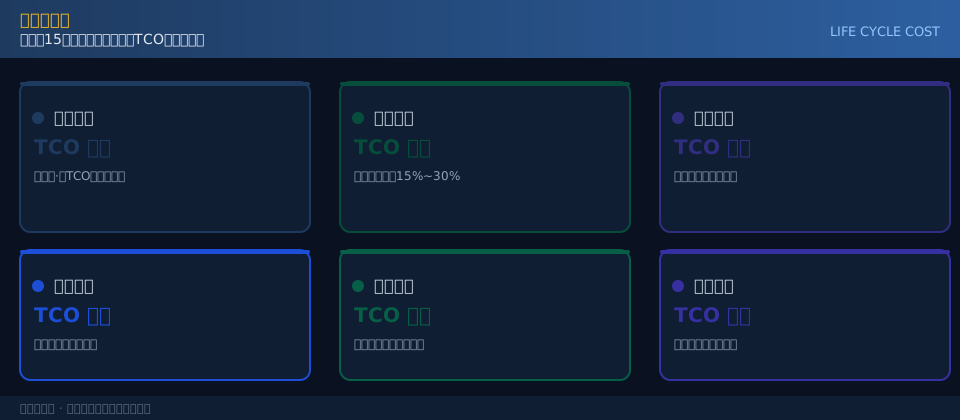
15-Year Cost Comparison for a 50t Overhead Crane: Conventional vs. Smart Models
The following example uses a 50t, A6 duty, three-shift overhead crane to compare a conventional Resistance speed control model against a VFD-based smart model, item by item. Note: the figures below are industry experience ranges intended to illustrate the direction and magnitude of differences. Actual amounts depend on the specific configuration and contract measurements and should not be used as a basis for Quotation.
| Cost Item | Conventional Model Reference | Smart Model Reference | Difference Description |
|---|---|---|---|
| Procurement andinstallation | Baseline | One Tier Higher | Frequency Inverter / VFD/PLC/Sensor/CommissioningIncremental |
| Energy Cost | ResistanceSpeed controlBaseline | Energy Saving15%~30% | Frequent LoadingDecelerationoperating conditionsMore Pronounced Energy Savings |
| maintenance cost | regular inspectionPredominantly | Condition Monitoringearly warning | Early Fault Detection,AvoidanceOverhaul |
| Labor Cost | Visual Alignment Waiting | Anti-sway+PositioningEfficiency Improvement | Reduced Waiting and Repeated Alignment |
| Downtime Loss | High Frequency of Unexpected Failures | Predictive Maintenance | Minimize Unexpected Downtime Impact on Production Line |
| Residual Value Recovery | StandardModel Residual Value Rate | Higher Residual Value Rate | Robust Construction、mechanismExtended Service Life |
| 15Annual Total | Baseline | TCOCan Overtake | Continuous Productionoperating conditionsGreater Disparity |
Running this breakdown through the net present value formula year by year yields a consistent conclusion: the higher upfront purchase price is typically recovered during the mid-life of the equipment, thanks to cumulative savings across energy, maintenance, labor, and downtime. The heavier the operating conditions, the fuller the three-shift schedule, and the more critical the production line uptime, the faster the payback. When Kelude prepares cost models for European Standard (EN) custom projects, this itemized table is included as a contractual appendix, ensuring every incremental investment has a traceable return.
Four Cost Calculation Pitfalls That Skew Smart Crane TCO
Hit any one of these four traps and your total cost of ownership (TCO) analysis can be completely thrown off.
Pitfall 1: Comparing only purchase price instead of full lifecycle cost. A higher purchase price does not necessarily mean a higher total bill. Once energy, maintenance, downtime, and residual value are factored in, the conclusion often flips. This is the most common—and most expensive—cognitive bias in crane procurement.
Pitfall 2: Forgetting to discount future cash flows. Money 15 years from now is not worth the same as money today. Failing to discount overstates future savings. Apply a consistent discount rate to bring all figures to the same base year, and only then are the two options truly comparable.
Pitfall 3: Applying someone else's operating conditions to your own workshop. A three-shift, A6-grade case study cannot be directly mapped onto a single-shift, A5-grade environment—both energy-saving and productivity figures will be distorted. Operating conditions are the single biggest variable in TCO, so you must define your own before running any numbers.
Pitfall 4: Treating intelligence as a one-time hardware expense. The real differentiator lies in software commissioning and ongoing data maintenance. The quality of VFD parameter tuning, positioning accuracy, and interlock monitoring adjustments determines whether the paper savings in energy and efficiency actually materialize on the workshop floor. Kelude writes VFD energy-saving ratios, positioning accuracy, and monitoring interlock indicators into the contract as acceptance items specifically to prevent "paper intelligence" from shrinking when it hits the shop floor.
Smart vs. Conventional Crane: Itemized Cost Comparison at a Glance
| Comparison Parameter | Conventional Model | Smart Model | Differentiation Aspect |
|---|---|---|---|
| Speed controlMethod | rotorStringResistance | Variable Frequency Speed Control | Energy Efficiency+Smooth |
| loadsway angle | 5°and Above | 1°Within | Handling Efficiency Improvement |
| Positioning Accuracy | Visual (Tens of)mm | ±2~5mm | automationFoundation |
| Condition Monitoring | regular inspection | GB/T 28264 Safety Monitoring and Management SystemTraceability | Predictive Maintenance |
FAQ: Cost Analysis of Smart Cranes
Q: Is there a standard basis for the 15%–30% energy savings from Variable Frequency Speed Control?
A: The energy-saving effect of VFD speed control compared to rotor series resistance speed control is well-documented in motor speed control engineering, typically falling in the 15%–30% range depending on load factor and operating conditions. GB/T 12668, the technical specification for variable frequency drives, serves as a key technical basis for configuring inverter drives. Beyond energy savings, converting hoisting and travel mechanisms to VFD also enables smoother acceleration/deceleration and reduces mechanical shock.
Q: How do I know if a Smart Crane is worth the investment for my workshop?
A: Look for three signals: first, whether a significant portion of your handling cycle is spent waiting for the load to stop swaying; second, whether positioning frequently requires manual fine-tuning; and third, whether downtime from crane failure causes substantial production losses. If any one of these is clearly present, the payback on a Smart Crane usually justifies the investment. If none apply, you're better off putting the money into mandatory safety compliance and routine maintenance.
Q: Why can't I judge a Smart Crane's value from the purchase price alone?
A: Because a crane is a long-term asset—the purchase price accounts for only 40%–50% of total ownership costs over a 15-year lifespan. Energy consumption, maintenance, labor, and downtime losses are what truly separate conventional and intelligent crane economics. Smart cranes carry a higher upfront cost, but VFD energy savings, anti-sway efficiency gains, predictive maintenance from monitoring, and reduced collision risk from precise positioning deliver returns year after year. A fair comparison requires discounting these future benefits to net present value.
For guidance on configuration by lifting capacity and span, refer to the parameter tables in Smart Overhead Crane Pricing & Selection: How to Determine Lifting Capacity and Span to weigh functionality against cost before making a purchasing decision.
The goal of a thorough cost analysis isn't to justify higher spending—it's to ensure every dollar of your procurement budget goes where it will deliver real returns over the next 15 years.
