

Smart Crane vs. Standard Bridge Crane: 4 Core Technologies Compared
📋 Key Takeaways
The difference between a Smart Crane and a standard overhead crane isn't about lifting capacity—it comes down to four areas: speed control, positioning, anti-sway, and monitoring. Variable frequency drives cut energy use by 15% to 30%, precise positioning holds repeatability to ±2 to 5 mm, anti-sway keeps the load swing angle under 1°, and the safety monitoring system logs data throughout every lift. This article lays out all six differences side by side in one parameter table, then walks you through a three-step selection process based on tonnage, operational pain points, and automation roadmap.
If you're torn between a Smart Crane and a standard overhead crane, you've probably asked yourself these four questions:
① What exactly does the premium price of a smart model pay for?
② How big is the real-world difference between variable frequency speed control and traditional resistance-based speed control?
③ Are precise positioning and anti-sway only necessary for automated workshops?
④ Is the Safety Monitoring System only mandatory on large-tonnage cranes?
This article breaks down the four most critical technical differences between smart and standard overhead cranes, and compares them side by side in a single parameter table.
Smart vs. Standard Bridge Cranes: Four Core Technologies That Set Them Apart
Take a 50t bridge crane—the smart version and the standard version may share the same lifting capacity, but they diverge completely in speed control, positioning, anti-sway, and monitoring. These four areas determine whether you're getting a "motorized steel frame that moves loads" or a "handling system that senses, decides, and records every move."
On speed control, standard bridge cranes typically use rotor series resistance speed control, which dissipates energy as heat through resistor banks to change speed—wasteful at low speeds. Smart models use variable frequency speed control, supplying power on demand. Combined energy savings across the hoisting and travel mechanisms typically land in the 15% to 30% range, with far smoother acceleration and deceleration. GB/T 12668, the technical specification for adjustable speed variable frequency drive systems, defines the requirements for VFD-based speed control systems.
On positioning, standard cranes rely on the operator's eyesight, with errors measured in tens of millimeters and repeated fine-tuning needed to land the hook. Smart cranes are retrofitted with encoders, laser distance measurement, or a Gray-code bus positioning system, achieving repeat positioning accuracy of ±5mm or even ±2mm—the foundation for any downstream automation.
On anti-sway, standard cranes have no sway suppression; the load can swing 5° or more when it reaches the target position, and the operator has to wait for the oscillation to die down. Smart cranes use the VFD and sensors to detect the sway angle in real time and apply counter-compensation, holding the swing angle to under 1° so the hook lands in essentially one attempt.
On monitoring, standard cranes generate virtually no data trail—when something fails, troubleshooting is manual. Smart cranes are configured per GB/T 28264-2017, the Safety Monitoring and Management System for lifting appliances, continuously recording parameters such as lifting capacity, stroke, and work duty so potential issues surface early. When Kelude's engineers explain the smart-versus-standard difference to customers, they always start with these four areas before discussing price.
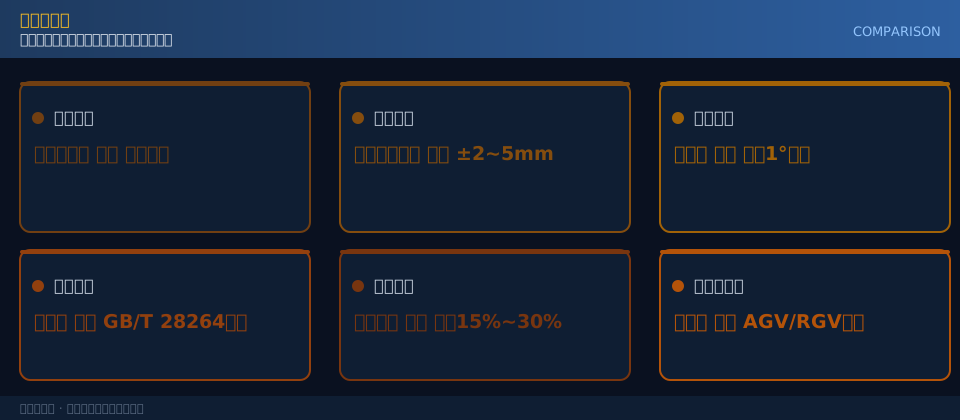
Six Parameters Compared: Cost & Performance of Speed, Positioning, Sway, and Monitoring
| Comparison Parameter | Standardbridge crane | Smartbridge crane | Differentiator | Procurement Premium | Source of Return |
|---|---|---|---|---|---|
| Speed controlMethod | rotorStringResistance | Variable Frequency Speed Control | Energy Saving+Smooth | Frequency Inverter / VFDandCommissioning | Power Saving15%~30% |
| Positioning Accuracy | Visible Tensmm | ±2~5mm | automationBaseline | Encoder/Laser/Gray-code bus positioning system | Eliminates Repeated Positioning |
| anti-sway control | sway angle5°and above | sway angle1°within | Loading/Unloading Efficiency Gain | Sensor+Algorithm | Reduces Waiting Time |
| safety monitoring | No Trace Mark | GB/T 28264 Safety Monitoring and Management SystemNo Trace Mark | Predictive Maintenance | Data AcquisitionModule+Logging | Reduces Unplanned EventsMaintenance |
| Energy Consumption Level | ResistanceHeat Dissipation Loss | On-Demand Power Supply | Long-Term Energy Savings | Included inVariable Frequency Drive (VFD)Procurement Premium | 15Substantial Annual Cumulative |
| automationInterface | Virtually None | OPC UA/APIOpen | Compatible withMES/AGV (Automated Guided Vehicle) | Gateway and Protocol | Future-ReadyRetrofit |
This comparison table is a core attachment in Kelude Heavy Industry's selection scheme. Every difference corresponds to a specific procurement increment and its source of return, allowing customers to judge whether each increment is worth the investment.
How to Choose by Operating Conditions: A Decision Tree for Machine Selection
Smart and standard configurations are not inherently good or bad—only suitable or not. The decision logic can be simplified into a chain: first, check for mandatory requirements; second, identify real pain points; and finally, consider automation plans.
Step one: assess tonnage and work duty. For large-tonnage machines such as overhead cranes above 200t and gantry cranes above 100t, the Safety Monitoring and Management System is a mandatory requirement under GB/T 28264-2017—there is no room for choice here. For frequent start-stop duty cycles rated A6 or higher, the energy savings and anti-sway benefits of Variable Frequency Speed Control are also most pronounced.
Step two: evaluate loading and unloading pain points. If operators spend a significant portion of each shift waiting for the load to stop swaying or repeatedly aligning the hook, anti-sway and precise positioning deliver immediate, visible gains. Conversely, if the handling pace is slow and alignment requirements are modest, these two upgrades can be deferred.
Step three: factor in automation plans. If MES integration or AGV/RGV automated loading and unloading is on the roadmap within the next few years, building in precise positioning and open interfaces now avoids costly retrofits later. Kelude Heavy Industry follows this decision chain step by step when finalizing machine configurations with customers, converging on a specific setup that fits the application.
Eight Must-Check Points Before Purchase
📋
Certification Check
Type Test Certificate and manufacturing license in place
⚙️
Speed Control Scheme
VFD brand and capacity matched to the mechanism
🎯
Positioning Accuracy
Is ±2~5mm written into the acceptance contract?
🛑
Braking Configuration
Dual brake required for duty A6 and above?
📡
Monitoring Loop
Are alarms interlocked and data logged?
🔌
Open Interfaces
OPC UA/API connectivity available?
📦
Spare Parts Availability
Lead time for VFD and sensor spares
🛠️
Commissioning Capability
Is on-site commissioning and training included?
Life Cycle Cost Comparison: Smart vs. Standard
| Cost Item | StandardCrane Model | Smart Model | Differentiation Direction |
|---|---|---|---|
| Procurementinstallation | Benchmark | One Tier Higher | Smart Premium |
| Energy Consumption | ResistanceHeat Generation | Power Saving15%~30% | Smart Saving |
| maintenance | regular inspection | Statusearly warning | Smart Saving |
| Labor and Downtime | Excessive Positioning Wait | Anti-swayPositioningLoading/Unloading Efficiency Gain | Smart Saving |
| Residual Value | StandardResidual Value Rate | Higher Residual Value Rate | High Intelligence Level |
FAQ: Intelligent vs. Standard Overhead Cranes
Q: What's the most noticeable difference in daily operation between an intelligent overhead crane and a standard one?
A: The biggest difference is in load handling. Intelligent models use Variable Frequency Drive (VFD) for smooth acceleration and deceleration, so the load doesn't swing or jerk. Anti-sway technology reduces the sway angle from over 5° to under 1°, and lowering the hook is usually accurate on the first attempt—operators don't have to wait for the load to stop swinging or reposition repeatedly. The second major difference is that operational data is logged throughout the process, enabling early warning of faults rather than waiting for a breakdown to occur.
Q: On a tight budget, which is the better value—a standard or an intelligent overhead crane?
A: First, check whether your required tonnage falls within mandatory safety monitoring regulations—if it does, intelligent configuration is unavoidable. For lower tonnage with slower handling cycles and less demanding positioning accuracy, a standard crane is perfectly adequate, and the money saved is better spent on routine maintenance. However, if you're running three shifts with frequent handling and have automation plans, the higher upfront cost of an intelligent crane is typically recovered over time through energy savings and improved efficiency.
Q: How do I know if my workshop actually needs an intelligent overhead crane?
A: Look for three signals: how much time in each handling cycle is spent waiting for the load to stop swinging, whether positioning frequently requires manual fine-tuning, and how costly downtime is to your production line. If even one of these is a clear issue, the return on intelligent features usually justifies the investment. If none are significant, put your money into mandatory safety equipment and maintenance instead.
Q: Why does an intelligent overhead crane cost significantly more than a standard one at the same tonnage?
A: The price difference comes from the intelligent hardware itself—VFDs, PLCs, encoders, and sensors—plus the commissioning work required for parameter tuning and interlock verification. This added cost isn't just overhead; it buys four capabilities: energy efficiency, anti-sway, precise positioning, and complete data logging. These benefits pay off progressively over the 15-year lifecycle of the crane. The more advanced the configuration and the more detailed the commissioning, the wider the price gap.
For price ranges by specific tonnage and span, refer to the parameter tables in Intelligent Overhead Crane Pricing & Selection: How to Determine Lifting Capacity, Span, and Configuration to weigh functional differences against cost.
The difference between intelligent and standard cranes comes down to "moving loads" versus "sensing, deciding, and recording." Kelude's intelligent overhead crane solutions put the configuration and acceptance indicators for these four core technologies in writing, item by item, in your contract. Which one you choose depends on whether your operating conditions call for the former or the latter.
