

Crane Smart Monitoring with Real-Time Alerts
📋 Key Takeaways
Crane intelligent monitoring systems detect five critical hazard categories—overload/over-torque, hoist height and travel limit violations, motor overheating, wire rope and brake wear, and personnel entering danger zones—before they escalate into accidents. When dangerous thresholds are reached, the system automatically triggers interlocked deceleration or shutdown. Unlike intermittent manual inspections, intelligent monitoring provides continuous, around-the-clock surveillance with a complete data trail. This article breaks down the monitoring parameters, early-warning threshold logic, and interlock actions for each of the five hazard categories, explaining how the closed loop from data acquisition to interlock protection works in practice.
The temperature rise curve of a hoisting motor typically shows a sustained abnormal climb before it burns out. Traditional cranes leave no trace of this curve—operators can only rely on feel, noticing "the motor feels a bit hot today," and often don't catch the problem until they smell burning. A crane equipped with intelligent monitoring, however, triggers an alarm the moment the temperature rise crosses its threshold, and can even automatically reduce speed before a dangerous level is reached.
This is the fundamental difference between intelligent monitoring and traditional inspection: one relies on a person taking an occasional look, the other relies on sensors watching every second—and keeping the data. Below, we break down the five hazard categories that intelligent monitoring can prevent.
Here's the bottom line: among these five categories, some are mandatory monitoring requirements under safety regulations, while others are value-adds that can genuinely prevent accidents. Understanding the distinction is key to investing in the right protection.
Five Hazard Categories Intelligent Monitoring Detects: From Overload to Temperature Rise
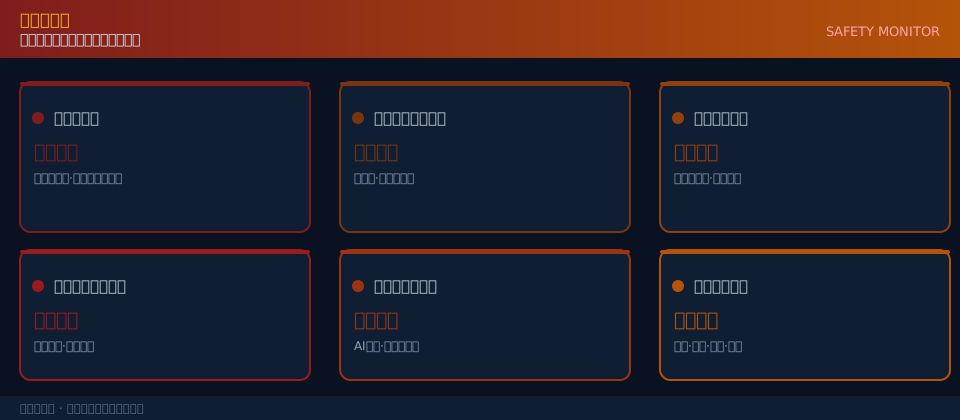
Category 1: Overload and over-torque. This is the most critical category. The overload limiter continuously acquires real-time lifting capacity and torque data (as required by FEM 1.001 Crane Design Standard). When values reach a preset warning percentage of rated capacity, an alarm sounds; when they exceed the limit value, the hoisting circuit is cut off directly. This isn't about preventing minor inconveniences—it's about preventing catastrophic events like crane overturning, main girder fracture, and suspended loads falling.
Category 2: Hoist height and travel limit violations. Without limit protection, a hoist that travels to its top limit or a crane bridge/trolley that runs to the end of the rail risks head-on collision with the end stops or derailment. Intelligent monitoring continuously compares real-time height and travel values against limit thresholds, automatically decelerating and stopping the crane when limits are approached.
Category 3: Motor overheating and mechanism overload. The temperature rise and current draw of the hoisting motor and travel motors are reliable indicators of mechanism health. An abnormal temperature rise typically precedes motor failure by several minutes to over ten minutes—this window is the golden opportunity for early warning.
Category 4: Wire rope and brake wear. These are consumable parts with progressive wear patterns. Manual inspections have intervals, and issues like wire breaks, uneven wear, and accelerated brake lining deterioration that occur between inspections can only be caught through continuous monitoring.
Category 5: Personnel entering dangerous work zones. Someone walking beneath a lifting path is the most typical collision hazard. AI vision divides the work area into safe, warning, and danger zones. When someone crosses a boundary, the system issues tiered alarms or even interlocks the crane to a stop.
The Complete Early-Warning Loop: How Acquisition, Identification, Alarm, and Interlock Work Together
Intelligent monitoring isn't just about installing a few sensors—it's a closed loop from data acquisition to interlock protection. If this loop only runs halfway, you're left with nothing more than "a screen that displays numbers," which provides no real protection.
Step 1: Acquisition. Sensors continuously collect parameters such as lifting capacity, torque, height, travel, temperature rise, and current. The sampling frequency and accuracy of this data determine the reliability of all subsequent decisions.
Step 2: Identification. Acquired values are continuously compared against preset thresholds to determine whether limits are being exceeded or whether the crane is entering a danger zone. Threshold logic must be calibrated to actual operating conditions—too sensitive and you get false alarms; too lenient and you miss real hazards.
Step 3: Alarm. When limits are exceeded, the system notifies the operator and management through audible/visual signals, on-screen alerts, and remote push notifications. The alarm must reach the right people immediately.
Step 4: Interlock. When dangerous values are reached, the system automatically decelerates, cuts power, or stops the crane. TSG 51-2023 Crane Safety Technical Supervision Regulation sets supervisory requirements for various safety interlocks. This is the most critical step—and the one most often omitted. Many monitoring systems collect data, light up screens, and sound alarms, but never actually interlock, effectively removing the last line of defense. Kelude's monitoring systems undergo step-by-step acceptance testing for all four stages, with particular emphasis on field verification that interlock actions are genuinely effective.
Root Causes Behind Monitoring Data: Why Traditional Inspections Miss These Hazards
Traditional inspection relies on periodic visual checks, manual touch, and listening. The problem lies in the time gap between when a hazard develops and when the next inspection occurs. Wire rope can develop wire breaks overnight; brake linings can wear beyond limits within a week. These changes happen between inspections, and by the time the next check catches them, the crane is often already on the brink of an accident.
On a deeper level, many early warning signs of hazards are simply beyond human perception. Abnormal temperature rise in motor windings, subtle current fluctuations in mechanisms, and gradual increases in brake slip distance all fall below human sensory thresholds—yet sensors capture them with precision.
So the value of intelligent monitoring isn't that it's "more diligent than a person." It's that the physical quantities it monitors are continuous, quantifiable, and traceable. When an accident occurs, you can pull up the data to analyze root causes; when no accident occurs, you can use trends to predict and prevent issues in advance. When Kelude explains the value of monitoring to customers, this is the point we emphasize: monitoring leaves behind an evidence chain, not just a pile of numbers.
Building a Preventive System: From Reactive Repairs to Proactive Early Warning
Installing monitoring is only the first step. Turning it into a true preventive system is where the real value lies. Here are three key points.
Point 1: Calibrate thresholds to actual operating conditions. The same temperature rise threshold means something entirely different in a three-shift A6-grade duty cycle versus a single-shift A5-grade duty cycle. Calibration must be performed on-site—never rely on factory default values.
Point 2: Alarms must be responded to and closed out. An alarm isn't the goal—responding to it is. Every alarm needs an owner, an investigation record, and a resolution. Otherwise, alarms become "the boy who cried wolf" and eventually get ignored.
Point 3: Review data on a regular schedule. The greatest value of monitoring data lies in hindsight. Monthly reviews of temperature rise trends, current distribution, and brake actuation records can reveal signs of mechanism aging one to two months in advance. Kelude recommends that customers build monthly data reviews into their maintenance procedures—this is the critical step in moving from reactive repairs to proactive early warning.
Monitoring Parameters and Interlock Actions for the Five Hazard Categories
| Hazard Type | monitoring parameters | early warningThreshold Logic | interlockAction | CorrespondingStandard |
|---|---|---|---|---|
| overloadExceedTorque | Lifting Capacity/Torque | Exceedearly warningProportional Alarm、Overtravel Cut-off | Overtravel Cut-offHoisting / LiftingCircuit | FEM 1.001 Crane Design Standard、TSG (Special Equipment Safety Technical Regulation) 51 Safety Technical Specification for Special Equipment |
| HeightstrokeOvertravel | Height/stroke | In PositionDeceleration、Overtravel Stop | automatic decelerationOvertravel Stop | TSG (Special Equipment Safety Technical Regulation) 51 Safety Technical Specification for Special Equipment |
| MotorOverheatoverload | temperature rise/Current | Threshold Exceedance Alarm、Approach Danger Speed Reduction | Speed Reduction or Stop | GB/T 28264 Safety Monitoring and Management System |
| Wire RopeBrakeWear | wire break/Wear/Gap | Trend Anomalyearly warning | Maintenance Reminder | ISO 4309 |
| Personnel Intrusiondanger zone | Vision/Radar Zone | Zone Boundary CrossinggradingProportional Alarm | Alarm or Stop | ISO 23812 |
Quick Reference: Monitoring-Related Standard Clauses
| Standard | Clause Key Points | CorrespondingMonitoringItem |
|---|---|---|
| GB/T 28264 Safety Monitoring and Management System | large tonnageMandatoryconfigurationMonitoringwith Traceability | Lifting Capacity/Height/stroke/Status |
| TSG (Special Equipment Safety Technical Regulation) 51 Safety Technical Specification for Special Equipment-2023 Crane Safety Technical Supervision Regulation | limit protectionsafety supervisionrequirements | limit switch/overload/interlock |
| ISO 23812 | intelligent anti-collision systemtechnical requirements | Personnel/Obstacleanti-collision |
| ISO 4309 | Wire Ropemaintenanceandscrapping | wire break/Weardiscard criteria |
FAQ: Smart Monitoring for Cranes
Q: What is the fundamental difference between smart monitoring and manual inspection in detecting hazards?
A: Manual inspection is intermittent—relying on periodic visual, tactile, and auditory checks—which leaves blind spots between rounds and often misses early warning signs that fall below human sensory thresholds. Smart monitoring continuously collects physical parameters such as lifting capacity, temperature rise, current, and stroke around the clock. It quantifies data, makes it traceable, and can detect abnormal spikes 10 to 20 minutes before a failure occurs. The difference is not about diligence—it's about monitoring continuity and quantifiability.
Q: How should alarms from a crane smart monitoring system be investigated and resolved?
A: First, confirm the alarm type and the associated parameter to determine whether it indicates a real hazard or a false alarm caused by overly sensitive threshold calibration. For genuine hazards, follow the parameter trail—for example, a temperature rise alarm should prompt a check of motor cooling and load conditions, while an overload alarm requires verifying the actual lifting weight. Every alarm must be logged, investigated, and resolved, creating a closed loop so that alarms don't become ignored "cry wolf" signals.
Q: Is smart monitoring necessary for low-tonnage cranes?
A: Most low-tonnage models fall outside the mandatory safety monitoring requirements, so the decision depends on the operating conditions. For occasional hoisting with low risk, basic safety configurations such as overload limiting and limit protection are sufficient—no need for a full monitoring suite. However, for continuous three-shift operations or lifting and transport paths that cross pedestrian traffic or valuable materials, adding monitoring provides early warning for motor overheating and personnel intrusion, delivering a clear return on investment.
To understand how safety monitoring system configurations vary across different tonnage classes, refer to the mandatory scope outlined in "GB/T 28264 Safety Monitoring and Management System—Standard Interpretation".
If you're planning to retrofit smart monitoring onto an existing overhead crane, the step-by-step approach in "The Complete Guide to Smart Crane Retrofits: Kelude's Digitalization Upgrade Solution for Traditional Workshops" provides practical guidance.
Smart monitoring isn't about preventing a single collision—it's about catching the hazards that manual inspection will never see in time. Kelude makes the four-step closed-loop acceptance of its monitoring systems a standard deliverable, ensuring that early warnings truly arrive before incidents do.
