

Smart Crane Retrofit Guide: Kelude Heavy Industry Digital Upgrade
Retrofitting a traditional crane into a Smart Crane hinges on adding or replacing control systems, positioning systems, safety protection devices, and communication networks—enabling a step-by-step progression from manual operation to remote control, semi-automatic, fully automatic, and ultimately unmanned operation.
Why Retrofit Your Overhead Crane? Key Drivers
Traditional cranes play an indispensable role in workshop production, yet as digitalization accelerates, many companies find legacy equipment has become a bottleneck in their digital factory roadmap. Retrofit needs typically stem from the following pain points:
1.1 Efficiency Bottlenecks
Traditional cranes rely on cab operation or floor-following control, wasting significant time per lift cycle on operator entry/exit, load positioning adjustments, and waiting for instructions. Statistics show that under conventional cab operation, effective working time accounts for only 40%–55% of a shift—the remainder is lost to idle travel, waiting, and auxiliary tasks. Smart Cranes, by contrast, leverage Path Planning and automatic positioning to boost effective working time to 75%–90%.
1.2 Safety Pressures
Human error accounts for over 80% of accidents involving traditional cranes, with frequent issues such as improper operation, blind spots, and signal misinterpretation. ISO 12480, the international standard for safe use of cranes, explicitly requires lifting appliances to be equipped with comprehensive safety protection devices. A smart retrofit—adding multiple Sensors and a safety PLC—dramatically reduces accident risk.
1.3 Labor Costs
A qualified overhead crane operator requires a long training period, commands high wages, and the workforce is aging. After a retrofit, even L1 reduces dependence on operator experience, while L3/L4 enables one operator to monitor multiple cranes simultaneously, significantly cutting labor costs.
1.4 Digitalization Gaps
With MES (Manufacturing Execution Systems) and ERP (Enterprise Resource Planning) now widespread, traditional cranes act as "information islands," unable to supply operational, performance, or fault data—the missing piece in the digital factory puzzle. Once these needs are clear, companies can select the appropriate retrofit level based on budget, production tempo, and digitalization goals.
Four-Level Retrofit Solutions Compared
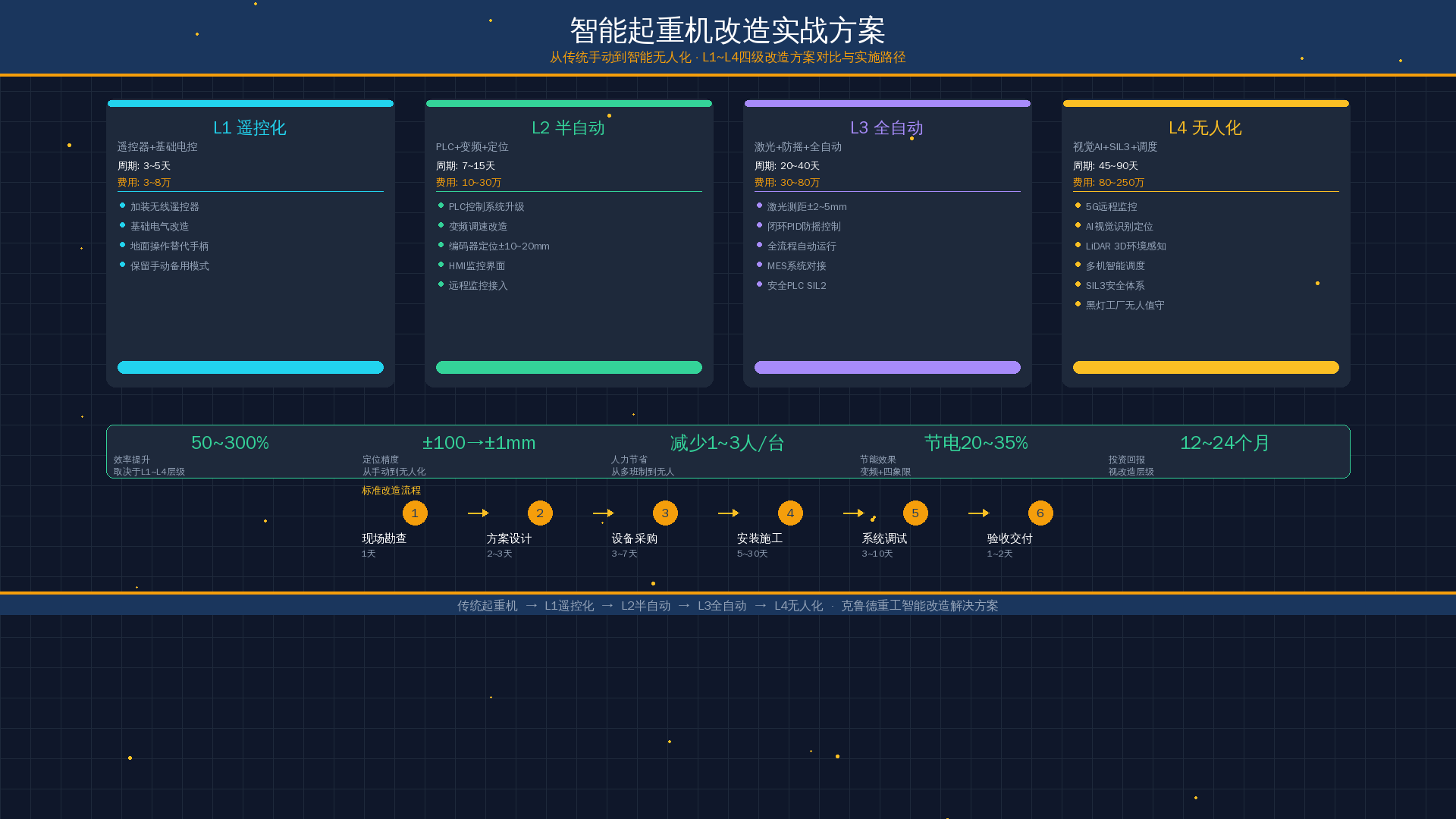
Kelude Heavy Industry divides crane smart retrofits into four distinct levels, progressing from basic remote control to fully unmanned operation. The table below compares all four across five dimensions: retrofit scope, added equipment, real-world results, investment cost, and implementation timeline:
| Comparison Parameter | L1 Remote Control Integration | L2 Semi-automatic | L3 Fully automatic | L4 Unmanned Operation |
|---|---|---|---|---|
| Retrofit Content | Removal Operator Cabin Control Console, Wireless Retrofit Remote Receiver; Retention Manual operation Logic | Retrofit PLC Controller(Siemens S7-1200), Initial Positioning Points Positioning; Operator Station+Dual-Mode Remote Control | Full PLC Control(Siemens S7-1500), Automatic Path Planning; Automatic Positioning at Critical Workstations | Fully Unmanned Operation, Multi-Crane Coordinated Scheduling; Fully Automated Process Without Manual Intervention |
| Additional Equipment | industrial wireless remote control(2.4G/ISMFrequency Band), Emergency Stop Receiver Module, electrical control box Retrofit | PLC Controller, Incremental Encoder, Limit switch Group, Simplified Touch Screen (HMI)HMI, Remote Control/Manual Switcher | Siemens S7-1500 PLC, SICKLaser Distance Sensor / Laser Rangefinder, variable-frequency speed control system, Industrialnetwork switch, HMIOperator Station | SIL3Safety PLC,3DLiDAR(2-4Unit), High Accuracy Encoder, Wi Fi6/5GCommunication Module, MESInterface Gateway, Video Monitoring System |
| Effect | Operator Can Follow on Ground, Eliminate Elevated Work Risks; Efficiency Improvement10%-15% | Achieve Point-to-Point Semi-automatic Operation; Reduce Dependence on Operator Experience; Efficiency Improvement20%-30% | Fully automatic Hoisting and Transport, Manual Only for Dispatch Commands; Positioning Accuracy±10mm; Efficiency Improvement40%-60% | Completely Unmanned Operation, Intelligent Multi-Crane Scheduling; Can Integrate With MES/ERPDeep Integration; Efficiency Improvement60%-80% |
| Cost(10,000 CNY) | 3-80,000 | 10-300,000 | 30-800,000 | 80-2,500,000 |
| Cycle Time | 3-5Days | 7-15Days | 20-40Days | 45-90Days |
Control System Upgrade Breakdown
The control system is the "brain" of any smart crane retrofit—it's also the most technically demanding and cost-intensive component. Control system solutions vary significantly across upgrade levels.
3.1 L1: Wireless Remote Control Retrofit
The core of L1 is replacing the operator interface. The original cab-mounted master controller (cam controller + contactor system) is replaced with a wireless remote receiver. The receiver outputs relay signals that directly control motor direction and brake application. Key upgrade points include:
- Remote control selection: Industrial-grade IP65-rated enclosure, 2.4G frequency-hopping technology, effective range ≥100m; the emergency stop channel uses an independent hardware circuit that cuts the main contactor.
- Electrical modifications: The main power circuit remains unchanged; only the control circuit is modified. A remote/cab dual-mode selector switch is added for commissioning and emergency operation.
- Safety interlock: Emergency stop, overload limiter, and limit switch signals are wired in series into the remote receiver's safety chain.
3.2 L2: PLC-Based Semi-Automatic Retrofit
L2 introduces a programmable logic controller (PLC) to enable basic semi-automatic functions. The Siemens S7-1200 series is recommended for its cost-effectiveness and programming flexibility. The PLC receives commands from the remote control or HMI and outputs speed setpoints to the VFD and braking control signals.
- VFD upgrade: The original direct-on-line contactor starting is replaced with variable-frequency drive (VFD) control, enabling smooth speed regulation and precise stopping.
- Encoder feedback: Incremental encoders are added to both the crane bridge and trolley drives for position closed-loop control.
- HMI: A 7-inch or 10-inch touch screen displays equipment status, fault diagnostics, and position data.
- Semi-automatic mode: The operator selects a target position (e.g., Station A or Station B), and the PLC automatically executes the sequential motion of bridge/trolley/hoist, with the operator only confirming safety.
3.3 L3/L4: Fully Automatic and Unmanned Operation
L3 and L4 control systems demand a higher-performance platform. The Siemens S7-1500 series is the preferred choice, thanks to its powerful processing capability and PROFINET communication. Key technical points:
- Motion control: The S7-1500's technology objects enable three-axis (X/Y/Z) interpolated motion control, eliminating load swing.
- Anti-sway algorithm: Closed-loop anti-sway control based on pendulum angle sensors or accelerometers keeps residual oscillation after stopping within ±50mm and settles in just 2–3 swing cycles.
- Path planning: The PLC automatically generates optimal travel paths based on workstation coordinates, avoiding obstacles and crossing zones.
- Multi-crane coordination: A supervisory dispatching system manages the operating zones of multiple cranes to prevent collisions and task conflicts.
- SIL3 safety PLC: L4 unmanned operation requires a dedicated safety PLC, physically separate from the main PLC, with a pure hardware-based safety chain architecture compliant with ISO 13849.
Positioning System Selection Guide
Positioning accuracy directly impacts the operational quality and efficiency of a smart crane. Different upgrade levels have different accuracy requirements, and the corresponding technical solutions vary accordingly.
4.1 L1/L2: Incremental Encoder Positioning
Suitable for semi-automatic applications with moderate accuracy requirements (within ±50mm). Incremental encoders are mounted on the drive wheels of the bridge and trolley, or on the drum shaft, converting pulse counts into displacement. The advantages are low cost and easy installation; the drawbacks include cumulative error, and positioning drift caused by wheel slip or wear, requiring periodic calibration.
4.2 L3: Laser Distance Sensor Positioning
SICK laser distance sensors (e.g., Dx35 or LMS series) are the mainstream choice for L3 fully automatic retrofits. The laser head is mounted on the crane end carriage or trolley frame, with a reflector plate installed on the floor or at the rail end. Distance is measured using laser time-of-flight (ToF). A typical configuration:
- Crane bridge direction: 1 laser distance sensor, effective measuring range 50–100m, accuracy ±3mm.
- Trolley direction: 1 laser distance sensor, effective measuring range 30–50m, accuracy ±3mm.
- Lifting height: Rotary encoder or absolute encoder, converting drum rotation count into height.
- Integrated positioning: The PLC reads sensor data via PROFINET, combined with encoder backup data for redundant positioning.
4.3 L4: 3D LiDAR + Multi-Sensor Fusion
Unmanned scenarios demand high reliability and gap-free perception. We recommend 2–4 3D LiDAR units (e.g., SICK LMS series or Velodyne) to cover the entire crane operating area. Point cloud data is processed by an edge computing unit to generate a 3D scene map, enabling:
- Obstacle detection: Identifies dynamic obstacles such as personnel, materials, and equipment, triggering a stop or detour.
- Precise positioning: 3D contour matching against the target drop-off point (e.g., stillage, AGV, machining center) achieves ±5mm stopping accuracy.
- Environment modeling: A Digital Twin system reconstructs the workshop scene in real time for remote monitoring and dispatch optimization.
Safety System Upgrade Essentials
Safety is the number one priority in any crane retrofit. ISO 12480 (referenced from GB 6067.1-2010) provides clear requirements for various safety devices. The intelligent upgrade must not weaken existing safety protections and must add new safety measures for automated scenarios.
5.1 Retaining and Upgrading Existing Safety Devices
All traditional safety devices must be retained or upgraded:
- Overload limiter: All units are replaced with digital overload limiters with ±5% accuracy, featuring overload alarm and power cutoff functions.
- Travel limit switch: Mechanical limits are retained as hard safety redundancy, with electronic limits (soft limits within the PLC) added.
- Emergency stop: The remote control, HMI, and ground control station each have an independent Emergency Stop Button, all wired in series into the hardware safety chain.
- Wind rail clamp / anchor device: For outdoor cranes, the rail clamp must be interlocked with the PLC—travel is prohibited unless the clamp is fully released.
5.2 Adding Intelligent Safety Functions
The following safety functions are required for automated operation:
- Area scanning: SICK safety laser scanners are installed in critical areas along the crane travel path (e.g., pedestrian walkways, material staging areas) to create a three-dimensional protective zone. Personnel intrusion triggers immediate deceleration or stop.
- Speed monitoring: The PLC continuously monitors the actual speed of each axis and automatically decelerates to a stop in the event of overspeed.
- Load sway monitoring: Pendulum angle sensors monitor spreader swing amplitude and automatically decelerate when a safe threshold is exceeded.
- Communication loss protection: If communication between the remote control or host system and the PLC is interrupted for more than a set time (typically 500ms), the system automatically stops and maintains braking.
- Anti-collision protection: When multiple cranes operate on the same runway, each crane broadcasts its real-time position, and the supervisory dispatching system or PLC-to-PLC interlocking logic prevents collisions.
5.3 SIL Safety Level Requirements
L4 unmanned operation must comply with functional safety standards ISO 13849 or IEC 61508. Critical safety functions (emergency stop, overspeed protection, anti-collision) should achieve SIL2 or SIL3. We recommend a dedicated safety PLC (e.g., Siemens S7-1500F or SICK Flexi Soft), physically isolated from the main control PLC, exchanging only essential information via a safety bus. The safety PLC response time requirements are as follows:
- Emergency stop trigger to main contactor opening: ≤50ms
- Overspeed trigger to power cutoff: ≤100ms
- Area intrusion to deceleration/stop: ≤200ms
Communication Network Upgrade
The communication network of a smart crane operates on two distinct levels: internal communication within the crane itself, and communication between the crane and the higher-level control system.
6.1 Internal Crane Communication
PROFINET real-time Ethernet is the preferred protocol for modern industrial communication. The Siemens S7-1500 PLC connects to the following devices via the PROFINET bus:
- Frequency Inverters / VFDs: Siemens G120 or S120 series drives receive speed setpoints and transmit status feedback over PROFINET.
- Laser Distance Sensors: SICK sensors with integrated PROFINET interfaces periodically transmit distance data.
- Encoders: Absolute encoder data is read via PROFINET interface modules.
- HMI: Exchanges data with the PLC via PROFINET or PROFINET RT.
- Remote I/O Stations: ET200SP remote I/O stations, mounted on the crane end carriages and hoisting mechanism, minimize field wiring.
6.2 Crane-to-Host Communication
Communication between the crane PLC and the workshop's host system (MES/ERP/dispatching system) is critical for digital integration. Recommended solutions include:
- WiFi 6 (802.11ax): Suitable for medium to large workshops. Multiple industrial-grade WiFi 6 access points (e.g., Moxa or Siemens SCALANCE) are deployed overhead, while a client module (CP 1543-1) on the crane enables seamless roaming with handover times under 50 ms. WiFi 6 supports data rates up to 2.4 Gbps, accommodating both video streaming and real-time control data.
- 5G Private Network: Ideal for very large facilities or applications with stringent latency requirements. With a deployed 5G UPF, end-to-end latency can be kept within 10 ms. 5G is particularly well-suited for multi-crane coordination and remote video operation in L4 unmanned scenarios.
- Communication Protocol: OPC UA (Unified Architecture) is the recommended protocol for upper-level data exchange. The PLC acts as an OPC UA server, while the MES or dispatching system acts as a client, reading crane status data, task commands, and alarm information.
6.3 Communication Redundancy Design
Critical applications (such as L4 unmanned operations) demand redundant communication links:
- Deploy both WiFi 6 and 5G links simultaneously, with automatic failover in case the primary link fails.
- Configure redundant communication modules on the PLC side, supporting MRP (Media Redundancy Protocol) ring topologies.
- Implement a heartbeat mechanism for the OPC UA session between the host system and PLC. A communication interruption exceeding 1 second triggers a safe stop.
MES Integration and Data Acquisition
The ultimate value of a smart crane lies in its integration into the workshop's digital ecosystem, serving as a production execution terminal for MES/ERP systems. In Kelude's retrofit solutions, MES integration is a standard feature for L3 automation levels and above.
7.1 Data Acquisition Scope
Data collected and uploaded by the PLC includes:
- Operational Data: Status of each mechanism (running/stopped/fault), current crane bridge, trolley, and hoist position coordinates, load weight, travel speed, and cumulative operating hours.
- Job Data: Current task ID, source and destination stations, number of lifts, cycle time per lift, and records of abnormal interruptions.
- Equipment Data: Inverter current/temperature/fault codes, brake status, wire rope usage (cumulative fatigue count), and status of all sensors.
- Alarm Data: Overload alarms, limit switch triggers, emergency stop records, communication interruption logs, and safety scanner activation events.
7.2 MES Interface Architecture
The recommended standard data link is: PLC → OPC UA → MES Database/Message Queue.
- Data blocks are programmed within the PLC, refreshed at a fixed interval (typically 100–500 ms).
- The PLC functions as an OPC UA server, exposing the data block address space.
- An OPC UA client (e.g., Kepware or custom-developed) is deployed in the workshop, polling or subscribing to data changes.
- The client writes data to the MES database (SQL Server/MySQL) or publishes it to a message queue (RabbitMQ/Kafka).
- MES applications consume the data to update work order status, equipment OEE, and material tracking records.
7.3 Digital Twin and Remote Monitoring
In L4 unmanned scenarios, a Digital Twin system can be further developed. A 3D workshop scene is built using Unity or Three.js, with virtual equipment movements driven in real-time via OPC UA. This allows management personnel to remotely monitor the operation of unmanned overhead cranes from a central control room via large displays or VR devices, and even issue task commands.
Retrofit Cost and ROI Analysis
Cost is a primary consideration for companies evaluating retrofit options. The following analysis, based on Kelude Heavy Industry's actual project data, breaks down the cost structure and investment return for each automation level.
8.1 Cost Breakdown
Using a typical L3 fully automatic retrofit (budget: 500,000 CNY) as an example, the cost structure is as follows:
- Control System (35%): Siemens S7-1500 PLC, HMI, PROFINET communication modules, and programming/commissioning services — approximately 175,000 CNY (~$25,900).
- Positioning System (20%): Two SICK laser distance sensors, three encoder sets, mounting brackets, and calibration — approximately 100,000 CNY (~$14,800).
- Variable Frequency Speed Control System (25%): Crane bridge, trolley, and hoist inverters (Siemens G120 series), braking resistors, and electric control cabinet modifications — approximately 125,000 CNY (~$18,500).
- Safety System (15%): Safety PLC or safety relays, safety laser scanners, light curtains, and safety interlock circuit modifications — approximately 75,000 CNY (~$11,100).
- Installation & Commissioning (5%): On-site installation, wiring, commissioning, training, and acceptance — approximately 25,000 CNY (~$3,700).
8.2 ROI Calculation
Consider a medium-sized manufacturing enterprise with three traditional overhead cranes, opting for an L3 fully automatic retrofit (500,000 CNY per crane, totaling 1,500,000 CNY investment):
- Labor Savings: Each crane originally required two operators (shift work). After the retrofit, one operator can monitor all three cranes, saving five operator positions. At an annual salary of 80,000 CNY each, this saves 400,000 CNY per year.
- Efficiency Gains: The average lifting cycle time is reduced from 8 minutes to 4 minutes, and equipment utilization increases from 50% to 80%. This equates to saving 3.2 hours of production capacity per day, translating to an annual benefit of approximately 150,000 CNY.
- Reduced Downtime & Maintenance: Variable frequency soft start reduces mechanical shock, lowering equipment failure rates by approximately 40% and cutting annual maintenance costs by about 50,000 CNY.
- Loss Prevention: Damage to equipment or goods caused by operator error is reduced by approximately 30,000 CNY per year.
- Total Annual Benefit: Approximately 630,000 CNY, resulting in an ROI period of about 2.4 years.
Retrofit Implementation Process
Kelude Heavy Industry has developed a "Five-Phase Retrofit Implementation Process" based on years of project experience, ensuring minimal disruption to normal production and consistent quality control.
9.1 Phase 1: Site Survey and Solution Design (1–2 Weeks)
- Inspect the crane's mechanical structure (main girder deflection, crane rail straightness, mechanism wear).
- Measure workshop dimensions and verify communication network coverage.
- Collect operational data including station coordinates, lifting frequency, and material types.
- Develop the technical solution and quotation, confirming the automation level and project timeline.
9.2 Phase 2: Equipment Procurement and Prefabrication (2–4 Weeks)
- Complete laboratory simulation and validation of PLC programs, HMI configurations, and drive parameters.
- Prefabricate the electric control cabinet, including internal wiring and module installation.
- Procure external components such as laser distance sensors, safety scanners, and communication modules.
9.3 Phase 3: On-Site Installation (Primary Time-Consuming Phase)
- Schedule installation during planned production shutdowns or holidays to minimize operational impact.
- Installation sequence: Position the electric control cabinet → Connect main power circuits → Connect control circuits → Install sensors → Lay communication cables.
- Strictly adhere to the requirements of ISO 4301 (Crane Design Standard) to ensure mechanical and electrical installation quality.
9.4 Phase 4: Commissioning and Trial Operation (Approximately 30% of Project Duration)
- Begin with no-load commissioning: Inching/Jog Mode → Continuous operation → Automatic cycle → Fault simulation.
- Proceed to load testing: Light load (25%) → Rated load (100%) → 110% dynamic load test.
- Verify all performance indicators: positioning accuracy, travel speed, braking distance, and safety function validation.
9.5 Phase 5: Acceptance and Training (3–5 Days)
- Conduct acceptance testing in accordance with the relevant clauses of FEM 1.001 (General Purpose Bridge Crane standard).
- Issue the retrofit acceptance report, including all test records and safety function verification logs.
- Provide systematic training for the enterprise's operators and maintenance personnel (2 days of operator training + 1 day of maintenance training).
- Deliver the complete set of technical documentation: electrical schematics, PLC program backups, HMI backups, operation manual, and maintenance manual.
Frequently Asked Questions (FAQ)
Conclusion: The Road to Smart Crane Adoption
Retrofitting a traditional crane into a Smart Crane is far more than a simple equipment swap. It is a systematic engineering overhaul that integrates control technology, sensor systems, communication networks, software logic, and safety engineering. From the quick wins of Level 1 remote control to the deep digital integration of Level 4 unmanned operation, each stage offers distinct application scenarios and clear commercial value. Through over a hundred retrofit projects, Kelude has learned a critical lesson: successful smart upgrades hinge on a thorough understanding of on-site conditions, strict adherence to safety standards, and a precise grasp of customer production needs. Before starting, companies must conduct thorough requirement analysis and feasibility studies, choosing a technology path that fits their current stage of development—avoiding the trap of chasing the highest automation level without a solid return on investment. As 5G, Edge Computing, and AI continue to mature, the next frontiers for crane intelligence are adaptive scheduling and Predictive Maintenance. Adaptive scheduling allows cranes to automatically prioritize tasks based on real-time production flow, while Predictive Maintenance uses vibration analysis, temperature trends, and Lubricating Oil Condition Monitoring to flag potential failures early, minimizing unplanned downtime. These technologies are set to significantly raise the value ceiling of Smart Cranes over the next 3-5 years. Digitalization is a journey without a final destination. Kelude Heavy Industry is committed to exploring this path alongside manufacturers, breathing new digital life into existing equipment and moving together toward a new era of Smart Manufacturing.
References & National Standards
- ISO 4301 Crane Design Standard — Defines the fundamental requirements and calculation methods for crane design, covering core aspects such as load calculation, structural design, mechanism design, and electrical systems.
- GB 6067.1-2010 Safety Regulations for Lifting Appliances – Part 1: General Provisions — A mandatory national standard for the safety protection of lifting appliances, specifying the configuration requirements for various safety devices.
- FEM 1.001 General Purpose Bridge Crane — The product standard for general purpose bridge cranes, outlining technical requirements, Test procedures, and Inspection rules.
- ISO 13849-1:2023 Safety of Machinery – Safety-Related Parts of Control Systems — An international standard for the functional safety design and validation of control systems, serving as a core reference for safety system design in automation retrofits.
