

LH vs QD Bridge Cranes: Trolley Type & Cost
📋 Key Summary
Both the LH electric hoist double-girder crane and the QD double-girder bridge crane carry the "double girder" label, yet their hoisting mechanisms could hardly be more different: the LH uses an electric hoist trolley, while the QD carries a full winch mechanism plus an operator cab. This single difference in trolley type dictates the lifting capacity ceiling, work duty, factory clearance, and purchase cost across the board. This article breaks down the selection logic for both types — from structural fundamentals and parameter boundaries to operating-condition decisions and life cycle cost — in one pass.
Many buyers do a double-take the first time they receive a "double-girder crane" quotation: both are labeled "double girder," yet the price gap between an LH and a QD can reach three to five times. The instinct is to blame capacity, but what actually drives the difference is the trolley type — the LH carries an electric hoist, while the QD carries a complete winch mechanism plus an operator cab. Miss this distinction, and you risk spending a QD budget on an LH configuration, or overpaying for a trolley hoist on a light-duty application.
This misjudgment is especially common among small and mid-sized manufacturers. Below, we unpack the structural, parameter, and cost boundaries layer by layer, starting with what "double girder" actually means.
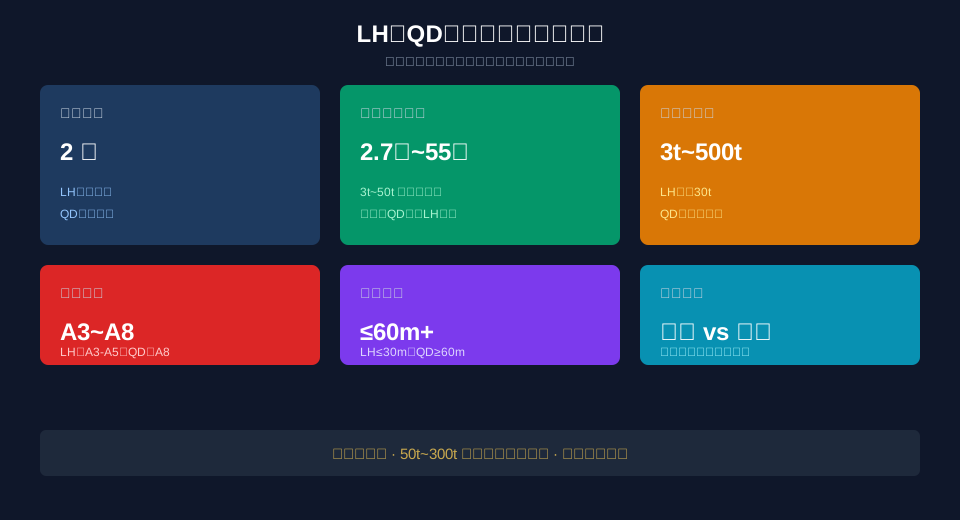
LH vs QD: Electric Hoist Trolley or Trolley Hoist?
"Double girder" refers to the bridge structure formed by two main girders and two end carriages — this part is identical on both the LH and the QD. The dividing line is the trolley that runs along the bridge. The LH's formal name is "electric hoist double-girder crane": the trolley itself is an electric hoist, with both hoisting and traveling functions integrated into the hoist body, running back and forth along the I-Beam Rail on the lower flange of the main girder. The QD's formal name is "double-girder bridge crane": its trolley is a standalone winch mechanism — drum, wire rope, hook block, reducer, and brake all mounted on the trolley frame, with a separate operator cab that travels with the crane.
This structural difference is the source of every parameter difference that follows. It comes down to three motion dimensions:
① Hoisting action: The LH relies on the gearbox and drum inside the hoist — compact, but limited in winching capability. The QD uses an independent drum with multi-layer winding, allowing greater lifting height and higher single-rope pull.
② Traveling action: The LH trolley is the hoist body itself — lightweight, with low rail loading. The QD trolley frame carries the drum, drive system, and operator cab, with a dead weight several times that of a hoist, raising the demands on the main girder and crane rail accordingly.
③ Operation mode: The LH is primarily operated via a pendant station on the ground, with remote control as an option. The QD is primarily operated from a cabin, often with an operator console, suited to long-distance, high-frequency lifting and transport.
On the standards side, trolley design can reference EN 13001-3-7:2020 "Bridge Crane End Carriage Trolley Design", and hoisting mechanism requirements can reference EN 13001-3-6:2018 "Bridge Crane Hoisting Mechanism Requirements". For its European Standard double-girder trolley hoists, Kelude verifies trolley frame stiffness and hoisting mechanism load combinations item by item against these two standards.
Capacity, Work Duty, and Lifting Height: LH vs QD Boundaries
When structural differences translate into numbers, a clear boundary table emerges. LH lifting capacity typically tops out at 30 t — beyond that, the electric hoist's drum and wire rope can no longer handle the load. The QD starts at 5 t and scales up to several hundred tons, which is exactly the range Kelude's 50 t to 300 t European Standard double-girder cranes cover. On work duty, per the A1 to A8 classification in FEM 1.001 Crane Design Standard, the LH is mostly light to medium duty, while the QD covers medium to extra-heavy duty — handling harsh operating conditions like metallurgical and casting work with frequent full loads.
Lifting height is equally critical. The LH is limited by the hoist drum's rope capacity, generally staying within 30 m. The QD's trolley hoist can reach 60 m or higher, suited to high-bay factory buildings and deep-pit operations. Parameter comparison follows.
| Comparison Parameter | LHElectric HoistDouble Girder | QDdouble-girder bridge crane | Difference Description | Typicaloperating condition | selection recommendations |
|---|---|---|---|---|---|
| lifting capacity range | 3t~30t | 5t~500t | HoistDrumrope capacityIs the Upper Limit | 30tLight and Medium Duty Below | 30tMandatory AboveQD |
| Work Duty / Classification | A3~A5 | A3~A8 | winchStructure Can BearLoad CapacityGrade | FrequentFull load/metallurgical | A6Mandatory AboveQD |
| Lifting Height | General≤30m | Up to60mAbove | Drummulti-layer windingDifference | High SpanFactory building/Deep Pit | 30mOptional AboveQD |
| TrolleyType | Electric HoistTrolley | trolley hoist+Cabin / Operator Cab | Dead WeightandCrane RailLoadSignificant Difference | Compact vs High Capacity | Depends onHoisting / LiftingDetermined by Capacity |
| Operation Mode | Pendant Control/remote controlPredominant | Cabin / Operator Cab/Operator console | field of visionand ControlAccuracyDifferent | Longdistance/High FrequencyLifting and transport | Selected for High-Frequency OperationQD |
| Factory buildingclearance | requirementsRelatively Low | requirementsRelatively High | trolley hoistGreater Headroom | Low-Headroom vs High Span | Subject toFactory buildingDetermined by Constraints |
LH vs. QD: A Decision Tree for Choosing the Right Crane
Once you've reviewed the spec sheets, you still need a clear decision sequence before committing to a purchase. Rather than framing LH and QD as "cheap vs. expensive," think of them as two capability curves: LH excels in applications under 30t with light-to-medium duty and low-headroom constraints, while QD is the definitive choice above 30t with heavy-duty cycles and high lifting heights. The decision process follows four steps.
Step 1: Does the lifting capacity exceed 30t? If so, QD is the only option—no further discussion needed.
Step 2: Check the work duty classification. If the operation runs 10+ hours daily with frequent full-load cycles, or involves metallurgical or casting environments, and the work duty is A6 or above, you should move to QD even if the capacity is under 30t.
Step 3: Evaluate lifting height and factory clearance. If the lifting height exceeds 30m, or the factory building already has high-bay conditions, QD's trolley hoist is the better fit. In low, tight-clearance buildings, LH's electric hoist trolley can actually save you the cost of building modifications.
Step 4: Assess operational intensity and accuracy requirements. For production lines requiring extended continuous operation from an operator cab and precise load placement, QD's operator console delivers a noticeably more stable experience.
Before purchasing, verifying the Type Test Certificate and manufacturing license is equally essential. Supervision inspection of the complete machine follows TSG 51-2023 Crane Safety Technical Supervision Regulation. The technical director at Kelude Heavy Industry pointed out: "Many buyers lump LH and QD bridge girders together, comparing only capacity and total price during procurement—only to discover later that the work duty or lifting height doesn't meet requirements. The cost of rework and retrofit far exceeds the price difference they thought they were saving." This highlights the hidden risk of getting the selection sequence wrong.
How Trolley Type Drives Purchase Cost and Lifecycle Economics
The price gap ultimately comes down to the trolley. The electric hoist is a standardized, off-the-shelf component, keeping LH trolley costs manageable. QD's trolley hoist is a custom-built assembly—drum, reducer, brake, and operator cab must all be individually configured to match capacity and operating conditions. Based on 2015–2020 East China crane industry reference prices, LH electric hoist double-girder cranes in the 3t to 30t range cost approximately $4,000 to $32,700, while QD double-girder bridge cranes in the 5t to 50t range cost approximately $14,900 to $81,800—QD typically runs several times the price of LH at the same capacity, and the gap widens as capacity increases.
But purchase price is only the beginning of the equation. Before buying, verify the following eight items one by one to avoid costly surprises down the road.
📋
Capacity Limit
Confirm whether 30t—LH's hard ceiling—is exceeded
📋
Work Duty
Check if A6 or above requires switching to QD hoisting
📋
Lifting Height
Above 30m, prioritize QD multi-layer hoist winch
📋
Building Clearance
Measure rail-to-roof distance before deciding trolley type
📋
Type Test Certificate
Request Type Test Reports for the complete machine and hoisting mechanism
📋
Manufacturing License
Verify the special equipment manufacturing license coverage scope
📋
Installation Acceptance
Agree on supervision inspection and acceptance milestones after installation
📋
Maintenance Response
Confirm spare parts supply and fault response time terms
The lifecycle cost picture reveals the long-term impact of trolley type even more clearly. QD's trolley hoist carries a higher purchase price, but its reducer and brake are designed for heavy-duty cycles—under the same full-load frequency, the overhaul cycle is longer and downtime cost more controllable. LH's hoist, being a standard part, is cheap and fast to replace as a complete unit when it fails, but frequent replacements under heavy-load conditions drive up long-term maintenance costs. Below, we lay out the cost structure across two time horizons: five years and fifteen years.
Please provide the Chinese text to be localizedHTMLContent,I will output idiomatic English as requestedHTML。| costItem | LHElectric HoistDouble Girder | QDdouble-girder bridge crane | Cause of Difference |
|---|---|---|---|
| Procurementcost | 2.7Ten Thousand~22Ten Thousand | 10Ten Thousand~55Ten Thousand | HoistOutsourced vs Hoist WinchCustomized |
| Installation & Commissioning | Short Lead Time、Low Difficulty | Long Lead Time、CommissioningMany Items | Cabin / Operator Caband MultiplemechanismInterlocked |
| 15Annual Maintenance | ReplacementHoistlow cost | Overhaul CycleLonger | Heavy Dutydesign vs Standard part |
| energy consumption | Total installed powerRelatively Small | Many ItemsmechanismPowerHigher | Hoisting / LiftingCapacity and Frequency Difference |
| downtime cost | Light loadAcceptable Under | Heavy loadMore Controllable Under | operating conditionStrengthDetermining Weight |
Kelude Heavy Industry serves the custom European Standard double-girder market from 50t to 300t, delivering complete QD-class trolley hoist units. Every unit is verified item by item to FEM and DIN standards, with the hoisting mechanism and trolley design conforming to the EN 13001 Crane Safety Standard series. Pricing for these machines varies unit by unit depending on capacity, span, work duty, and lifting height — subject to the actual contract. What follows is selection logic only, not a formal quotation.
📖 Related reading: The main girder is a crane's backbone: structural design insights into imported vs. domestic European-standard double-girder cranes | How to convert between FEM and GB work duty classifications — the actual gap between European-standard and Chinese national standard cranes
FAQ
Q: What is the core component difference between an LH electric hoist double-girder crane and a QD double-girder bridge crane?
A: The trolley. The LH carries an electric hoist trolley, with hoisting and traveling both integrated into the hoist. Lifting capacity typically tops out at 30t, with work duty from A3 to A5. The QD carries a standalone hoist winch mechanism plus an operator cab, with a multi-layer winding drum. Lifting capacity can reach several hundred tons, with work duty up to A8. At the bridge girder level, the double-girder structure is common to both.
Q: At the same capacity, roughly how much more does a QD cost than an LH, and where does the extra money go?
A: Based on 2015–2020 East China crane industry reference prices, an LH electric hoist double-girder crane from 3t to 30t runs about ¥27,000 to ¥220,000 (approx. $4,000 to $32,700), while a QD double-girder bridge crane from 5t to 50t runs about ¥100,000 to ¥550,000 (approx. $14,900 to $81,800). At the same capacity, a QD typically costs several times an LH. The price gap concentrates in the custom hoist winch trolley assembly — drum, reducer, brake, and operator cab all configured individually to capacity and operating condition.
Q: How do I decide whether my workshop needs an LH or a QD?
A: Apply four checks: Does lifting capacity exceed 30t? Is work duty A6 or above? Does lifting height exceed 30m? Is high-frequency continuous operation from an operator cab required? If either of the first two applies, move to a QD. Only scenarios within 30t, light-to-medium duty, and low-headroom conditions favor an LH. Before purchasing, always verify work duty and lifting height to avoid rework.
Q: Why can a QD double-girder crane achieve far greater lifting height and capacity than an LH?
A: It comes down to drum structure. The LH relies on a short drum built into the hoist, with limited rope capacity and lifting height generally within 30m. The QD trolley hoist uses a large drum with multi-layer winding, giving it several times the rope capacity of a hoist. Lifting height can exceed 60m, and single-rope pull rises substantially with wire rope diameter and reduction ratio. This is the physical reason a QD can cover large tonnage.
Kelude Heavy Industry specializes in custom manufacturing of 50t to 300t European Standard double-girder bridge cranes. Trolley type and hoisting mechanism are both verified to FEM and DIN standards. Selection schemes are subject to the actual contract.
