

Crane Hook Wear Detection & Discard Criteria
📋 Key Summary
The hook is the safety component that carries the most concentrated load in lifting appliances — and the one most often overlooked. This article covers hook wear detection and discard criteria: the critical section sits at the hook opening, where stress concentrates most heavily. Three indicators — wear amount, throat opening deformation, and torsional deformation — together determine whether a hook can stay in service. It provides inspection interval recommendations, measuring tools, and measurement locations, and lays out the quantified limits for discard criteria such as cracks, wear exceeding the limit, and plastic deformation — helping maintenance crews replace guesswork with reproducible data and keep damaged hooks out of service.
How much longer can a worn crane hook stay in service? Most maintenance crews answer with "it depends" — a quick feel by hand, a rough visual estimate, then back to work. But the critical wear limit at the hook's critical section is often just a few millimeters, far below what the naked eye can resolve. By the time you can actually see that a hook is "worn pretty badly," the safety margin at that section is usually already gone.
What's more counterintuitive: hook discard criteria never rest on wear amount alone. Whether the throat opening has been stretched, whether the hook body has twisted, whether the critical section shows plastic deformation — any single one of these triggers rejection. These four indicators work as a one-vote veto, not as an average score.
That's exactly what this article breaks down: replacing "it depends" with a reproducible, quantified inspection and judgment process.
Where Is the Critical Section on a Lifting Hook?
The critical section of a hook is the segment at the hook opening where bending is most severe and stress is most concentrated. Standards single it out as the inspection focus because when a hook suspends a load, bending and tensile stresses stack up most heavily at this segment — and wear and plastic deformation appear here first.
By manufacturing process, hooks fall into three categories: Forged Hook, Laminated Hook, and plate hook. A forged single hook is simple in structure and light in dead weight, widely used for lower lifting capacities; for higher capacities, a symmetrical double hook is preferred. Laminated and plate hooks are built from steel plate by riveting or stacking — a crack in a single plate won't immediately fracture the whole hook, giving them high safety, but their dead weight is greater, so they're mainly used for heavy lifting capacities or for lifting and transport of molten metal. The first step in deciding whether a hook can stay in service is identifying which type it is and where its critical section lies.
GB/T 10051.1-2010, Mechanical Properties, Material Grades, and Discard Criteria for Lifting Hooks sets out general provisions for hook mechanical properties, material grades, and discard criteria; hook devices for European Standard projects must also meet the technical requirements of ISO 12481:2012, Technical Specification for Crane Hook Devices. In its 50t to 300t European Standard Double-Girder custom projects, Kelude Heavy Industry configures hook devices against both standards in tandem, and records the original dimensions of the hook's critical section as baseline data in the Accompanying Documentation at delivery for later inspection comparison.
Three Core Parameters for Hook Wear Detection
What really matters in routine hook inspection isn't "how much has worn off" but three quantifiable parameters. The first is wear amount at the critical section, the second is change in throat opening, and the third is torsional deformation. Each corresponds to a different failure mechanism, and each calls for a different measuring tool.
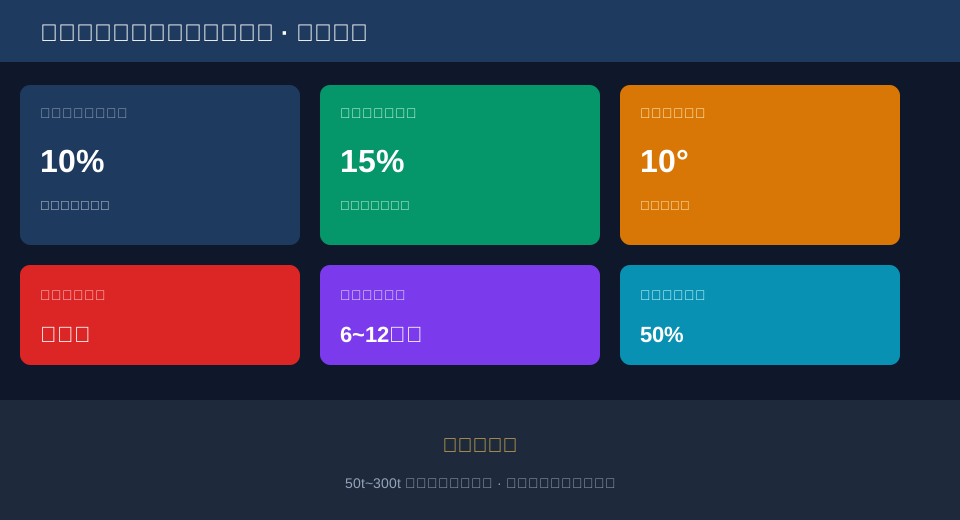
Measure wear amount at the critical section with a vernier caliper at the thinnest point of the section, then compare against the original factory dimension — wear reaching 10% of the original dimension hits the discard line. Measure throat opening with a caliper across the two ends of the hook opening — an increase of 15% over the original dimension requires scrapping. Measure torsional deformation by angle — a twist of more than 10° from the original position means the hook is rejected. The technical director pointed out: "Wear at the critical section is rarely uniform — the side near the hook opening wears fastest. Pick the wrong measurement location, and your discard judgment drifts right along with it."
Inspection intervals can't be set arbitrarily — they must follow usage intensity. For cranes with a high Work Duty / Classification, frequent starts and stops, or lifting and transport of hot metal or abrasive materials, the hook inspection interval should be shortened; for low Work Duty / Classification and steady loads, it can be relaxed appropriately. As a rule, carry out a dedicated inspection every 6 to 12 months, and immediately re-inspect before re-commissioning after more than three months out of service, or after any hook collision or overload.
| test indicators | discard criteriaValue | inspection tooland Method |
|---|---|---|
| Critical Sectionwear amount | Reaches Original Dimension10% | vernier caliperMeasure Thinnest Point |
| throat openingIncrease | Increase from Original Dimension15% | calipercomparisonOriginal Dimension |
| torsional deformation | Exceed10° | AngleDimension Compared with Original Position |
| SurfaceCrack | If Found, Immediatelyscrapping | Magnetic Particle orpenetrant testing |
| plastic deformation | Critical Section or Hook Neck Develops | Visual Inspection with Template Comparison |
Seven Hook Scrap Criteria: Crack, Wear, Deformation & Throat Opening Inspection
Hook scrapping isn't a judgment call — it's a checklist. The standard defines seven scrap criteria, and if any one of them is met, the hook must be taken out of service immediately. There is no room for "let's keep an eye on it." These seven items are the ones worth committing to memory in any maintenance log.
The seven scrap criteria are: cracks on the surface; wear at the critical section reaching 10% of the original dimension; throat opening increased by 15% over the original dimension; torsional deformation of the hook body exceeding 10°; plastic deformation at the critical section or hook neck; wear on the plate hook bushing reaching 50% of the original dimension, requiring bushing replacement; and wear on the plate hook mandrel reaching 5% of the original dimension, requiring mandrel replacement.
The inspection sequence matters too. Start with a visual inspection for cracks and deformation, then measure wear and throat opening with gauges, and finally confirm suspected areas using magnetic particle or penetrant testing. This procedure aligns with the periodic inspection requirements of TSG 51-2023 Crane Safety Technical Supervision Regulation. Kelude Heavy Industry incorporates hook inspection as a standard task in every routine inspection, archiving results alongside original dimension records to create a traceable hook service life file.
| inspection items | inspection method | Acceptance Criteria | Corrective Action |
|---|---|---|---|
| SurfaceCrack | Magnetic Particle orpenetrant testing | AnyCrack | Immediately Remove from Servicescrapping |
| Critical SectionWear | caliperMeasure Thinnest Point | Reaches Original Dimension10% | scrapping |
| throat openingIncrease | calipercomparisonOriginal Value | Increase from Original Dimension15% | scrapping |
| torsional deformation | AngleMeasurement | Exceed10° | scrapping |
| Hook Neckplastic deformation | Visual Inspection with Template Comparison | Critical Section or Hook Neck Developsplastic deformation | scrapping |
| Plate Hook BushingWear | caliperMeasurement | Reaches Original Dimension50% | scrappingPlate Hook Bushing |
| Plate Hook MandrelWear | caliperMeasurement | Reaches Original Dimension5% | scrappingPlate Hook Mandrel |
Three Common Mistakes in Crane Hook Wear Detection: Why Grinding, Flipping, and Visual Inspection Fall Short
The biggest pitfall in hook inspection isn't inaccurate measurement — it's repairing the wrong thing. Three practices commonly seen on site may look like cost savings, but they actually defer safety risks down the road.
The first is grinding down the worn area with an abrasive wheel to smooth the cross-section. This actively thins the critical section, increasing rather than reducing the wear amount, and pushes the hook past its discard threshold. The second is flipping the hook 180° when one-sided wear is found. The load direction on a hook is determined by design; flipping it alters the stress state of the critical section — this constitutes an unauthorized modification. The third is substituting visual inspection for measurement, relying on a "looks fine to me" judgment. The critical wear limit on the danger section is only a few millimeters — far too small for the naked eye to resolve.
The reliable approach is to scrap hooks strictly based on measurement data, with inspection performed by qualified personnel. This principle is also reflected in the safety requirements for load-handling devices under FEM 1.001 Crane Design Standard. Kelude has encountered numerous cases during customer follow-ups where hooks were "ground down and put back into service" — in every instance, we recommended immediate replacement and advised including hook replacement in the overall crane maintenance budget rather than waiting for an accident to force the issue.
📖 Related reading: How to Select an Electric Hoist: Configuration Logic from CD Type to Metallurgical VFD | How to Calculate Motor Power for an Overhead Crane: Selection Formulas
FAQ
Q: What's the difference between a vernier caliper, a snap gauge, and an ultrasonic thickness gauge for hook wear detection?
A: Each tool measures a different parameter. A vernier caliper directly measures the thinnest point of the critical section to determine whether wear has reached 10%. A snap gauge compares the throat opening profile and hook body contour to assess throat opening and plastic deformation. An ultrasonic thickness gauge measures wall thickness at enclosed locations — such as on plate hooks — where a caliper cannot reach. No single tool covers all seven scrap criteria; they are typically used in combination.
Q: At what percentage of original dimension must a lifting hook be scrapped due to critical section wear?
A: A hook must be scrapped when the critical section wear reaches 10% of the original dimension. The same applies when the throat opening increases by 15% over the original, the hook body twists more than 10°, plastic deformation occurs at the critical section or hook neck, or any crack appears on the surface. For plate hooks, the bushing is scrapped at 50% wear of its original dimension, and the mandrel at 5%.
Q: How much does it cost to replace a crane hook?
A: Hook pricing varies considerably with lifting capacity, material, and the matching hook block. Kelude quotations for hook replacement are subject to the actual contract. Beyond the hook itself, replacement should also include verifying the latch, hook nut, and pulley block compatibility, and budgeting for inspection fees — replacing only the hook without the supporting components leaves hidden risks.
Q: How do I determine whether critical section wear on a hook has exceeded the limit?
A: Measure the thinnest point of the critical section with a vernier caliper and compare it against the factory original dimension. Wear exceeding 10% of the original is over the limit. Have qualified personnel take and record the measurements, and enter the measurement data into the maintenance log. If no original dimension record exists on site, use the corresponding section dimension of a new hook of the same specification as the baseline.
