

How Unmanned Overhead Cranes Take Over the Entire Workshop
📋 Key Summary
The real challenge of an automation retrofit isn't installing a VFD or a positioning system on a single crane — it's getting multiple machines across an entire production line to work in sync. This article breaks the retrofit path into four levels: single-machine VFD, single-machine automation, system integration, and unmanned operation. It explains how each level differs in positioning accuracy, anti-sway capability, dispatching coordination, and the degree of human intervention required, and clarifies when to go straight to full automation versus when to start with a single-machine retrofit. The core takeaway: choose the wrong level, and you'll pay for the same work twice.
Many plant managers assume that once a crane is fitted with a VFD and PLC-based control, the workshop has achieved automation. That's not entirely wrong — but it's a long way from running the entire workshop autonomously. Single-machine automation answers the question "how do I make this one crane move more precisely?" System integration answers a completely different question: "how do I keep the whole production line working together without collisions?" The engineering scope of the two is on an entirely different order of magnitude.
The real trap is this: many retrofit projects invest heavily at the single-machine stage, then discover later that without system-level dispatching design, part of that work has to be torn out and redone. This article lays out the technical boundaries, parameter differences, and investment logic of all four levels in one pass, so you can avoid paying twice.
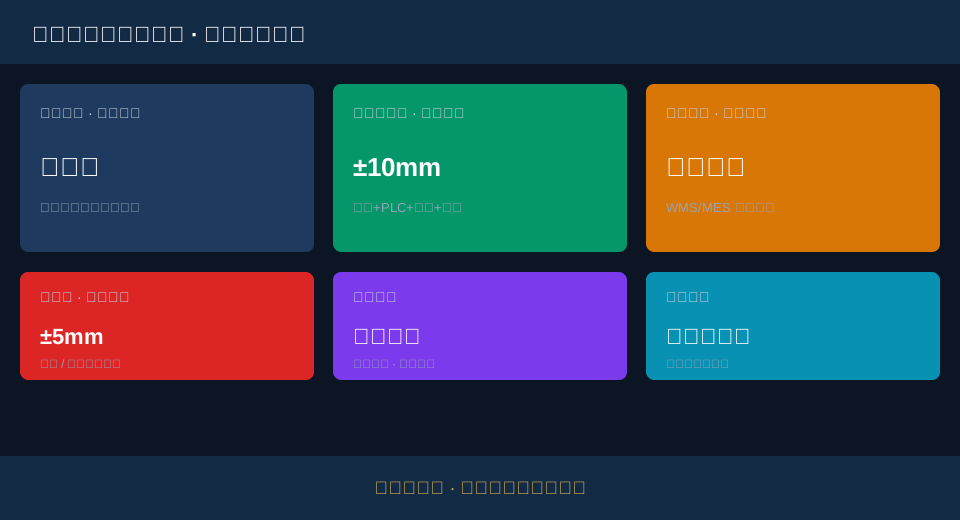
Four Automation Levels for Unmanned Overhead Crane Operations
An automation retrofit isn't a simple on/off switch — it's a four-step path. Each step solves a different problem and carries a different engineering scope.
The first level is single-machine VFD: adding Frequency Inverters to the hoisting, trolley, and bridge motors to smooth out speed control and reduce starting shock. This is a relatively modest investment, but it delivers neither meaningful positioning accuracy nor anti-sway capability — it's still a long way from automation.
The second level is single-machine automation: layering PLC control, position detection, and anti-sway algorithms on top of the VFD. This lets a single crane run automatically along preset paths and self-align to target positions. It solves "how do I make this one crane move more precisely," and positioning accuracy typically reaches around ±10 mm (subject to actual measurement).
The third level is system integration: connecting multiple cranes to a single dispatching system and interfacing with the warehouse management system to achieve multi-crane coordination, automated pick-and-place, and task allocation. The technical framework for this level is systematically defined in ISO 23810:2021, "Automation control system for cranes," which specifies the level hierarchy and functional boundaries.
The fourth level is unmanned operation: adding Predictive Maintenance, Remote Monitoring, and emergency intervention on top of system integration to achieve fully Unattended Operation across the line. The real difficulty here is that the bottleneck is rarely the equipment — it's data quality and the operation and maintenance system behind it.
At Kelude Heavy Industry, we confirm the target level with the customer during the solution phase before deciding on the control architecture. This prevents the double spending that comes from "install single-machine first, bolt on integration later."
Single-Machine Automation vs. System Integration: Key Control Architecture Differences
Many people conflate single-machine automation with system integration. The dividing line is simple: who gives the orders. In single-machine automation, each crane operates independently. In system integration, a central brain issues unified commands.
From an electrical control standpoint, single-machine automation focuses on the speed control performance specified in GB/T 12668, "Variable Frequency Speed Control technical specification," and the control equipment requirements of ISO 10245, "Electrical control equipment for cranes." It's about the drive system and control system of a single machine.
System integration focuses on communication and dispatching. It requires real-time data channels between multiple cranes, host systems, and conveying equipment. The surface appearance is highly misleading — single-machine automation can also achieve automatic operation and looks a lot like unmanned operation. But the moment you need handoffs between process steps, the absence of a dispatching layer means machines wait on each other, and throughput drops instead of rising.
| Comparison Parameter | Standalone UnitVariable Frequency Drive (VFD) | Standalone Unitautomation | system integration | unmanned operation | Engineering Decision Criteria |
|---|---|---|---|---|---|
| Positioning Accuracy | NonePositioning | ±10mmLevel | ±10mmLevel | ±5mmLevel | unmanned operationLaser-Dependent/Gray-code bus positioning system |
| Anti-swayCapability | None | Open-Loop | closed loop | closed loop+Predictive | variable-frequency anti-swayAlgorithm |
| dispatchingCollaborative | None | Standalone Autonomous Operation | multi-crane coordination | Full-Domaindispatching | Required WMS/MES Interface |
| Manual Intervention | Fully Manual | Semi-automatic | Lights-Out / Minimal Staffing | Unattended Operation | Emergency Remote Intervention |
| Typicaloperating condition | Legacy EquipmentSpeed control | Independentworkstation | assembly lineCoupled | Fully Unmanned Line | Coupling-Degree-Based Decision |
System Integration vs. Standalone Retrofit: Which Fits Your Operation?
The right level of automation isn't determined by budget—it's determined by how tightly your processes are coupled. The tighter the coupling, the more you need system integration. The looser the coupling, the more a standalone automation retrofit will suffice.
If your production line runs continuous, flow-style operations where loading, lifting and transport, and cutting are interlinked, going straight to system integration delivers the greatest return. Conversely, if you're dealing with scattered, multi-point warehousing and lifting tasks where each workstation operates relatively independently, starting with standalone automation and adding dispatching later as needed is the more prudent path.
Kelude Heavy Industry's technical manager pointed out: "To decide whether system integration is warranted, look at two indicators: whether there's real-time takt time coupling between processes, and whether the host system already has a data interface available for integration. If either condition is missing, a standalone retrofit is the better investment."
Whichever level you choose, the safety baseline remains the same. The higher the degree of automation, the more rigorously you must implement safeguarding, interlocks, and emergency stops in accordance with TSG 51-2023 Crane Safety Technical Supervision Regulation. Unmanned areas also require proper personnel-entry protection.
📋 Positioning Accuracy Requirements
Determine whether ±10mm or ±5mm is needed—accuracy drives sensor selection
📋 Anti-sway Control Requirements
Check suspended load sway angle and takt time to decide open-loop vs. closed-loop anti-sway
📋 Dispatching Scale & Interfaces
Count connected devices and concurrent task strokes
📋 Host System Integration
Confirm whether WMS/MES already has a data interface
📋 Communication Protocol Compatibility
Unify device bus and industrial Ethernet protocol versions
📋 Safeguarding & Interlocks
Verify unmanned-area guards, emergency stops, and access interlocks item by item
📋 Shutdown Window for Retrofit
Assess production downtime impact on delivery and phased approaches
📋 O&M Team Competence
Evaluate whether on-site staff can handle routine maintenance of automated equipment
Retrofit Cost Breakdown and Payback Period: From Standalone to Unmanned
The investment in an automation retrofit isn't just the quotation for one piece of equipment—it's the sum of five parts: control system, machinery, communication, software, and commissioning. The payback period depends on two variables: labor savings and efficiency improvement.
Before calculating, you need to establish the equipment's technical prerequisites. The Work Duty and load spectrum defined in FEM 1.001 Crane Design Standard determine how many more years the equipment can serve after the retrofit. If the remaining design life is already limited, the economics of unmanned retrofitting need to be re-evaluated.
Within the cost breakdown, standalone VFD retrofits are relatively inexpensive, with costs mainly going to frequency inverters and commissioning. Standalone automation adds positioning, anti-sway, and PLC components. System integration is dominated by dispatching software and interface development. Unmanned operation layers on perception, predictive maintenance, and a remote platform. Actual figures vary significantly depending on operating conditions, span, and lifting capacity—Kelude Heavy Industry's quotations are always subject to the actual contract.
(no source text was provided — the "【Source Text】" section is empty, so there is nothing to translate) Please paste the Chinese HTML you want localized, and I'll return the translated HTML only.| RetrofitHierarchy Level | Key Investment Components | Core Variables Affecting ROI | engineering recommendations |
|---|---|---|---|
| Standalone UnitVariable Frequency Drive (VFD) | Frequency Inverter / VFD、Braking Resistor、Commissioning | Start-StopFrequency、Speed controlScope | Legacy Equipment Life Extension Priority |
| Standalone Unitautomation | positioning sensor、PLC、Anti-swayAlgorithm | Positioning Accuracy、Operationtakt time | IndependentworkstationRetrofitApplicable |
| system integration | dispatchingSoftware、interfaceDevelopment、Communication Network | Process Coupling Degree、Host System / Upper-Level System | assembly lineOne-Step Implementation |
| unmanned operation | Perception / Sensing、predictive maintenance、remote platform | data quality、operation and maintenanceSystem Architecture | data foundationDeploy After Maturity |
📖 Related reading: The main girder is a crane's backbone — structural design differences between imported and domestic European-standard double-girder cranes | How FEM and GB work duty classifications convert — the actual gap between European-standard and Chinese national standard cranes
FAQ
Q: What is the essential difference between standalone automation and system integration as retrofit approaches?
A: Standalone automation focuses on precise operation of a single crane — Variable Frequency Speed Control, PLC logic, and positioning with anti-sway control enable automatic alignment, with each unit working independently. System integration focuses on coordinating multiple units and their upstream/downstream processes, linking task allocation, Path Planning, and takt time sequencing through a unified dispatching platform. The dividing line is who gives the orders — in the first case each crane runs on its own; in the second, a single brain handles unified dispatching.
Q: Which standards govern Positioning Accuracy and anti-sway control for unmanned overhead cranes?
A: The hierarchy and functional scope of an automated control system can reference ISO 23810:2021; Variable Frequency Speed Control performance references GB/T 12668; electrical control equipment requirements reference ISO 10245. The safety baseline follows TSG 51-2023 Crane Safety Technical Supervision Regulation for safeguarding and interlock. Positioning Accuracy in the industry typically falls within ±5 mm to ±10 mm, subject to actual on-site measurement.
Q: What level of investment does an overhead crane system integration retrofit typically require?
A: The investment in a system integration retrofit consists of four parts — dispatching software, interface development, communication network, and commissioning — which together account for the bulk of the total cost. Engineering scope varies widely with operating condition, Span, and Lifting Capacity, so no uniform Quotation is possible. Kelude Heavy Industry's Quotations are always subject to the actual contract; we recommend a site survey before any budget is prepared.
Q: How long does it take for a system integration retrofit to pay for itself?
A: The payback period depends on two variables: labor savings and efficiency improvement. Production lines with Continuous operation and multi-crane coordination typically see faster payback; those with independent workstations and low-frequency operation take longer. Before any calculation, assess the equipment's remaining design life — if the remaining life is insufficient, the economic case for the retrofit needs to be re-evaluated.
Kelude Heavy Industry specializes in high-end customization of European-standard double-girder cranes. Our automation retrofit solutions verify control architecture and positioning/anti-sway parameters unit by unit according to the target level, and commit dispatching interfaces, safety interlock, and payback period into a verifiable Technical Agreement. Specific configurations are subject to the actual contract.
