

Can Unmanned Cranes Run in the Dark? 5 Safety Redundancy Safeguards
📋 Key Summary
An unattended overhead crane running with the lights off isn't powered by a single "smart" crane — it's protected by five layers of safety redundancy: overload and over-torque protection, limit protection, condition monitoring, AI vision zone guarding, and emergency stop with power-off interlock. If one layer fails, the next one catches it. This article breaks down the trigger conditions and acceptance criteria for each layer, the prerequisites you must meet before deployment, and the most common mistakes in unattended retrofit projects.
Unattended operation is far more than removing the operator from the cabin. A workshop that can truly run with the lights off doesn't rely on one "smart" crane — it relies on layered safety redundancy, where every failure is caught by the next line of defense.
Most people assume the real hurdle to unattended operation is automation. In fact, it's safety. A crane that can move and position itself is automation; a crane that can stop itself safely — without injury or damage — is unattended operation. Here's how each of the five safety layers works.
Prerequisites for Unattended Operation: Which Operating Conditions Qualify
Lights-off operation isn't suitable for every duty cycle. Start with these three prerequisites — if you can't meet them, don't rush to remove the operator.
First, the duty cycle must be predictable. Unattended operation depends on programmed travel paths and repetitive motions. Fixed lifting paths, uniform load specifications, and stable cycle times are the easiest to automate. Scenarios with random paths, varying loads, or on-the-spot judgment calls carry high risk if forced into unattended mode.
Second, all five safety redundancy layers must be in place. Each one is indispensable — this is what fundamentally distinguishes unattended operation from manned operation. Missing even one layer is gambling with safety.
Third, remote supervision and emergency response must be staffed. Unattended operation does not mean unmanaged operation. Someone must monitor the control room, respond to alarms, and intervene when anomalies occur. Kelude Heavy Industry checks these three prerequisites item by item before proposing any unattended configuration solution.
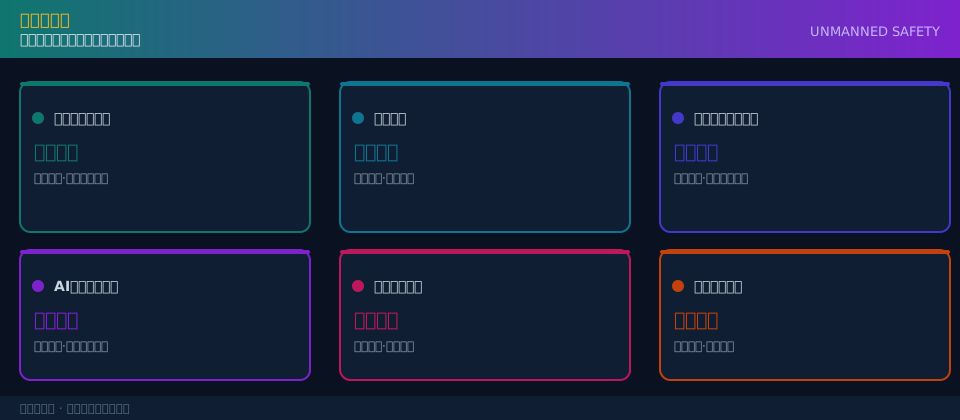
Setting the Five Safety Redundancy Parameters: Layered Protection from Overload to Emergency Stop
Layer 1: Overload and over-torque protection. This is the most fundamental — and most critical — layer. When lifting capacity or torque exceeds the rated capacity, an alarm triggers; when it exceeds the limit, hoisting is cut off (as required by FEM 1.001 Crane Design Standard). In unattended operation, this layer must act automatically — no manual intervention allowed.
Layer 2: Limit protection. Deceleration at travel limits and cutoff beyond them — for lifting height, crane bridge, and trolley stroke — are the hard safeguards against end-carriage collision and derailment. In unattended mode, limit switches must actuate reliably, with redundant secondary limit switches as backup.
Layer 3: Condition monitoring. Continuous monitoring of motor temperature rise, mechanism current, and brake status allows the system to automatically decelerate or shut down while an anomaly is still developing — preventing equipment failure from escalating into an accident.
Layer 4: AI vision zone guarding. The work area beneath the lifting path is divided into safe, warning, and danger zones. When a person or obstacle crosses into a warning zone, a graded alarm sounds; entry into the danger zone triggers automatic shutdown. This is the defining feature that sets unattended operation apart from manned operation, and ISO 23812 Intelligent Anti-Collision System for Cranes provides the technical framework.
Layer 5: Emergency stop with power-off interlock. This is the final safety net. Any anomaly or emergency stop signal triggers an immediate power-off shutdown. Together, the five layers extend protection from overload prevention to anti-collision and finally to emergency stop — each layer reinforcing the next.
Step-by-Step Deployment Process for Unattended Systems
Unattended deployment must proceed in stages, with each redundancy layer validated individually — never jumping straight to fully automatic operation.
Step 1: Upgrade speed control and positioning first. Solid variable frequency speed control and precise positioning are the "hands and feet" of unattended operation — if these aren't reliable, nothing else matters.
Step 2: Implement safety monitoring and condition monitoring to collect and log operational data. This is the "eyes and nervous system" of unattended operation.
Step 3: Add AI vision zone guarding and emergency stop interlocks to complete the collision protection and backup shutdown layers. This is the "safety net" of unattended operation.
Step 4: Conduct phased trial runs. Start with supervised semi-automatic operation, then gradually transition to unattended mode. Each phase must be validated with measured data confirming that the redundancy layers actuate correctly before moving to the next stage. Kelude Heavy Industry insists on phased validation in every unattended system delivery — never a one-step leap to full automation.
Most Common Mistakes in Unattended Deployment
Mistake 1: Confusing automation with unmanned operation. A crane that can travel and position itself automatically is not the same as one that can operate unattended. Without zone guarding and emergency stop backup, an automated crane can actually be more dangerous than a manned one.
Mistake 2: Downgrading safety redundancy. Some believe that adding intelligent control means the "old-school" limit switches and overload protection can be trimmed. That's a fundamental error. Unattended operation demands more safety redundancy, not less — intelligence is additive, not substitutive.
Mistake 3: Skipping the trial run phase. Going straight to unattended operation without thorough semi-automatic validation shifts the cost of trial and error onto the production floor. Kelude Heavy Industry makes phased validation a contractual delivery milestone.
Five Safety Redundancy Devices and Trigger Actions at a Glance
| redundancyLevel | Deviceconfiguration | trigger condition | Action | standard basis |
|---|---|---|---|---|
| Stage 1 | Overload Limiter | Overrated capacity | Alarm+Cut-offHoisting / Lifting | FEM 1.001 Crane Design Standard |
| Stage 2 | HeightTravel Limit Switch | In-position/Limit Exceeded | DecelerationStop | TSG (Special Equipment Safety Technical Regulation) 51 Safety Technical Specification for Special Equipment-2023 Crane Safety Technical Supervision Regulation |
| Stage 3 | temperature riseCurrentMonitoring | Threshold Exceeded | Alarm & Speed Reduction | GB/T 28264 Safety Monitoring and Management System |
| Stage 4 | AI vision/Radar | Personnel Intrusion | gradingAlarm & Shutdown | ISO 23812 |
| Stage 5 | emergency stop+Power Cut-off | Fault/emergency stop | power-off shutdown | TSG (Special Equipment Safety Technical Regulation) 51 Safety Technical Specification for Special Equipment-2023 Crane Safety Technical Supervision Regulation |
Acceptance Standards for Unattended Operation Deployment
| AcceptanceItem | standard basis | Acceptance Criteria | CommonDefect |
|---|---|---|---|
| Overload protectionAction | FEM 1.001 Crane Design Standard | AlarminterlockEffective | Alarm-only (No)interlock |
| limit switchAction | TSG (Special Equipment Safety Technical Regulation) 51 Safety Technical Specification for Special Equipment-2023 Crane Safety Technical Supervision Regulation | In-positionDecelerationLimit Stop | Secondarylimit switchMissing |
| Zoneguards | ISO 23812 | Personnel IntrusiongradingAlarm & Shutdown | Blind Zone Notcoverage |
| emergency stopinterlock | TSG (Special Equipment Safety Technical Regulation) 51 Safety Technical Specification for Special Equipment-2023 Crane Safety Technical Supervision Regulation | emergency stopPower Cut-off Effective | emergency stopIneffective |
| Positioning Accuracy | Contract Measured Value | RepeatPositioningCompliant | AccuracyReduced |
| Phased Verification | Delivery Milestone | Semi-automaticPilot | Full ImplementationFully automatic |
FAQ: Unattended Operation for Overhead Cranes
Q: What standards apply to unattended crane operation?
A: Safety monitoring and condition monitoring follow GB/T 28264-2017. Limit switches and emergency stop functions must meet the inspection requirements of TSG 51-2023. For intelligent anti-collision systems, ISO 23812 serves as the reference, while overload protection is governed by FEM 1.001. There is no single mandatory standard for unattended operation itself — compliance is built on layering these safety standards. Each of the five safety redundancy levels corresponds to a specific standard, and each is verified individually during acceptance testing.
Q: What configuration is required for unattended operation?
A: Investment centers on four areas: variable frequency speed control and precise positioning (the "hands and feet"), safety monitoring and condition monitoring (the "eyes and nervous system"), AI vision for area protection plus emergency stop interlocks (the "safety net"), and a remote supervision platform (the "management layer"). Investment scales with the level of redundancy required. Basic safety features like overload protection and limit switches form the foundation, while AI vision and remote monitoring are incremental additions unique to unattended operation. The exact configuration and cost depend on your specific operating conditions and target redundancy level.
Q: How do I know if my workshop is ready for unattended operation?
A: Three preconditions determine readiness: consistent operating conditions (fixed travel paths, uniform loads, stable cycle times), the ability to implement all five layers of safety redundancy, and the capacity for remote supervision and emergency response. If all three are met, a phased rollout is feasible. For environments with random load handling, varying material types, or situations requiring on-the-spot judgment, forcing unattended operation carries significant risk. In such cases, we recommend starting with variable frequency drive and anti-sway retrofits to improve efficiency first.
Q: Why is safety redundancy more critical than automation for unattended cranes?
A: A crane that can move and position itself automatically is merely automated. True unattended operation means the crane can stop itself safely in the event of an anomaly — protecting both people and equipment. This relies on five stacked layers of redundancy: overload protection, limit switches, condition monitoring, area protection, and emergency stop. If any single layer fails, the next one provides backup. Automation addresses efficiency; safety redundancy determines whether unattended operation can be trusted to run reliably.
For a complete roadmap on smart retrofits, refer to the step-by-step approach in "Smart Crane Retrofit Playbook: Kelude Heavy Industry's Digitalization Roadmap for Traditional Workshops" and plan unattended operation as the final phase of your upgrade.
The barrier to unattended operation is not how "intelligent" the overhead crane is — it's whether all five layers of redundancy are fully implemented and properly validated. Kelude Heavy Industry advocates a phased, verification-driven approach. We'd rather move one step slower and ensure every safety net holds up under real-world testing.
