

Electric Hoist Motor Overheating: 7 Fault Diagnosis & Fixes
Key Takeaways
Hoist motor overheating and burnout is one of the most frequent failure modes in industrial lifting equipment, accounting for over 35% of all electrical faults in cranes based on field data. The root causes fall into seven categories: overload, poor heat dissipation, excessive inching, phase loss, insulation aging or moisture ingress, brake drag, and abnormal voltage. A systematic diagnosis should follow the "external before internal, electrical before mechanical" principle—starting with the incoming power supply and progressively working down to winding insulation testing, using infrared thermometers and clamp meters for rapid fault localization. This article aligns ISO 4301 motor temperature rise limits with field-tested diagnostic procedures, providing test methods, acceptance criteria, and protective measures for each failure mode to help maintenance personnel pinpoint the fault within 30 minutes.
The core standards referenced in this article include:
📘 ISO 4301 Crane Design Standard: Chapter 5 specifies temperature rise limits, insulation class (Class F: resistance method temperature rise ≤105 K), and overload capacity requirements for hoisting mechanism motors—the primary basis for judging motor overheating.
📘 JB/T 5315 Conical Rotor Motors for Electric Hoists: Specifies factory acceptance test requirements including insulation resistance ≥0.5 MΩ (cold state), dielectric test at 2500 V for 1 minute, and temperature rise evaluation criteria for Class F insulation system design.
📘 GB/T 28264-2012 Safety Monitoring and Management System for Lifting Appliances: Chapter 6 requires the safety monitoring system to provide real-time motor temperature monitoring with over-temperature alarm, with temperature sensors installed at the stator winding ends.
Why Hoist Motors Overheat: Failure Mechanisms and Consequences
Crane hoist motors operate under intermittent duty (S3/S4) with frequent starts. Each start draws 6–7 times the rated current, causing rapid winding heating during the starting transient. When the temperature rise exceeds the insulation class limit, the winding insulation accelerates aging—as a rule of thumb, insulation life halves for every 10°C increase in temperature.
Early signs of overheating include a noticeably hot motor housing (above 80°C) that is uncomfortable to touch. As the condition worsens, a burning varnish odor from the insulation becomes apparent. If the motor is not shut down at this stage, turn-to-turn short circuits or ground faults can develop within 5–10 minutes, ultimately destroying the motor. A burnout typically results in 3–5 days of downtime and direct repair costs ranging from several thousand to tens of thousands of RMB.
Kelude Heavy Industry after-sales data shows that approximately 40% of motor overheating cases are operator-related (excessive inching or overloading), 30% stem from maintenance issues (poor heat dissipation or insulation moisture), 20% are caused by power supply quality problems (phase loss or voltage fluctuation), and the remaining 10% are indirectly caused by mechanical faults such as brake drag.
Diagnosing the 7 Causes of Motor Overheating: Step-by-Step Methods
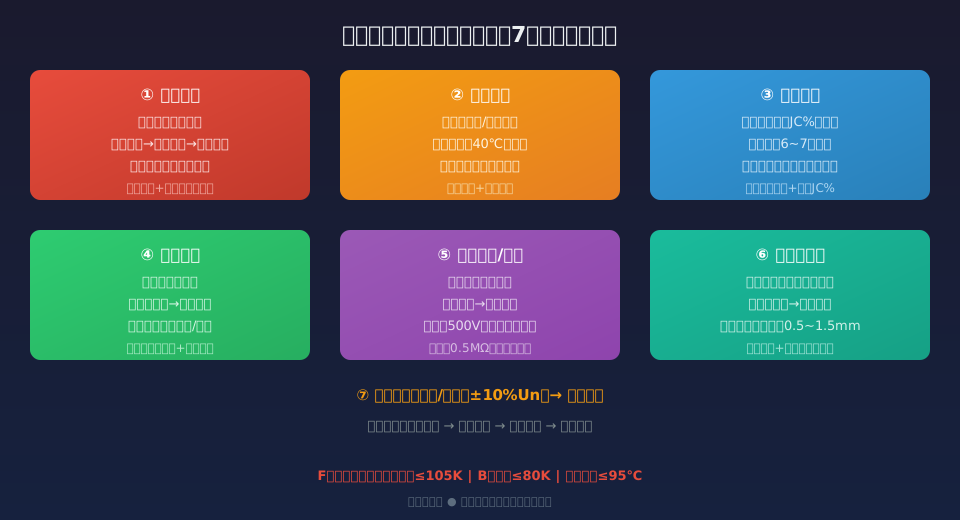
① Overload: Use a clamp meter to measure the running current on all three phases. If the current consistently exceeds the nameplate rated current by more than 15%, the motor is being overloaded. Per ISO 4301, the crane's overload limiter must trigger an alarm at 1.05 times the rated lifting capacity and automatically cut hoisting power at 1.1 times.
② Poor Heat Dissipation: Open the motor wind cover and inspect the fan blades for cracks, deformation, or accumulated dust and grease. Blow out the cooling fins from the inside out using compressed air (≤0.3 MPa). Also measure the ambient temperature—if it exceeds 40°C, additional ventilation or a reduced duty classification is required.
③ Excessive Inching: Count the number of start/stop cycles within a 10-minute window. If the frequency exceeds the allowable limit for the duty cycle (JC 40%), heat buildup inside the hoisting motor will outpace heat dissipation. For conical rotor motors under S4 duty, every 10% increase in JC% requires an 8–12% reduction in allowable power output.
④ Phase Loss: Measure the three-phase line voltage at the motor junction box. A deviation greater than 5% between any two phases indicates abnormal conditions. Under phase loss, the current in the two energized phases surges to 1.7–2.4 times the rated value, potentially destroying the windings within minutes. The phase loss protection relay must trip within 3 seconds.
⑤ Insulation Aging or Moisture: With power disconnected, measure the phase-to-ground insulation resistance using a 500 V megohmmeter. A cold-state reading of ≥0.5 MΩ is acceptable. If the reading is below 0.2 MΩ, the motor must be dried in an oven at 80–90°C for 6–8 hours. If below 0.1 MΩ, winding rewinding is recommended. In coastal or humid environments, test insulation resistance quarterly.
⑥ Brake Drag: With the motor de-energized, measure the brake clearance using a feeler gauge. For conical rotor motors, the standard brake clearance is 0.5–1.5 mm. If the clearance is too small (<0.3 mm), the brake pads do not fully release, forcing the motor to run against the brake load—current draw increases by approximately 20–40%.
⑦ Abnormal Voltage: Measure the steady-state voltage at the motor terminals. Per ISO 4301, the voltage must remain within ±10% of the rated voltage. Low voltage reduces rotational speed and increases slip, raising current draw; high voltage saturates the iron core and sharply increases eddy current losses. Both conditions cause motor overheating.
Temperature Rise Limits and Insulation Classes: When Is It "Overheating"?
Class F insulation (rated for 155°C) is now standard for crane hoist motors, while Class B (rated for 130°C) is being phased out. ISO 4301 specifies a temperature rise limit of 105 K for Class F insulation when measured by the resistance method—meaning the winding temperature must not exceed ambient temperature plus 105°C.
For quick field checks, aim an infrared thermometer at the middle of the motor housing. For Class F insulation, the housing temperature typically stays between 85–95°C (accounting for a 15–20°C temperature gradient between the winding and the housing). If the housing exceeds 100°C or a burning odor is detected, shut down the motor immediately. At an ambient temperature of 40°C, the maximum allowable winding temperature is approximately 105 + 40 = 145°C, which is close to the critical limit for the insulation material.
Kelude Heavy Industry recommends installing motor temperature sensors on critical workstation cranes for real-time monitoring, with an alarm threshold of 130°C and a shutdown threshold of 145°C. For winding temperature measurement, the embedded temperature detector (ETD) method is recommended—Pt100 platinum resistance sensors are embedded at the stator winding ends, providing accuracy of ±1°C.
Overload Limiters and Thermal Protection: Selection and Configuration
Motor overheat protection should be implemented as a three-tier system. The first tier is the overload limiter, which triggers an audible and visual alarm at 1.05 times the rated lifting capacity and cuts the hoisting circuit at 1.1 times. The second tier is a thermal overload relay (bimetallic type), set at 1.05 times the motor's rated current, which must trip within 20 minutes under a 20% overload condition.
The third tier is embedded PTC thermistor protection. Positive temperature coefficient thermistors are embedded in each phase winding; when the winding temperature exceeds the PTC Curie point (typically 130°C or 145°C), the resistance surges, causing the thermal protection relay to trip. This method responds quickly and operates independently of the external power supply, making it standard equipment on Kelude Heavy Industry crane hoist motors.
For hoist motors driven by variable-frequency drives (VFDs), the inverter's electronic thermal protection should also be enabled. This function calculates the I²t integral based on the speed-torque curve, providing precise overload curve protection. Multi-segment protection curves can be configured to accommodate the different heat dissipation characteristics of S3 and S4 duty classifications.
Routine Inspection and Preventive Maintenance Program
Daily checks: Before each shift, the operator should briefly touch the motor housing with the back of the hand (following safety procedures) to detect abnormal temperature. Visually inspect the wind cover for blockage and confirm the fan is rotating properly. Listen for uniform motor operation—an abnormal hum may indicate phase loss or bearing trouble.
Weekly checks: Use an infrared thermometer to measure the motor housing temperature at fixed points and log the trend. Compare readings against similar motors of the same model in the workshop (normal temperature difference should be <10°C). Clean the wind cover filter screen and check the terminal block inside the junction box for loose connections—loose contacts create localized resistance and heat. Tighten terminals to the specified tightening torque for the motor wiring terminal size.
Monthly checks: With power off, measure insulation resistance using a 500 V megohmmeter and maintain an insulation resistance trend chart for each motor. If insulation resistance shows a declining trend for three consecutive readings (even if still above 0.5 MΩ), schedule oven drying or varnish impregnation. During the annual overhaul, replace the motor bearing grease with lithium grease ZL-3, filling the bearing housing to 1/2 to 2/3 of its volume—over-greasing causes churning and heat generation.
Motor Overheating: 7-Cause Diagnostic Reference Table
Kelude Heavy Industry: Overhead Crane & Gantry Crane Manufacturer
Kelude Heavy Industry is a professional manufacturer of overhead cranes, gantry cranes, and electric hoists. We provide a full range of material handling equipment, from single-girder and double-girder bridge cranes to explosion-proof and low-headroom hoist cranes, serving industries such as steel, power generation, and general manufacturing.
Motor Insulation Class and Temperature Rise Limit Standards Comparison Table
| Insulation Class | Temperature Resistance Limit(℃) | Resistance Methodtemperature rise limit(K) |
|---|---|---|
| BClass | 130 | ≤80(Phase-Out) |
| FClass | 155 | ≤105(Mainstream Configuration) |
| HClass | 180 | ≤125(Metallurgical High Temperature) |
| CClass | >180 | >125(Special Environment) |
| Bearing Temperature | Rolling≤95℃ | Sliding≤80℃ |
| Housing Surface | FClass≤95℃ | Infrared Temperature Reference Value |
Motor Overheat Protection: Key Parameter Reference Card
105K
Class F insulation temperature rise limit (resistance method)
0.5MΩ
Minimum cold-state insulation resistance
145℃
Maximum allowable winding temperature (Class F)
±10%
Permissible power supply voltage fluctuation
6~7x
Motor starting current multiplier
0.5mm
Minimum brake clearance — conical rotor motor
Further Reading
📖 ISO 4301 Crane Design Standard: Load combination selection across 9 load groups and duty classifications from A1 to A8
📖 FEM 1.001 Crane Testing Specification: 3 load test procedures and 6 acceptance criteria
📖 GB/T 28264 Safety Monitoring and Management System for Lifting Appliances: Breakdown of 7 functional modules and 4-level architecture
📖 GB/T 25120-2010 — Electric Hoists for Lifting Appliances: Standard Interpretation
Frequently Asked Questions
Q: What is the difference in temperature rise limits between Class F and Class B insulated motors?
A: Per ISO 4301, the temperature rise limit for Class F insulation (rated 155°C) measured by the resistance method is 105K, while Class B insulation (rated 130°C) allows 80K — a 25K difference. In practice, a Class F motor housing temperature of 85–95°C is considered normal, whereas a Class B motor exceeding 70–75°C warrants attention. Kelude hoisting motors come standard with Class F insulation to handle the high thermal stress of S3/S4 intermittent duty cycles.
Q: Can a motor that suddenly emits smoke during operation still be used?
A: Smoke from a motor indicates severe thermal breakdown of the winding insulation or an inter-turn short circuit. Immediately disconnect the main power supply — not just the stop button — and do not re-energize. After smoking, winding insulation resistance typically drops below 0.1MΩ. The motor must be removed and sent to a qualified repair shop for inspection: if only the end-turn insulation is carbonized, localized repair may suffice; if the slot windings are melted, a full rewind is required. After repair, a 2500V/1min dielectric test and a 2-hour no-load temperature rise test must be performed per JB/T 5315 before reinstallation.
Q: What brake clearance on a conical rotor motor prevents both brake drag and load slipping?
A: The standard brake clearance for conical rotor motors is 0.5–1.5mm, measured with a feeler gauge. Below 0.5mm, the brake lining drags and overheats; above 1.5mm, insufficient braking torque can cause load slipping. Adjustment procedure: remove the rear end cover → loosen the lock nut → turn clockwise to reduce clearance, counterclockwise to increase → measure with a feeler gauge while adjusting → re-tighten and test. FEM 1.001 requires that the loaded braking distance S ≤ V_lifting/100 (mm). For example, with a lifting speed of 8 m/min, the maximum allowable descent is 80mm.
Q: What motor power rating prevents overheating in a 10-ton electric hoist?
A: A 10t hoisting motor is typically rated at 13kW–15kW (CD1/MD1 series) for a lifting speed of 7 m/min. For duty classifications above M5 or with a JC% exceeding 40%, a 15kW or higher rating is recommended, leaving a 15%–20% power margin. Bigger is not always better — an oversized motor running under light load for extended periods suffers from poor power factor and inefficiency, while an undersized motor trips thermal protection under frequent overload. Kelude offers precise hoisting mechanism power calculations based on FC/ISO/FEM standards, optimizing selection for your actual duty cycle and annual operating hours.
