

Overhead Crane Automated Loading: 5 Key Handoff Points
📋 Key Summary
The real challenge in automating overhead crane loading and unloading isn't the crane itself—it's whether five critical links can form a reliable chain: precise positioning, cycle-time matching, workstation handoff, automatic lifting spreaders, and anti-collision. This article breaks down each of these five workstation interfaces, explains how to calculate loading/unloading cycle time, how to align it with production line takt, what the phased deployment steps are, and the most common mistakes to avoid.
Before you automate loading and unloading on an overhead crane, these five questions are worth asking first:
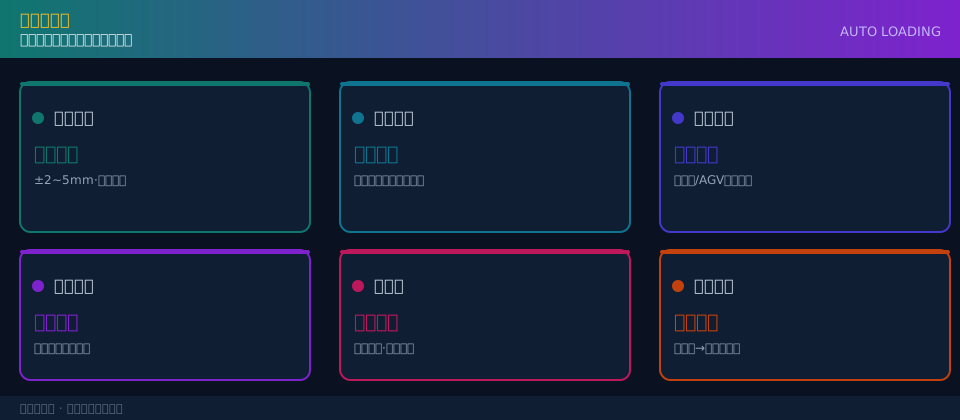
① Can positioning accuracy for pickup and placement hold consistently within ±2 to 5 mm?
② Does the loading/unloading cycle time match the production line takt?
③ How will the crane automatically interface with conveyor lines, AGVs, and buffer zones?
④ Can the lifting spreader switch automatically between different workpieces?
⑤ During automatic operation, how do you ensure the crane won't hit people or equipment?
These five questions are the five critical points for making automated loading and unloading work. Let's examine each one.
Prerequisites for Automated Loading and Unloading: Five Workstation Interfaces to Get Right
Automated loading and unloading isn't just adding a program to the crane. At its core, it turns the crane into an automatic workstation on the production line. And as a workstation, it must interface seamlessly with upstream and downstream conveyor lines, AGVs, and buffer zones. If any single interface fails, the entire automatic chain breaks.
The first interface: precise positioning. For automatic pickup and placement, repeat positioning accuracy must hold steady within ±2 to 5 mm. This is achieved through encoders, laser distance measurement, or a Gray-code bus positioning system—and it's the foundation for every automatic action that follows. The FEM 1.001 Crane Design Standard sets corresponding requirements for mechanism positioning accuracy.
The second interface: cycle-time matching. The time for one complete loading/unloading cycle must align with the production line takt. If the crane is too slow, it chokes the line; if too fast, it sits idle waiting. Cycle-time calculation must be based on a real breakdown of the motion sequence—not a rough guess.
The third interface: workstation handoff. Between the crane and conveyor lines, AGVs, and buffer zones, sensors and interlock signals must automatically confirm "in position, clamped, released." If the timing of any handshake signal is off, you get part collisions or empty releases.
The fourth interface: automatic lifting spreader. Different workpieces require different spreaders. Automated loading and unloading either needs standardized workpiece specifications or an automatically switching spreader. Otherwise, every changeover requires manual intervention, and the automation loses its value.
The fifth interface: anti-collision. With no operator watching during automatic operation, AI vision and radar divide the work area into safe zones, early-warning zones, and danger zones. If a person or obstacle crosses a boundary, the system triggers graded alarms and automatic shutdown. When Kelude designs automated loading and unloading solutions, the first step is always verifying these five interfaces one by one.
Setting Cycle-Time Parameters: How to Calculate Loading/Unloading Cycle Time
Cycle-time matching is the easiest step to get wrong in automated loading and unloading. The total cycle time is the sum of several motion segments: pickup, hoisting, traversing, lowering, placement, and return. Each segment must be measured from actual operation—you can't just divide travel distance by speed.
The key lies in acceleration and deceleration time. The accel/decel phases of the hoisting and travel mechanisms often account for a larger share of cycle time than the constant-speed segments, especially on short travel distances. Variable Frequency Speed Control smooths out acceleration and deceleration (the IEC 61800 technical specification governs VFD system requirements), but smooth doesn't mean fast. Cycle-time calculations must factor in the full acceleration/deceleration curve.
Another time that's often overlooked: "waiting for confirmation." The positioning check before pickup and placement, the interlock handshake for clamping and releasing—each one eats up a few tenths of a second, and together they add up to a significant share of the cycle. When calculating cycle time, these handshake intervals need to be itemized separately.
The calculated cycle time should leave a buffer against the production line takt. Too little buffer, and the crane stalls the line at the slightest hiccup; too much buffer, and the crane sits idle, wasting production capacity. Kelude builds a reasonable buffer into its cycle-time calculations and provides the optimal travel speed and accel/decel parameters for the crane—rather than simply chasing maximum speed.
Phased Deployment Process for Automated Loading and Unloading Systems
Deploying automated loading and unloading has to be done in phases. Trying to go fully automatic in one step is almost guaranteed to fail.
Step one: implement precise positioning and Variable Frequency Speed Control first—get the "hands and feet" solid. If positioning is unstable and accel/decel is jerky, every automatic action that follows is built on sand.
Step two: run semi-automatic mode on a single workstation. Let the crane complete pickup and placement on one workstation in semi-automatic mode, verify positioning accuracy and cycle-time data, and correct parameters based on measured data.
Step three: connect the workstation interfaces. Wire up the interlock signals between the crane and conveyor lines, AGVs, and buffer zones. Verify the handshake timing segment by segment, confirming that each step—in position, clamped, released—is reliable.
Step four: transition to fully automatic operation. After semi-automatic mode has run stably for a period and the data meets targets, switch to fully automatic, while keeping remote monitoring and emergency stop as a safety net. Kelude insists on phased verification when delivering automated loading and unloading systems—better to move one step slower than to leave any interface unproven in real operation.
Most Common Mistakes in Loading/Unloading Automation
Mistake one: calculating only constant-speed travel and ignoring acceleration/deceleration. This distorts the cycle-time estimate, and the crane ends up unable to keep pace with the production line. Cycle-time calculations must be based on the full accel/decel curve.
Mistake two: ignoring handshake time. The interlock signal timing for positioning confirmation and clamp/release isn't measured separately, so the cycle time comes in understated and the actual takt falls short.
Mistake three: standardizing the control system but not the workpiece specifications. When workpiece dimensions, weight, and center of gravity vary, the alignment reference for automatic pickup falls apart, and the system triggers frequent alarms or part collisions. Kelude always confirms workpiece specification consistency with the customer before designing the solution—it's a prerequisite for automation.
Configuration and Cycle-Time Checklist for the Five Workstation Interfaces
| workstationinterface | key configuration | takt target | Acceptancekey points | FAQ |
|---|---|---|---|---|
| Precise Positioning | Encoder/laser/Gray-code bus positioning system | ±2~5mm | repeatabilityPositioningmeasured | Accuracydrift |
| takt matching | cycle time breakdown | line takt alignment | including accelerationDecelerationhandshake | steady-state only |
| workstationdocking | interlocksignal handshake | position-clamp-release | step-by-step sequence verification | sequence misalignment collision |
| automaticLifting spreader | Lifting spreaderautomatic switching | changeover without manual intervention | switching reliability | workpieceSpecificationinconsistent |
| anti-collision | AI vision/radar zoneguards | gradingalarm shutdown | out-of-boundsinterlockmeasured | blind spot notcoverage |
Acceptance Standards for Automated Loading and Unloading Systems
| Acceptanceitem | standard basis | acceptance criteria | commonDefect |
|---|---|---|---|
| Positioning Accuracy | contract measured value | repeatabilityPositioningcompliance | Accuracydrift |
| takt achievement | measured cycle time | line takt alignment | steady-state calculation distortion |
| interlockhandshake | TSG (Special Equipment Safety Technical Regulation) 51 Safety Technical Specification for Special Equipment-2023 Crane Safety Technical Supervision Regulation | reliable position-clamp-release | sequence disorder |
| radar zoneguards | ISO 23812 | out-of-boundsgradingalarm shutdown | blind spot notcoverage |
| Lifting spreaderswitching | contractual agreement | reliable switching without jamming | manual changeover required |
| phased verification | delivery milestone | Semi-automaticpreliminary | one-step implementationFully automatic |
Overhead Crane Automation FAQs: Loading & Unloading
Q: Is there a standard basis for calculating the cycle time of automated loading and unloading?
A: Cycle time calculation is an engineering method rather than a single mandatory standard. However, the technical specification for variable frequency speed control systems can reference IEC 61800, and the layout and operation of control devices can reference ISO 7752-5. The key is to measure the acceleration, deceleration, and interlock handshake times for each segment—pickup, lifting, traversing, lowering, placement, and return—and then align them with the production line cycle, rather than only calculating constant-speed travel.
Q: With a limited budget, which automation features should we prioritize for loading and unloading?
A: Prioritize two foundational areas: precise positioning and variable frequency speed control. Stable positioning and smooth acceleration/deceleration are the foundation for all subsequent automatic movements. Next comes anti-collision and interlock handshaking—these are the safety baseline and cannot be compromised. Automatic lifting spreader changes can be deferred; if workpiece specifications are consistent, a semi-automatic transition can handle this step initially, and full automation can be added once the benefits are validated.
Q: How do I know if my production line is suitable for automated loading and unloading?
A: Look at three conditions: consistent workpiece specifications, stable cycle times, and continuous line operation. When workpiece dimensions, weight, and center of gravity are uniform, the alignment reference for automatic pickup remains stable; with stable cycle times, the loop time is easier to calculate; and with continuous line operation, the efficiency gains from automation can be realized. If all three conditions are met, automated loading and unloading delivers a fast return on investment. If workpieces vary frequently and cycle times are unpredictable, we recommend starting with variable frequency drive and positioning retrofits first.
Q: Why is step-by-step validation essential for automated loading and unloading instead of a one-shot implementation?
A: Automated loading and unloading is a chain of five interlinked elements: positioning, cycle timing, interlocking, lifting spreader, and anti-collision. If any one parameter is not tuned correctly, full automatic operation can amplify the error into a collision or line stoppage. Step-by-step validation allows you to correct parameters using measured data at each stage, exposing risks at the single-workstation or semi-automatic level rather than waiting for a failure during full automatic operation. This is the standard engineering approach to controlling trial-and-error costs.
For a complete solution on automatic handoff between overhead cranes and AGVs or RGVs, refer to the collaborative design approach outlined in "AGV/RGV and Overhead Crane Multi-Machine Coordination: A Practical Guide to Unmanned Material Handling Dispatching Systems for Smart Factories".
The real challenge in automated loading and unloading is not getting the crane to move on its own—it is ensuring that five workstations connect into a stable, uninterrupted chain. Kelude insists on step-by-step validation, letting measured data speak for the cycle time and accuracy of every handoff.
