

Electric Hoist Motor Overheating: 5 Causes & Fixes
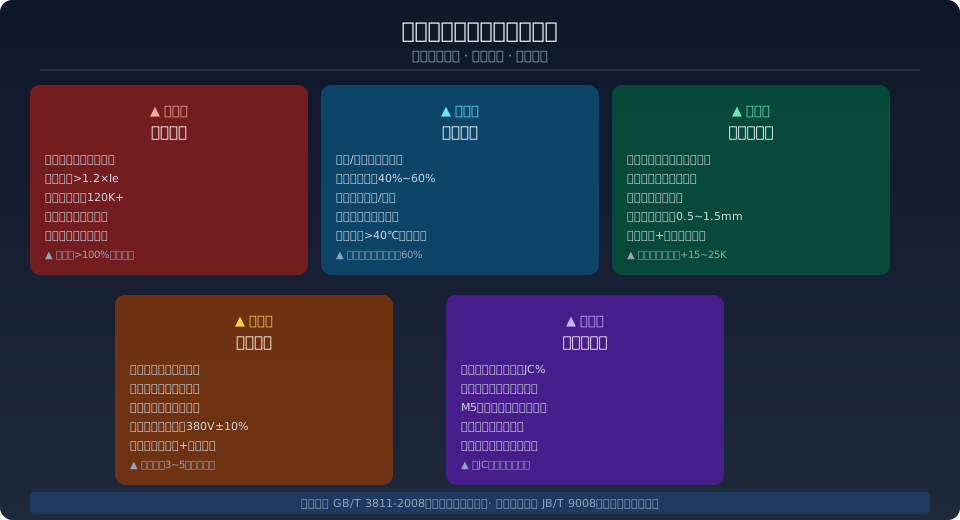
Electric hoist motor overheating is one of the most common faults in daily equipment operation, with five primary causes: overload (current exceeding 1.2× rated value), blocked cooling air path (dust buildup reducing heat dissipation efficiency by 40%–60%), brake not fully disengaging (friction lining drag generating excess heat), single-phase loss in the power supply (unbalanced three-phase current), and duty cycle overrun (exceeding the JC% value stated on the nameplate).
When an electric hoist motor trips on thermal overload, many operators simply wait for it to cool down and restart. But without addressing the root cause, the next trip is inevitable. This article examines the structural characteristics of the conical rotor motor used in electric hoists, draws on Kelude's years of after-sales maintenance experience, and breaks down the five most common causes of motor overheating—along with step-by-step troubleshooting and corrective actions for each.
Why Electric Hoist Motors Overheat: Core Mechanism
Electric hoists typically use a conical-rotor brake motor (per JB/T 10218-2014 Conical Rotor Motors for Electric Hoists), characterized by a tapered rotor core and a matching tapered stator bore. When power is cut, a spring pushes the rotor toward the smaller-diameter end, pressing the brake disc against the friction lining to stop the hoist. When power is applied, the axial magnetic pull generated by the stator's rotating field draws the rotor into the larger-diameter end, automatically releasing the brake.
While compact and reliable, this design means that brake gap accuracy, motor cooling airflow, and load current control all directly affect operating temperature. The motor's insulation class is typically F (155°C), with a winding temperature rise limit of 105K (per ISO 4301 Crane Design Standard, Section 5.2). When the temperature rise exceeds this limit, insulation aging accelerates—for every 10K increase, insulation service life is halved.
5 Common Causes of Hoist Motor Overheating—Troubleshooting Guide
The five root causes below are listed in order of frequency, with inspection methods and corrective actions for each:
Cause 1: Overload—Actual Load Exceeds Nameplate Rated Capacity
This is the most frequent cause, accounting for roughly 35% of motor overheating faults. A hoist nameplate states its rated lifting capacity (e.g., 5t), but in practice, operators often push beyond—running a 5t hoist with a 6t load. In this condition, motor current continuously exceeds 1.2× the rated value, and winding temperature rise can quickly reach 120K or higher. Inspection: Use a clamp meter to measure three-phase current while the motor is running. If any phase draws more than 1.1× the nameplate rated current for over 3 minutes, overload is confirmed. Corrective action: Reduce single-lift weight to within rated capacity, or upgrade to a higher-capacity electric hoist.
Cause 2: Poor Cooling—Blocked Wind Cover or High Ambient Temperature
The conical rotor motor has a cooling fan at the rear that draws air through the wind cover and across the motor housing's cooling fins. In dusty environments such as foundries, cement plants, and woodworking shops, the wind cover and fin gaps quickly clog with dust. Field data shows that a fully blocked wind cover reduces cooling efficiency by 40%–60%, and after 1 hour of operation, the temperature rise is 25–35K higher than normal. Inspection: With the motor stopped, visually check the wind cover inlet for obstructions and confirm the fan blades are intact. Corrective action: Blow compressed air from the outside of the wind cover inward each shift (pressure ≤0.4MPa), and periodically remove the cover for thorough cleaning of fin gaps. If ambient temperature consistently exceeds 40°C, install an auxiliary axial fan for forced ventilation.
Cause 3: Brake Not Fully Disengaging—Excessively Tight Gap Causing Drag
The brake gap on a conical rotor motor is critical. When the gap is too small (<0.3mm), the rotor is pulled in by magnetic force when power is applied, but the brake disc still makes light contact with the friction lining—a "drag" condition. This continuous friction generates additional heat, raising motor temperature rise by 15–25K. Inspection: Measure the brake gap with a feeler gauge. The standard range is 0.5–1.5mm (refer to the hoist nameplate or manual). Adjustment: Remove the rear end cover and turn the lock nut—clockwise reduces the gap (tighter braking), counterclockwise increases it (looser braking). After adjustment, re-measure with the feeler gauge to confirm the gap is within spec. Important: Always perform no-load and rated-load braking tests after adjustment to verify reliable braking.
Cause 4: Single-Phase Loss—One Phase Disconnected in Three-Phase Supply
Single-phasing is the fastest way to destroy a motor. When a three-phase asynchronous motor loses one phase, the current in the remaining two phases surges to approximately 1.7–2.5× rated current, and the windings can overheat and burn out within 3–5 minutes. Common causes include loose power supply inlet terminals, a burned contactor main contact causing intermittent phase loss, or a worn carbon brush in the conductor rail current collector breaking the circuit. Inspection: At the motor junction box, use a multimeter to measure three-phase line voltage—normal is 380V±10% with no more than 5% deviation between phases. If one phase reads significantly low or zero, single-phasing is confirmed. Corrective action: Check the supply circuit step by step—tighten terminal block connections (torque to 12–15N·m for M8 bolts), replace burned contactor contacts, and replace current collector carbon brushes when remaining height is below 40% of original.
Cause 5: Duty Cycle Overrun—Excessive Starting Frequency Beyond Nameplate JC% Rating
The duty classification on a hoist nameplate (e.g., JC25%, JC40%) indicates the allowable percentage of energized running time within one duty cycle. For example, JC25% means no more than 2.5 minutes of running per 10-minute cycle. If a JC25% hoist is used in assembly line or high-frequency loading/unloading applications as if it were JC60%, the motor never gets adequate intermittent cooling, and temperature rise accumulates unchecked. Inspection: Record the actual energized running time over a complete duty cycle and calculate the duty cycle percentage. Corrective action: Reduce operating frequency to allow sufficient cooling between cycles, or upgrade to a hoist with a higher duty classification (e.g., replace a CD1-type JC25% hoist with an MD1-type JC40% two-speed hoist). In Kelude's after-sales statistics, approximately 12% of motor overheating service calls trace back to duty cycle mismatch.
Quick-Reference Troubleshooting Chart for Hoist Motor Overheating
The table below summarizes the inspection tools, key indicators, and corrective actions for all five causes, providing a rapid reference for field maintenance personnel:
| Troubleshooting | Tools Used | Critical Indicator | Resolution |
|---|---|---|---|
| Overload | clamp meter | Current>1.1×Ie Continuous3min | Reduce Load or Upgrade Capacity |
| Poor Heat Dissipation | Visual Inspection+Compressed Air | Cooling Efficiency Lowering≥40% | Cleaning Wind Cover+Forced Ventilation |
| Brake Dragging | Feeler Gauge(0.5~1.5mm Measuring Range) | Clearance<0.3mm | Air Compressor Lock Nutto0.5~1.5mm |
| Power Supply Phase Loss | multimeter(AC 750VStage) | Wire Voltage Deviation>5%or Zero | Tightening Terminal/Replace Contacts/Replace Carbon brush |
| Duty Classification Overload | Stopwatch+Log Sheet | Actual JC%> Nameplate JC% | Reduce Frequency or Upgrade to Higher JC%Hoist |
Preventive Measures for Abnormal Motor Temperature
Beyond troubleshooting after a fault occurs, routine preventive maintenance can significantly reduce the likelihood of motor overheating. Kelude recommends that electric hoist operators establish the following three lines of defense:
Line 1: Pre-Shift Inspection — Before each shift, the operator runs the hoist unloaded for 1–2 minutes, listening for abnormal motor sounds (no unusual noise or metallic friction), checking the housing temperature by hand (under normal operation, the housing should not be hot to the touch, typically ≤65°C), and verifying that the wind cover intake is not blocked by debris.
Line 2: Weekly Inspection — The maintenance electrician uses an infrared thermometer to measure the hottest point on the motor housing and records the trend. If the housing temperature rises more than 5°C for two consecutive weeks under the same operating conditions, an early warning is triggered, and a scheduled shutdown for inspection is arranged. At the same time, a clamp meter is used to record three-phase current values and build a current log.
Line 3: Quarterly Maintenance — Remove the wind cover to thoroughly clean the cooling fins, measure the motor winding insulation resistance to ground with a 500V Megohmmeter (Insulation Tester) (requirement: ≥1MΩ; if below 0.5MΩ, drying treatment or re-varnishing is mandatory), check terminal tightness inside the junction box (loose terminals increase contact resistance and cause heat buildup), and measure and adjust the brake clearance to the standard value.
As a light-duty lifting appliance listed under special equipment regulations, the electric hoist must undergo periodic inspection and maintenance in accordance with TSG 51-2023 Crane Safety Technical Supervision Regulation. For electric hoists equipped with inverter drives, reference should also be made to IEC 60204-32 (IEC 60204-32) — Safety of Machinery — Electrical Equipment of Machines — Part 32: Requirements for Hoisting Machines regarding motor thermal protection and over-temperature alarm provisions.
Further Reading: Electric hoist brake adjustment is closely related to motor temperature — excessive brake clearance causes load slipping, while insufficient clearance leads to drag friction and overheating. See How to Adjust Electric Hoist Brake Clearance? Standard Gap Values and Adjustment Steps for Conical, Disc, and Electromagnetic Brakes for the complete brake adjustment procedure.
Frequently Asked Questions
Q: After the electric hoist motor thermal overload protection trips, how long does it take to cool down before it can reset?
A: The built-in PTC thermistor or bimetallic temperature switch in the electric hoist motor automatically resets once the winding temperature drops below the trip threshold (typically with a 5–10K hysteresis). The cooling time depends on ambient temperature and heat dissipation conditions, generally ranging from 20 to 40 minutes. Bypassing or shorting the thermal protection switch to keep the motor running is strongly discouraged — the winding insulation has already been compromised, and continued operation could lead to inter-turn short circuits and motor burnout. ISO 4301 (ISO 4301) — Crane Design Standard — explicitly requires that motors be equipped with reliable overheat protection devices.
Q: What is the difference between Class F and Class H insulation in electric hoist motors? Can they be used interchangeably?
A: Class F insulation allows a maximum temperature of 155°C with a winding temperature rise limit of 105K; Class H insulation allows a maximum temperature of 180°C with a temperature rise limit of 125K. Class H motors can operate in higher ambient temperatures (e.g., metallurgical workshops where ambient temperature can exceed 60°C), but the cost increases by approximately 30%–50%. The physical dimensions of the two classes are typically identical and interchangeable, but the thermal protection settings in the existing control cabinet must be verified — the trip threshold for a Class H motor should be adjusted accordingly. The standard governing temperature limits for each insulation class is specified in the conical rotor motor standard for electric hoists.
Q: What could cause an electric hoist motor to overheat when the current readings are normal?
A: When current is normal but temperature is abnormally high, the most common cause is restricted heat dissipation — check the wind cover, fan blades, and cooling fins. The second likely cause is brake drag: insufficient brake clearance causes the friction lining to make light contact, generating additional heat (this small additional current may not be detectable with a clamp meter). The third cause is poor lubrication or wear in the motor bearing — check for radial play at the motor shaft extension. In Kelude's after-sales maintenance records, approximately 18% of "normal current but overheating" cases were ultimately traced to brake clearance issues.
Q: How much impact does frequent forward/reverse operation have on an electric hoist motor?
A: Frequent forward/reverse cycling (more than 4 complete lift/lower cycles per minute) subjects the motor to current surges approximately 2–3 times higher than rated conditions — each start draws 5–7 times the rated current, and the plugging (counter-current braking) between forward and reverse starts generates additional heat in the windings. If the production cycle cannot be changed, consider upgrading the electric hoist from a standard single-speed model to a two-speed hoist, or replacing the standard conical rotor motor with a variable-frequency motor (equipped with a braking resistor to dissipate regenerative energy). This can extend motor service life by 3–5 times.
Kelude Heavy Industry offers sales and after-sales maintenance services for CD1/MD1/HC series electric hoists, covering capacities from 0.5t to 32t. If you encounter motor overheating, brake adjustment, or electrical system issues during operation, contact our technical service center for remote diagnostics support.
