

Crane Hook Replacement Criteria: 5 Checks per GB/T 10051
GB/T 10051.1-2010 "Lifting Hooks — Part 1" specifies five quantifiable discard criteria for hooks: opening increase ≤10%, twist angle ≤10°, cross-section wear ≤10%, corrosion depth ≤5% of original dimension, and immediate discard upon crack detection. These constitute the statutory red lines for safe crane hook operation.
The hook is one of the most critical load-bearing components of a crane, and its condition directly affects personnel safety and equipment integrity during lifting operations. GB/T 10051.1-2010 "Lifting Hooks — Part 1" and TSG 51-2023 Crane Safety Technical Supervision Regulation together form the regulatory framework governing hook discard decisions, defining five core quantitative indicators that give end users clear technical criteria for daily inspections and periodic examinations.
The design calculations in this solution follow the core requirements of GB/T 3811-2008 Crane Design Standard and TSG 51-2023 Crane Safety Technical Supervision Regulation, with targeted inspection and assessment based on actual hook service conditions.
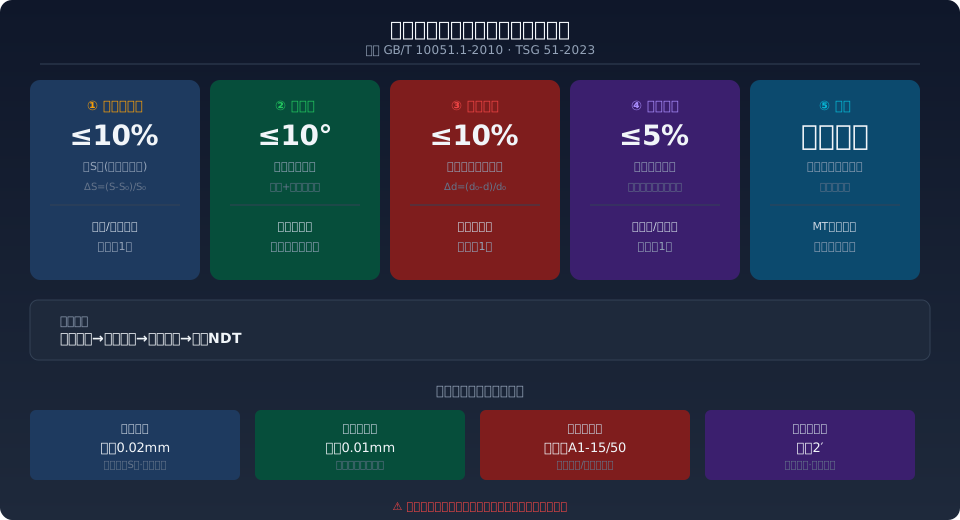
Regulatory Framework and Standards Governing Hook Discard
Crane hook discard decisions are not based on subjective judgment — they are governed by a complete hierarchy of national regulations and industry standards. TSG 51-2023 Crane Safety Technical Supervision Regulation, as a safety technical specification for special equipment, explicitly requires end users to establish systematic daily inspection and periodic examination procedures for hooks. GB/T 6067.1-2010 "Safety Rules for Lifting Appliances — Part 1: General Requirements" further mandates that hooks exhibiting cracks, excessive wear, or opening deformation must be taken out of service and discarded immediately.
At the technical standard level, the GB/T 10051.1-2010 series through GB/T 10051.5-2010 "Lifting Hooks — Part 5: Laminated Hooks" covers mechanical performance requirements and discard conditions for all hook types, including forged hooks, laminated hooks, and hook nuts. Internationally, GB/T 18444-2016 "Crane Hooks" remains aligned with the ISO standard framework. For smaller hooks used on electric hoists, the technical requirements of JB/T 10224-2007 "Hooks for Electric Hoists" should also be referenced.
In practice, hook discard criteria work in tandem with GB/T 5972-2016 "Crane Wire Ropes — Care, Maintenance, Inspection and Discard" to form a complete discard assessment system for the two primary lifting components of a crane. Both should be inspected concurrently during the same examination to ensure the overall safety of the hoisting system.
Five Quantifiable Discard Criteria Explained
Chapter 6 of GB/T 10051.1-2010 "Lifting Hooks — Part 1" defines five discard criteria, each with a specific numerical limit. These indicators fall into three categories: geometric changes (opening increase, twist angle, cross-section wear), material degradation (corrosion), and defects (cracks) — forming a complete assessment system that captures both gradual deterioration and sudden failure.
Among the five criteria, cracks represent the most stringent "one-strike" rule — regardless of crack length, depth, or location, once confirmed by Magnetic Particle Inspection (MT) or penetrant testing, the hook must be discarded immediately. Repair by welding is strictly prohibited. The other four criteria are progressive in nature, requiring periodic measurement and comparison against original dimensions to determine whether the discard threshold has been reached. All measurement data should be recorded in the Crane Hook Inspection Log and retained as part of the special equipment safety technical file for at least 3 years.
| Judgment Indicator | Scrap Limit | Detection Tool | Detection Period | Standard Clause |
|---|---|---|---|---|
| Opening Increment ΔS | ≤ 10% S₀ | Vernier Caliper/Special Gauge | Quarterly | GB/T 10051.1 §6.2 |
| Torsion Angle | ≤ 10° | Universal Angle Ruler | Monthly Visual/Quarterly Measurement | GB/T 10051.1 §6.3 |
| Cross Section Wear Measurement | ≤ 10% d₀ | Outside Micrometer (0.01mm) | Semi-annually | GB/T 10051.1 §6.4 |
| Corrosion Depth | ≤ 5% Original Dimension | Depth Micrometer/Ultrasonic Thickness Gauge | Semi-annually | GB/T 10051.1 §6.5 |
| Crack | Any Crack Immediate Scrap | Magnetic Particle Inspection (MT)/Penetrant Testing (PT) | Annually NDT | GB/T 10051.1 §6.1 |
During field service operations, Kelude has found that more than 60% of hook scrapping cases are triggered by two geometric indicators: opening increment and cross-section wear. Although cracks account for less than 15% of all failures, they draw the most attention from inspection bodies due to their potentially catastrophic consequences.
Daily Hook Inspection Methods and Tool Requirements
Daily hook inspection is carried out at three levels: operator visual checks at every shift, monthly dimensional checks by equipment management personnel, and annual non-destructive testing by third-party inspection bodies. Each level requires different tools and precision, but together they form the technical defense line for full life cycle safety management of the hook.
The per-shift visual inspection is the most basic and most frequent check. At each shift handover, the operator should perform a visual inspection of the hook, focusing on: visible cracks, deformation, or corrosion spots on the hook surface; whether the hook latch is intact and functional; whether the hook rotates freely without binding; and whether the threaded connections show any signs of loosening. Any abnormality should be reported immediately and the hook taken out of service pending further evaluation by qualified inspection personnel. Kelude recommends that users establish a hook inspection card system, where each shift's inspection results are signed off by both the operator and the shift supervisor, creating a traceable inspection chain.
Common Hook Damage Types and Corrective Actions
Hooks can suffer from various types of damage during service, each with distinct causes, severity levels, and required corrective actions. Understanding how each damage mode develops helps users improve hoisting practices at the source and extend hook service life.
Surface wear is the most common damage type, caused primarily by prolonged friction between the rigging and the inner surface of the hook. When wear reaches 10% of the original diameter, the load-bearing capacity of the critical cross-section drops significantly and the hook must be scrapped. To slow down the wear rate, rigging with anti-wear liners is recommended, along with regular lubrication maintenance of the hook inner surface — but care should be taken to keep lubricants away from the threaded connection areas.
Corrosion damage is commonly found in aggressive environments such as chemical plants, plating facilities, and coastal docks. Uniform corrosion is evaluated by depth (≤5%), while pitting corrosion requires special attention — even if the average depth is within limits, a single pit exceeding 5% of the original dimension warrants scrapping. For hooks that have been idle for more than 3 months in outdoor or humid conditions, a full re-inspection is mandatory before returning them to service.
Overload deformation manifests as an enlarged hook opening or bending/twisting, usually caused by overloading or improper angled pulls. This type of damage is irreversible plastic deformation. Even if the deformation has not yet reached the 10% scrapping threshold, it indicates the hook has been subjected to stresses beyond its design rated load. The hook should be immediately downgraded for lighter duty, inspection frequency increased, and the root cause of the overload investigated.
Fatigue cracks typically originate in stress concentration zones on the inner surface of the hook and propagate gradually under cyclic loading. Cracks in forged hooks usually develop radially through the cross-section, while cracks in laminated hooks may appear around rivet holes. Magnetic Particle Inspection (MPI) is the most reliable method for detecting surface and near-surface cracks and should be performed at every annual inspection. Penetrant Testing (PT) can be used as a supplementary method for hooks made of non-ferromagnetic materials.
Hook Replacement Procedure and Record Management
When a hook reaches any scrapping criterion, the replacement procedure should be initiated immediately. Replacement work must be carried out by qualified maintenance personnel following established safety procedures. Before replacement, verify that the new hook's model, lifting capacity grade, and material match the original design, and that it comes with a Factory Certificate and Material Certificate.
The replacement procedure includes: lowering the hook to a safe ground position, cutting off the power supply and applying lockout/tagout, using special tools to remove the old hook's latch and nut, inspecting the hook beam and thrust bearing for wear (replace the bearing if wear exceeds limits), installing the new hook and tightening the nut to the specified torque, installing the latch and checking its opening/closing flexibility, and finally performing a trial lift at no-load and at rated load to confirm proper operation.
All inspection and replacement records must be filed in the special equipment safety technical archive. Records should include: the hook's Serial Number and model, the date and measurement data of each inspection (S value / d value / angle / corrosion depth), inspector signatures, replacement date and new hook information, and the NDT Report number and results. Archives must be retained for at least 3 years after the hook is scrapped.
Kelude offers crane users a full life cycle management service for hooks, including scheduled on-site inspections, NDT flaw detection, wear trend analysis, Spare Parts Supply, and replacement services — helping users achieve systematic and standardized hook safety management. For high-frequency applications in harsh environments such as metallurgical and Ladle Crane operations, it is recommended to shorten the inspection interval to half of the regular cycle.
Related Reading:Crane Wire Rope Clip Installation Direction and Quantity Standards ·How to Adjust Electric Hoist Brake Clearance ·Key Differences Between Crane Safety Brake and Service Brake
Frequently Asked Questions
Q: At what hook opening increase percentage must a crane hook be retired under GB/T 10051.1-2010?
A: The standard specifies that the hook opening increase must not exceed 10% of the original dimension, expressed as ΔS=(S-S₀)/S₀≤10%. Measurement of S should be taken at the maximum distance between the hook tip and the hook shank using an optical flat with 0.02mm accuracy, then compared against the factory original value S₀. When the opening increase reaches 10%, the hook has undergone significant plastic deformation, its load-carrying capacity is substantially reduced, and it must be taken out of service. For large hooks with a lifting capacity above 50t, it is recommended to issue an early warning and prepare spare parts once the increase reaches 8%.
Q: Can a hook with surface cracks be repaired by welding and returned to service?
A: Absolutely not. Both GB/T 10051.1-2010 and TSG 51-2023 Crane Safety Technical Supervision Regulation explicitly require that any crack on a hook — regardless of length, depth, or location — mandates immediate retirement. Welding repair, grinding, or any other remedial method is strictly prohibited. Hook materials are typically medium-carbon alloy steel (e.g., DG20Mn, 34CrMo4); the heat-affected zone from welding generates brittle microstructures and residual stresses that actually increase fracture risk. Numerous past incidents of dropped loads and fatalities caused by weld-repaired hook fractures have repeatedly validated this non-negotiable rule.
Q: How are hook inspection intervals determined? Do they vary by duty classification?
A: TSG 51-2023 requires visual inspection on every shift, dimensional measurement with gauges on a monthly basis, and at least one NDT flaw detection inspection per year. For heavy-duty applications — such as A6~A8 duty classifications, metallurgical casting in high-temperature environments, or operation exceeding 4,000 hours annually — it is recommended to shorten gauge measurement to every two weeks and NDT flaw detection to every six months. For hooks operating under light or medium duty classifications (A3~A5) indoors with less than 1,000 annual operating hours, the standard intervals may be maintained. Any adjustment to inspection frequency must be approved by the equipment management department and incorporated into the facility's equipment maintenance program.
Q: What are the differences in retirement criteria between forged hooks and laminated hooks?
A: Retirement criteria for the two hook types are specified separately in GB/T 10051.2 and GB/T 10051.3. The five core indicators are essentially identical, but laminated hooks carry additional requirements: an individual lamination with a crack or notch must be replaced; if more than half of the laminations require replacement, the entire hook assembly must be retired; and any loosening of riveted joints or cracks in rivets mandates complete retirement. Forged hooks offer the advantage of structural integrity and simpler NDT inspection, while laminated hooks provide the benefit of individual lamination replacement and lower maintenance costs.
Further Reading: GB/T 5972-2016 "Crane Wire Rope — Care, Maintenance, Inspection and Retirement" ·GB/T 10051.2-2010 "Lifting Hooks — Part 2: Technical Conditions for Forged Hooks" ·GB/T 18444-2016 "Crane Jibs"
Kelude Heavy Industry offers full-lifecycle hook inspection and spare parts supply services, covering NDT flaw detection, wear trend analysis, and model-matched replacement. Consultation hotline: 400-086-9590
