

Why Ship Crane Wire Ropes Wear Out Faster Than Land Cranes
Wire rope on ship cranes typically needs replacement 2–4 times more often than on land-based cranes, due to the combined effects of four degradation mechanisms: marine salt-spray corrosion, wet-dry cycling, UV aging, and wave-induced dynamic loading. By combining hot-dip galvanized or stainless steel construction with a C5-M coating system and scheduled non-destructive testing, service life can be extended from 12–18 months to 36–48 months.
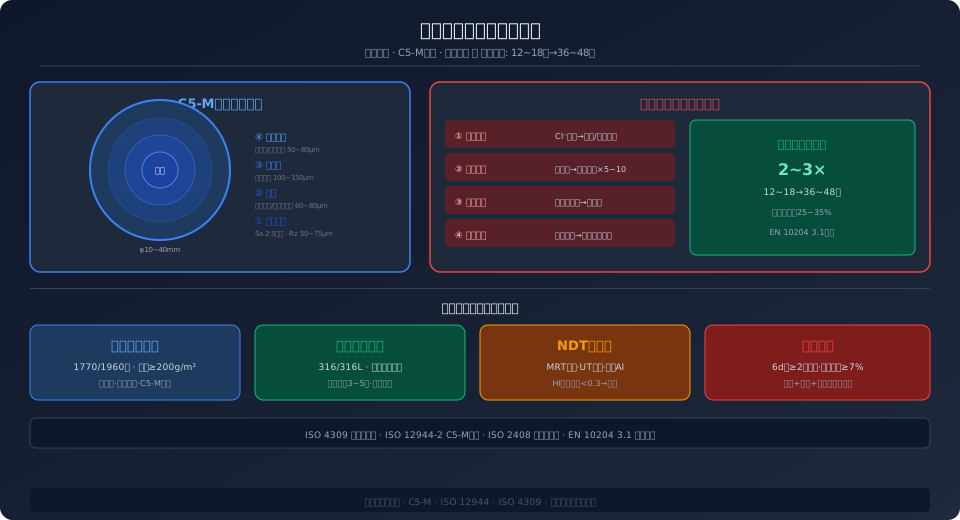
Wire rope is the most critical wear part on any crane — and on ship cranes it also represents the single largest maintenance cost item, typically accounting for 25%–35% of annual upkeep spending. In the marine environment, wire rope follows a far more aggressive degradation path than onshore equipment: salt spray attacks the wire surface from the outside in, wet-dry cycling accelerates fatigue crack growth, and wave-induced bending causes micro-motion wear between inner wires. Understanding these marine-specific degradation mechanisms is the first step toward an effective protection strategy.
Wire rope safety factor and discard criteria are determined in accordance with ISO 4301 and ISO 4309 Wire Rope Inspection Standard. Coating system performance data references the C5-M (marine atmospheric) classification defined in ISO 12944-2.
Four Marine Degradation Mechanisms That Shorten Wire Rope Life
①Salt-spray corrosion — Chloride ions in seawater (Cl⁻ concentration ≈ 19,000 ppm) penetrate the grease barrier on the rope surface and form pitting corrosion sites on individual wires. Each pit acts as a stress concentration point that quickly develops into a fatigue crack under cyclic loading. ISO 9223 classifies coastal environments as C5/CX corrosion categories, where carbon steel corrodes at 80–200 μm/year — compared with just 1.3–25 μm/year in inland C2 environments.
②Wet-dry cycling — During lifting operations, ship crane rope frequently transitions from fully submerged conditions (e.g., when hoisting subsea equipment) to dry exposure. As salt crystals form and expand during drying, they wedge open the gaps between wires, allowing corrosive media to penetrate deeper into the rope core. The repeated volume changes from wet-dry cycles also accelerate loss of rope core lubrication.
③UV aging — Unlike land-based crane rope that often operates indoors or under cover, wire rope on offshore platforms and deck cranes is exposed to intense ultraviolet radiation (UV Index can reach 15–20 in equatorial waters). This breaks down the polymer chains in fiber cores and surface grease, leaving them brittle and unable to seal or protect the rope.
④Wave-induced dynamic loading — Ship heave causes the load on the wire rope to cycle between 60% and 130% of its rated value. This low-frequency, high-amplitude fatigue load (typically 0.1–0.2 Hz, with 3–6 million cycles per year) is far more damaging than the high-frequency, low-amplitude vibration seen on land cranes (typically 1–5 Hz), because it produces larger stress amplitudes and deeper crack propagation.
Wire Rope Material Selection: Hot-Dip Galvanized vs. Stainless Steel vs. Carbon Steel
Choosing the right wire rope material for a ship crane is a balancing act between strength, corrosion resistance, and cost. Three options dominate the industry:
Hot-dip galvanized wire rope is the most common choice for offshore platform cranes. Before being drawn to final diameter, the wire passes through a molten zinc bath (450°C), producing a zinc layer of ≥50 μm (Grade A galvanizing per ISO 2232). In salt-spray conditions, the zinc acts as a sacrificial anode, slowing corrosion of the underlying steel. Tensile strength ratings are typically 1770 N/mm² or 1960 N/mm² — essentially the same as bright finish rope of equivalent specification. Expected service life in a C5 marine environment: 18–30 months, depending on maintenance frequency.
Stainless steel wire rope (AISI 316/316L) offers the highest level of corrosion resistance — austenitic stainless steel with 16%–18% Cr, 10%–14% Ni, and 2%–3% Mo is virtually immune to rusting in marine atmospheres (pitting resistance equivalent number PREN = Cr + 3.3Mo + 16N ≥ 24). The trade-off is a 15%–20% reduction in strength (stainless wire typically achieves 1570–1770 N/mm² versus 1770–1960 N/mm² for carbon steel) and a cost 3–5 times higher than hot-dip galvanized rope of the same specification. For these reasons, stainless steel rope is generally reserved for applications with strict cleanliness requirements (such as food-grade vessels or research ship winches) or for the most severe splash-zone exposure.
Bright finish carbon steel rope (ungalvanized) is not recommended for marine service at all — its expected life is only 6–12 months, making it suitable only for temporary work or one-off hoisting jobs. Even when cost reduction is a priority in ship crane design, Grade B hot-dip galvanizing (zinc layer ≥30 μm) should be the absolute minimum baseline.
C5-M Coating System: The External Armor for Wire Rope
Beyond the zinc layer on the wire itself, the external lubrication and coating system plays an equally important role in determining rope service life. Under ISO 12944-2, marine environments correspond to C5-M (high durability marine) or CX (extreme marine/offshore) corrosion categories, and the coating system must meet the following requirements:
| Coating Layers | Material/Specification | Dry Film Thickness (DFT) | Function |
|---|---|---|---|
| Rope core lubrication | Bituminous or Synthetic Compound Grease | Penetration to Core | Inner Wires Corrosion Resistant+Reduction Micro-motion Wear |
| Strand Core Filling | Aluminum-Based or Calcium-Based Compound Grease | Inter-Strand Void Filling | Barrier Against Moisture and Salt Spray Ingress to Core |
| Surface Coating | Bituminous Sealer | ≥100μm | Outer Surface Shielding Against Salt Spray and UV |
| Outer Layer Lubrication Mo S₂ Graphite Compound Open Gear Grease | ≥50μm | Reduction of Friction with Pulley/Drum Friction Wear | |
| End Termination Sealing Heat-Shrink Sleeve + Silicone Sealant | — | Prevention of Capillary Moisture Ingress at Rope End into Core |
For offshore platform cranes operating in particularly harsh environments (such as the North Sea or splash-zone duty), an additional sacrificial anode protection layer is required on top of the standard C5-M coating system. A zinc alloy anode block (weight ≥0.5 kg) is installed near the wire rope fixing point to further reduce galvanic corrosion rates through electrochemical protection. Anode consumption must be inspected quarterly and the anode replaced when more than 50% has been consumed.
Non-Destructive Testing: The Three Essential Wire Rope Inspection Methods
Ship crane wire ropes must be subject to a scheduled non-destructive testing (NDT) regime, as required by all major classification societies and the ISO 4309 Wire Rope Inspection Standard. Three complementary NDT methods, used in combination, provide full coverage of wire rope condition assessment:
Electromagnetic testing (MRT — Magnetic Rope Testing) is the most critical wire rope inspection technique. A strong magnetic field (H = 5000–12000 A/m) magnetizes the rope to saturation, while a Hall sensor array (typically 16–32 channels) detects leakage flux anomalies on the rope surface — broken wires produce sharp leakage flux peaks, while loss of cross-sectional area (from corrosion or wear) manifests as a gradual baseline shift. Modern MRT instruments (such as the Magnograph series from NDT Technologies or the INTROS series from Intron Plus) can detect local defects with a loss of metallic cross-sectional area (LMA) of ≥2%, with positioning accuracy of ±5 mm and inspection speeds of 0.5–3 m/s. Results are automatically generated as LMA curves and LF (local flaw) event reports.
Visual testing (VT) may be the most traditional method, but it holds irreplaceable value in marine environments — surface corrosion of outer wires, grease depletion, and strand loosening or deformation are degradation modes that MRT cannot readily quantify, and only an experienced inspector can assess them accurately through visual examination (with the aid of a 10× magnifying glass or borescope where necessary). The ISO 4309 standard provides detailed visual inspection acceptance criteria: visible broken wires in outer strands reaching 2 within a length of 6d or 5 within a length of 30d (where d is the rope's nominal diameter) constitutes grounds for discard.
Grease analysis is an emerging wire rope condition assessment method. A grease sample is scraped from the rope surface and subjected to ferrography to determine the concentration and morphology of metallic wear particles in the grease — spherical particles indicate fatigue, flat particles indicate wear, and cutting-shaped particles indicate severe abrasion — providing insight into internal wear levels. The grease's acid number (TAN ≤ 3.0 mgKOH/g) and moisture content (≤ 1000 ppm) are also measured to evaluate grease aging. Sampling is recommended every six months.
| Detection Method | Detectable Defect Type | Detection Frequency | Limitations |
|---|---|---|---|
| Electromagnetic Detection MRT | Wire Breaks, Cross-Sectional Area Loss LMA | Semi-Annually | Inability to Detect Detection Surface Corrosionand Lubricant Condition |
| Visual Inspection VT | Surface Corrosion, Deformation, Looseness | Quarterly | Outer Wires Only, Dependence on Inspection Inspector Experience |
| Grease Analysis | Internal Wear Trend, Grease Aging | Semi-Annually | Indirect Inference, Inability to Positioning Defect Location |
| Ultrasonic Guided Wave | Deep-Seated Wire Breaks, Core Deterioration | Annually | Sensitivity to Surface Condition, Requirement for Clean Surface |
Wire Rope Replacement Decisions: Discard Criteria and Life Predictionent Criteria and Life Prediction
Replacement decisions for ship crane wire ropes cannot rely on service time alone. They must be based on the retirement criteria of the ISO 4309 Wire Rope Inspection Standard and trend analysis of historical NDT inspection data. A practical approach is to establish a "Health Index" (HI) for the wire rope, calculated by normalizing and weighting three parameters: the LMA value from MRT inspection, the number of outer broken wires from visual inspection, and the ferrographic wear index from grease analysis: HI = 0.5×(1-LMA/10%) + 0.3×(1-broken wire count/retirement limit) + 0.2×(1-ferrographic index/critical value). When the HI drops below 0.3, replacement should be planned proactively even if no single retirement criterion has been met—because the remaining life of most wire ropes degrades at an accelerating rate once HI falls below 0.3.
Kelude Heavy Industry has applied this Health Index methodology across multiple offshore platform crane projects, reducing unplanned wire rope replacement rates from the industry average of 15% to below 5%. The approach has been validated on several FPSO and jack-up drilling rig projects, helping clients cut average annual rope replacements from 1.5 to 0.4 per crane—significantly reducing production interruptions and emergency repair costs caused by sudden rope failure.
Full life cycle cost (LCC) analysis shows that while Grade A hot-dip galvanized wire rope carries a 15%~20% higher initial purchase price than Grade B, its 40%~50% longer service life and the elimination of one replacement cycle's labor and downtime costs (offshore platform day rates typically range from ¥30~800,000) result in a total LCC that is actually 25%~35% lower than Grade B.
Frequently Asked Questions
Q: Should ship crane wire ropes be hot-dip galvanized or stainless steel? Which is better for coastal and inland port applications?
A: For offshore platforms and ocean-going vessels, Grade A hot-dip galvanized rope (zinc layer ≥50μm, 1770~1960N/mm²) is recommended for the best cost-performance ratio, with a service life of 18~30 months. Stainless steel 316L is only specified for food-grade vessels, research winches, or extreme corrosion conditions in the splash zone—it costs 3~5 times more than hot-dip galvanized and offers 15%~20% lower strength. For inland and coastal ports (C3~C4 environments), Grade B hot-dip galvanized rope (zinc layer ≥30μm) is suitable, with an expected service life of 24~36 months.
Q: How often should MRT electromagnetic inspection be performed on wire ropes? Do CCS and DNV requirements differ?
A: CCS and DNV requirements for wire rope NDT inspection intervals are essentially the same: MRT electromagnetic inspection every six months and visual inspection every quarter. However, for offshore platform cranes (API 2C), if the rope has been in service beyond 50% of its design life, MRT frequency should be increased to quarterly. Inspection reports must be issued by a class society-approved NDT Level II or Level III technician and retained onboard for at least 2 years after rope replacement.
Q: Can a wire rope with "birdcage" deformation continue to be used?
A: No. Birdcage deformation—where outer strands loosen and bulge outward in a cage-like pattern—indicates that the rope core has severely degraded or fractured, and the internal structural integrity of the rope has been irreversibly compromised. Even if MRT inspection has not reached the LMA retirement threshold, a rope exhibiting birdcage deformation must be taken out of service and replaced immediately. With loose strands, load distribution among wires becomes highly uneven, and sudden fracture can occur at loads below the rated load. Birdcage deformation is particularly common in the luffing wire ropes of marine deck cranes, where repeated bending over small radii creates high inter-strand friction.
Q: How should wire rope grease be selected? Can standard grease replace marine-grade rope lubricant?
A: Absolutely not. Standard calcium-based grease has a dropping point of only 80~100°C, contains no rust inhibitors, and will wash out or emulsify within 2~3 months in marine salt-spray environments. Marine-grade wire rope lubricant must meet the following requirements: dropping point ≥180°C (to prevent run-off at tropical deck temperatures), compounded rust inhibitors (calcium sulfonate or aluminum complex soap), four-ball test PB value ≥800N (extreme-pressure and anti-wear capability), and salt spray test ≥500 hours without corrosion (ASTM B117). Recommended brands: Shell Gadus S5 V100, Klüberplex AG 11-462, Castrol Molub-Alloy 777.
Kelude Heavy Industry provides full life cycle management services for ship crane wire ropes, from selection and calculation to scheduled NDT inspection. Contact our engineering team for a detailed technical solution.
