

Crane Carbon Brush Selection & Replacement
📋 Key Summary
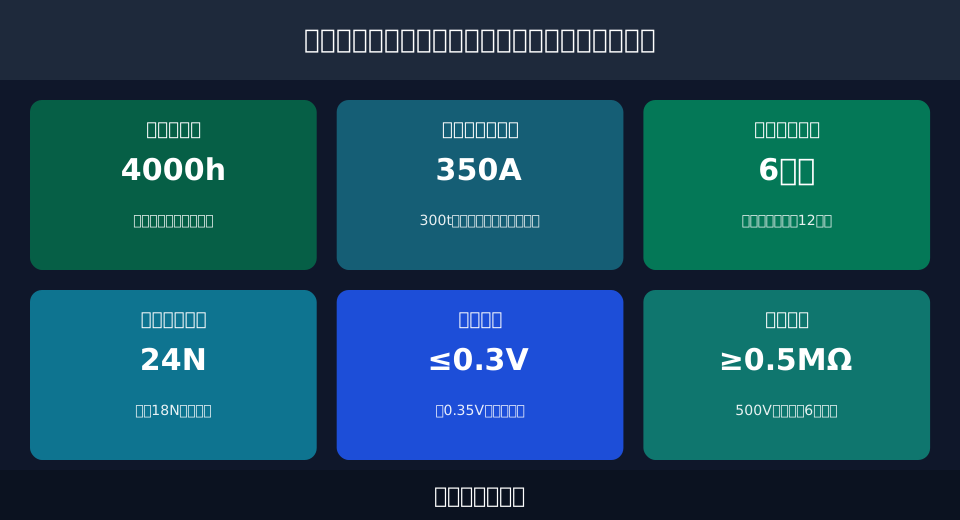
For European Standard Double-Girder Cranes (50t–300t), selecting current collector carbon brushes requires matching rated current, conductor rail material, and travel speed. Replace brushes when remaining length drops below one-third of the original or 20mm, whichever is greater. Maintain spring pressure at ≥18N; investigate control circuits if contact voltage drop exceeds 0.3V over time. Under standard conditions, replace every 6–12 months; in dusty environments or heavy loads, reduce to 3–6 months. Kelude recommends measuring wear monthly to track trends. Replace immediately upon detecting cracks, spalling, or if copper braid strand breaks exceed 15%.
Maintenance of carbon brushes on European Standard Double-Girder Cranes (50t–300t) cannot rely solely on visual inspection. Per the FEM 1.001 Crane Design Specification regarding mechanical strength, insulation, and temperature rise of power supply devices, and the TSG 51-2023 Safety Technical Supervision Regulation requirements for safety protection devices and main structural components, carbon brushes—being wear-prone sliding contacts—must be integrated into a periodic maintenance loop. Kelude Heavy Industry provides specific data in factory documentation, including model numbers, rated current, allowable wear limits, and spring pressure ranges, which field personnel must strictly follow.
Selecting Carbon Brushes: Matching Current Ratings & Conductor Rail Materials
Carbon brush selection begins by comparing the current collector’s rated current against the crane’s total load current. For a 50t European Standard Double-Girder Crane, the combined continuous current for the trolley travel mechanism, long travel mechanism, lighting, and control circuit typically ranges from 60A to 100A. In 200t–300t cranes operating under full load with variable frequency drive hoisting mechanisms, total current can reach 180A–350A. Select brushes with an allowable current capacity at least 1.2 times the collector’s rated current to prevent overheating during sustained operation.
Current density is generally calculated at 4A/cm²–8A/cm². For example, a brush with a cross-section of 40mm × 20mm (8cm²) allows 32A–64A. If the machine’s continuous current is 150A, at least three brushes must be used in parallel. When paralleling, adjust each brush’s spring pressure individually to prevent uneven current distribution caused by floating brushes.
The conductor rail material is critical for selection. Copper rails offer high conductivity and low contact resistance, suitable for high-current applications in 50t–300t cranes. Use copper-graphite brushes (copper content 45%–70%, density 2.2g/cm³–2.6g/cm³, Shore hardness 40–60). Aluminum rails form oxide films quickly; use higher-copper-content brushes with mild abrasive properties. Stainless steel rails are harder, increasing brush wear by ~20%–30%; thus, increase measurement frequency.
Kelude typically uses 50mm–60mm long brushes with initial spring pressures of 22N–28N. Never mix different materials during on-site replacement to avoid accelerated oxidation from electrochemical potential differences. Contact voltage drop should remain 0.35V at rated current, check rail joints, brush surfaces, and spring pressure before considering a higher current rating.
Calculating Wear Limits & Remaining Life on Site
Wear assessment requires evaluating both length and pressure. Length: Replace if remaining length is <1/3 of original or <20mm. Pressure: Replace if spring pressure drops below 18N, even if length is acceptable, as insufficient pressure increases contact drop, causing arcing and local overheating. Measure pressure using a spring scale along the brush axis while detached from the rail, recording the force at separation.
Engineering Example: A 160t European Standard Double-Girder Crane (Kelude) with a long travel speed of 80m/min and 180m single-phase rail. Initial brush length: 55mm. After 8 months, average length is 41mm (wear: 14mm; rate: 1.75mm/month). Minimum allowable length: 20mm. Remaining usable wear: 21mm. Estimated remaining life: 21 ÷ 1.75 = 12 months. Considering rail joint impacts and dust seasons, recommend replacement at 10 months rather than waiting for the 12-month limit.
Pressure Attenuation Calculation: With spring stiffness k=2.4N/mm and initial compression x=10mm, initial force F=24N. If field measurement shows compression reduced to 7.5mm, new force F=18N, reaching the replacement threshold. Replace springs or the entire bracket assembly even if brush length is adequate.
Inspect for surface cracks, spalling, edge chipping, and copper braid strand breaks. Replace if strand breaks exceed 15% of the total cross-section to prevent localized current concentration and holder burning. After replacement, run light load for 24 hours to achieve >80% contact area before full-load operation.
Replacement Cycle Management & Inspection Frequency Guidelines
Replacement cycles should not be based solely on calendar months but on annual operating hours, rail length, environmental dust, and load factors. • Cleanroom Environment (<2,800h/year): Replace every 12 months. • Dusty/Outdoor (>3,500h/year): Replace every 6 months. • High Temp/Humidity/Metal Dust: Replace every 3–6 months based on wear measurements. Kelude recommends monthly measurements to record length and pressure trends.
Inspection Frequency: • Daily Visual Check: Every 7 days. Inspect for arc black spots on rails and brush bouncing. • Quantitative Measurement: Every 30 days. Reduce to every 15 days for speeds >100m/min or shifts >10 hours. • Insulation Test: Every 6 months. Use a 500V Megohmmeter to measure phase-to-phase and phase-to-ground insulation; result must be ≥0.5MΩ.
| operating conditionType | Annual Operating Hours | recommendationLength Measurement Cycle | recommendationPressureinspection interval | recommendationReplacement Interval |
|---|---|---|---|---|
| IndoorcleanlinessLight load | ≤2800h | 30Days | 60Days | 12Months |
| StandardIndoorFull load | 2800h~4000h | 30Days | 30Days | 6~12Months |
| Outdoor Dust or High Temperature | ≥3500h | 15Days | 15Days | 3~6Months |
| Metallic Dust or Heavy Shock | ≥4000h | 7~15Days | 15Days | 3Months or As Perwear amount |
Record retention must be closed-loop. Document the old carbon brush length, wear amount, spring pressure, and post-replacement 24-hour run-in voltage drop for every replacement, along with the spare parts batch number. Keep records for at least 3 years to identify abnormal wear at Conductor Rail joints. If the Replacement Interval drops below 6 months for two consecutive cycles, troubleshoot the straightness of the Conductor Rail, Current Collector bracket oscillation, and phase-to-phase insulation, rather than simply shortening the cycle. Following the periodic inspection logic in weld crack detection, include carbon brush wear and Conductor Rail displacement in a single routine inspection checklist.
Kelude Heavy Industry Maintenance Guidelines & Closed-Loop Records for European Standard Double-Girder Cranes (50t–300t)
For maintenance on 50t–300t European Standard Double-Girder cranes, Kelude Heavy Industry requires isolating the Power Supply and applying Lockout/Tagout procedures before replacing Current Collector carbon brushes. Verify zero energy and discharge residual charge after isolation. Position the Crane Travel Mechanism in the designated inspection zone to prevent accidental movement. After removing the carbon brush, inspect the inner wall of the holder for arc erosion; replace the holder if wear exceeds 1mm. When installing new carbon brushes, adjust the spring pressure to 22N–28N to ensure contact area covers at least 80% of the cross-section.
Maintenance also requires checking the step height at Conductor Rail joints. If the carbon brush bounces more than 0.5mm when passing over a joint, intermittent arcing occurs, accelerating wear. Grind joint steps to under 0.3mm and tighten all Connection bolts. Clean the insulator surfaces on the Current Collector brackets every 6 months to prevent carbon dust accumulation that could create leakage paths. Measure phase-to-phase Insulation Resistance with a 500V Megohmmeter; it must not fall below 0.5MΩ.
Kelude recommends verifying carbon brush status alongside the limit switch position for anti-collision safety distance during routine inspections of European Standard Double-Girder cranes. In smart speed control projects, integrating anti-sway algorithms can reduce frequent long travel acceleration events, minimizing carbon brush bouncing and arcing. Frequent hard acceleration can increase carbon brush wear rates by over 30%, making parameter optimization essential for extending service life.
FAQ
Q: At what remaining length must carbon brushes be replaced?
A: Replace carbon brushes when the remaining length is less than 1/3 of the original length or less than 20mm. Even if the length is within limits, replace them if spring pressure drops below 18N. In dusty environments or under heavy load conditions, replace them proactively rather than waiting for limit values. Refer to the allowable dimensions annotated on the factory drawings from Kelude Heavy Industry for specific requirements.
Q: Why is a run-in period necessary after replacing carbon brushes?
A: The actual contact area between new carbon brushes and the Conductor Rail is initially insufficient. Running at full load immediately causes local overheating and sparking. It is recommended to operate under no-load or light load conditions for 24 hours to allow the contact area to gradually exceed 80% before resuming rated conditions. Check voltage drop and temperature rise daily during the run-in period.
Q: Is high contact voltage drop always caused by carbon brush issues?
A: Not necessarily. Oxidation at Conductor Rail joints, attenuation of spring pressure, loose Connection bolts, or Current Collector bracket misalignment can all cause increased voltage drop. Measure section by section. If contact voltage drop exceeds 0.3V accompanied by joint temperature rise, inspect the carbon brush, holder, and Conductor Rail simultaneously.
Q: Can I continue using carbon brushes if the replacement interval has passed but wear is still low?
A: Yes, but this decision must be based on continuous measurement data. If spring pressure is normal, contact voltage drop is below 0.3V, and there are no cracks or chipping, you may extend the interval slightly. However, a single extension should not exceed 3 months, and total usage beyond 18 months is not recommended. Ensure all measurement records are retained.
