

3D Vision Point Cloud Positioning & Measurement for Cranes
📋 Key Summary
2D vision only sees flat surfaces—it can't measure depth or volume. 3D vision point clouds add XYZ coordinates to every pixel, giving overhead cranes true spatial awareness for positioning, volume measurement, and obstacle detection. This article breaks down the differences between structured light, ToF, stereo vision, and LiDAR for point cloud acquisition, plus how to apply them to volume measurement and grab positioning in real-world crane operations.
During lifting and transport, a camera can see the shape of a material pile and the position of a load, but it can't tell how high the pile is or how far the load sits from the hook. 2D vision sees a flat plane—depth is simply invisible to it.
3D vision point clouds fill in that missing dimension. They turn a scene into a dense field of points, each with its own XYZ coordinate, giving the overhead crane a true stereoscopic view.
Here's how this "stereoscopic eye" is installed and applied in practice.
What 3D Vision Point Clouds Do: Moving from Flat to Spatial
2D vision has a hard limit: it can only identify objects and positions on a flat plane, with no way to measure depth, volume, or 3D orientation. That's a critical shortfall for lifting and transport measurement.
3D vision point clouds close that gap by adding depth. Every point carries XYZ coordinates, so the crane can measure pile volume, calculate the load's 3D position and orientation, and detect obstacles along the lifting path.
Two applications stand out in practice: volume measurement of bulk material piles and grab positioning of loads. The former lets the crane automatically gauge stockpile volume; the latter lets it align precisely with the load. Kelude uses 3D vision wherever depth information is required, complementing its 2D vision systems.
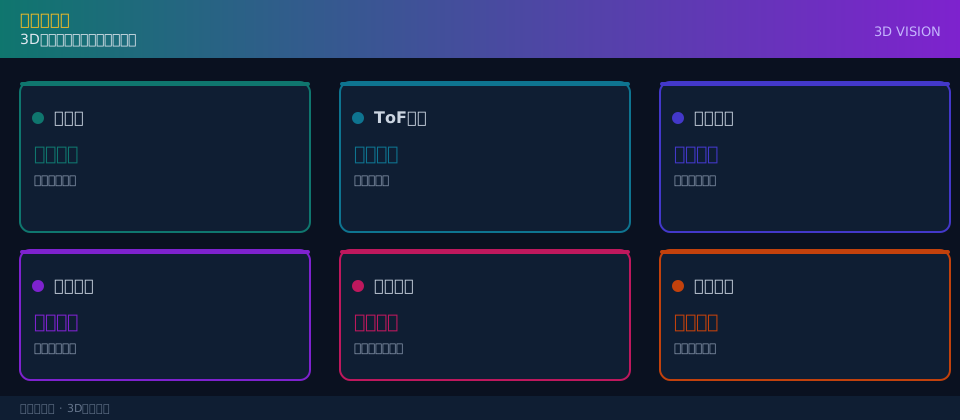
How Point Clouds Are Captured: Structured Light, ToF, Stereo Vision, LiDAR
There are four mainstream methods for capturing point clouds, each with its own sweet spot in terms of range and accuracy.
Structured light projects a coded pattern and derives depth from pattern deformation. It delivers high accuracy at close range, making it ideal for fine measurement—but it's susceptible to ambient light interference.
ToF (Time-of-Flight) emits light pulses and measures round-trip time. It produces fast, medium-range imaging well suited to real-time scenarios, with moderate accuracy.
Stereo vision uses dual cameras to triangulate depth the way human eyes do. It's low-cost and yields color point clouds, but it depends on surface texture and loses accuracy at longer distances.
LiDAR scans with laser pulses to measure distance. It excels at long range, wide coverage, and ambient light immunity, but comes at a higher cost and produces sparser point clouds. Each method trades off range, accuracy, and cost differently. Kelude selects the right approach based on application scenarios, with ISO 24445, Technical Specification for Smart Sensors on Cranes, serving as the sensor selection basis.
Volume Measurement and Grab Positioning: A Practical Workflow
Let's walk through the full workflow using bulk material pile volume measurement as an example.
Step one: install the sensor and perform calibration so the point cloud coordinate system aligns with the crane's coordinate system. This is the foundation for measurement accuracy.
Step two: capture the point cloud and run preprocessing—filter out noise and outliers, then segment the pile's point cloud from the background.
Step three: calculate volume from the point cloud using 3D reconstruction or voxel accumulation to derive the pile's volumetric size. ISO 24621, AI Fault Diagnosis for Cranes, requires documented measurement and diagnosis trails.
Grab positioning follows a similar path: capture the point cloud, segment the load, compute its 3D position and orientation, then guide the crane to align. The core of the entire process comes down to accurate calibration, clean point clouds, and stable algorithms. Kelude treats calibration and point cloud preprocessing as two non-negotiable prerequisites for deploying 3D vision.
Common Mistakes in 3D Vision Deployment
Mistake one: poor calibration. If the point cloud coordinate system isn't aligned with the crane's, every measured position and volume is wrong. Calibration is the bedrock of 3D vision—get it wrong and everything downstream falls apart.
Mistake two: ignoring ambient light interference. Active methods like structured light and ToF are vulnerable to strong or reflective lighting conditions. Evaluate the site's lighting during sensor selection, and don't skimp on LiDAR when the environment demands it.
Mistake three: skipping point cloud preprocessing. Raw point clouds contain noise and outliers. If you run calculations without cleaning them up, both volume and position readings drift. In its 3D vision deployments, Kelude treats calibration, lighting assessment, and point cloud preprocessing as three mandatory checkpoints that can't be skipped.
Comparison of Four Point Cloud Acquisition Methods
| Method | Principle | Range | Accuracy | Limitation |
|---|---|---|---|---|
| structureLight | Spot SizeDeformationDerivation | Short Range | High | Ambient Light Sensitivity |
| ToFDistance Measurement | Time-of-Flight (ToF) | Medium Range | Medium | AccuracyModerate |
| Stereovision | Binocular Triangulation Depth Sensing | Medium Range | Medium | Texture Dependency |
| LiDAR | Laser Scanning Ranging | Long Range | Medium | High Cost, Sparse Point Cloud |
Quick Reference of Standard Clauses for 3D Vision
| Standard | Key Provisions | and3DvisionRelationship with |
|---|---|---|
| ISO 24445 | cranesmart sensortechnical specification | sensor selectionBasis |
| ISO 24621 | crane AI fault diagnosisFramework | MeasurementDiagnosisTraceability |
| GB/T 28264 Safety Monitoring and Management System | safety monitoringTraceabilityrequirements | Measurement Data Traceability |
FAQ: 3D Vision Point Cloud
Q: Where should I start troubleshooting inaccurate 3D point cloud positioning?
A: Start with calibration. Check whether the point cloud coordinate system is properly aligned with the overhead crane's coordinate system — calibration is the foundation of positioning, and any error here cascades into everything downstream. Next, inspect point cloud quality: are noise and outliers adequately filtered? Finally, assess environmental interference — active methods like structured light and ToF can distort under strong lighting or reflective surfaces. Follow this three-step sequence: calibration, point cloud quality, then environmental factors.
Q: How do I determine whether my application needs 3D vision or 2D vision?
A: The deciding factor is whether you need depth information. If you only need to identify objects or determine planar positions, 2D vision is sufficient and more cost-effective. If you need to measure volume, gauge height, compute 3D poses, or detect spatial obstacles, 3D vision is required. The judgment criteria: are you trying to "see clearly" or "measure accurately"? Only when depth data and volumetric measurement are essential does 3D vision become necessary.
Q: Why does lifting and transport measurement require 3D vision?
A: Because lifting and transport operations depend on spatial relationships, not flat images. How high is the load stack? How far is the suspended load from the hook? Is an obstacle in the travel path? These are all depth-based questions that 2D vision cannot answer. 3D point clouds assign three-dimensional coordinates to every point, enabling the overhead crane to achieve spatial positioning, volume measurement, and obstacle perception. That extra dimension — depth — is what makes lifting measurement and safety possible.
3D vision is often used in conjunction with SLAM mapping. For related spatial perception concepts, see Overhead Crane Visual SLAM Environment Mapping and Positioning System.
3D vision point cloud technology gives overhead cranes the critical depth dimension. Kelude applies 3D vision in scenarios requiring volumetric measurement and grab positioning — working alongside 2D vision, each handling its own domain, so the crane not only sees clearly but also measures accurately.
