

Crane AI Active Learning with Limited Defect Annotation Budget
📋 Key Summary
Annotation budgets are fixed, but the samples you choose to label are not. Active learning lets the model flag the samples it is least confident about, so engineers prioritize those for annotation. With the same budget, this approach delivers higher accuracy than random sampling. This article breaks down three strategies—uncertainty sampling, diversity sampling, and query-by-committee—and shows exactly how active learning puts every dollar where it counts.
🧮 Core Logic of This Article
Random annotation: Pick a random batch from a massive pool of samples. The information gained is unpredictable, and the budget is spent blindly.
Active learning: The model selects the samples that will most improve accuracy. Every dollar goes where it builds the most capability.
One fact that is often overlooked: the annotation budget matters just as much as annotation quality—but how that budget is spent is usually taken for granted as "just grab a random batch and label it." Kelude Heavy Industry has accumulated over 500,000 annotated images of industrial defects, and the biggest lesson learned along the way is this: random labeling is worse than no labeling, and blind labeling is worse than smart labeling.
Active learning is exactly what "smart labeling" means: letting the model point out which samples should be annotated first. Let's run the numbers.
Active Learning Boundary Conditions: Maximize Information with a Fixed Budget
Active learning starts with a fixed budget. Annotation engineers have limited time and capacity, so only a finite number of samples can be labeled. Within that constraint, the question shifts from "how many to label" to "which ones to label."
The problem with random annotation is that the information gain is unpredictable. In a massive sample pool, many samples are ones the model already knows or are near-duplicates of each other. When random selection hits those, the annotation budget is wasted.
Active learning, by contrast, lets the model choose: it picks the samples it is least certain about and the ones most different from what is already labeled. These carry the highest information value for improving accuracy. With the same budget, active learning spends annotation effort where it matters most, driving faster accuracy gains. At Kelude Heavy Industry, active learning is standard practice on projects with tight annotation budgets, and ISO 24621 AI Fault Diagnosis for Cranes requires continuous optimization of the diagnostic model.
Three Sampling Strategies: Uncertainty, Diversity, and Committee
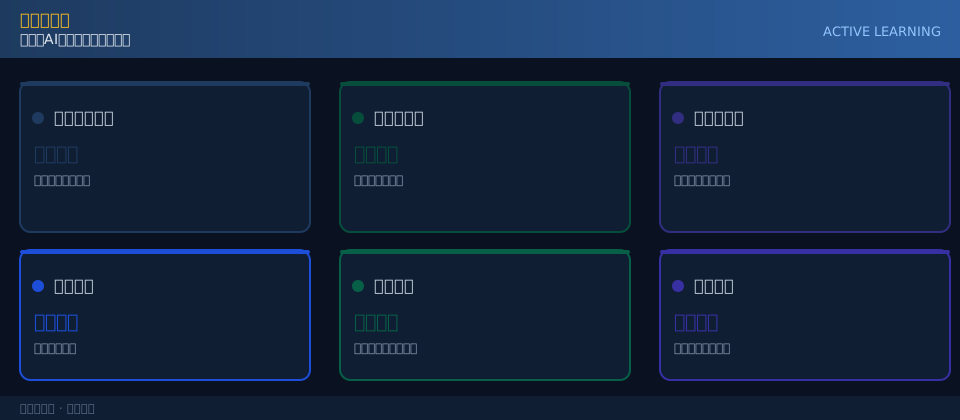
Active learning relies on three mainstream strategies for sample selection.
Uncertainty sampling picks the samples the model is least confident about. When the model's prediction confidence is low or hovers near a decision boundary, it means the model has not learned that case yet—labeling it yields the biggest payoff. This is the most basic and widely used approach.
Diversity sampling selects samples that are most different from the already-labeled set. The goal is to avoid labeling a pile of similar samples, ensuring the annotation covers a broader distribution so the model learns more comprehensively.
Query-by-committee trains multiple models and picks the samples where they disagree the most. When several models are uncertain or hold conflicting opinions, those samples tend to have the highest annotation value. The three strategies can be combined: uncertainty as the baseline, diversity for coverage, and committee for tackling the hard cases.
The Economics of Active Learning: Higher Accuracy on the Same Budget
The value of active learning must be measured against the same budget.
Random annotation spends the same money but labels a large share of samples the model already knows—redundant data that slows accuracy gains and wastes budget.
Active learning targets the samples the model is least sure about. Every annotation hits a known weakness, accelerating accuracy gains and pushing closer to the accuracy ceiling on the same budget.
The core of this calculation is annotation density: active learning raises the information content of each labeled sample, making the budget go further. Kelude Heavy Industry's experience shows that the tighter the annotation budget, the greater the relative value of active learning. When the budget is large enough to label everything, the strategy matters less.
Most Common Mistakes When Deploying Active Learning
The first mistake is ignoring sample diversity. If you only pick uncertain samples, you end up labeling a batch of near-identical data. The model learns locally but misses global coverage, leading to poor generalization. Uncertainty must be paired with diversity.
The second mistake is treating active learning as a shortcut. Active learning is only a sample-selection strategy—annotation quality and engineer involvement cannot be compromised. Even perfectly selected samples are wasted if the labeling itself is sloppy.
The third mistake is labeling everything in one pass without iteration. Active learning is a loop: label a batch, retrain, pick the next batch, and repeat. Only continuous iteration unlocks its full value. Kelude Heavy Industry runs active learning as a closed loop of "label, train, select"—not a one-off action—and GB/T 28264-2017 Safety Monitoring and Management System for Lifting Appliances requires traceability of annotated data.
Comparison of Three Sampling Strategies
| Strategy | Sample Selection Criteria | Information Source | Implementation Complexity | Application Scenarios |
|---|---|---|---|---|
| Uncertainty Sampling | Low Prediction Confidence | Model Weakness | Low | Initial Priority |
| Diversity Sampling | High Divergence from Labeled Data | coverageBreadth | Medium | Global Coveragecoverage |
| Query-by-Committee | High Model Disagreement | ChallengePositioning | High | Hard Sample Tackling |
Quick Reference of Standard Clauses for Active Learning
| Standard | Key Clause Points | andactive learningRelationship |
|---|---|---|
| ISO 24621 | craneAI fault diagnosisFramework | diagnostic modelContinuous Optimization |
| GB/T 28264 Safety Monitoring and Management System | safety monitoringTraceabilityrequirements | annotated datatraceable |
| ISO 24619 | craneIoT interfaceSpecification | Data Refeedingaccess system |
FAQ: Active Learning in AI Vision
Q: What is the fundamental difference between active learning and random annotation?
A: The difference comes down to "who decides what gets labeled." Random annotation grabs a batch of samples and labels them without much thought — the information value of each sample is uncertain, and you may end up labeling plenty of redundant data the model already understands. Active learning, by contrast, lets the model pick the samples it is least confident about, so every annotation targets a known weakness. This yields higher information density. With the same budget, active learning delivers faster accuracy gains — annotation decisions shift from random to strategic.
Q: With a limited annotation budget, which active learning strategy should I start with?
A: Start with uncertainty sampling — it is the simplest and delivers the fastest results. The model picks the samples it is least sure about, and you label those first. Once that is running, layer in diversity sampling to avoid labeling a pile of similar samples and to improve overall coverage. For tighter budgets or harder sample sets, bring in query-by-committee to tackle the tough spots. The sequence is: uncertainty sampling as the foundation, diversity sampling for coverage, and query-by-committee for edge cases.
Q: Can active learning eliminate annotation costs?
A: No — it cannot replace the annotation work itself. What it does is stretch the value of your existing annotation budget. Active learning decides which samples are worth labeling, but the selected samples still require careful work from engineers, and annotation quality cannot be compromised. Its real value lies in improving budget efficiency: reaching higher accuracy with fewer samples, not in making annotation optional.
For a practical look at building a data pipeline with active learning, see "Crane AI Vision Algorithm Training and Testing Platform: 500,000+ Industrial Defect Annotations Accumulated".
When annotation budgets are tight, every dollar has to count. Kelude builds its approach on uncertainty sampling as the foundation, diversity sampling for coverage, and query-by-committee for edge cases — so every annotation targets a model weakness and delivers higher accuracy from the same budget.
