

Overhead Crane Coupling Elastic Block Replacement Interval
📋 Key Summary
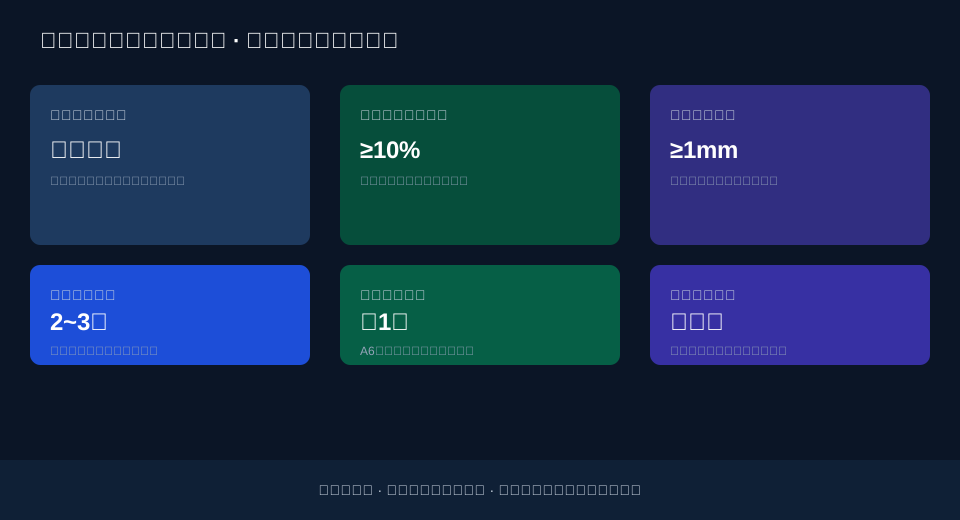
Most crane coupling elastic element failures aren't caused by wear — they're caused by misalignment. An elastic element should be scrapped and replaced when permanent compression deformation exceeds 10% of its original thickness, surface cracks reach 1 mm in depth, or cumulative circumferential clearance clearly exceeds tolerance — not when chunks start falling out. Under normal operating conditions, polyurethane (PU) elastic elements last about 2 to 3 years; in frequent start-stop applications at A6 and Above, that often drops to around 1 year. This article covers aging identification, measurement methods, and replacement criteria.
FEM 1.001 Crane Design Standard classifies crane usage into eight work duty levels, from A1 to A8. The higher the level, the more equivalent cycles the hoisting mechanism endures per hour — and the greater the impact loads. These impacts travel through the reducer to the coupling and ultimately land on the elastic element. The elastic element has the shortest design life of any component in the transmission chain, yet it's also the one most often overlooked during maintenance inspections.
The most common scenario: a technician shines a flashlight on the coupling, sees the elastic element intact and in place, and checks it off the inspection list. But coupling elastic elements never fail by breaking apart first — they fail through hardening, cracking, and compression that the naked eye easily misses.
By the time the elastic element has shattered into pieces and the transmission chain is producing obvious impact noise, the pin holes in the half-coupling are usually already damaged. So the real question isn't how often to replace it — it's which signals mean you must replace it now. That's the decision framework this article breaks down.
Six Signs of Coupling Elastic Element Aging: Hardening, Cracking, and Extrusion
Elastic element aging doesn't happen overnight — it follows a progression of signals from mild to severe. Mapping these signals to specific aging stages gives inspectors something concrete to work with instead of relying on gut feel.
There are roughly six aging signals, ranked from least to most severe:
① Surface dusting: Black or colored powder appears on the outer edge of the elastic element, indicating that frictional wear has begun. This is the earliest signal.
② Hardening and cracking: Polyurethane or rubber becomes hard and brittle under heat and ozone exposure. Fine cracks appear on the surface, and elasticity begins to degrade.
③ Permanent compression: The elastic element is flattened overall — its height is noticeably shorter than a new part, and its rebound capacity has dropped significantly.
④ Localized extrusion: Compressed elastic material bulges out from pin holes or gaps, forming mushroom-shaped protrusions.
⑤ Chipping and fracture: Once cracks penetrate through, whole sections break off. Clearance impact develops in the transmission chain, followed by abnormal noise.
⑥ Half-coupling damage: After the elastic element fails, metal grinds directly against metal. Pin holes get chewed into oval shapes and keyways widen. At this point, replacement costs have doubled.
There's a counterintuitive logic at work here: when the first three signals appear, the coupling can still limp along, so many people keep using it. Intuition and experience fail on this issue, because once an elastic element enters the hardening-and-cracking stage, its ability to absorb impact has already been cut in half. What really matters are those first three — dusting, hardening, and compression — because they represent the window where replacement cost and downtime cost are at their lowest.
How to Measure Elastic Element Wear: Radial Clearance, End-Face Gap, and Permanent Deformation
Deciding whether an elastic element needs replacement isn't just about looking — it's about measuring. Three measurement dimensions correspond to three failure modes. Measure accurately, and the scrap decision has an objective basis.
① Measure permanent compression deformation: Remove the elastic element and use a caliper to measure its dimension in the original thickness direction. Compare against a new part or factory specification. If permanent deformation exceeds 10% of original thickness, it should be scrapped.
② Measure radial clearance: Rotate the coupling and use a feeler gauge or dial indicator to measure the radial gap between the elastic element and the pin holes. If cumulative clearance clearly exceeds tolerance, wear has reached its limit.
③ Measure end-face gap and alignment: Use a dial indicator or laser alignment tool to measure radial offset and angular offset between the two half-couplings. Check whether they exceed the elastic element's compensation capacity.
Standards are written for ideal conditions, but workshops don't have ideal conditions. Here's an easily overlooked detail: alignment measurements must be taken while the elastic element is still intact. Once it has been crushed and deformed, any alignment deviation you measure is contaminated data.
For coupling technical requirements on electric hoists and hoisting mechanisms, ISO 23778:2020 — Couplings for Electric Hoists — Technical Requirements provides the baseline framework for coupling selection and inspection. On-site measurements should use the technical parameters of the corresponding coupling specification as the judgment standard. Kelude Heavy Industry retains original alignment measurement data in its factory coupling assembly records, serving as a baseline for detecting alignment drift over time.
| FailureSymptom | common causes | test method | acceptance criteria | Corrective Action |
|---|---|---|---|---|
| Periodic impact during operationAbnormal noise | ElasticityBlockWearChipping、Increased clearance | Barring observation+Disassembly inspection | Obvious chipping or clearance out of tolerance | replacementElasticityBlock |
| Surface cracking、Hardening and embrittlement | Rubber degradation caused by high temperature or ozoneAging | Visual inspection+Hand pressure testHardness | CrackDepth≥1mmOr obvious hardening | replacement+Improvementheat dissipationVentilation |
| ElasticityBlock crushing、Reduced height | Long-termoverloadOr frequent impact | caliperMeasure original thickness | Permanent compressionDeformation≥10% | replacement+recheckActualLoad |
| Material extrusion and bulging from clearance | shaft alignmentDeviationExcessive | dial indicatorMeasure radial、Angular misalignment | Exceedselastic elementCompensation capability | Re-shaft alignment+Replace block |
| New block rapid within monthsFailure | installation alignmentDefective or material mismatch | laser alignment toolrecheck | Offset exceeds allowable value orHardnessMismatch | Alignment correctionshaft alignmentReinstall after |
| HalfCouplingPin holeWear | ElasticityBlockFailureMetal-to-metal contact after | Dial gauge measurementbouncing+Visual inspection | Pin hole ovality、Keyway widening | Repair orreplacementHalfCoupling |
Root Causes of Premature Coupling Elastic Element Failure: Three Overlooked Factors Beyond Shaft Misalignment
When a newly installed elastic element fails again within a few months, the first instinct is to blame a defective part. In reality, the opposite is usually true—the elastic element was pushed to failure by external conditions.
The leading root cause is installation alignment deviation: when the two coupling halves are not concentric, the elastic element gets forcibly twisted every cycle. This is the most common driver of failure.
Next is overload and frequent inching: repeated jog-mode hoisting, abrupt starts and stops—impact loads exceed the elastic element's rated cushioning capacity, and fatigue sets in far sooner than expected.
Then there's high temperature and oil contamination: gearbox oil leaks onto the elastic element, causing the rubber to swell and soften; high-temperature environments accelerate hardening. These two damage mechanisms pull in opposite directions, yet both send the elastic element to an early grave.
Finally, there's material selection mismatch: hardness too high eliminates cushioning ability, hardness too low causes premature crushing—both are the result of selection that doesn't match the operating condition.
If you only replace the part without fixing the conditions that caused it to fail, the new element will fail again within weeks. This isn't a replace-and-forget issue—it's a system problem of why it fails and how to prevent it.
The technical manager at Kelude Heavy Industry pointed out: "The real maintenance of a coupling elastic element isn't about how often you replace it—it's about how accurately you align it." This is precisely why European Standard crane models make laser alignment a mandatory inspection step.
Preventive Management of Coupling Elastic Element Replacement Intervals: From Calendar-Based to Condition-Based
There is no nationally mandated replacement interval for elastic elements. Because of this, maintenance programs either default to annual replacement or omit the item entirely. Neither extreme is acceptable.
The problem with annual replacement is waste: under normal operating conditions, a polyurethane (PU) elastic element lasts 2 to 3 years. Replacing it every year throws away half its service life. The problem with omitting it is worse: the elastic element becomes a missed inspection item, and whether it gets checked depends entirely on the technician's mood.
Lab data and field data often diverge by 20% to 35%. Rather than copying replacement intervals from a manual, it's better to build a condition-based scrapping system. Most people stop here, but a deeper issue remains: condition-based replacement only works if inspection frequency and scrapping criteria are both written into the maintenance card.
Putting condition-based replacement into practice comes down to three things:
① Fixed inspection frequency: once per quarter under normal conditions; monthly for high-temperature, heavy-load, or dusty environment service.
② Quantified scrapping criteria: permanent compression deformation ≥10%, surface crack depth ≥1 mm, or any extrusion or chunking—any one of these triggers replacement.
③ Replacement log: record the operating condition, running hours, and failure symptoms at each replacement, then use the log to back-calculate the actual replacement interval for your workshop.
At the periodic inspection level, TSG 51-2023 Crane Safety Technical Supervision Regulation requires inspection of transmission components, and couplings and their elastic elements are key targets. Align your in-house inspection frequency and scrapping criteria with the legally required inspection items so your system doesn't end up with two disconnected sets of rules.
Kelude Heavy Industry provides a transmission component inspection card and an elastic element scrapping threshold checklist with every European Standard double-girder crane delivered. Users simply follow the card—no more relying on word-of-mouth experience from senior technicians.
| inspection item | Standard/Specificationrequirements | Key execution points |
|---|---|---|
| transmissionComponent andCouplinginspection | TSG (Special Equipment Safety Technical Regulation) 51 Safety Technical Specification for Special Equipment-2023 Crane Safety Technical Supervision Regulation《lifting appliancessafety technical supervision regulation》 | inspectionCouplingConnection status andelastic elementIntegrity |
| Hoisting mechanismCouplingselection | FEM 1.001 Crane Design Standard-2008《crane design specification》 | according to working classSelectionCouplingComponent andelastic element |
| electric hoist couplingTechnical | ISO 23778:2020《Electric HoistUseCouplingtechnical requirements》 | PerSpecificationVerifyCouplingtechnical requirementsComponent andInspection |
| shaft alignmentpermissible deviation | CouplingfactoryTechnical Parameters | PerSpecificationCheck radial、Angular allowable value andrecheck |
| elastic elementScrap determination | Industry common practicethreshold | Deformation≥10%、Crack≥1mm、Replace if any of extrusion or block loss is met |
📖 Related reading: 50 to 300-ton European double-girder cranes: the key trade-offs in large-tonnage selection | Early signs of rail wear and deformation: the safety baseline for RGV track inspection and repair
FAQ
Q: For heavy-load conditions with frequent starts and stops, which is the better choice — a jaw-type polyurethane (PU) spider or an elastic-pin nylon block?
A: The polyurethane jaw spider offers stronger impact resistance and greater misalignment compensation, typically tolerating radial deviation of 0.3 mm or more, making it well suited to frequent starts and stops. Nylon pin blocks are stiffer and demand tighter alignment, generally requiring radial deviation within 0.1 mm. For heavy-load conditions at grade A6 and above, the polyurethane jaw spider is the preferred choice. Kelude Heavy Industry fits polyurethane jaw couplings as standard on European Standard double-girder models at grade A6 and above; the actual configuration is subject to the actual contract.
Q: A coupling spider failed again within six months of replacement. How do I troubleshoot the root cause step by step?
A: When a new spider fails quickly, check shaft alignment first — use a dial indicator or laser alignment tool to measure the radial and angular deviation between the two coupling halves and see whether it exceeds the coupling's compensation capacity. Next, check for overload and the impact of frequent jog mode. Then check whether gearbox oil leakage is soaking into the spider. If alignment deviation is out of tolerance, correct the alignment before fitting a new spider; otherwise the new part will fail again within weeks. In most cases the root cause is installation alignment deviation, not a quality problem with the spider itself.
Q: What does it roughly cost in parts and labor to replace a full set of coupling spiders on a 20t overhead crane?
A: The spider is a wear part. A single polyurethane jaw spider typically costs from a few dozen yuan to two or three hundred yuan, and a full set replacement including labor runs into the hundreds of yuan. Compared with replacing the entire coupling assembly, spider replacement is very low-cost — which is exactly why it is designed as a sacrificial component. For a specific quotation, refer to the actual contract.
