

Overhead Crane IoT: Multi-Protocol & Smart Data
The Industrial Internet platform for overhead cranes brings every crane in your plant into a unified digital space, eliminating the information silo caused by multi-vendor, multi-protocol equipment. The platform supports OPC UA/Modbus/MQTT for unified access, and delivers data aggregation and storage, intelligent fault diagnosis, and energy consumption optimization — all from a single platform managing 1,000+ cranes.
Once your crane fleet exceeds 10 units, running each crane as a standalone island becomes a bottleneck. An Industrial Internet platform pulls every crane in the plant into one unified digital space — whether the PLC is Siemens or Mitsubishi, whether communication runs over OPC UA or Modbus, whether data lands in InfluxDB or SQL Server, the platform presents everything in a single, consistent format.
| platform layer | Function | technical implementation |
|---|---|---|
| Device Access Layer | multi-protocol gateway, Edge Data Acquisition, protocol conversion | OPC UA/Modbus/MQTTGateway |
| Data Storage Layer | time-series data+Business Data+File Storage | Influx DB+Postgre SQL+Min IO |
| Analytics Service Layer | Fault Diagnosis AI, energy consumption optimization, Reports | Python/MLModelsmicroservice |
| Application Presentation Layer | equipment map, monitoring screen, Mobile Endpoint | React+Three.js+Grafana |
How the platform connects to existing overhead cranes: New cranes come with a pre-installed data acquisition module and 5G communication module, so they connect automatically once powered on. For existing cranes, an edge gateway (OPC UA/Modbus protocol converter) is added without modifying the original control system. A gateway costs approximately $450–$750, and installation & commissioning takes about 2 hours.
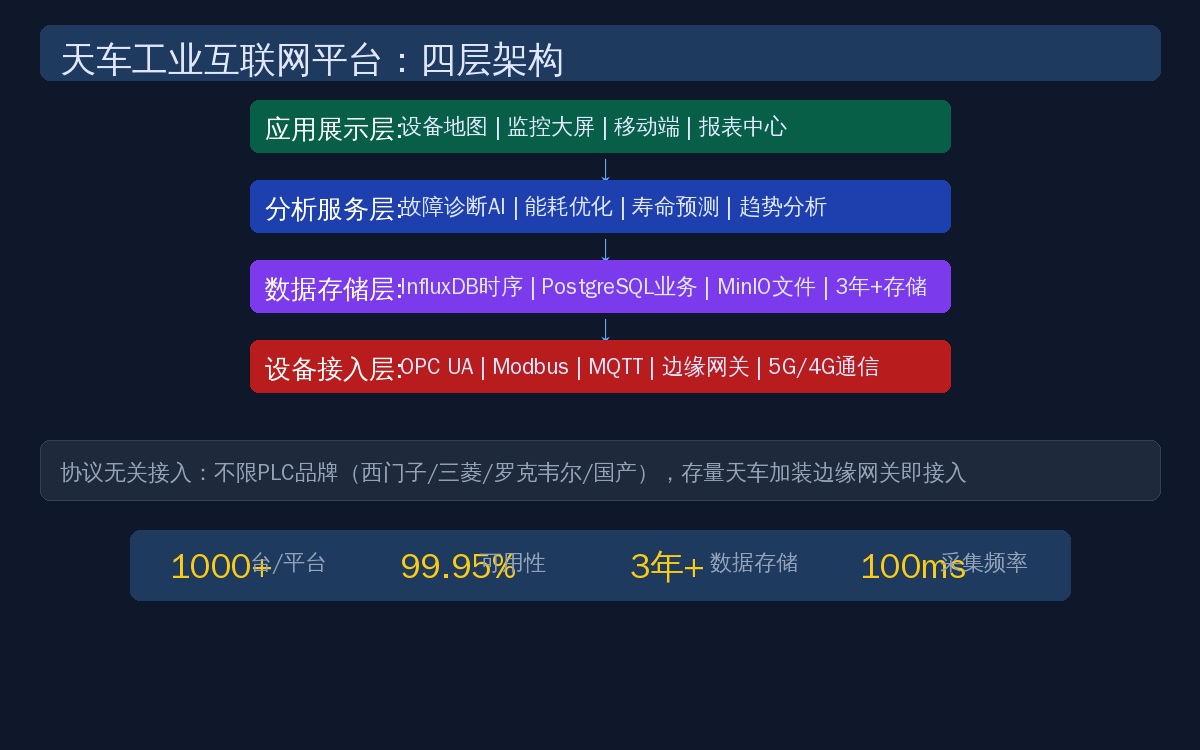
Overhead Crane IoT Platform Architecture
The overhead crane Industrial Internet platform uses a four-layer architecture: device access layer, data storage layer, analytics service layer, and application visualization layer. Each layer has clearly defined responsibilities and standardized interfaces, supporting horizontal scaling and independent upgrades.
Device access layer forms the foundation. Each crane is equipped with an edge industrial gateway (e.g., Siemens IoT2050, Huawei AR series) that collects real-time data from the PLC and handles protocol conversion. The gateway acts as an OPC UA Client to read tag variables from the crane PLC (Siemens S7-1200/1500, Mitsubishi FX5U, etc.), maps Modbus RTU/TCP data into an OPC UA information model, and uploads it to the platform via MQTT. Another key responsibility of the edge gateway is offline data buffering and retransmission—when the network drops, the gateway caches data locally and automatically retransmits once connectivity is restored, ensuring no data loss. Communication between the gateway and platform uses TLS encryption, with MQTT over TCP as the standard protocol and Protobuf serialization to minimize bandwidth consumption.
Data storage layer uses a hybrid storage architecture. Time-series data (vibration, current, temperature, and other continuous measurements) goes into InfluxDB, partitioned by day with automatic downsampling (retention policy: 30 days raw data, 1 year aggregated data, 3 years statistical summaries). Business data (crane asset registry, maintenance records, configuration information) is stored in PostgreSQL with structured management. Unstructured data (scan logs, fault screenshots, maintenance videos) is stored in MinIO object storage. The storage layer exposes unified REST APIs and WebSocket interfaces, so upper-layer services don't need to worry about underlying storage details. Data sharding strategy: data is hashed by crane ID across storage nodes, ensuring read/write operations for any single crane never become a bottleneck.
Analytics service layer runs as a Kubernetes microservice cluster, including a fault diagnosis engine (LSTM-based vibration anomaly detection), energy consumption analysis module (per ton-mile energy statistics), remaining life prediction service (Monte Carlo simulation-based wheel assembly remaining life estimation), and rules engine (Drools-based alarm rule configuration). Microservices are decoupled via a message queue (Kafka)—raw data published by the device access layer enters Kafka topics, analytics services consume and process it, and results are written back to the storage layer. This asynchronous architecture ensures the platform doesn't block under high concurrency.
Application visualization layer offers three interaction terminals. The Web management console uses React + Ant Design, featuring a crane equipment map (Three.js-based 3D scene), real-time instrument panel, and reporting center. The Grafana monitoring screen is used for on-site workshop monitoring, connecting directly to the InfluxDB data source with real-time refresh. The mobile app is built with Flutter or as a WeChat mini-program, supporting QR code device lookup, work order processing, and alarm push notifications. All terminals access backend APIs through a unified API Gateway (Kong), which centrally manages authentication and rate limiting.
Multi-Protocol Device Integration for Cranes
Crane PLCs come from many manufacturers, and equipment from different eras and vendors supports different communication protocols. The platform must solve the challenge of unified access across protocols. Here are integration approaches and application scenarios for the three mainstream protocols.
OPC UA (Unified Architecture) is the recommended protocol, especially for Siemens PLC series (S7-1200/1500). Three key advantages: standardization—OPC UA is the IEC 62541 international standard, so equipment from different vendors can be integrated uniformly; security—supports X.509 certificate authentication, AES-256 encrypted communication, and session authentication, meeting industrial network security requirements; information modeling—PLC variables can be organized into semantically meaningful object structures (e.g., "Crane 1 / Main Motor / Current"), so data meaning is clear without referencing tag tables. The Siemens S7-1500 natively supports OPC UA Server; the S7-1200 requires firmware V4.4 or later. Configuration steps: enable OPC UA Server in TIA Portal, specify the accessible variable list (structured variable groups recommended), and connect the edge gateway as an OPC UA Client.
Modbus TCP/RTU suits Mitsubishi, Delta Electronics, Xinje, and other domestic PLCs, as well as the vast majority of older crane control systems. Modbus's strength is simplicity—lightweight protocol stack, near-zero implementation cost, and support from every PLC vendor. Implementation essentials: connect the edge gateway's Modbus RTU port (RS485) to the PLC communication port inside the crane control cabinet, with parameters set to baud rate 9600–115200 bps, 8 data bits, no/odd parity, and 1 stop bit. The Modbus address mapping table (e.g., holding registers 40001–4xxxx) must be calibrated point-by-point during commissioning and recorded in the gateway configuration. Note that Modbus is not encrypted—if data traverses the public internet, a VPN or TLS tunnel must be added at the gateway side.
MQTT (Message Queuing Telemetry Transport) is ideal for IoT scenarios and edge node data upload. The gateway acts as an MQTT Publisher, publishing collected data in JSON or Protobuf format to the platform's MQTT Broker (e.g., EMQX or Mosquitto). MQTT's advantages: lightweight—the message header is only 2 bytes, minimizing bandwidth usage, ideal for bandwidth-constrained 4G/5G networks; QoS mechanism—supports QoS 0/1/2 service levels, with critical data (e.g., fault alarms) using QoS 2 to guarantee delivery and periodic data using QoS 0 to reduce overhead; Last Will message—when a gateway goes offline, it automatically publishes a Last Will message so the platform can promptly detect device disconnection. Recommended practice: assign each crane a dedicated MQTT Client ID, and structure topics as factory/zone/crane_id/data_type (e.g., plant01/zoneA/CR001/vibration) for easy filtering by device and type on the platform side.
Gateway deployment strategy: A dedicated gateway per crane is the recommended approach, providing fault isolation so one crane's network failure doesn't affect others. If cranes are concentrated in the same control room (e.g., multiple small-capacity cranes sharing a control cabinet), multiple cranes can share one gateway to reduce costs, provided the gateway has enough COM/Ethernet ports. Gateways should be installed inside the control cabinet or in the crane operator's cab, using industrial-grade wide-temperature (-20 to 70°C) devices powered from the control cabinet's 24V DC power supply.
Data Acquisition Frequency and Storage Strategy
The Industrial Internet platform collects three categories of data. High-frequency data (100ms level): vibration, current, real-time position—used for real-time monitoring and fault diagnosis, retained on a 30-day rolling basis. Medium-frequency data (1–10 second level): temperature, pressure, speed—used for trend analysis and energy consumption statistics, retained for 1 year. Low-frequency data (minute level): operating status, cumulative runtime, fault codes—used for reporting and statistical analysis, retained for 3 years. Storage estimation: a single crane generates approximately 500MB–2GB of raw data per day (depending on sensor count and sampling rate), so a platform with 100 cranes requires roughly 50–200TB of storage per year.
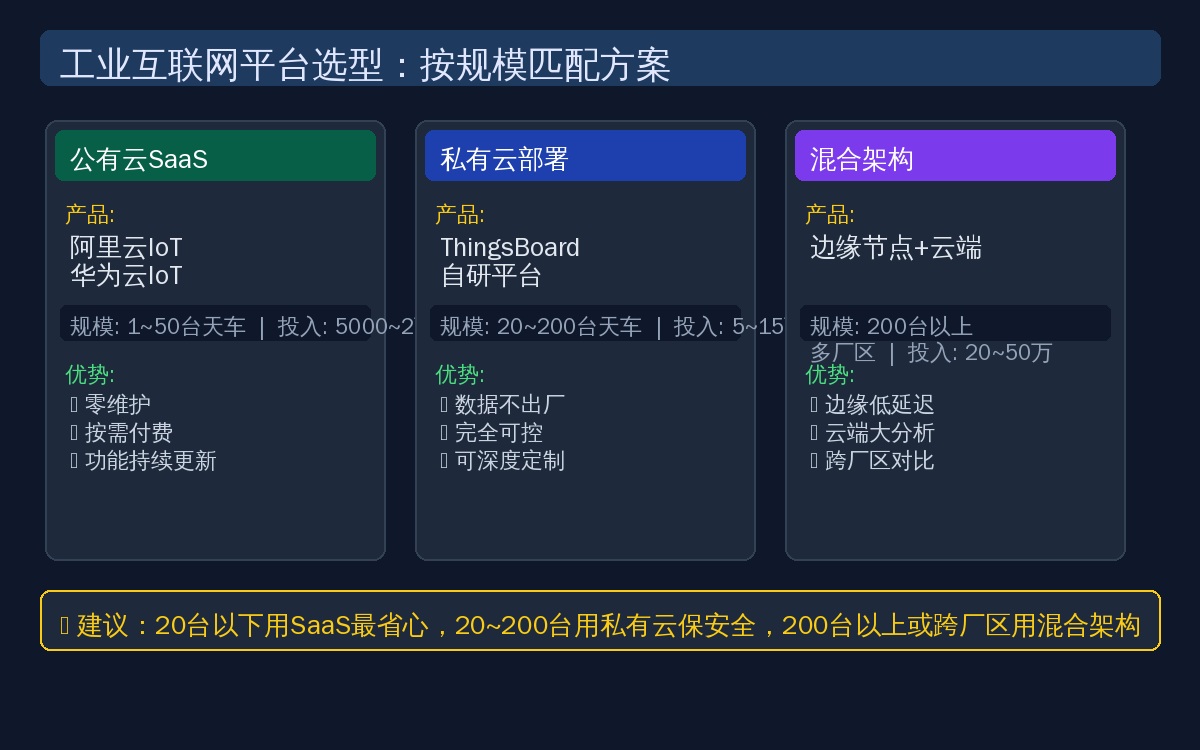
When selecting a platform type, three factors matter most: number of cranes, data security requirements, and IT operations capability. For fewer than 20 cranes with no strict data security requirements (non-classified facilities), public cloud SaaS is the most cost-effective option—zero maintenance, annual subscription, and continuous feature updates. For 20–200 cranes or when data cannot leave the facility (military, nuclear, confidential manufacturing), choose private cloud deployment—a one-time investment200 cranes or when data cannot leave the facility (defense, nuclear power, confidential manufacturing), private cloud deployment is the right choice—higher upfront investment but complete data control. For more than 200 cranes or multi-site operations requiring centralized management, a hybrid architecture works best—edge nodes handle real-time processing and local storage, while the cloud performs big data analytics and cross-site comparisons.
Platform Selection Comparison
Kelude Heavy Industry: Overhead Crane & Gantry Crane Manufacturer
Kelude Heavy Industry is a professional manufacturer of industrial overhead cranes and gantry cranes, integrating design, manufacturing, installation, and after-sales service. Our product range covers single-girder and double-girder overhead cranes, gantry cranes, explosion-proof cranes, and low-headroom cranes, widely used in machinery manufacturing, metallurgy, petrochemicals, and warehousing logistics. We provide comprehensive material handling solutions tailored to specific working conditions.
Complete Range of Overhead and Gantry Cranes
We offer a full line of industrial cranes, from 1-ton light-duty models to 300-ton heavy-duty systems. All cranes are designed and manufactured in compliance with ISO 4301 and ISO 4306 standards, ensuring reliable performance and operational safety. Our engineering team customizes lifting equipment to match your exact load capacity, span, and lifting height requirements.
| Crane Type | Capacity Range | Typical Applications |
| Single-Girder Overhead Crane | 1 – 20 tons | Machine shops, maintenance bays, light assembly |
| Double-Girder Overhead Crane | 5 – 300 tons | Heavy fabrication, steel mills, foundries |
| Gantry Crane | 3 – 100 tons | Yards, docks, precast concrete plants |
| Explosion-Proof Crane | 1 – 50 tons | Chemical plants, oil & gas facilities |
Explosion-Proof Cranes for Hazardous Environments
For operations in explosive atmospheres, our explosion-proof cranes are engineered with fully sealed motors, anti-sparking controls, and grounding systems that meet IEC 60204-32. These cranes are certified for use in Zone 1 and Zone 2 hazardous areas, providing safe and reliable lifting in chemical, pharmaceutical, and petrochemical plants.
Low-Headroom Cranes for Space-Constrained Facilities
Our low-headroom cranes are designed for facilities with limited vertical space. The compact trolley design maximizes hook height, allowing you to lift higher within the same building height. This solution is ideal for warehouses, workshops, and plants where headroom is at a premium.
Anti-Sway Technology for Precision Load Positioning
Kelude cranes can be equipped with advanced anti-sway control systems that minimize load swing during travel and positioning. This technology improves safety, reduces operator fatigue, and increases productivity in precision handling tasks such as mold changing, assembly line feeding, and container handling.
Customized Crane Solutions and After-Sales Support
Every lifting application is unique. Our engineers work closely with you to design a crane that fits your building structure, load requirements, and workflow. We provide complete after-sales support, including installation supervision, operator training, spare parts supply, and preventive maintenance programs. With Kelude, you get a reliable partner committed to maximizing your uptime.
Frequently Asked Questions
Q: What is the lead time for a standard overhead crane?
A: For standard single-girder cranes up to 10 tons, the lead time is typically 30-45 days. Double-girder and custom-engineered cranes may require 60-90 days depending on complexity.
Q: Do you provide installation services overseas?
A: Yes, we offer turnkey installation services in the US and Europe through our certified partner network. Our technicians can also provide on-site supervision and training.
Q: What safety certifications do your cranes have?
A: Our cranes are designed and manufactured in accordance with ISO 4301, ISO 4306, and IEC 60204-32. We can also provide CE certification upon request for the European market.
Q: Can you customize a crane for an existing building?
A: Absolutely. We regularly design cranes to fit existing building structures, including low headroom situations and unusual span requirements. Our team will conduct a site survey to ensure a perfect fit.
Q: What is your warranty policy?
A: We offer a standard 12-month warranty on all crane components. Extended warranties and service contracts are available for critical applications.
| Platform Type | Representative Product | Applicable Scale | Annual Fee/Investment | Features |
|---|---|---|---|---|
| Public Cloud Saa S | Alibaba Cloud Io T/Huawei Cloud Io T | 1~50units | approx.5000~210K/year | Zero Maintenance, Pay-as-You-Go |
| Private Cloud Deployment | Things Board/In-House Developed | 20~200units | approx.5~1510K | Data Stays On-Premise, Customizable |
| Hybrid Architecture | Edge+Public Cloud | 200units and above | approx.20~5010K | Low Edgelatency+Cloud Big Analytics |
FAQ: Industrial Internet Platform vs. SCADA & Deployment Questions
Q: What's the difference between an Industrial Internet platform and a traditional SCADA system?
A: SCADA focuses on equipment monitoring and data acquisition, primarily tracking real-time operating status. An Industrial Internet platform builds on top of SCADA by adding advanced analytics, AI-based diagnosis, and energy consumption optimization. In short, SCADA shows you the data; the platform analyzes it and turns it into actionable decisions.
Q: Can overhead cranes from different manufacturers be connected to the platform?
A: Yes. The platform uses OPC UA as its unified access layer, so any crane whose PLC supports OPC UA can be connected directly. For older equipment, a protocol conversion gateway can be added to enable connectivity without modifying the existing control system.
Q: What hardware is required to deploy the platform?
A: For small to medium installations, a hyper-converged appliance is recommended, costing roughly $7,400 to $11,900. For larger deployments, a cloud-based model with pay-as-you-go pricing is the better option. On the edge side, each crane needs an edge gateway, priced at approximately $440 to $740 per unit.
