

Smart Crane Retrofit Payback Period: 3 Upgrade Solutions Compared
📋 Key Summary
Legacy overhead cranes don't have to be scrapped entirely. Three retrofit options—Variable Frequency Drive (VFD), VFD plus Anti-sway, and VFD plus Anti-sway plus Condition Monitoring—offer escalating investment levels, with returns expanding from energy savings alone to efficiency gains and Predictive Maintenance. Using a typical three-shift operating scenario, this article breaks down the procurement increment and annualized returns for each option, calculates payback periods, and explains why retrofitting with VFD and anti-sway is usually far more cost-effective than replacing the crane outright.
At a machinery workshop in southern China, a 32t bridge crane running three shifts to hoist semi-finished parts cycles several hundred times a day. The workshop manager's two complaints are telling: "The crane swings so much that the operator has to wait for it to settle every single lift," and "The electricity bills keep climbing, and the maintenance crew is fixing something every day."
The plant's initial instinct was to replace the crane with a larger-tonnage model, reasoning that "the crane is old and no longer up to the job." But a closer look at the site revealed that 32t of Lifting Capacity is more than adequate for hoisting semi-finished parts. The real problem isn't tonnage at all—it's the speed control method and the lack of anti-sway. This crane still uses outdated rotor series resistance speed control, has no anti-sway, and captures no operational data.
The final recommendation: no replacement needed—an intelligent upgrade is the way to go. The retrofit comes in three tiers, with investment and returns scaling up progressively, and the calculated payback period is far shorter than a crane replacement. Here's how the math works out.
Typical Retrofit Case: Three Key Pain Points of a Three-Shift Legacy Crane
The pain points of legacy cranes like this one fall into three categories: high energy consumption, slow load handling, and frequent breakdowns. These issues are interconnected and all trace back to the same root cause—outdated speed control and control methods.
High energy consumption stems from rotor series resistance speed control, which wastes energy as heat through resistors at low speeds. VFD, by contrast, supplies power on demand. GB/T 12668, the technical specification for Variable Frequency Speed Control systems, defines the technical requirements for VFD systems, and continuous three-shift operation maximizes this waste.
Slow load handling is due to the absence of anti-sway. The load swings at a sway angle of 5° or more when it reaches its target position, forcing the operator to wait for the oscillation to stop—eating up more than ten seconds per cycle just on "waiting for the sway to settle."
Frequent breakdowns occur because there's no Condition Monitoring. Wear and temperature rise can only be caught through intermittent manual Inspection rounds, so hidden issues often go unnoticed until they escalate into full-blown failures. These three pain points are exactly what an intelligent upgrade is designed to address, one by one.
The Wrong Call Before Retrofitting: Why a Bigger Crane Isn't the Answer
When a crane "doesn't perform well," many plants instinctively reach for a larger model—but in most cases, that's a misdiagnosis. Insufficient tonnage and poor efficiency are two entirely different problems.
Insufficient tonnage means the Rated Lifting Capacity is less than the weight of the load—a hard constraint that can only be solved by replacing the crane. Poor efficiency, on the other hand, means the crane's speed control, anti-sway, and monitoring capabilities are outdated—a soft shortfall that can be fixed through configuration changes.
Treating a soft shortfall as a hard constraint and replacing the crane means spending tens of thousands of dollars to get a new crane that still lacks anti-sway and still uses resistance-based speed control—the efficiency problem remains exactly as it was. The cost of this misjudgment is money that could have been saved. When Kelude receives inquiries like this, the first step is always to determine whether it's a tonnage problem or an efficiency problem.
Investment vs. Returns: A Side-by-Side Look at Three Retrofit Options
All three options share a common approach: they perform electrical and control upgrades on the existing steel structure without touching the Main Girder, keeping modifications minimal and downtime short. The differences lie in the depth of configuration and the breadth of returns.
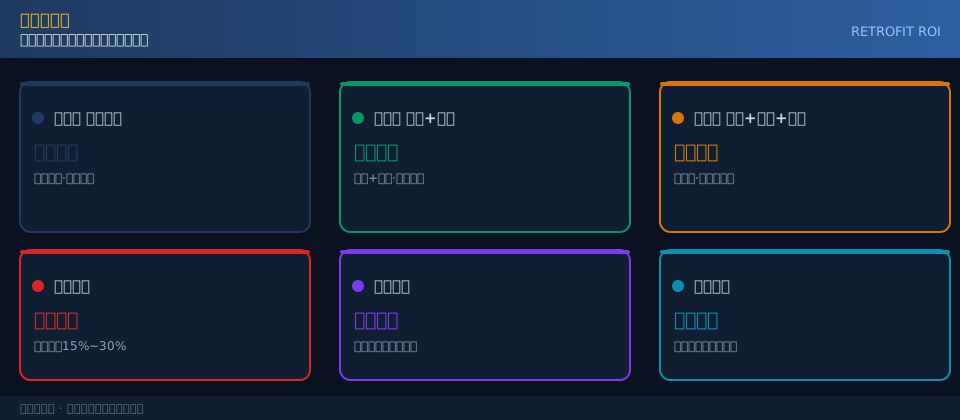
| retrofit solution | Investment Level | Annualized Return | Payback Period Reference |
|---|---|---|---|
| Option 1 Variable Frequency Speed Control | minimum | Energy Savings15%~30% | 1~2Year |
| Option 2 Variable Frequency Drive (VFD)+Anti-sway | Moderate | Energy Efficiency+Handling Efficiency Improvement | 1.5~3Year |
| Option 3 Variable Frequency Drive (VFD)+Anti-sway+Monitoring | Maximum | Energy Efficiency+Handling Efficiency Improvement+Unexpected Downtime Reduction | 2~4Year |
It should be noted that the payback periods shown in the table above are typical ranges based on three-shift, high-duty operation. Actual figures will vary with electricity rates, labor costs, cycle frequency, and downtime losses, so a project-specific assessment is required for precise numbers. That said, the trend is clear: the higher the load, the costlier the downtime, and the more frequent the cycles, the faster the payback. Before any retrofit, Kelude Heavy Industry uses on-site measurement of actual cycle counts and energy consumption data to tailor this table to each customer's specific operating conditions.
From Single-Unit Retrofits to Plant-Wide Deployment
Once the economics of a single crane retrofit are clear, the logic for scaling up to plant-wide deployment follows naturally. The recommended approach is to start with the line that carries the highest load and incurs the greatest downtime losses, validate the return on investment with real data, and then use those results to bring other production lines on board.
One often-overlooked advantage here is that the retrofit addresses electrical and control systems only—not the steel structure—so units can be upgraded one at a time without shutting down the entire workshop. Retrofit one crane, verify its performance, and calculate the savings before moving to the next. This keeps risk manageable throughout the process.
When rolling out across the workshop, it's essential to standardize on a unified monitoring platform. Consolidating data from multiple cranes onto a single platform enables side-by-side comparison and centralized maintenance, elevating condition monitoring from individual machines to fleet-wide predictive maintenance. GB/T 28264-2017 Safety Monitoring and Management System for Lifting Appliances provides the technical framework for this approach. Kelude Heavy Industry's retrofit solutions include provisions for unified interfaces and platform integration from the outset.
Standard Clauses Quick Reference for Retrofit Solutions
| RetrofitItem | related standards | Key Points |
|---|---|---|
| Variable Frequency Speed Control | GB/T 12668 | Variable Frequency Drive (VFD)Systemtechnical specification |
| safety monitoring | GB/T 28264 Safety Monitoring and Management System | MonitoringTraceability andearly warning |
| limit switchTraceability andinterlock | TSG (Special Equipment Safety Technical Regulation) 51 Safety Technical Specification for Special Equipment-2023 Crane Safety Technical Supervision Regulation | safety deviceNo Feature Reduction |
| RetrofitAcceptance | ISO 4310 | RetrofitAfterTestProcedure |
FAQ: Intelligent Upgrading of Traditional Overhead Cranes
Q: Where should I start when upgrading a traditional overhead crane?
A: Start with the speed control system. Replacing rotor resistance with Variable Frequency Drive (VFD) is the most cost-effective single upgrade with the fastest payback—it cuts energy consumption by 15% to 30% and enables smooth acceleration and deceleration. If budget allows, add anti-sway technology next to tackle slow load handling. Condition monitoring should be the third priority; let the data from the first two upgrades accumulate before deciding on full-scale monitoring, avoiding a heavy upfront investment.
Q: How do I know whether to retrofit my overhead crane or replace it?
A: First determine whether the issue is insufficient lifting capacity or poor efficiency. If the rated lifting capacity is below the weight of the loads you handle, that's a hard constraint—replacement is the only option. But if the problem is outdated speed control, lack of anti-sway, or no monitoring, a configuration upgrade will solve it. For cranes with sound steel structures and adequate tonnage, retrofitting is almost always far more economical than replacement, with shorter downtime and the flexibility to proceed unit by unit with manageable risk.
Q: Why is a VFD and anti-sway retrofit usually more cost-effective than buying a new crane?
A: Replacing the crane means paying for an entirely new machine even though the steel structure is still sound—and if the new crane still uses resistance-based speed control without anti-sway, you've carried the same efficiency problems forward. A retrofit only touches the electrical and control systems, keeping costs low and downtime short. The returns come directly from three measurable areas: energy savings, improved productivity, and reduced loss. For cranes with adequate tonnage and sound steel structures, the math almost always favors retrofitting over replacement.
For a step-by-step breakdown of the retrofit process, refer to the full guide: Smart Crane Retrofit Playbook: Kelude Heavy Industry's Digitalization Upgrade for Traditional Workshops.
The payback period for a retrofit isn't a guess—it's calculated from actual operating cycles, energy consumption, and downtime losses. Kelude Heavy Industry insists on measuring first and retrofitting second, using your own data to build a realistic business case before deciding which upgrade tier fits.
