

VFD Energy Saving & Efficiency Optimization for Overhead Cranes
Energy Efficiency & VFD Control: Kelude Heavy Industry's Crane Energy-Saving Technical Solution. As carbon-peak and carbon-neutrality strategies continue to drive industrial transformation, optimizing overhead crane energy efficiency has become a critical lever for smart factories to cut costs and boost productivity.
Overhead cranes represent the most power-dense equipment cluster on any workshop floor. A single 20–50 t crane typically carries an installed power rating of 50–150 kW, and a workshop operating ten cranes can easily consume 2–5 million kWh annually. Energy optimization therefore goes far beyond operational cost—it directly impacts carbon quota compliance and green factory certification. Drawing on years of electrical system integration experience, Kelude Heavy Industry has developed a comprehensive energy-saving framework for overhead crane systems built around five core technologies: variable-frequency speed control, regenerative energy recovery, permanent magnet synchronous motor retrofits, smart standby operation, and power factor correction. This article examines the principles, selection parameters, and engineering implementation of each approach.
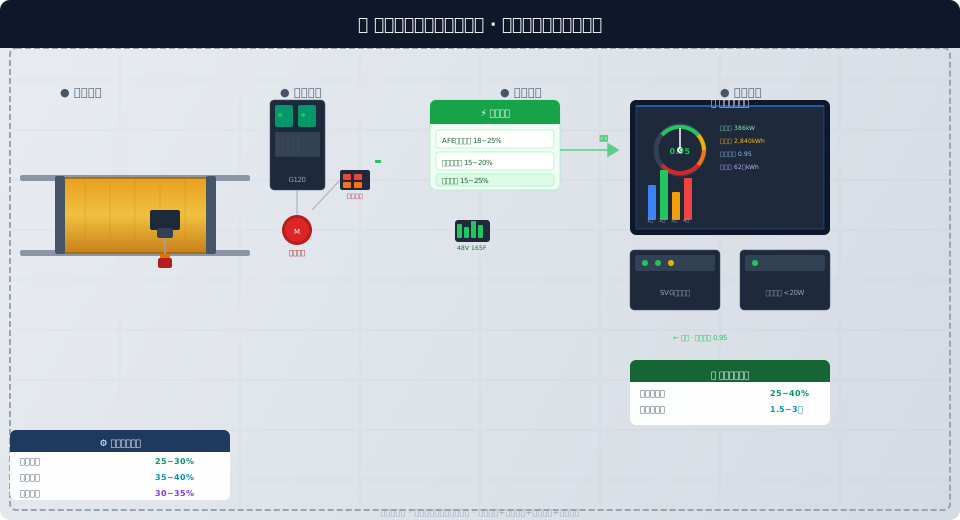
VFD Energy Savings: Principles & Drive Selection
Variable frequency drive (VFD) retrofitting is the first line of defense in crane energy optimization. Conventional cranes rely on wound rotor motors with resistor-based speed control, where the hoisting mechanism suffers slip losses of 15–25% under light-load conditions, and the frequent start-stop cycles of the bridge and trolley travel mechanisms dissipate substantial energy as heat through braking resistors. VFDs eliminate these rotor-resistance losses by continuously adjusting stator voltage and frequency, keeping the motor operating in its high-efficiency zone across all duty conditions.
Kelude Heavy Industry recommends Siemens G120 or Inovance MD880 series drives with sensorless vector control (SLVC, parameter P1300=20). The hoisting mechanism requires four-quadrant operating capability and must be equipped with a dynamic braking unit plus braking resistor, or alternatively a regenerative feedback unit. The bridge and trolley travel mechanisms can use two-quadrant drives with braking resistors. For drive sizing, the VFD rated current must be at least 1.2× the motor rated current; for hoisting applications, specify 1.5× to ensure adequate torque margin during heavy-load lifts.
Measured energy savings after VFD retrofits by mechanism are as follows: hoisting achieves 25–30% savings (highest under light-load conditions), bridge travel delivers 35–40% in frequent start-stop applications, and trolley traverse saves 30–35%. For a typical 32 t overhead crane operating 3,000 hours per year at a 60% average load factor, VFD conversion yields approximately 36,000 kWh in annual energy savings. At an industrial electricity rate of RMB 0.8/kWh, this translates to roughly RMB 28,800 in yearly cost savings, with a drive investment payback period of about 1.5 years.
| Technical Solution | Energy Saving Rate | Investment Cost | Payback Period |
|---|---|---|---|
| Variable Frequency Speed Control | 25~40% | 5~810k/units | 1.5years |
| AFERegenerative Feedback to Grid | 18~25% | +510k/units | 3~4years |
| common DC bus | 15~20% | +310k/units | 2~3years |
| supercapacitor Energy Storage | 15~25% | +810k/units | 3~5years |
| Permanent Magnet Synchronous Motor | +5~8% | +30%Motor Price | 2~3years |
| smart standby | Standby Power Reduction95% | 0.210k/units | <1years |
Regenerative Energy Recovery Solutions Compared
Overhead crane hoisting mechanisms generate regenerative electrical energy during lowering operations, as do trolley and bridge travel during deceleration. Conventional systems dissipate this energy as heat through braking resistors, achieving zero energy recovery. Kelude Heavy Industry offers three regenerative energy recovery solutions, allowing users to select the option that best fits their site conditions and investment budget.
| Recovery Solution | Recovery Rate | Application Scenarios | Harmonic Impact |
|---|---|---|---|
| AFERegenerative Feedback to Grid | 18~25% | Sufficient Grid Capacity | THDi<5% |
| common DC bus | 15~20% | Multi-Mechanism Coordinated Operation Scenario | None |
| supercapacitor Energy Storage | 15~25% | Grid Feedback Not Permitted | None |
The regenerative feedback solution uses an AFE (Active Front End) rectifier/regenerative unit to invert excess energy from the DC bus back into the AC grid. This approach achieves an energy recovery rate of 18%–25% and is best suited for facilities with sufficient grid capacity that permit energy feedback. The added equipment cost is approximately $7,400 per crane (relative to a braking resistor solution), with an annual energy recovery of about 7,200 kWh and a static payback period of 3–4 years. Grid harmonic requirements must be considered: with an LCL filter, THDi (total harmonic current distortion) is kept below 5%, in compliance with GB/T 14549-1993.
The common DC bus solution parallels the DC buses of multiple overhead cranes—or of multiple mechanisms within a single crane—so that regenerative energy from one mechanism's lowering operation is consumed directly by another mechanism's hoisting operation, creating an internal energy loop. Energy recovery rates reach 15%–20%, with a system payback period of 2–3 years. This approach is ideal for applications where multiple cranes operate in the same bay or where several mechanisms run simultaneously and frequently. Since no energy is fed back to the grid, it produces zero harmonic impact on the power supply.
The supercapacitor energy storage solution captures regenerative energy in supercapacitor modules (48V/165F, storing approximately 200 kJ per module) and releases it during motoring operation. Energy recovery rates range from 15% to 25%, with a response time under 20 milliseconds and a cycle life exceeding 500,000 cycles. This option suits facilities with limited grid capacity, no feedback allowance, and frequent multi-crane coordination. While the initial investment is higher (about $11,800 per crane), the modules deliver a service life of over 10 years with no replacement needed, making the total cost of ownership attractive over the long term.
Permanent Magnet Synchronous Motor Retrofit for Higher Efficiency
Replacing traditional three-phase asynchronous motors with permanent magnet synchronous motors (PMSMs) has become a key strategy in overhead crane energy savings. PMSM rotors use neodymium-iron-boron permanent magnets, eliminating rotor copper losses and excitation current. Rated efficiency reaches 95%–97%, a 5–8 percentage point improvement over same-frame asynchronous motors (88%–92%). The efficiency advantage is even more pronounced under light-load and low-speed conditions—while an asynchronous motor's efficiency drops below 75% at 30% load, a PMSM maintains efficiency above 90% across the entire 30%–120% load range.
Kelude Heavy Industry recommends PMSM retrofits for hoisting mechanisms (frequent start/stop, heavy loads at low speed) and for trolley and bridge travel mechanisms (frequent acceleration/deceleration). Implementation requires a VFD with permanent magnet motor control capability—for Siemens G120 drives, set P1300 = 21 or 23 (PMSM vector control)—and a static motor data identification (P1910 = 1) must be performed at startup. Compared to an asynchronous motor solution, the PMSM option increases equipment costs by approximately 30%, but the resulting energy savings typically recover the cost difference within 2–3 years.
Smart Standby and Power Factor Correction
In real-world production, overhead cranes typically spend 30%–50% of their time idling, during which motors and VFDs remain energized, generating substantial no-load losses. Kelude's smart standby solution automatically disconnects the main circuit contactor when the crane has been idle for longer than a configurable threshold (5 minutes by default), keeping only the control system powered (consumption below 20 W). When the operator initiates any command via remote control or from the cabin, the main circuit re-closes within 2 seconds. This approach cuts standby energy consumption by more than 95%, saving approximately $2,200 per year for a fleet of 10 cranes.
Power factor correction is an often-overlooked energy-saving opportunity in crane power supply systems. A single crane's natural power factor ranges from 0.75 to 0.85 (depending on load factor and operating state); without compensation, multiple cranes fed from a common supply can drag the overall power factor down to 0.6–0.7, triggering utility penalty charges (utilities typically require a power factor of 0.9 or higher). Kelude installs intelligent reactive power compensation equipment—either SVG (Static Var Generator) units or smart capacitor banks—at the incoming side of the crane power distribution cabinet. These devices automatically switch compensation capacity based on real-time power factor, stabilizing it above 0.95. This also reduces distribution system line losses by approximately 8%–12% and improves transformer utilization.
Integrated Energy-Saving Solutions and Field Case Study
Kelude's integrated energy-saving program follows a four-phase methodology: Measure, Analyze, Retrofit, Verify. Phase one establishes an energy baseline through 72-hour continuous power monitoring of each crane using power analyzers. Phase two calculates the payback period for each energy-saving technology based on measured data, defining the retrofit scope. Phase three implements the selected measures in priority order—VFD retrofits, smart standby, PMSM replacement, regenerative energy recovery, and power factor correction. Phase four compares post-commissioning energy consumption against the baseline to verify actual savings.
A case study from a steel mill's fleet of six 30-ton ladle cranes illustrates the impact of a comprehensive retrofit combining VFD speed control, a common DC bus, PMSMs, and smart standby. Annual energy consumption dropped from 5,280,000 kWh to 4,660,000 kWh—a saving of 620,000 kWh per year (11.7% reduction). At an electricity rate of $0.096/kWh, this translates to annual savings of approximately $59,600. The total project investment of $275,000 yields a static payback period of 4.6 years. Additionally, the retrofit reduces carbon emissions by roughly 482 tons per year (based on a national average grid emission factor of 0.777 t/MWh).
From a policy perspective, China's 14th Five-Year Plan for Industrial Green Development mandates that by 2025, 30% of production capacity in key industries must meet energy-efficiency benchmark levels. The Ministry of Industry and Information Technology's Motor Energy Efficiency Improvement Plan requires that new high-efficiency motors account for over 70% of installations by 2025. VFD-based energy-saving retrofits for overhead crane systems are a proven motor-system efficiency measure and are eligible for funding support under multiple provincial energy-saving programs.
Frequently Asked Questions (FAQ)
Q: Does retrofitting an overhead crane with VFDs affect production efficiency?
A: No, there is no negative impact. In addition to saving energy, variable-frequency speed control provides soft starting, which reduces mechanical shock and extends equipment life.
Q: Can an older crane be retrofitted with VFDs without replacing the motor?
A: Yes. By shorting the rotor windings and connecting the VFD to the stator side, an existing asynchronous motor can be operated with variable-frequency control.
Q: Will harmonics generated by the VFD affect other equipment?
A: Modern VFDs are equipped with built-in DC link chokes or optional LCL filters that effectively suppress harmonic distortion. For sensitive applications, additional harmonic filtering can be specified to meet IEEE 519 or other applicable standards.
Q: What is the typical payback period for a comprehensive crane energy-saving retrofit?
A: Payback periods vary depending on the specific measures implemented, crane duty cycles, and local electricity rates. In practice, most comprehensive retrofits achieve payback within 2 to 5 years.
